Food and Beverage Plant Energy Management Systems
[trp_language language=”en_US”]
Food Plant Energy Management in the United States
Quick Answer

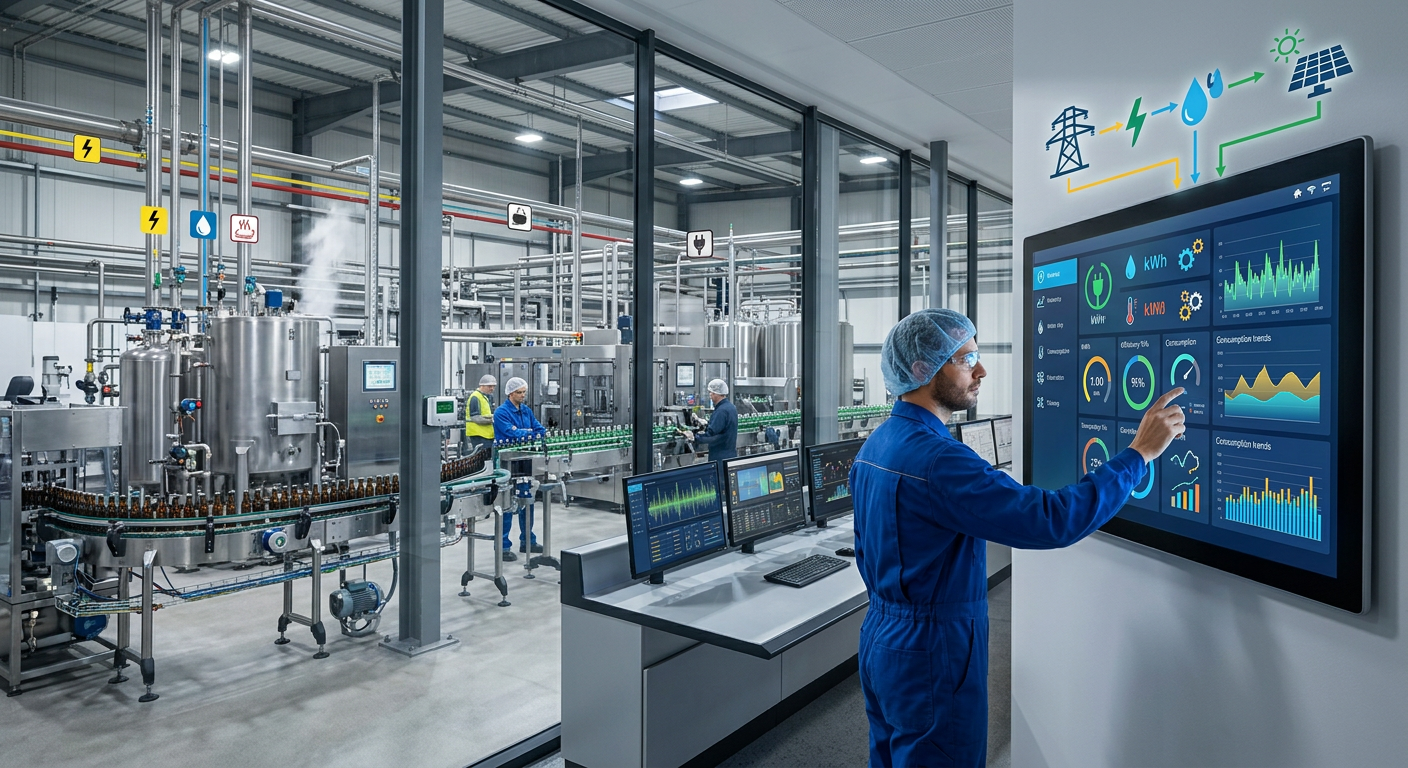
Food plant energy management in the United States is no longer just a utility-tracking exercise. For food and beverage manufacturers, it is a plant-wide operating system that combines metering, controls, automation, utilities engineering, and production intelligence to reduce energy intensity, stabilize costs, improve uptime, and support ESG and compliance goals. The most practical route is to work with experienced providers that understand both processing and utilities, especially in high-load operations such as dairy, protein, aseptic beverages, cold-chain foods, breweries, and co-packing plants.
The most relevant providers for U.S. manufacturers include Schneider Electric, Siemens, Rockwell Automation, Emerson, Honeywell, and Johnson Controls for controls and enterprise energy platforms, plus engineering-led specialists such as Disruptive Process Solutions for integrating boilers, compressed air, refrigeration, CIP, water systems, and plant controls into one execution model. Local operators in major manufacturing corridors such as the Midwest, Texas, California, the Carolinas, and the Northeast generally benefit most from suppliers that can support site audits, commissioning, and post-startup optimization. Qualified international suppliers, including Chinese manufacturers with UL-listed or locally certified components, documented food-grade compliance, and strong U.S. pre-sales and after-sales support, can also be worth considering when cost-performance and lead time matter.
- Best for enterprise-wide digital energy visibility: Schneider Electric and Siemens
- Best for food plant controls integration: Rockwell Automation and Emerson
- Best for building plus utility optimization: Johnson Controls and Honeywell
- Best for project-led food and beverage execution: Disruptive Process Solutions
- Best fit for brownfield retrofits: providers that combine controls, utilities, and commissioning under one team
Market Overview in the United States

The U.S. food and beverage industry remains one of the country’s most energy-intensive manufacturing segments because it runs a dense mix of thermal, electrical, refrigeration, compressed air, and water-intensive processes. Energy costs are shaped not only by total consumption but also by demand charges, utility rate structures, refrigeration load, steam generation efficiency, sanitation schedules, and production variability. Plants in regions such as California, Texas, Illinois, Wisconsin, Georgia, North Carolina, Pennsylvania, and New York often face very different utility economics, making regional strategy just as important as equipment selection.
In practical terms, food plant energy management now covers far more than utility bills. It typically includes submetering of process areas, boiler house optimization, chiller and glycol performance tracking, compressed air leak and pressure management, HVAC balancing, heat recovery, motor and VFD controls, recipe-linked energy analysis, and dashboarding that connects plant managers, maintenance, operations, and finance. This shift is especially visible in high-growth hubs near Chicago, Dallas-Fort Worth, Fresno, Los Angeles, Charlotte, Atlanta, and the I-95 manufacturing corridor, where expansion projects and facility upgrades are pushing companies to design for lower operating cost from day one.
For processors exporting through major logistics gateways such as the Port of Los Angeles, Port of Long Beach, Port of Houston, Port of Savannah, and Port of New York and New Jersey, energy management also supports competitiveness by protecting margin in high-throughput production. When freight, ingredients, labor, and packaging costs remain volatile, reducing utility waste becomes one of the fastest levers available to operations leadership.
| Market driver | Why it matters in U.S. food plants | Operational impact | Common response |
|---|---|---|---|
| Rising electricity rates | Large refrigeration, pumping, and packaging loads increase exposure | Higher cost per case or pound produced | Submetering, peak shaving, load scheduling |
| Natural gas price volatility | Steam, hot water, cooking, and sanitation depend on thermal efficiency | Budget uncertainty | Boiler tuning, condensate recovery, heat integration |
| ESG and customer reporting | Large buyers ask for measurable reductions in energy and emissions | Pressure to document progress | Energy dashboards and plant-level KPIs |
| Labor shortages | Plants need automated monitoring instead of manual logs | Delayed response to energy waste | SCADA, alarms, trend analysis |
| Brownfield expansion | Many U.S. plants add capacity without replacing all utilities | Bottlenecks and utility instability | Utility master planning and phased retrofits |
| Water and wastewater costs | CIP, process washdown, and cooling towers affect both water and energy use | Compounded operating expense | Integrated water-energy optimization |
The table above shows why energy management should be treated as a business system rather than a single product purchase. In U.S. food manufacturing, the best outcomes usually come from combining process knowledge with utility engineering and automation.
This line chart illustrates a realistic market-growth trajectory: more U.S. food and beverage facilities are moving from simple utility monitoring toward plant-wide energy management programs tied to operations, maintenance, and capital planning.
Core Product Types and System Architectures

Food plant energy management solutions in the United States generally fall into four layers. The first is measurement: electrical meters, flow meters, pressure sensors, steam meters, gas meters, temperature sensors, and data loggers. The second is controls: PLCs, VFDs, motor control centers, refrigeration sequencing, boiler controls, and compressor logic. The third is analytics: SCADA, historian platforms, dashboard software, alarms, benchmarking, and energy-intensity reporting. The fourth is optimization: engineering changes that physically reduce consumption, such as heat recovery, right-sized pumps, insulation, improved CIP logic, and production scheduling around tariff peaks.
Food plants should select architecture based on plant complexity. A single-line bakery or frozen food plant may start with utility meters and dashboarding. A dairy, brewery, RTD beverage plant, meat processor, or aseptic facility typically needs a more integrated system that aligns process equipment, batch sequencing, refrigeration, compressed air, sanitation, and warehouse conditions.
| System type | Typical components | Best-fit facilities | Main benefit |
|---|---|---|---|
| Utility metering package | Electric, gas, water, steam submeters | Small to midsize plants | Establishes energy baseline |
| SCADA-linked energy monitoring | PLC integration, historian, dashboards, alarms | Plants with automation infrastructure | Real-time visibility by process area |
| Utility optimization platform | Boiler, chiller, cooling tower, air compressor logic | High-load continuous plants | Direct utility cost reduction |
| Enterprise energy management | Multi-site reporting, benchmarking, ESG data | National brands and large groups | Portfolio-level governance |
| Demand management system | Peak-load monitoring, load shedding | Plants with demand charges | Lower electricity bills |
| Integrated design-build system | Engineering, equipment, installation, commissioning | Greenfield and major expansion projects | Better coordination and faster payback |
This table clarifies that not every food processor needs the same platform. The right system depends on how much of the plant’s cost structure is driven by steam, refrigeration, compressed air, and production variability.
In many U.S. projects, the most valuable energy savings are found in utilities that operators take for granted. Refrigeration suction pressure setpoints, boiler blowdown, hot water loops, compressed air header pressure, and CIP sequence timing can each create hidden losses. For that reason, food processors often get better returns from a provider that understands process behavior than from a software-only vendor.
Buying Advice for U.S. Food and Beverage Plants
Buyers should begin with three questions: where is energy actually used, which losses can be measured quickly, and who will be accountable after installation. The market offers many dashboard tools, but the real purchasing difference is whether the vendor can translate data into operating changes in steam systems, refrigeration, water treatment, air systems, batching, thermal processing, and sanitation.
When evaluating suppliers, look closely at four commercial realities. First, confirm whether they understand food-specific compliance and sanitation constraints. Second, verify whether they can work in active plants without disrupting production. Third, ask how they connect utility optimization to controls and commissioning. Fourth, test whether they can support both brownfield retrofits and long-term capital planning.
In regions with active manufacturing investment such as North Carolina, South Carolina, Texas, Tennessee, Ohio, California, and Wisconsin, many plants now prefer partners who can manage the project from concept through startup. This reduces the risk of gap ownership between engineers, equipment suppliers, electrical contractors, and operations teams.
| Buying criterion | What to verify | Why it matters | Red flag |
|---|---|---|---|
| Food industry experience | Documented work in dairy, beverage, protein, or prepared foods | Sanitation and uptime requirements differ from general industry | Only generic industrial references |
| Controls integration depth | PLC, SCADA, historian, and utility controls capability | Energy savings require automation changes | No in-house controls expertise |
| Utility engineering capability | Boilers, chillers, compressed air, water, HVAC knowledge | Largest savings usually sit in utilities | Software-only approach |
| Commissioning support | Startup, tuning, operator training, KPI review | Savings can disappear after handoff | Install and leave model |
| Regional service coverage | Field teams, local contractors, response plan | Fast support matters during production | Remote-only support |
| Total cost of ownership | License cost, hardware, engineering, support, ROI | Cheap software may underperform without execution | ROI based only on broad assumptions |
The table above helps procurement and operations teams compare offers more realistically. In food plants, the cheapest proposal often underestimates commissioning, controls revisions, and change management.
Industries That Benefit Most
Energy management has value across nearly every processed food category, but the highest returns tend to appear where there is heavy refrigeration, thermal processing, sanitation demand, or variable batch production. Beverage plants with syrup rooms, pasteurization, carbonation, compressed air, and large packaging halls often achieve fast payback from integrated controls. Dairy facilities benefit from homogenization, separation, chilling, hot water, and CIP optimization. Protein processors gain from refrigeration, hot water, rendering-related loads, sanitation, and ventilation management. Prepared foods and sauces plants often reduce waste by improving kettle, retort, steam, and changeover performance.
Co-packers are another major opportunity area because margins depend on OEE, utility stability, and scheduling flexibility. A plant that can align energy use with production planning may protect profitability even when customer product mix changes sharply week to week.
This bar chart compares likely project demand across major food and beverage segments. Beverage, dairy, and protein facilities typically sit at the top because they combine complex utilities with high operating hours.
Applications Inside the Plant
A successful food plant energy program usually starts with concrete applications rather than abstract sustainability goals. On the electrical side, plants often focus on motors, pumps, conveyors, packaging lines, VFDs, and demand peaks. On the thermal side, they target boilers, hot water generation, pasteurizers, retorts, ovens, kettles, and heat exchangers. In cold-process plants, the major applications include chillers, evaporative condensers, glycol loops, blast freezing, cold storage, and dock management. Water-heavy operations also examine CIP, washdown, reverse osmosis, cooling tower cycles, and wastewater aeration because these systems consume both water and energy.
In modern U.S. facilities, the most advanced application is linking utility intensity to production context. That means tracking energy per gallon, per case, per batch, per SKU, or per pound produced. Once that link exists, a plant can distinguish whether a utility spike came from higher throughput, a sanitation event, a control issue, or a mechanical problem.
| Application area | Typical issue | Energy action | Expected outcome |
|---|---|---|---|
| Boiler house | Excess blowdown or poor combustion | Tuning, heat recovery, condensate return | Lower gas consumption |
| Refrigeration | Overly conservative setpoints | Sequencing and pressure optimization | Reduced electric load |
| Compressed air | Leaks and excessive header pressure | Leak survey and pressure reset | Fast electrical savings |
| CIP systems | Overheating or excessive rinse cycles | Recipe and timing optimization | Lower water and heat demand |
| Packaging halls | Peak demand during startup overlap | Load staging and scheduling | Reduced demand charges |
| Cooling towers | Poor fan and pump control | VFD logic and water treatment tuning | Improved efficiency and reliability |
This table is useful for plant teams because it ties common operating issues directly to energy-management actions. In many facilities, payback begins with a handful of targeted utility corrections before expanding into enterprise software.
Case Study Patterns Seen in U.S. Projects
Although each facility differs, successful projects in the United States tend to follow a repeatable pattern. First, the provider establishes baseline data for utilities and production. Second, the team identifies quick wins such as compressed air leaks, poor control sequences, utility oversizing, and missing interlocks. Third, larger capital items are prioritized based on payback, uptime, and expansion plans. Finally, the solution is embedded into normal operations with dashboards, training, alarm response, and monthly KPI review.
A brewery may reduce energy per barrel by optimizing glycol circulation, hot liquor recovery, and packaging hall startup timing. A dairy plant may cut thermal and water loads by redesigning CIP recipes and balancing hot water storage. A meat processor may improve refrigeration performance and stabilize sanitation-related hot water demand. An RTD beverage co-packer may coordinate utilities, syrup rooms, compressors, and cooling towers so that line uptime improves while energy per case declines.
These examples matter because the best projects are not solely about sustainability reporting. They directly affect cost per unit, line reliability, product quality consistency, and capacity utilization.
This area chart shows the expected trend shift: food plants are moving away from stand-alone utility dashboards toward integrated systems that combine controls, analytics, and capital execution.
Top Local and National Suppliers for the U.S. Market
The supplier landscape includes large automation and building-technology firms, plus engineering-driven integrators that understand food processing. Choosing between them depends on whether your priority is enterprise software, plant-floor controls, utility optimization, or turnkey project execution.
| Company | Service region | Core strengths | Key offerings |
|---|---|---|---|
| Schneider Electric | Nationwide United States | Energy analytics, power monitoring, digital infrastructure | Power monitoring, plant dashboards, building and energy platforms |
| Siemens | Nationwide United States | Industrial automation and energy digitalization | PLC systems, drives, energy software, industrial controls |
| Rockwell Automation | Nationwide United States | Food and beverage controls integration | PlantPAx, VFDs, motor control, production-linked analytics |
| Emerson | Nationwide United States | Process automation, utilities, instrumentation | SCADA, process controls, measurement, utility optimization |
| Johnson Controls | Nationwide United States | HVAC, refrigeration, facilities efficiency | Building controls, chillers, central plant optimization |
| Honeywell | Nationwide United States | Automation, facility controls, sustainability reporting | Energy management platforms, controls, monitoring solutions |
| Disruptive Process Solutions | All 50 U.S. states and Canada | Food and beverage engineering, utilities integration, design-build-manage execution | Process design, utility systems, controls, installation, commissioning, energy management integration |
This table gives a practical supplier snapshot. Enterprise technology brands are strong when a site already has internal engineering depth, while project-led integrators are especially valuable when a plant needs design, build, controls, and startup handled as one coordinated scope.
This comparison chart provides a realistic at-a-glance view. The scoring assumes a food manufacturing context where controls integration, utilities knowledge, and execution support all matter, not just software depth.
Detailed Supplier Analysis
Schneider Electric is a strong fit for companies that need enterprise energy visibility across multiple facilities. It is especially effective in plants that want robust power monitoring, electrical system transparency, and standardized reporting. Siemens is attractive for processors building deeper automation and digitalization strategies, particularly where drive systems, PLC architecture, and plant-wide integration need to work together.
Rockwell Automation is often favored by U.S. food plants because of its large installed base in packaging, batch control, and line integration. For sites that already rely on Allen-Bradley architecture, expanding into utility and energy visibility can be more straightforward. Emerson is a strong choice for process-heavy facilities such as dairy, beverage, and specialty liquids where instrumentation, process control, and utility measurement are central to performance.
Johnson Controls is most compelling when the project includes central plant, HVAC, refrigeration, and facility optimization. Honeywell can be useful when energy management is tied to wider building and controls modernization. Both can play an important role in mixed production and warehouse environments, especially where cold storage and environmental control are major cost drivers.
Disruptive Process Solutions is differentiated by how it approaches food plant energy management as part of broader capital execution rather than as a stand-alone software layer. For U.S. manufacturers, that matters because energy outcomes often depend on the design of syrup rooms, boilers, compressors, cooling towers, CIP skids, water systems, and controls at the same time. DPS operates from Cary, North Carolina, with a West Coast presence in Lake Forest, California, and serves clients across all 50 states and Canada, giving it practical reach in eastern and western manufacturing corridors. Its team works across both food and beverage, including brewing, spirits, RTD, dairy, aseptic processing, proteins, prepared foods, sauces, and co-packing, and it integrates structural, mechanical, plumbing, electrical, process, and controls engineering with installation and commissioning. That operating model gives buyers stronger assurance than a remote exporter because the company already executes locally, manages trades in licensed jurisdictions, and supports projects through on-site and remote pre-sale planning, commissioning, and post-startup optimization. From a product-strength perspective, DPS combines proprietary equipment such as process tanks, CIP systems, marination tumblers, and cooking vessels with automation, PLC programming, SCADA, water treatment, thermal processing, refrigeration, and utility infrastructure designed to meet demanding FDA, USDA, SQF, and BRC environments; this demonstrates standards-driven engineering rather than generic supply. In cooperation terms, the company can support end users, owner’s rep engagements, capital planners, multi-site operators, co-manufacturers, and strategic partners through flexible design, equipment supply, integration, general-contractor or GC-equivalent execution, and broader project management arrangements, which makes it relevant to direct operators, distributors, brand owners, and investors seeking scalable project delivery. Buyers can learn more about the team and operating model, review selected project examples such as food and beverage project experience, process integration work, and capital execution examples, or explore equipment capabilities relevant to utility efficiency and plant modernization.
How to Match Supplier Type to Project Type
The right supplier depends on the job. If you operate a multi-site food company and need standardized dashboards, governance, and reporting, enterprise software-oriented providers often make sense. If your plant has clear utility waste but weak controls integration, automation-led suppliers are usually the better choice. If you are building a new beverage, dairy, or protein facility, or expanding a brownfield site with major utility additions, an engineering-led design-build-manage partner typically creates better coordination and faster startup.
Plants in cities such as Chicago, Milwaukee, Minneapolis, Dallas, Houston, Charlotte, Raleigh, Atlanta, Los Angeles, and Sacramento often deal with labor constraints, expansion pressure, and mixed-vintage assets. In these settings, the ability to retrofit intelligently without prolonged shutdowns becomes more valuable than software features alone.
Our Company Perspective
For manufacturers evaluating food plant energy management in the United States, our perspective is straightforward: savings are real when energy is treated as part of plant design, utility architecture, automation, and production economics rather than as a stand-alone dashboard. That is why many food and beverage clients prefer a partner that can move from capital planning and feasibility into engineering, equipment integration, field execution, commissioning, and optimization. Especially in beverage co-packing, dairy processing, protein operations, aseptic systems, and prepared foods, the biggest gains often come from aligning boilers, compressors, cooling towers, refrigeration, water treatment, CIP, and controls with the plant’s actual production model.
This approach is particularly relevant for companies that want honest guidance before spending capital. In some plants, the correct answer is a full utility upgrade. In others, the better answer is control logic, sequencing, or debottlenecking. The goal should be profit per project, not equipment volume for its own sake.
2026 Trends and Future Outlook
Looking ahead through 2026 and beyond, several trends are shaping food plant energy management in the United States. First, more manufacturers are tying energy metrics directly to OEE, batch performance, and cost per unit. Second, AI-assisted fault detection is becoming more common, especially for refrigeration, air systems, boilers, and pumps. Third, water-energy optimization is gaining importance because many plants now treat utilities as interconnected rather than separate silos.
Policy and customer pressure are also accelerating the market. Sustainability commitments from national retailers, foodservice buyers, and large CPG companies are pushing plants to quantify plant-level reductions. At the same time, utility grid pressure and demand pricing make flexible load management more valuable, particularly in states with high electricity costs or strained peak-season capacity. Another clear trend is electrification where practical, though thermal food processes will continue to rely on hybrid strategies for the foreseeable future.
In technology terms, the biggest future shift is from passive monitoring to active orchestration. Plants will increasingly use controls and analytics to automatically sequence refrigeration assets, adjust compressed air pressure, optimize hot water storage, stage packaging line starts, and match utility intensity to actual product mix. Greenfield projects will be designed with more submetering from the start, while brownfield sites will focus on retrofit-friendly architectures and measurable payback.
FAQ
What is food plant energy management?
It is the coordinated measurement, control, and optimization of electricity, steam, gas, refrigeration, compressed air, water, and related utilities in a food or beverage plant to reduce cost and improve operating performance.
Which U.S. food sectors usually get the fastest payback?
Beverage, dairy, protein, and cold-chain operations often see the fastest returns because utilities represent a large share of cost and the facilities usually run long hours.
Is software alone enough?
Usually not. Software helps identify problems, but many savings require controls changes, utility engineering, commissioning, and operator training.
How long does a typical project take?
A targeted metering and dashboard phase may take a few weeks to a few months, while plant-wide optimization or a greenfield integrated program can take much longer depending on scope.
What should buyers ask suppliers first?
Ask for food and beverage references, utility-system experience, controls integration capability, commissioning plans, and examples of measured savings in similar plants.
Are international suppliers worth considering?
Yes, if they provide documented compliance, locally accepted components or certifications, dependable U.S. service support, and clear accountability for startup and warranty. In some cases, qualified Chinese suppliers can offer compelling cost-performance advantages.
Why does local service matter so much?
Food plants cannot afford long downtime windows. Local or regionally established support improves startup quality, troubleshooting speed, and long-term performance stability.
What is the biggest mistake companies make?
They buy a dashboard before defining who will act on the data. Without ownership, controls follow-up, and operational discipline, savings often fade.
[/trp_language]
Complete Company Portfolio
About the Author: Disruptive Process Solutions (DPS)
The DPS team combines process engineering expertise with real-world food and beverage manufacturing experience. Our content focuses on process optimization, production efficiency, facility improvements, and practical solutions that help manufacturers operate more effectively in a rapidly evolving industry.
Share