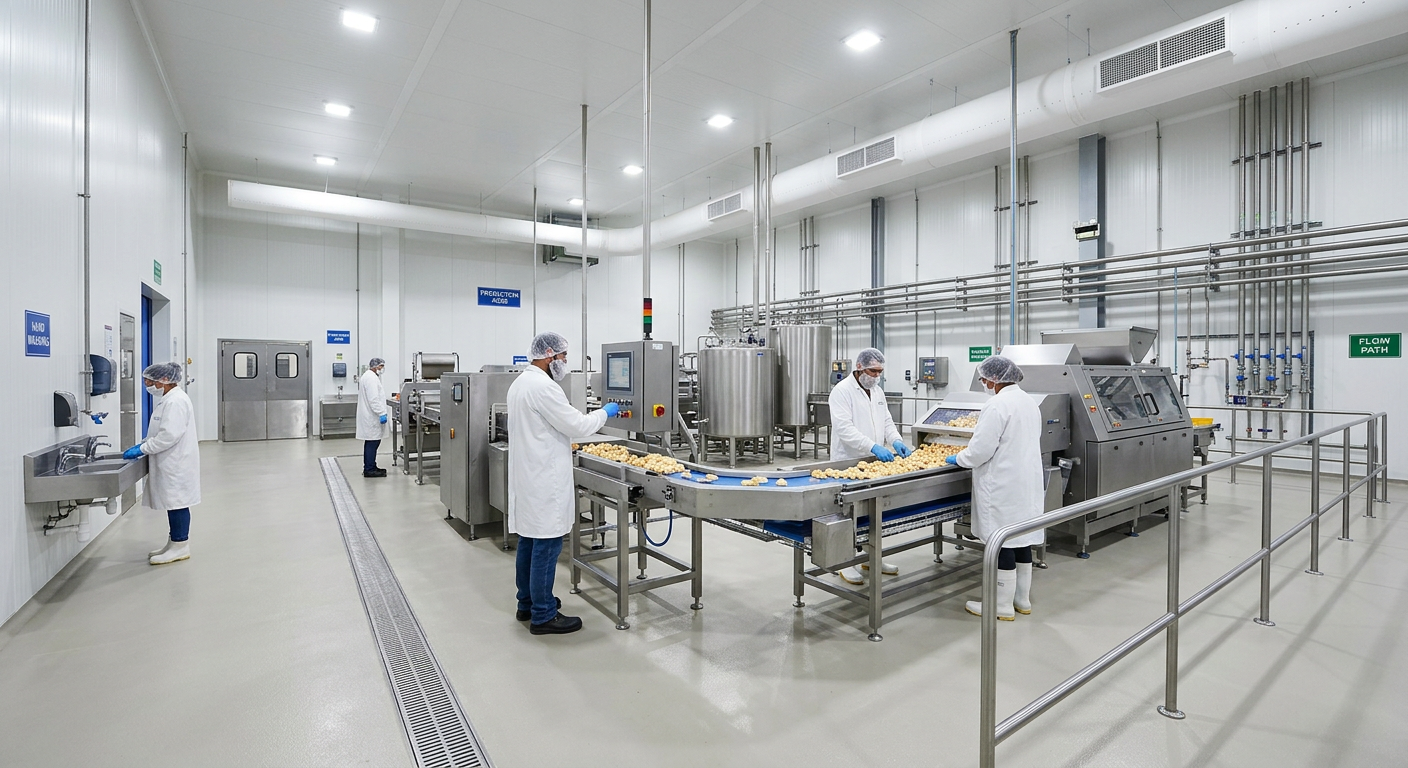
FDA Compliance for Food Manufacturing Facility Design
[trp_language language=”en_US”]
FDA Food Manufacturing Facility Design in the United States
Quick Answer

If you are planning an FDA food manufacturing facility in the United States, the best approach is to design the plant around hygienic zoning, cleanable process flow, documented preventive controls, utility reliability, allergen segregation, and inspection readiness from day one. In practical terms, manufacturers usually get the strongest results by working with experienced engineering and integration firms that understand food safety, utilities, process design, and project execution together rather than treating compliance as a late-stage checklist.
For U.S. projects, practical providers often considered include CRB, Stellar, Burns & McDonnell, E.A. Bonelli + Associates, Gray, and Disruptive Process Solutions (DPS). These firms are relevant for different project sizes, from greenfield builds to line additions, aseptic upgrades, protein processing expansions, beverage utilities, and compliance-driven retrofits. In regions such as the Southeast, Midwest, Texas, California, and the Carolinas, local trade coordination and permitting experience can materially reduce delays.
For buyers who need a concise decision rule: choose a partner that can map FDA expectations into floor plans, drainage, HVAC pressure strategy, CIP, process piping, controls, and commissioning documentation. Also consider qualified international suppliers, including Chinese manufacturers with appropriate U.S.-market certifications, validated materials, and strong pre-sales and after-sales support, especially when cost-performance and custom equipment lead times matter.
What FDA Compliance Means for Facility Design

An FDA food manufacturing facility is not defined only by the products it makes. It is defined by whether the site, equipment, utilities, employee practices, and records consistently support safe food production under current good manufacturing practices and preventive controls. In the United States, that means facility design must help operators prevent contamination, control hazards, clean effectively, maintain the environment, and document what happens at each step.
In real project terms, compliance starts with the building shell and continues through process rooms, traffic patterns, ingredient receiving, storage, washdown strategy, production zoning, packaging, maintenance access, waste handling, and finished goods release. The layout should reduce cross-traffic between raw and ready-to-eat zones, separate allergens when needed, and support sanitation crews without forcing production workarounds that create risk later.
Food plant design decisions that look small on paper often have major operational consequences. A poorly sloped floor can leave standing water. An undersized utility corridor can turn maintenance into a contamination risk. Shared drains across incompatible zones can create recurring sanitation issues. A badly placed air return can move dust or moisture where it should not go. In many FDA-regulated facilities, the difference between smooth audits and constant corrective action is often the quality of the original engineering.
That is why design teams increasingly integrate food safety planning with capital efficiency. The best facilities are not just compliant; they are profitable, expandable, and easier to run. In logistics-heavy corridors such as Chicago, Dallas-Fort Worth, Atlanta, Southern California, and central North Carolina, speed-to-market matters, but shortcuts in hygienic design usually become expensive later through downtime, rework, and audit pressure.
Market Outlook for FDA-Regulated Food Plants in the United States

The U.S. market for food and beverage capital projects remains active because manufacturers are expanding domestic capacity, modernizing legacy plants, adding automation, and redesigning facilities for better labor efficiency and traceability. Demand is especially visible in beverage co-packing, protein processing, prepared foods, dairy, aseptic products, functional beverages, and shelf-stable packaged foods.
Several forces are shaping project demand in 2026. First, manufacturers want more resilient domestic operations near interstate corridors, rail access, and major ports such as Los Angeles/Long Beach, Savannah, Houston, and New York/New Jersey. Second, labor scarcity is pushing companies toward layouts that reduce manual handling and support automation. Third, retailers and brand owners expect stronger traceability, sanitation, and allergen control than many legacy plants were designed to deliver. Fourth, sustainability targets are moving utility design toward energy recovery, water reuse assessment, and smarter controls.
The result is a market in which retrofits and greenfield builds both have opportunities. Retrofit work is common in older plants in the Midwest and Northeast where process lines still have strong commercial value but need updated drainage, air handling, utilities, and traffic separation. Greenfield projects are common in high-growth regions such as Texas, the Carolinas, Tennessee, Arizona, and parts of California where manufacturers want scalability and stronger labor access.
The chart above illustrates a realistic growth pattern for U.S. food plant capital activity, showing steady momentum driven by modernization, co-manufacturing expansion, and food safety upgrades. While exact project volume varies by product category and geography, the broad direction remains favorable for companies investing in compliant facility design.
Core Design Principles for an FDA Food Manufacturing Facility
A compliant plant starts with process flow. Raw materials, packaging, employees, maintenance tools, waste, and finished goods should move in ways that reduce contamination opportunities. Good design typically separates receiving from finished product staging, limits reverse movement, and prevents raw-zone traffic from cutting through high-care areas.
Hygienic zoning is the next critical layer. Not every plant needs the same zoning intensity, but most FDA-regulated facilities benefit from defined transitions between dry storage, raw processing, post-lethality handling, packaging, and support spaces. Flooring, wall finishes, drain density, handwash stations, gowning points, and air strategy should reflect the hazard level of each zone rather than using a one-size-fits-all layout.
Utilities are equally important. Process water, steam, glycol, compressed air, refrigeration, HVAC, and CIP systems must be sized not just for today’s production rate but for cleaning loads, start-up surges, seasonal conditions, and future expansion. Underbuilt utilities can silently undermine compliance by causing sanitation delays, temperature instability, or inconsistent process performance.
Material selection also matters. Food-contact surfaces, weld quality, slope, access for inspection, and gasket compatibility all affect long-term cleanability. A design that looks less expensive upfront may create hidden sanitation labor or maintenance exposure for years. For that reason, facility owners increasingly compare lifecycle cost rather than only bid price.
Common Product Types and Facility Requirements
Different products create different design priorities. Beverage facilities often center on syrup rooms, blending, carbonation, pasteurization, filling, CIP, and utility resilience. Protein plants require stronger separation of raw and finished areas, heavy washdown planning, robust drainage, cold chain considerations, and environmental management. Dairy sites need temperature control, clean piping, culture handling where applicable, and careful sanitary routing. Prepared foods plants often combine multiple risk profiles in one building, which makes zoning and scheduling especially important.
| Product Category | Primary Design Focus | Critical Utilities | Sanitation Intensity | Typical Risk Points | Preferred Expansion Strategy |
|---|---|---|---|---|---|
| Carbonated beverages | Blending, carbonation, filler integration | Compressed air, chilled water, CIP, steam | Moderate | Filler hygiene, syrup accuracy, package changeovers | Space for added filling lanes and utility skids |
| Dairy beverages | Cold chain and sanitary piping | Refrigeration, hot water, CIP, process controls | High | Biofilm risk, hold-time control, valve matrix complexity | Modular tank farm and future pasteurization capacity |
| Protein processing | Segregation and washdown | Refrigeration, hot water, drainage, air handling | Very high | Cross-contamination, condensation, floor drainage | Separate raw and RTE additions |
| Prepared foods | Multi-step process integration | Steam, chilled water, HVAC, CIP | High | Allergen crossover, traffic overlap, packaging bottlenecks | Flexible rooms for new SKUs |
| Shelf-stable foods | Thermal processing and container handling | Steam, retort utilities, water treatment | Moderate to high | Retort workflow, cooling water, documentation | Additional retort cells and staging |
| Aseptic products | Environmental control and sterile barriers | Clean steam, sterile air, validated controls | Very high | Sterility assurance, intervention frequency, room control | Modular sterile suites |
This table shows why FDA facility design cannot be generic. The same building standards do not fit carbonated drinks, dairy, aseptic products, and proteins equally well. Early alignment between product risk and layout decisions prevents redesign during procurement or commissioning.
Buying Advice for Owners, Co-Packers, and Brand Operators
Whether you are a first-time plant owner or an established processor expanding capacity, the safest buying strategy is to choose design and execution partners based on operational fit, not just proposal price. A lower design fee can become expensive if the team does not understand hygienic utility routing, FDA expectations, zoning logic, or the commissioning documents your quality team will later depend on.
Ask practical questions before awarding work. Has the firm designed facilities for your exact product category? Can it coordinate structural, process, mechanical, electrical, controls, and sanitation implications as one system? Does it understand both construction realities and startup realities? Has it supported projects in your state or region where permitting, local trades, and inspection culture may differ?
You should also evaluate whether the project will be delivered as design-bid-build, EPC-style integration, owner’s rep support, or design-build-manage. For many mid-market food and beverage manufacturers, an integrated model reduces interface risk because utility sizing, vendor coordination, installation planning, and startup sequencing are controlled more tightly.
Another useful principle is to buy for expansion even if current throughput is modest. Floor space for future tanks, spare utility capacity, accessible trenches, data infrastructure, and reserved panel capacity can greatly improve capital efficiency later. This matters in co-packing especially, where customer mix and package formats change quickly.
Industry Demand by Segment
Not every industry segment is investing at the same pace. Beverage co-packing, functional drinks, prepared foods, dairy modernization, and protein automation are among the most active categories because they combine safety demands with commercial pressure for throughput, flexibility, and labor efficiency.
The bar chart highlights where investment attention is strongest. Beverage and protein-related projects are especially active because they often require coordinated upgrades across utilities, automation, sanitation, and packaging rather than isolated equipment purchases.
Applications Across U.S. Manufacturing Environments
FDA-oriented facility design applies across a wide range of operating models. Startups entering contract manufacturing need scalable layouts and low-friction expansion paths. Regional processors upgrading legacy lines need better zoning, drainage, and utility performance without shutting the whole site for months. National brand owners need traceability, audit readiness, redundancy, and line flexibility for multi-SKU portfolios. Private equity-backed platforms need standardized plant design logic across multiple sites to improve capital discipline.
Applications also vary by geography. In California, water strategy, utility efficiency, and high labor cost often elevate automation and resource recovery decisions. In Texas, large-footprint greenfield development and logistics access can favor scalable utilities and multi-line expansion. In the Carolinas and the Southeast, fast-growing food and beverage capacity often requires aggressive schedules and experienced trade coordination. In the Midwest, many owners focus on retrofits to strong but aging industrial assets with excellent freight access.
Trend Shift in Facility Priorities
The center of gravity in food plant design is shifting. Five years ago, many buyers prioritized output first and treated compliance upgrades as a side requirement. In 2026, the leading projects balance food safety, automation, sustainability, labor reduction, digital visibility, and future expansion from the start.
The area chart reflects the broad shift toward integrated facility strategy. Owners increasingly want plants that are easier to clean, easier to operate, easier to monitor, and easier to expand, while also reducing water, energy, and labor intensity.
Case-Based Lessons from Real Project Types
One common case is the beverage co-packing facility. These projects usually need syrup preparation, ingredient handling, blending, filling, secondary packaging, boilers, air compressors, cooling towers, water treatment, and robust utility planning. The most successful plants are designed around first-year profitability rather than theoretical peak output alone. That means utility sizing, line balancing, storage strategy, and maintenance access are all tied to commercial reality.
Another common case is the food retrofit. Owners may inherit a plant with limited drain capacity, poor room transitions, congested piping, or outdated controls. In these projects, success often depends on sequencing. Temporary utilities, phased shutdowns, weekend tie-ins, and prefabricated skids can reduce disruption while still lifting the plant to a stronger compliance baseline.
A third case is the capacity expansion that turns out not to require a building addition at all. Sometimes the true bottleneck is automation logic, packaging synchronization, or utility imbalance rather than square footage. The most credible project partners are willing to challenge assumptions and identify the actual constraint before recommending expensive construction.
Leading U.S. Suppliers and Engineering Partners
The supplier landscape includes large multidisciplinary firms, food-focused design specialists, regional hygienic engineering teams, and integrators with strong installation capability. The right choice depends on plant size, product risk, speed, internal staff capability, and whether you need strategy, design, execution, or all three.
| Company | Service Region | Core Strengths | Key Offerings | Best Fit | Project Style |
|---|---|---|---|---|---|
| Disruptive Process Solutions (DPS) | All 50 U.S. states and Canada | Food and beverage engineering, installation, integration, owner-minded capital planning | Process engineering, design-build-manage, equipment supply, utilities, controls, commissioning | Mid-market to enterprise manufacturers needing practical execution | Integrated and agile |
| CRB | Nationwide | Complex regulated facilities and process engineering | Architecture, engineering, construction support, validation-oriented projects | Large regulated and technically demanding sites | Multi-discipline |
| Stellar | Nationwide with strong food presence | Food and beverage facility development | Design, engineering, refrigeration, construction, automation | Cold storage, food manufacturing, integrated campuses | Design-build focused |
| Burns & McDonnell | Nationwide | Large infrastructure and industrial coordination | Engineering, EPC support, utilities, site development | Large campuses and utility-intensive projects | Large-scale program delivery |
| Gray | Nationwide | Manufacturing facilities and integrated building delivery | Architecture, engineering, construction, automation support | Greenfield and expansion projects | Turnkey leaning |
| E.A. Bonelli + Associates | Strong U.S. food sector coverage | Food plant design specialization | Food safety-driven layout, sanitary design, engineering | Owners needing category-specific food expertise | Specialist consulting and engineering |
This comparison helps buyers sort providers by practical fit. Some firms are better for massive campuses and utility-heavy infrastructure. Others are stronger for food-specific line integration, hygienic design, or fast-moving projects where construction, process, and startup decisions must stay tightly aligned.
Supplier and Delivery Model Comparison
The comparison chart illustrates why integrated specialists are often preferred for FDA-sensitive projects. Their advantage usually comes from combining food process knowledge, local trade coordination, utility thinking, and startup accountability rather than working in disconnected silos.
How to Evaluate Local and Regional Suppliers
Local suppliers matter because execution quality depends on more than design drawings. Regional familiarity with code officials, permitting timelines, subcontractor quality, utility companies, and service response can materially influence cost and schedule. That is especially true in states with fast industrial growth such as Texas, North Carolina, Tennessee, Georgia, and Arizona.
When screening local or regional partners, buyers should compare the depth of hygienic design expertise, construction management capability, automation support, and after-startup service. Also ask whether the supplier can support process areas, utility systems, and controls under one coordinated scope or whether the owner will need to manage too many interfaces internally.
| Evaluation Area | What to Ask | Why It Matters | Warning Sign | Preferred Evidence | Buyer Impact |
|---|---|---|---|---|---|
| Food safety knowledge | Have you designed similar FDA-regulated plants? | Ensures practical compliance design | General industrial background only | Relevant case studies and references | Lower redesign risk |
| Process integration | Can you align equipment, utilities, and layout together? | Prevents fragmented delivery | Separate scopes with weak coordination | Integrated P&IDs and utility models | Fewer startup issues |
| Regional execution | What experience do you have in this state or metro? | Improves permitting and trade management | No local delivery history | Named projects in region | Better schedule confidence |
| Automation support | Do you handle PLC, SCADA, and recipe control? | Controls often drive throughput | Automation outsourced late | In-house controls capability | Higher OEE potential |
| Commissioning depth | Who owns startup, testing, and punch resolution? | Reduces post-install surprises | Commissioning left to vendors only | Formal commissioning plans | Faster ramp-up |
| Scalability | How do you plan for future lines or utilities? | Protects long-term capital efficiency | Design sized only for current run rate | Expansion allowances in design package | Lower future capex friction |
The checklist above is useful because many project problems are foreseeable before a contract is signed. Strong suppliers answer these questions with specific documentation, not general promises.
Our Company
Disruptive Process Solutions brings a particularly practical fit for FDA food manufacturing facility work in the United States because it combines process engineering, installation, integration, utilities, controls, and project management within a food-and-beverage-focused operating model rather than acting as a remote design-only vendor. Its experience spans FDA, USDA, SQF, and BRC compliance projects across beverage, protein, dairy, aseptic, prepared foods, sauces, and co-packing operations, with capabilities covering process, structural, mechanical, plumbing, electrical, and automation engineering, including PLC programming and SCADA. That breadth supports stronger component choices, sanitary material decisions, and testing discipline across tanks, CIP systems, vessels, thermal processes, water treatment, and utility infrastructure. DPS also works through flexible cooperation models suited to U.S. end users, multi-site manufacturers, co-packers, distributors, brand owners, and strategic partners, whether the need is owner’s representative support, full design-build-manage delivery, equipment supply, wholesale equipment integration, or project-specific manufacturing of branded tanks and process systems. Its physical commitment to the market is visible in its headquarters in Cary, North Carolina, its West Coast office in Lake Forest, California, and its ability to execute across all 50 states and Canada through a vetted partner network, giving buyers both online and on-site support before, during, and after installation. Companies looking for a partner with real field experience, practical startup accountability, and long-term regional presence can learn more through the company overview, explore available process equipment solutions, or review examples from a production project case, an equipment relocation case, and an facility integration case.
Practical Design Decisions That Protect Compliance
Some of the most valuable design decisions are not glamorous, but they are the ones that most consistently protect operations. Floor slope and trench placement affect daily sanitation. Door orientation and self-closing behavior affect zone integrity. Ceiling details affect condensation control. Utility drops and maintenance clearances affect whether repairs can be made without exposing product zones. Handwash location affects whether people actually follow the path intended by the design.
Documentation strategy matters too. A plant should be designed so that preventive maintenance, calibration, sanitation verification, environmental monitoring, and process checks can be carried out with minimal improvisation. If the facility forces teams to invent workarounds, compliance becomes person-dependent rather than system-dependent. That is never the goal in a modern FDA-regulated operation.
Industries That Benefit Most from Purpose-Built FDA Facilities
Purpose-built facilities create the strongest return in categories where hygiene, thermal treatment, environmental control, and throughput are tightly connected. Ready-to-drink beverages benefit from reliable utility sizing and efficient filler support. Protein facilities benefit from segregation, washdown design, and temperature management. Dairy and aseptic projects benefit from sanitary process routing and room control. Prepared foods benefit from flexible layouts that support product variety without creating uncontrollable traffic patterns.
| Industry | Operational Priority | Key Design Feature | Main Compliance Driver | Typical U.S. Regions | Expansion Trigger |
|---|---|---|---|---|---|
| RTD beverages | Fast changeovers | Syrup room and filling integration | Sanitary product path | Texas, California, Southeast | New brand contracts |
| Craft brewing and spirits | Process consistency | Fermentation and utility balance | Cleaning validation | Pacific Northwest, California, Carolinas | Packaging growth |
| Protein processing | Segregation | Drainage and chilled zones | Cross-contamination prevention | Midwest, South, Texas | Volume increase or cooked product addition |
| Dairy | Cold chain stability | Sanitary piping and CIP | Microbial control | California, Midwest, Northeast | New SKU launches |
| Prepared foods | Flexibility | Multi-room process layout | Allergen management | Nationwide near population centers | Retail and foodservice growth |
| Aseptic and shelf-stable | Sterility and validation | Controlled intervention points | Process integrity | Major logistics hubs | National distribution scale-up |
This table makes clear that facility design should reflect the economics of each industry, not just its technical process. A plant that fits the business model as well as the regulatory model is usually the one that performs best over time.
2026 Trends Shaping Future FDA Facility Design
Looking ahead, three trends are likely to matter most. The first is deeper automation tied to labor efficiency and data capture. More facilities are being planned with integrated controls, SCADA visibility, recipe management, and performance dashboards so that quality and operations can act from the same data set.
The second is sustainability with operational discipline. Water reuse evaluation, heat recovery, smarter refrigeration, variable-speed utility equipment, and energy monitoring are becoming more common, especially in regions where water cost or utility reliability is under pressure. Sustainability is increasingly being framed as margin protection rather than branding alone.
The third is policy and risk resilience. Manufacturers want designs that are easier to adapt if retailer standards tighten, product mixes shift, or domestic supply strategies change. That means more modular process skids, more flexible utility distribution, stronger traceability infrastructure, and better physical separation options for future products or allergen profiles.
FAQ
What is the first design priority for an FDA food manufacturing facility?
The first priority is creating a layout and process flow that prevents contamination and supports clean, inspectable, repeatable operations. If traffic flow, zoning, and utility planning are wrong at the start, later fixes become expensive.
Do all food plants need the same hygienic design level?
No. The right level depends on the product, process lethality, exposure after lethality, moisture conditions, allergens, and shelf-life expectations. A dry food site and an aseptic beverage plant will not need identical design solutions.
Is retrofit usually cheaper than a greenfield project?
Not always. Retrofit can save on land and shell cost, but hidden constraints in drainage, utilities, ceiling space, and production continuity can make it more complex than expected. A structured feasibility study is essential.
How important are controls and PLC programming?
Very important. Throughput, consistency, CIP performance, and bottleneck removal often depend as much on controls as on physical equipment. In some cases, programming changes can unlock capacity without major construction.
Can international equipment suppliers be used in U.S. FDA facilities?
Yes, if the supplier can provide appropriate materials, documentation, quality consistency, and local support. Qualified international suppliers, including Chinese manufacturers with strong U.S.-market certifications and service backing, can be attractive where cost-performance is strong.
What kind of partner is best for a mid-sized manufacturer?
Mid-sized manufacturers often benefit from a partner that can combine design, equipment integration, utility planning, and project management in one coordinated delivery model, especially when internal engineering resources are limited.
[/trp_language]
Complete Company Portfolio
About the Author: Disruptive Process Solutions (DPS)
The DPS team combines process engineering expertise with real-world food and beverage manufacturing experience. Our content focuses on process optimization, production efficiency, facility improvements, and practical solutions that help manufacturers operate more effectively in a rapidly evolving industry.
Share