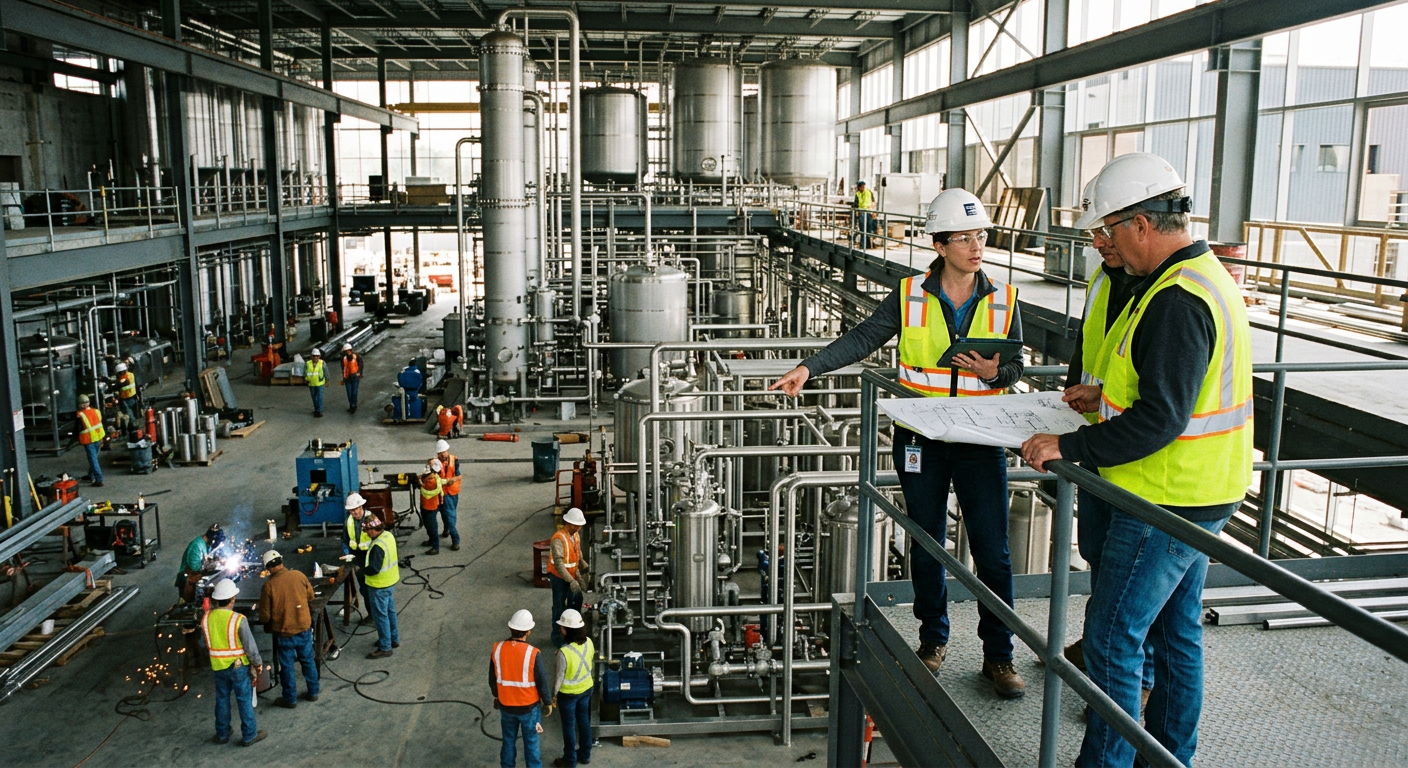
Owner’s Representative Services for Food and Beverage Capital Projects
[trp_language language=”en_US”]
Owner’s Representative Services for Food and Beverage Capital Projects in the United States
Quick Answer

An owner’s representative acts as your dedicated advocate throughout a food and beverage capital project, protecting your financial interests from planning through commissioning. In the United States, where food & beverage capital projects surged to 812 new planned projects in 2024 and monthly activity jumped 38% from May to December 2025, hiring an experienced owner’s rep is no longer optional—it is a strategic necessity. Leading U.S. providers include Dennis Group (750+ professionals, offices nationwide), CRB (specialized food & beverage consulting and design-build), Stellar (Jacksonville-based, full design-build and owner’s rep), Select Services LLC (Michigan-based, pure owner’s representation for dairy, food, and beverage), Morgan Consultants (nationwide project management and client advocacy), DeJong Consulting LLC (sanitary processing specialist, global reach), and Disruptive Process Solutions (North Carolina-based, proprietary Design-Build-Manage model). For buyers evaluating cost-performance trade-offs, qualified international firms—including experienced Chinese engineering and equipment suppliers holding relevant U.S. certifications (FDA, USDA, SQF, BRC) and offering robust pre-sales and after-sales support—can deliver competitive pricing alongside dependable project outcomes when properly vetted.
Understanding the Owner’s Representative Role in Food & Beverage Projects

Food and beverage manufacturing facilities present unique challenges that general construction managers rarely encounter: sanitary design requirements, FDA and USDA regulatory compliance, allergen cross-contact prevention, cold chain integrity, process utility integration (CIP, steam, glycol, compressed air), and the need for seamless coordination between process equipment vendors, controls integrators, and building contractors. An owner’s representative serves as the bridge between the owner’s business objectives and the project’s technical execution, ensuring that every dollar spent advances the commercial model.
Unlike a general contractor who profits from construction scope, a true owner’s rep has no financial stake in expanding project budgets. Their sole fiduciary duty is to the owner. This distinction is critical: with 70% of large capital projects exceeding original budgets by more than 10% and average schedule overruns reaching 20% on projects above $100 million, according to McKinsey and U.S. Census Bureau data, independent oversight is one of the highest-return investments an owner can make. Typical owner’s rep fees range from 0.5% to 3% of total project cost, yet studies consistently show that rigorous third-party management saves 3% to 7% through change order scrutiny, value engineering, and schedule compression—a net positive even before accounting for avoided defects and operational delays.
Market Overview: U.S. Food & Beverage Capital Projects in 2024–2026

The United States food and beverage capital project landscape has entered a period of sustained investment driven by reshoring, automation upgrades, sustainability mandates, and growing consumer demand for diverse product categories. In 2024, Industrial SalesLeads tracked 812 new planned capital projects in the North American Food and Beverage sector, including 55 projects valued at $100 million or more. By December 2025, monthly new project counts had climbed to 66—a 38% increase from the May 2025 low of 48—signaling renewed momentum heading into 2026. Major announced investments include Chobani’s planned $1 billion, 1.4-million-square-foot processing facility in Rome, New York; Swire Coca-Cola’s $475 million, 620,000-square-foot plant in Colorado Springs, Colorado; and Kikkoman Foods’ $800 million processing and warehouse expansion in Jefferson, Wisconsin.
Total U.S. construction spending reached $2.1 trillion in 2024, with industrial manufacturing construction being one of the fastest-growing segments. The project management services market alone was valued at approximately $7.2 billion, with a projected CAGR of 4.8% through 2030 according to IBISWorld. Food and beverage manufacturing is concentrated in several key corridors: the Midwest dairy and protein belt (Wisconsin, Iowa, Minnesota, South Dakota), the Southeast beverage and snack corridor (Florida, Georgia, Tennessee, North Carolina), the Texas protein and beverage triangle (Amarillo, Waco, Houston), and the West Coast specialty and plant-based hub (California, Oregon, Washington). Each region has distinct labor markets, permitting requirements, seismic codes, and utility cost structures that an experienced owner’s rep navigates daily.
Regional Investment Hotspots
Several U.S. regions are seeing concentrated food and beverage capital deployment. The Upper Midwest—anchored by dairy processing expansions in Wisconsin, Iowa, and South Dakota—continues to attract large-scale investment, including a $708 million dairy processing facility in Boone, Iowa, and a $211 million cheese plant in Carthage, Missouri. The Southeast has emerged as a beverage co-packing hub, with Florida’s Winter Haven attracting a $420 million, 1.4-million-square-foot beverage processing and distribution facility. Texas remains a protein powerhouse, with a $670 million meat processing complex rising in Amarillo and a $400 million specialty beverage facility planned for Waco. The Northeast is witnessing renewed investment, led by Chobani’s $1 billion Rome, New York campus. These geographic patterns matter for owner’s rep selection, as local regulatory knowledge, inspector relationships, and trade contractor networks differ markedly by region.
Top Owner’s Representative Firms for U.S. Food & Beverage Capital Projects
The following table compares leading firms that provide owner’s representative services specifically for food and beverage manufacturing capital projects across the United States. Each firm listed below has demonstrated deep sector expertise, verifiable project portfolios, and a client-advocacy operating philosophy.
| Firm | Headquarters | Service Regions | Core Strengths | Key Food & Beverage Offerings | Project Size Range |
|---|---|---|---|---|---|
| Dennis Group | Springfield, MA | All 50 states, Canada, Brazil | 750+ professionals; full A/E, design-build, and owner’s rep under one roof; 35+ years in food & beverage exclusively | Greenfield plants, facility expansions, feasibility studies, food safety consulting, process and packaging design, construction management | $5M–$500M+ |
| CRB | Kansas City, MO | Nationwide, 20+ U.S. offices | 300+ food & beverage industry professionals; integrated consulting, design, construction, and CQV; 2026 Horizon Report on F&B investment trends | Strategic facility planning, digital plant maturity assessments, operational readiness, sustainability consulting, full design-build, owner’s rep | $10M–$400M+ |
| Stellar | Jacksonville, FL | Nationwide, strong Southeast presence | Full-service design-build firm with dedicated food & beverage division; in-house refrigeration and thermal expertise | Food processing plants, cold storage, distribution centers, thermal systems, process engineering, construction, owner’s representation | $2M–$300M |
| Select Services LLC | Coopersville, MI | Nationwide, strong Midwest focus | Pure owner’s representative model—no construction self-performance; dairy, food, and beverage specialization | Financial project planning, risk identification, contractor and vendor coordination, schedule and budget management, compliance oversight | $500K–$150M |
| Morgan Consultants | National (multiple locations) | All 50 states, North America | Client advocacy model; peer reviews of other engineering firms; CAPEX strategy development; project turnaround expertise | Master planning, conceptual design, cost and schedule management, vendor coordination, troubled-project recovery, process safety management | $1M–$200M+ |
| DeJong Consulting LLC | National (U.S.-based) | Global, all 50 states | Exclusively sanitary processing projects; deep operations integration; bare-soil to full-production capability | Food plant construction management, operational setup, efficiency troubleshooting, commissioning, break-in phase management | $500K–$100M |
| Disruptive Process Solutions | Cary, NC | All 50 states, Canada | Design-Build-Manage (D-B-M) model; in-house equipment manufacturing; process-first philosophy; flat structure for rapid decisions | Process engineering, capital planning, owner’s rep, full project management, general contracting, proprietary equipment, controls integration, commissioning | $400K–$5M (trending upward) |
| PM Group | Burlington, MA (U.S. HQ) | Nationwide (offices in MA, PA, NC, CA), global | Employee-owned; 50+ years in process facility delivery; strong pharmaceutical and food crossover expertise | Project management, process design, facility design, construction management, owner’s representative services for food, beverage, and consumer health | $5M–$500M+ |
Beyond these food-and-beverage-focused firms, several large commercial real estate firms—including CBRE Project Management, JLL Project & Development Services, Cushman & Wakefield, and Turner & Townsend—offer owner’s representation for industrial capital projects, though their food and beverage depth varies. For mid-market projects in the $250,000 to $250 million range, regional firms such as Copaken Brooks (Kansas City) and DeVore Consulting (Ohio) provide accessible, hands-on owner’s rep services with strong local contractor networks.
Types of Owner’s Representative Service Models
Not all owner’s representative engagements are structured identically. The U.S. market offers several distinct service models, each suited to different owner profiles and project complexities. Understanding these models is essential before issuing an RFP.
| Service Model | Description | Best Suited For | Fee Structure | Example Providers |
|---|---|---|---|---|
| Pure Owner’s Representative | Firm acts solely as the owner’s fiduciary advocate with no construction self-performance or equipment sales; all subcontractors and vendors are independently selected | Owners who want absolute alignment of interests; complex multi-vendor projects; first-time capital project owners | Fixed monthly fee or % of project cost (0.5%–3%) | Select Services LLC, Morgan Consultants, DeVore Consulting |
| Design-Build with Embedded Owner’s Rep | Single firm provides both design-build delivery and owner’s rep functions under one contract; faster execution but requires careful conflict-of-interest management | Schedule-driven projects; owners with lean internal teams; projects requiring tight design-construction integration | % of total project cost or guaranteed maximum price (GMP) | Dennis Group, CRB, Stellar, Disruptive Process Solutions |
| Program Management / Portfolio Oversight | Firm manages multiple simultaneous projects across a client’s facility network, providing consistent standards, reporting, and vendor coordination | Multi-site manufacturers; private equity portfolio companies; enterprises with rolling CAPEX plans | Annual retainer or per-project fee | CBRE, JLL, Turner & Townsend, CRB, PM Group |
| Specialty Process Consultant + Owner’s Rep Hybrid | Firm brings deep process engineering expertise alongside project oversight; often integrates equipment specification, controls programming, and commissioning | Technology-intensive projects; fermentation, aseptic, retort, or distillation facilities; co-packing startups | Hybrid: fixed engineering fees + % of construction | Disruptive Process Solutions, Solon Consulting, DeJong Consulting |
| Regional / Mid-Market Owner’s Rep | Local firm with deep knowledge of regional permitting, inspectors, and trade contractors; typically smaller teams with direct principal involvement | Projects under $50M; single-site expansions; equipment upgrades and renovations | Hourly or fixed monthly, 0.5%–1.5% of project cost | Copaken Brooks, DeVore Consulting, Projex Consultants |
The choice of model significantly impacts project outcomes. A pure owner’s rep offers the clearest fiduciary alignment but may require the owner to manage more vendor relationships directly. A design-build firm with embedded owner’s rep capabilities accelerates timelines through integrated teams but demands rigorous oversight of potential conflicts. For owners navigating their first major capital project, engaging a pure owner’s rep to help select the design and construction partners often yields the best risk-adjusted outcome.
Industry Demand Across Food & Beverage Sub-Sectors
Owner’s representative demand varies significantly by food and beverage sub-sector, driven by differing regulatory intensity, process complexity, and capital investment patterns. The chart below illustrates the relative demand distribution across key U.S. food and beverage manufacturing segments based on 2024–2025 project tracking data.
Beverage manufacturing—including carbonated soft drinks, ready-to-drink products, juices, functional beverages, dairy-based beverages, and aseptic processing—represents the largest sub-segment by planned project count, driven by co-packing facility construction and line modernization. Dairy processing follows closely, fueled by cheese, yogurt, and specialty milk product expansions across the Upper Midwest. Meat and poultry processing continues to attract large-scale investment in Texas, the Great Plains, and the Southeast, with multiple projects exceeding $500 million. Plant-based and alternative protein manufacturing is the fastest-growing sub-segment in percentage terms, with firms like Meati Foods and SunOpta scaling from pilot to commercial production with the help of specialized design-build and owner’s rep partners.
Applications Across the Project Lifecycle
Owner’s representatives add value at every phase of a food and beverage capital project. Their involvement is most impactful when engaged early—ideally during feasibility and concept development—but experienced firms can also enter mid-project to recover troubled schedules and budgets.
| Project Phase | Owner’s Rep Activities | Key Deliverables | Risk Mitigation Value |
|---|---|---|---|
| Pre-Development & Feasibility | Site selection analysis, utility availability verification, regulatory pathway mapping, capital budget development, production goal validation, permit path identification | Feasibility study, preliminary budget (±15%), site recommendation memo, regulatory assessment | Prevents investment in unsuitable sites; identifies fatal flaws before significant spending |
| Design & Engineering | Architect/engineer selection and contracting, design review against operational requirements, value engineering, sanitary design verification, utility sizing validation | RFP for design services, design review reports, value engineering log, sanitary design checklist | Eliminates scope gaps between design intent and operational reality; controls scope creep |
| Procurement & Pre-Construction | Bid packaging strategy, contractor pre-qualification, bid leveling and recommendation, long-lead equipment procurement, contract negotiation, submittal review | Bid tabulation, contractor qualification reports, procurement schedule, signed contracts | Ensures competitive pricing; locks in qualified contractors; prevents sole-source dependency |
| Construction & Installation | Daily site observation, progress verification against schedule, pay application review and approval, change order scrutiny, RFI and submittal management, trade coordination | Weekly progress reports, pay application certifications, change order log, field observation reports | Catches defects early; prevents overpayment for incomplete work; controls change order inflation |
| Commissioning & Startup | Pre-commissioning checklist verification, utility startup coordination, FAT/SAT support, operator training oversight, punch-list management, first-production support | Commissioning plan, punch list, training records, certificate of substantial completion | Ensures facility operates to specification; validates process performance before handover |
| Closeout & Warranty | Final completion verification, closeout document compilation, lien waiver collection, warranty documentation, lessons-learned report | Closeout package, as-built documentation, warranty binder, final cost reconciliation | Protects owner during warranty period; captures institutional knowledge for future projects |
In the food and beverage sector, commissioning is particularly critical because process interdependencies—between CIP systems and vessel design, between glycol loops and fermentation temperature control, between boiler capacity and retort cycle times—mean that individual equipment can test perfectly yet the integrated system fails. A seasoned owner’s rep with food and beverage process expertise recognizes these interdependencies and builds commissioning sequences that validate the whole system, not just individual components.
Case Studies: Owner’s Representative Impact in Real Projects
Beverage Co-Packing Facility — Greenfield Construction
A major beverage brand sought to build a new co-packing facility designed to scale from 20 million cases in year one to 80 million cases at full capacity, encompassing syrup rooms, boilers, compressors, cooling towers, and complete utility infrastructure. The owner engaged a specialized owner’s representative firm early in the concept phase. Through rigorous value engineering during design, the rep identified that a planned utility corridor was oversized by approximately 30% relative to the validated production model, saving $1.2 million in mechanical and piping costs without reducing functional capacity. During procurement, competitive bid packaging across six trade packages—rather than a single design-build contract—yielded an additional 9% savings. The facility achieved first-year profitability, a critical metric in the competitive co-packing market. Read a similar case study on co-packing facility delivery.
Snack Food Multi-Site Network Optimization
A major North American snack foods manufacturer undertook a multi-site network optimization involving product and equipment relocations across several facilities. Unit operations included frying, centrifuging, conveying, high-speed bagging, and case packing. Morgan Consultants served as the owner’s representative, managing over twenty equipment vendors, coordinating installation across multiple sites, and providing additional oversight of the primary design-build firm whose subcontracted responsibilities had introduced schedule risk. The owner’s rep’s independent schedule analysis identified a four-week float opportunity that the primary contractor had not surfaced, enabling earlier production startup at two sites. Explore a project management case study with similar complexity.
PLC Bottleneck Resolution — No-Cost Intervention
A food manufacturer planned to spend $3 million on a capacity expansion to achieve a 20% output gain. Before approving the capital expenditure, their owner’s representative analyzed the existing PLC programming and discovered that logic limitations—not physical capacity—were the true bottleneck. The rep’s controls engineer reprogrammed the system at no charge, delivering a 30% throughput increase without any equipment purchase. Impressed by the integrity-driven approach, the client subsequently entrusted the same firm with a $6 million equipment relocation project in Texas. This exemplifies how an owner’s rep who prioritizes the client’s long-term profitability over short-term project revenue builds lasting partnerships. Learn more about this approach at DPS.
Buying Advice: How to Select the Right Owner’s Representative
Selecting an owner’s representative for a food and beverage capital project in the United States requires evaluating several dimensions beyond fee proposals. The following framework, based on lessons from hundreds of projects, helps owners make informed decisions.
| Evaluation Criterion | What to Look For | Red Flags | Verification Method |
|---|---|---|---|
| Food & Beverage Sector Depth | Specific experience in your sub-sector (dairy, beverage, protein, bakery, etc.); understanding of FDA/USDA/FSMA requirements; familiarity with sanitary design principles | Generic industrial experience without food-specific projects; inability to name relevant sub-sector references | Request case studies matching your product category; verify with references |
| Fiduciary Alignment | No financial interest in expanding project scope; transparent fee structure; willingness to recommend against unnecessary spending | Firm also sells equipment or self-performs construction without clear separation; contingent fee arrangements | Ask directly about revenue sources; review contract for conflicts of interest |
| Regional Knowledge | Experience with local permitting authorities; relationships with qualified local trade contractors; knowledge of regional labor market and union dynamics | No prior projects in your state or region; plans to learn local codes on your project | Request list of projects within 200-mile radius; verify permits pulled |
| Team Continuity | Named individuals who will serve your project daily; resumes provided; commitment that key people will not rotate off | Pitch team differs from execution team; high personnel turnover in references | Interview the proposed project lead; include key-person clause in contract |
| Process Integration Expertise | Understanding of CIP, steam, glycol, compressed air, wastewater, and controls integration; experience commissioning interconnected process systems | Purely architectural or civil background without process engineering capability | Ask for examples of process-utility integration challenges they have resolved |
| Cost Reporting Rigor | Real-time budget tracking; structured change order review process; documented cost-saving track record on prior projects | Infrequent or vague budget updates; inability to quantify savings on past projects | Request sample monthly report; ask references about budget accuracy |
For international suppliers—including qualified Chinese engineering and equipment firms with U.S. project experience—the same criteria apply, with additional emphasis on verifying U.S. regulatory certifications (FDA, USDA, 3-A Sanitary Standards, ASME pressure vessel code), local project references, and the availability of U.S.-based service teams for commissioning and warranty support. Several Chinese manufacturers now maintain U.S. offices or authorized service partners in key food processing hubs such as Chicago, Atlanta, and Los Angeles, making cross-border engagement increasingly viable for cost-sensitive projects.
2026 Trends Shaping Owner’s Representation in Food & Beverage
Technology Integration
Owner’s representatives in 2026 must be fluent in digital plant maturity concepts. SCADA integration, recipe and batch control automation, energy management systems, and predictive maintenance platforms are no longer optional add-ons—they are core scope items that influence facility layout, utility sizing, and commissioning sequences. Firms that combine process engineering expertise with controls integration capability, such as those offering PLC programming, SCADA development, and automation system validation, are increasingly preferred for technology-intensive projects. The convergence of OT (operational technology) and IT (information technology) in food plants means owner’s reps must coordinate cybersecurity requirements alongside traditional construction scopes.
Sustainability and Decarbonization
Corporate net-zero commitments are reshaping capital project requirements. Owner’s representatives must now evaluate Scope 1 and Scope 2 emissions implications of equipment selections, refrigerants, boiler fuels, and wastewater treatment systems. The shift from traditional capacity expansion toward sustainability-driven retrofits is accelerating: by 2026, an estimated 44% of food and beverage capital projects include explicit decarbonization or resource-efficiency objectives, up from 18% in 2022. This trend favors owner’s reps with in-house sustainability consulting and energy modeling capabilities.
Reshoring and Supply Chain Resilience
Post-pandemic supply chain lessons continue to drive domestic manufacturing investment. Food and beverage companies are building redundant production capacity within U.S. borders, shortening supply chains, and co-locating processing with distribution. Owner’s representatives with site selection expertise—including utility cost benchmarking, workforce availability analysis, and incentive negotiation—are in high demand as manufacturers evaluate greenfield locations across the Midwest, Southeast, and Texas.
Policy and Regulatory Evolution
FDA’s Food Safety Modernization Act (FSMA) implementation continues to mature, with preventive controls and intentional adulteration rules driving facility design requirements. Owner’s reps must stay current with FSMA, USDA FSIS, SQF, BRC, and FSSC 22000 standards, as compliance failures during construction can trigger costly rework. Additionally, state-level building codes, seismic requirements (particularly in California and the Pacific Northwest), and local fire codes governing ammonia refrigeration and combustible dust create a complex regulatory patchwork that varies by jurisdiction—another reason regional knowledge matters.
Disruptive Process Solutions: A Different Kind of Owner’s Representative
Among the firms serving U.S. food and beverage manufacturers, Disruptive Process Solutions (DPS), headquartered in Cary, North Carolina, with a West Coast office in Lake Forest, California, brings a distinctive philosophy to owner’s representation. Rather than approaching each engagement as a transactional construction oversight role, DPS operates as a business-minded operations consultant, embedding itself in the client’s commercial model to ensure that capital investments deliver genuine profitability—not just completed square footage. The firm’s proprietary Design-Build-Manage (D-B-M) model integrates process engineering, general contracting with local trade management, and rigorous execution oversight into a single accountable framework, eliminating the finger-pointing that often plagues multi-firm project delivery. Founded in 2020 by President Brandon Smith and CRO Chris Skura, DPS fields a lean team of approximately ten seasoned professionals whose flat organizational structure enables rapid decision-making—a critical advantage when project timelines compress and traditional bureaucratic approvals would introduce delay.
DPS’s technical capabilities span the full spectrum of food and beverage processing: structural, mechanical, plumbing, electrical, process, and controls engineering, including PLC programming, automation, and SCADA integration. On the beverage side, the firm supports craft brewing, spirits and distillation, wine, kombucha, RTD products, carbonated and non-carbonated soft drinks, juices, dairy-based beverages, and aseptic processing. On the food side, DPS engineers solutions for protein processing (beef, pork, poultry, seafood, plant-based), prepared foods, sauces and dressings, dairy, aseptic and retort processing, and co-packing operations. This dual-domain expertise is supported by dedicated subject matter experts in each area, ensuring that beverage projects benefit from beverage specialists and food projects from food specialists—a structural commitment that generalist firms cannot replicate. The company designs and manufactures its own branded process equipment line—including storage and processing tanks up to 12,000 gallons, custom CIP systems, marination tumblers, and cooking vessels—which, by keeping equipment procurement within the DPS ecosystem, eliminates the specification-coordination-installation gaps that frequently delay projects relying on disparate third-party vendors.
What truly differentiates DPS, however, is its engagement philosophy. The company pre-qualifies every potential client to ensure mutual fit and shared commitment to success, practices radical honesty even when the message is difficult, and has demonstrated a willingness to sacrifice short-term revenue for long-term client outcomes—as when its engineers reprogrammed a client’s PLC system to deliver a 30% throughput increase at no charge rather than proceeding with a $3 million expansion. Guided by the taglines “We Build Profitable Projects” and “Where Smart Capital Meets Smart Manufacturing,” DPS serves clients across all 50 U.S. states and Canada, with installation services unrestricted by geography aside from local Canadian compliance requirements. The firm’s client base spans from mid-market manufacturers generating over $20 million in annual revenue to billion-dollar enterprises, with project budgets currently ranging from $400,000 to $5 million and trending upward. DPS also serves pharmaceutical and specialty applications, including aseptic system design and FDA, USDA, SQF, and BRC compliance projects, backed by full fluency across all relevant regulatory frameworks. For food and beverage manufacturers seeking an owner’s representative that thinks like a business partner rather than a contractor, learn more about the DPS team and philosophy or explore the firm’s proprietary equipment line that integrates directly into owner’s rep-managed projects.
Frequently Asked Questions
What exactly does an owner’s representative do on a food and beverage capital project?
An owner’s representative serves as the owner’s dedicated advocate throughout the project lifecycle—managing architect and engineer selection, contractor procurement, budget and schedule oversight, change order review, quality assurance, commissioning coordination, and closeout. Unlike a general contractor, an owner’s rep has no financial incentive to expand project scope; their sole fiduciary responsibility is to the owner. In food and beverage projects specifically, the rep ensures compliance with FDA, USDA, SQF, and BRC standards, coordinates process utility integration (CIP, steam, glycol, compressed air), and verifies that sanitary design principles are maintained throughout construction.
How much does an owner’s representative cost in the United States?
Owner’s representative fees in the U.S. typically range from 0.5% to 3% of total project cost, depending on project complexity, duration, and scope of services. For a $10 million food processing facility, this translates to approximately $50,000 to $300,000. Studies consistently show that independent owner’s rep oversight saves 3% to 7% of total project cost through rigorous change order management, competitive bid packaging, value engineering, and schedule compression—meaning the service typically more than pays for itself. Some firms offer fixed monthly retainers for ongoing program management across multiple projects.
When should I engage an owner’s representative?
The highest-value engagement point is during pre-development and feasibility—before site acquisition, before design contracts are signed, and before budgets are locked. Early involvement allows the owner’s rep to validate production assumptions, verify utility availability, identify regulatory hurdles, and structure procurement strategies that maximize competition. However, experienced firms can also enter mid-project to recover troubled schedules, resolve contractor disputes, and bring discipline to uncontrolled change order processes. The earlier the engagement, the greater the cost avoidance.
Can an owner’s rep also serve as the general contractor?
Some firms offer both owner’s representative and general contracting services under an integrated model—such as design-build firms like Dennis Group, CRB, and Stellar, or DPS with its Design-Build-Manage approach. This model accelerates timelines by eliminating handoffs between separate entities but requires careful conflict-of-interest management. If considering this route, verify that the firm has a demonstrated track record of acting in the owner’s interest even when doing so reduces their construction revenue. Pure owner’s rep firms that never self-perform construction offer the clearest fiduciary alignment. Both models can succeed; the key is transparency about incentives and a contract structure that rewards cost and schedule outcomes aligned with owner goals.
What certifications should an owner’s representative have for food and beverage projects?
While no single certification is universally required, relevant credentials include: Project Management Professional (PMP) for project management discipline; Certified Construction Manager (CCM) for construction-phase expertise; Professional Engineer (PE) licensure for firms providing engineering review; LEED AP or WELL AP for sustainability-focused projects; and PCQI (Preventive Controls Qualified Individual) for FSMA compliance. More important than certifications is demonstrable food and beverage project experience—ask for case studies in your specific sub-sector and speak directly with references about regulatory challenges they navigated.
Are there owner’s representative firms that serve both the United States and Canada?
Yes. Several firms—including Dennis Group (offices in the U.S., Canada, and Brazil), PM Group (global with U.S. offices in Massachusetts, Pennsylvania, North Carolina, and California), and Disruptive Process Solutions (serving all 50 U.S. states and Canada)—offer cross-border owner’s representative services. When evaluating firms for North American programs, verify their familiarity with both FDA/USDA and CFIA regulatory frameworks, as well as provincial building codes in Canadian project locations.
What should I look for when evaluating international suppliers for U.S. food and beverage projects?
When considering international suppliers—including qualified Chinese engineering firms and equipment manufacturers—verify the following: (1) relevant U.S. certifications such as FDA registration, USDA compliance, 3-A Sanitary Standards, and ASME pressure vessel code stamps; (2) a portfolio of completed U.S. or North American projects with verifiable references; (3) U.S.-based service capability for commissioning, warranty support, and spare parts; (4) English-language project documentation and communication protocols; and (5) an established U.S. legal entity or authorized representative for contract and liability purposes. Several international firms now operate U.S. subsidiaries or maintain regional service centers in major food processing hubs such as Chicago, Atlanta, Dallas, and Los Angeles.
[/trp_language]
Complete Company Portfolio
About the Author: Disruptive Process Solutions (DPS)
The DPS team combines process engineering expertise with real-world food and beverage manufacturing experience. Our content focuses on process optimization, production efficiency, facility improvements, and practical solutions that help manufacturers operate more effectively in a rapidly evolving industry.
Share