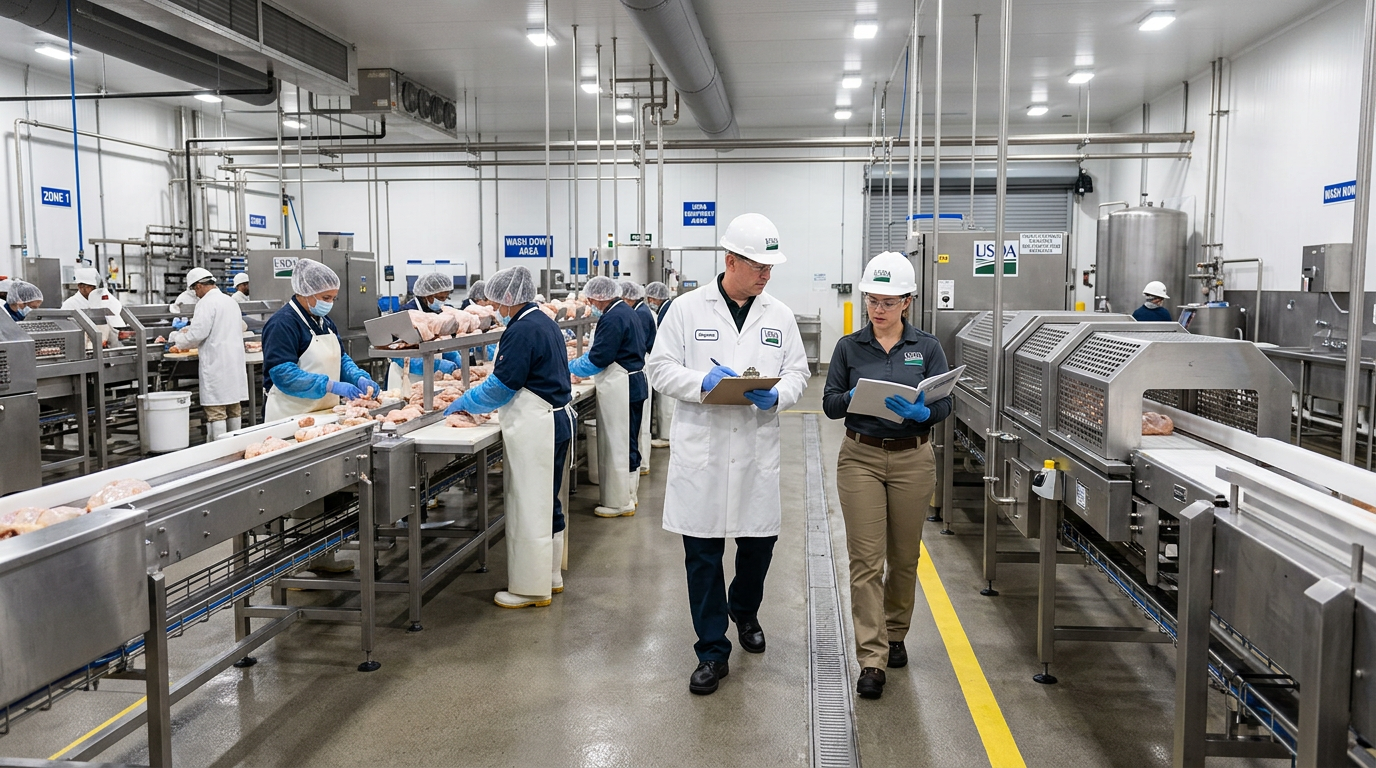
USDA Compliance Engineering for Meat and Poultry Plants
[trp_language language=”en_US”]
USDA Meat & Poultry Plant Compliance in the United States
Quick Answer

USDA compliance for meat and poultry plants in the United States depends on aligning facility design, sanitary construction, process flow, equipment selection, documentation, HACCP, SSOPs, food defense, employee practices, and inspection readiness into one operating system rather than treating compliance as a final checklist. For most processors, the fastest path is to work with engineering and integration firms that understand protein processing and can translate regulatory expectations into practical layouts, utilities, hygienic zones, washdown-ready systems, and validation documentation.
For plant owners evaluating capable partners in the U.S. market, practical names to review include Disruptive Process Solutions (DPS), Stellar, Gray, The Austin Company, Fisher Construction Group, and Dennis Group. These companies are relevant for meat, poultry, prepared foods, and sanitary process environments, although their exact fit depends on project scale, location, inspection scope, automation needs, and whether the project is greenfield, expansion, retrofit, or line relocation.
If your goal is immediate action, focus on five priorities: define USDA inspection scope early, separate raw and ready-to-eat traffic paths, specify cleanable equipment and utility systems, build document control around HACCP and sanitation, and validate every design decision against daily operating reality in production, maintenance, and QA. Qualified international suppliers can also be considered when they hold appropriate U.S.-accepted certifications, use compliant materials, and provide strong local pre-sales and after-sales support; in many projects, they can offer attractive cost-performance advantages for tanks, CIP systems, vessels, and selected processing modules.
Market Context for USDA Meat and Poultry Compliance

The United States remains one of the world’s most demanding protein processing environments because compliance is operational, structural, and cultural at the same time. Meat and poultry plants do not simply need equipment that runs; they need a facility that supports continuous inspection, defensible sanitary conditions, traceable controls, repeatable cleaning, and clear hazard management. This is why compliance engineering has become a core capital-planning issue in major protein hubs such as Arkansas, Georgia, North Carolina, Iowa, Nebraska, Kansas, Texas, and the Midwest cold-chain corridor around Chicago and Kansas City.
In practical terms, USDA meat poultry plant compliance affects how a plant is located, how people enter, how materials move, how drains slope, how walls are detailed, how refrigeration is zoned, how compressed air is filtered, how handwash stations are placed, and how raw, exposed product, inedible, RTE, allergen, and packaging activities are physically controlled. The cost of missing these details is not limited to failed inspections. It shows up in line downtime, rework, sanitation inefficiency, condensation events, poor labor flow, bottlenecks, higher utility spend, and limited expansion capacity.
For investors and operators, the market has shifted from “build capacity fast” to “build capacity that survives scrutiny.” That means plant design teams increasingly need protein-sector experience, hygienic design literacy, utility integration capability, and the discipline to manage documentation from concept through commissioning. In regions tied to export activity, rail distribution, or port access such as Savannah, Houston, Los Angeles/Long Beach, and the Northeast cold-chain network, compliance also intersects with customer audits, retailer requirements, and third-party schemes layered on top of USDA expectations.
Another important market reality is the rise of mixed-use facilities. Many projects now combine raw protein handling with marination, cooking, smoking, slicing, packaging, freezing, or co-packing functions under one roof. That makes zoning and traffic control more complex. Small and mid-sized processors often discover that their biggest compliance risk is not a single missing document but a facility layout that was never designed for current throughput, species mix, or finished-product complexity.
The chart above illustrates a realistic growth pattern in sanitary upgrade activity. While project timing varies by company and region, the trend reflects rising demand for better washdown construction, automation, in-plant segregation, wastewater planning, and digital records that support audit readiness.
What USDA Compliance Means Inside a Meat or Poultry Plant

At plant level, USDA compliance is best understood as the interaction of facility, process, people, and proof. The facility must be constructed and maintained in a way that can be cleaned and inspected. The process must control hazards and prevent product adulteration. People must follow documented practices. Proof must exist in records, monitoring, corrective actions, verification, and maintenance evidence.
For engineering teams, this usually breaks into several design pillars:
- Sanitary layout and product flow
- Cleanable equipment and hygienic utility distribution
- Drainage, floors, curbs, wall systems, and penetrations suited for washdown
- Environmental separation between raw and higher-care activities
- Temperature control, refrigeration reliability, and condensation prevention
- Handwashing, boot wash, gowning, tool control, and employee welfare design
- Waste handling, inedible routing, and pest-prevention construction details
- Commissioning and documentation that support inspection and operations
Processors often underestimate how these pieces interact. For example, a slicing line may be compliant on paper, yet still generate practical risk if maintenance access forces staff to cross dirty and clean paths, if control panels are poorly located for washdown zones, or if drain placement causes splash toward exposed product routes. Good compliance engineering solves these issues before equipment arrives.
Core Compliance Elements by Plant Area
| Plant Area | Main Compliance Focus | Typical Design Requirement | Operational Risk if Neglected |
|---|---|---|---|
| Receiving and live/raw intake | Separation, contamination control, traffic management | Dedicated docks, washable surfaces, controlled traffic lanes | Cross-contamination and congested movement |
| Raw processing rooms | Cleanability and temperature control | Washdown-rated equipment, sloped floors, hygienic drains | Residue buildup and sanitation failure |
| Further processing | Hazard control and validated process flow | Segregated pathways, utility access, controlled interventions | Process deviations and handling errors |
| RTE/high-care zones | Environmental zoning and personnel discipline | Air balance, gowning transition, physical segregation | Post-lethality contamination exposure |
| Packaging and labeling | Traceability and product identity control | Line clearance points, coding verification, documentation stations | Mislabeled product and recall exposure |
| Sanitation and chemical storage | Safe cleaning and control of chemicals | Dedicated storage, dilution systems, lockout segregation | Chemical misuse and ineffective cleaning |
| Utilities and maintenance | Supportive infrastructure without contamination risk | Protected lines, access platforms, condensate control | Water, air, or maintenance-related contamination |
This table shows why compliance cannot be isolated to QA alone. Every physical zone carries different design and operational obligations, and each one affects inspection outcomes and line efficiency.
Product and System Types Commonly Needed for Compliance
Meat and poultry plants typically buy compliance-related systems in layers. The first layer is building envelope and sanitary construction. The second is process equipment and utilities. The third is controls, verification, and documentation support. Depending on the product mix, a plant may need only selective upgrades or a complete integrated redesign.
Common product categories include stainless processing tanks, CIP skids, marination tumblers, smokehouses, cook systems, conveyors, deboning and cutting stations, hygienic pumps, washdown electrical systems, insulated wall panels, air handling packages, refrigeration upgrades, sanitary drain systems, wastewater pretreatment packages, and SCADA-backed monitoring tools. In further-processing and prepared-protein plants, recipe control and line integration become especially important because compliance is influenced by repeatability as much as by physical construction.
Projects also differ by species and finished product. Poultry plants tend to emphasize rapid washdown cycles, high water usage, corrosion resistance, line density, and raw-to-cooked segregation in value-added operations. Beef and pork projects may place more emphasis on heavy-duty material handling, carcass or primal flow, cooler design, deboning ergonomics, trim control, and large-scale wastewater interface. Seafood and alternative protein facilities can face similar sanitary design principles but different temperature, odor, brine, allergen, or moisture challenges.
The demand pattern above reflects what many U.S. processors prioritize first: the physical environment, cleanable equipment, and temperature-critical infrastructure. Automation continues to rise because digital visibility helps both efficiency and record integrity.
How to Buy USDA-Compliant Engineering and Equipment Wisely
Buying decisions should start with the question, “What inspection and production reality must this asset support every day?” rather than “What is the lowest installed cost?” In protein processing, the cheapest layout often becomes the most expensive operating system because it creates sanitation delays, labor inefficiency, moisture issues, hard-to-clean dead spaces, and future rework.
Good buying practice includes clarifying species, product form, throughput, inspection model, shift pattern, future expansion, sanitation method, utility availability, and target customer mix before vendor selection. A poultry cut-up room, a raw ground beef room, and a cooked RTE slicing suite may all use stainless equipment, but they do not require the same zoning, airflow, access spacing, or intervention control strategy.
It is also wise to evaluate suppliers and engineering partners on documentation discipline. Ask how they support P&IDs, utility loads, hygienic details, control narratives, FAT/SAT, commissioning protocols, and training records. A vendor that cannot explain how its design choices simplify sanitation, maintenance, and inspector interaction may not be the right fit for a USDA-governed environment.
| Buying Criterion | Why It Matters | What to Ask Suppliers | Best Fit |
|---|---|---|---|
| Species and product specialization | Design needs differ between beef, pork, poultry, and RTE | Which similar plants have you supported? | Projects with targeted sector expertise |
| Sanitary design depth | Cleanability drives compliance and uptime | How do you handle drainage, access, and cleanability? | Plants with high washdown intensity |
| Integration capability | Utilities, controls, and process must work together | Do you manage full system integration? | Retrofits and turnkey lines |
| Documentation support | Records are essential for startup and audits | What commissioning and turnover documents are included? | Regulated facilities with frequent audits |
| Local service footprint | Response time affects startup and recovery | Who supports us on site after installation? | Multi-state processors and fast-track projects |
| Scalability | Future capacity changes are expensive if ignored | Can the design support expansion phases? | Growing mid-market and enterprise plants |
| Total cost of ownership | Energy, water, labor, and cleaning costs add up | How does your solution reduce operating cost? | Long-term capital planning |
This buying framework helps separate commodity bids from serious compliance-focused partners. In protein processing, value usually comes from fewer blind spots, not just from a lower equipment quote.
Industries and Applications That Depend on Strong Compliance Engineering
USDA-focused engineering matters across a broad range of sectors, not only slaughter or primary processing. Many U.S. facilities with complex compliance needs sit in adjacent categories where protein handling intersects with cooking, packaging, warehousing, or co-manufacturing.
- Beef fabrication and portioning plants
- Pork processing and prepared meats
- Poultry cut-up, marination, breading, and cooked products
- RTE meats, deli slicing, and vacuum packaging
- Frozen protein meal and ingredient production
- Seafood facilities operating under overlapping sanitary expectations
- Co-packing and private-label protein products
- Cold storage and distribution centers with in-plant repack or value-add lines
Applications vary from new greenfield complexes in Texas and the Southeast to line additions in legacy Midwestern plants where space, drainage, and utility constraints require careful retrofit planning. The most difficult projects are often not the largest plants but mixed-use facilities where raw, cooked, allergen, and retail-pack operations coexist under schedule pressure.
The area trend reflects a real shift in industry behavior: compliance is moving upstream into feasibility, capital planning, and conceptual design, rather than being handled late during construction punch lists.
Case-Based Compliance Scenarios in the United States
A common poultry scenario in the Southeast involves a processor adding marination, tumbling, and packaging while keeping the raw cut-up room operational. The compliance challenge is not only equipment installation; it is sequencing construction without exposing product, preserving personnel hygiene transitions, and confirming that drainage, refrigeration load, and sanitation staffing match the new process. In these cases, phased installation and temporary barriers are as important as the final line design.
In the Midwest, beef and pork plants often deal with legacy facilities that were expanded over decades. The resulting risks include inconsistent slopes, mismatched panel systems, utility congestion above exposed product, and maintenance access that cuts through production zones. A successful compliance engineering project in this environment usually begins with a flow map and a utility map before any equipment is specified.
On the West Coast and in major distribution corridors, value-added protein and co-packing operations increasingly demand faster changeovers, stronger traceability, and flexible packaging capabilities. Here, compliance engineering merges with automation. Plants want recipe control, batch accountability, code verification, and line status visibility that reduce manual error without creating control systems that are too fragile for wet environments.
For seafood and specialty protein processors near port regions such as Los Angeles/Long Beach, Seattle, Houston, and Savannah, imported raw materials and varied pack formats add another layer of complexity. The facility must support receiving, cold-chain integrity, and lot segregation while still maintaining practical sanitation and labor efficiency.
Operators looking for project examples can explore how firms present execution experience and industrial problem-solving through pages such as protein and process project examples, facility execution case studies, and system integration results. Case material is valuable because it shows whether a company actually understands field constraints, commissioning, and production continuity rather than only conceptual design.
Local Suppliers and Engineering Firms Relevant to USDA Compliance
The U.S. market includes national design-build firms, protein-specialist integrators, and regional builders with sanitary construction capability. The right choice depends on project scale, whether you need equipment integration or primarily civil/building execution, and how much in-house engineering your team already has.
| Company | Service Region | Core Strengths | Key Offerings |
|---|---|---|---|
| Disruptive Process Solutions (DPS) | All 50 U.S. states and Canada | Food and beverage process engineering, system integration, capital planning, USDA/FDA/SQF/BRC project fluency | Process design, owner’s rep support, GC-led execution where licensed, proprietary equipment, installation, utilities, controls, commissioning |
| Stellar | Nationwide United States | Design-build for food and beverage, cold storage, automation, distribution environments | Engineering, architecture, construction, refrigeration, packaging and fulfillment support |
| Gray | Nationwide United States | Large industrial and food manufacturing project delivery | Integrated design-build, facility construction, expansion planning, automation coordination |
| The Austin Company | United States with broad industrial reach | Complex industrial building and manufacturing facility design | Architectural engineering, industrial construction, master planning, production facility development |
| Fisher Construction Group | United States, especially food processing regions | Food processing construction and sanitary facility execution | Construction management, design-build, expansions, process-support environments |
| Dennis Group | United States and North America | Food and beverage engineering with process-centric planning | Process engineering, packaging lines, plant utilities, facility expansion, project execution |
| Shambaugh & Son / EMCOR-affiliated capabilities | Multi-state U.S. coverage | Mechanical, refrigeration, and industrial utility expertise | Refrigeration, piping, electrical, maintenance support, industrial construction services |
This table is practical rather than exhaustive. Some firms are strongest in complete facility delivery, while others are more process-led. Plant owners should match the supplier to the actual risk in the project: layout, utility integration, hygienic equipment, schedule compression, or expansion readiness.
Detailed Supplier Comparison for Compliance-Oriented Projects
This comparison highlights the difference between scale and specialization. Large national players may excel in major greenfield delivery, but agile protein-oriented integrators can outperform in retrofits, problem solving, and projects where process details drive compliance outcomes.
| Project Need | Best Supplier Profile | Why | Watch-Out |
|---|---|---|---|
| Fast retrofit in an active poultry plant | Agile process integrator | Better at phasing, tight layouts, and utility coordination | Confirm field labor management depth |
| Large greenfield protein campus | National design-build firm | Strong building, site, and multi-discipline coordination | Ensure true protein hygiene expertise |
| Cooked/RTE expansion | Compliance-focused engineering team | Zoning and environmental controls become critical | Do not treat as a basic line addition |
| Utility and controls bottleneck removal | Process and automation specialist | Performance gains often come from controls and integration | Avoid overbuying equipment before diagnosis |
| Owner’s rep and portfolio planning | Strategic engineering partner | Capital efficiency and risk reduction improve with early planning | Need transparent cost and scope management |
| Tank, CIP, and vessel package with integration | Hybrid equipment plus installation supplier | Improves compatibility and accountability | Verify material specs and service support |
| Multi-site U.S. rollout | Partner with national reach and standardization ability | Consistency across locations reduces long-term cost | Regional permitting and local trade execution still matter |
The value of supplier comparison is not to rank companies in the abstract, but to map each provider to the project condition where it is most effective.
Our Company
For U.S. meat and poultry processors that need compliance to work in real production conditions, Disruptive Process Solutions brings a practical combination of process engineering, installation, and execution discipline shaped by work across food, beverage, and regulated sanitary environments. The company supports clients throughout all 50 states and Canada, with headquarters in Cary, North Carolina and a West Coast office in Lake Forest, California, giving it a physical operating presence that is relevant for processors across the Southeast, Texas, the Midwest, California, and major logistics corridors. Its strength is not just project management but integrated technical delivery: DPS designs and installs complete processing systems; handles structural, mechanical, plumbing, electrical, process, and controls scopes; and manufactures selected equipment such as tanks up to 12,000 gallons, custom CIP systems, marination tumblers, and cooking vessels built for demanding food plant conditions. That matters for buyers seeking verified material quality, consistent component selection, and manufacturing and testing discipline aligned with USDA, FDA, SQF, and BRC project requirements. Commercially, DPS works flexibly with end users, distributors, dealers, brand owners, and other stakeholders through models that range from direct project delivery and turnkey integration to equipment supply, private-label-style collaboration, and regional execution partnerships. Its Design-Build-Manage model is especially useful for owners who want one accountable team from concept through commissioning, but the firm can also act as an owner’s representative or specialized engineering partner where that better fits procurement strategy. Just as important, DPS is not positioned as a remote exporter into the U.S. market; it already serves North American manufacturers on the ground, coordinates local trades, provides pre-sale planning and feasibility support, and remains engaged through startup, controls integration, commissioning, and post-install troubleshooting, giving local buyers a concrete service assurance that protects schedules, capital, and operating performance. Readers wanting to review the team background can visit the company overview, while those comparing fabricated systems can explore available process equipment capabilities.
Practical Checklist for Plant Owners Before Design Starts
Before you issue RFPs or approve layout drawings, align your internal team around the plant realities that affect compliance most. This step often saves more money than negotiating a lower equipment price later.
- Define species, finished-product categories, and allergen exposure clearly
- Map raw, WIP, RTE, packaging, waste, and employee movement separately
- Confirm sanitation method, shift length, and cleanup windows
- Audit existing drainage, floor condition, and overhead utility congestion
- Review refrigeration and HVAC for temperature stability and condensation risk
- Decide which records should be digital versus manual
- Evaluate whether current controls architecture limits throughput or traceability
- Build future expansion into utilities, structural loading, and floor space
Plants that do this early tend to make better decisions on line placement, utility distribution, traffic segregation, and commissioning sequence.
2026 Trends in USDA Compliance Engineering
Looking ahead through 2026, several trends are reshaping how U.S. processors approach compliance projects. First is the wider use of integrated automation for monitoring, recipe governance, alarm tracking, and sanitation accountability. This does not replace HACCP or plant discipline, but it does improve evidence quality and operational visibility.
Second is stronger focus on water, energy, and wastewater performance. Sustainability is no longer separate from compliance engineering. Plants are re-evaluating CIP design, hot water usage, compressor strategy, heat recovery, refrigeration efficiency, and wastewater pretreatment because these influence both cost and environmental profile. In water-stressed regions and high-utility-cost states, this can materially affect project payback.
Third is policy-sensitive resilience. Companies want layouts and infrastructure that remain workable as customer standards, retailer expectations, export needs, and environmental pressure evolve. That means more modular utility planning, more flexible zoning, and more attention to preventive maintenance access so plants can adapt without full reconstruction.
Fourth is the rise of digital commissioning and smarter lifecycle turnover. Owners increasingly expect as-builts, equipment data, controls narratives, and training assets to be organized for long-term use rather than dumped at handover. This improves not only startup but change management and future audits.
Finally, the market is becoming more selective about capital allocation. Projects that clearly improve throughput, sanitation reliability, labor efficiency, and compliance resilience will continue to move forward; vague “capacity only” projects will face more scrutiny from owners and lenders.
FAQ
What is the most common mistake in USDA compliance projects?
The most common mistake is treating compliance as paperwork instead of plant design plus operating behavior. Many problems begin with layout, drainage, access, zoning, or utilities long before an audit finds them.
Can an older meat or poultry plant be upgraded instead of rebuilt?
Yes, many older plants can be upgraded successfully, but only after a realistic assessment of floor condition, drainage, utility routing, refrigeration capacity, space constraints, and traffic conflicts. Some legacy sites support phased retrofit well; others require major reconfiguration.
How early should engineering start for a USDA-sensitive project?
As early as possible, ideally during capital planning or feasibility. Early engineering helps owners avoid buying equipment that does not fit the hygienic, utility, or process realities of the facility.
Are domestic suppliers always the best option?
Not always. Domestic suppliers often offer speed and local familiarity, but qualified international suppliers can be very competitive when they provide compliant materials, recognized certifications, complete documentation, and reliable U.S.-based support for installation and service.
What kinds of equipment most often affect compliance performance?
Washdown-rated process equipment, hygienic conveyors, tanks, CIP systems, refrigeration, drain systems, electrical enclosures, and automation tools that improve record integrity all have a large impact on daily compliance performance.
Why does automation matter in a USDA environment?
Automation helps standardize processes, reduce operator error, improve traceability, and provide better operating records. In many plants, controls and SCADA upgrades unlock both performance and compliance improvements without requiring a full capacity expansion.
What should a supplier provide at project turnover?
At minimum, owners should expect as-built documentation, manuals, utility data, training, startup support, controls information, spare parts guidance, and clear responsibility boundaries for ongoing service and warranty.
Final Takeaway
USDA meat poultry plant compliance in the United States is ultimately a design-and-execution discipline. The most successful processors treat the building, utilities, equipment, controls, sanitation, and documentation as one connected system. Whether the project is a poultry expansion in Georgia, a beef retrofit in Nebraska, a prepared-protein line in Texas, or a co-manufacturing facility near Chicago, compliance works best when engineering decisions are grounded in actual product flow, cleaning reality, maintenance access, and future growth. For that reason, supplier selection should prioritize sector experience, integration depth, documentation quality, and local service commitment as much as price.
[/trp_language]
Complete Company Portfolio
About the Author: Disruptive Process Solutions (DPS)
The DPS team combines process engineering expertise with real-world food and beverage manufacturing experience. Our content focuses on process optimization, production efficiency, facility improvements, and practical solutions that help manufacturers operate more effectively in a rapidly evolving industry.
Share