Dairy-Based Protein Shakes
Specify protein source and concentration, mineral system, pH, viscosity, flavor and storage objective. The selected recipe must be assessed through the actual hydration, heat and packaging sequence.
Connect ingredient hydration, product stability, processing and filling to saleable output and realistic plant economics.
Discuss Your Project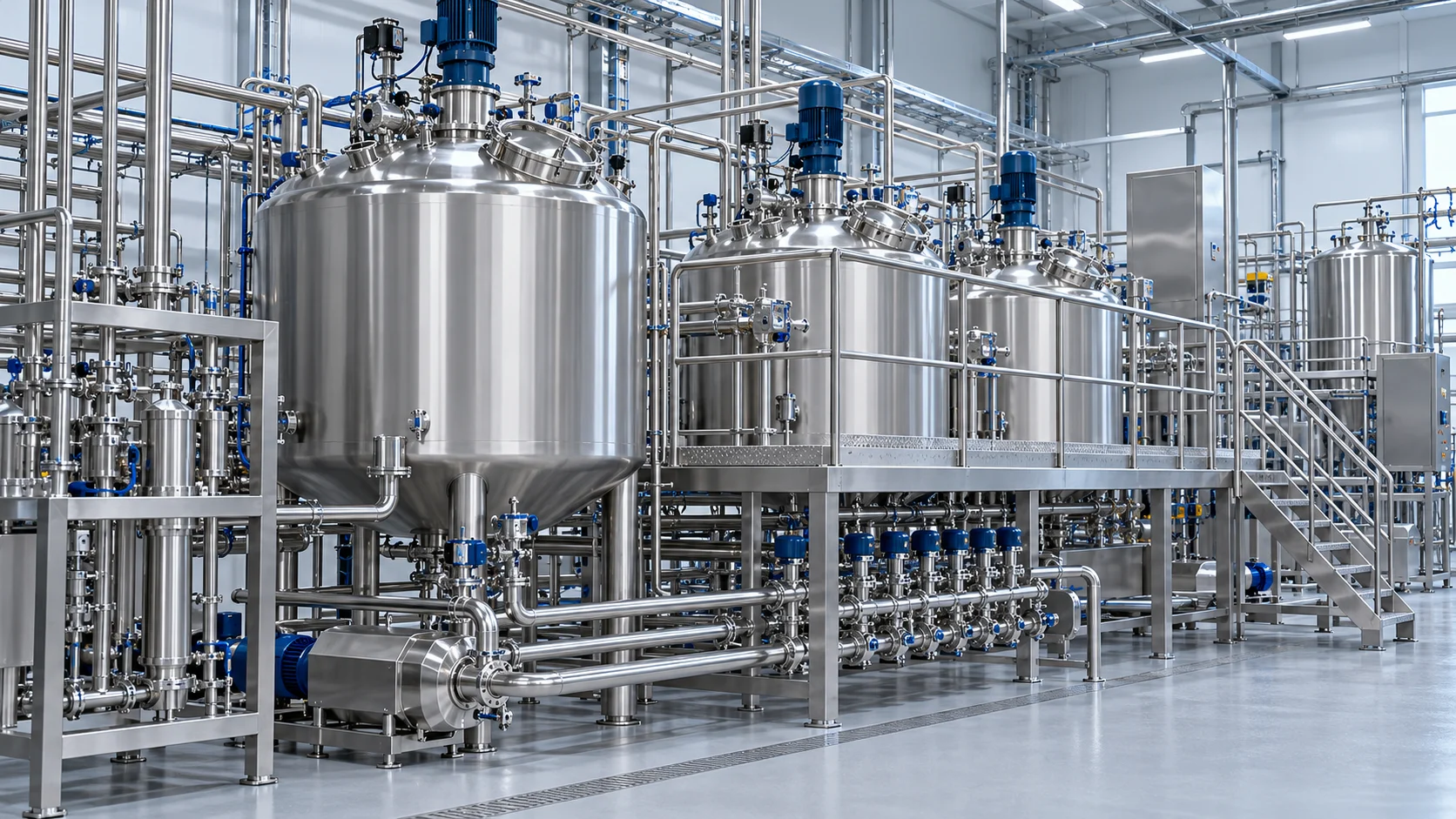
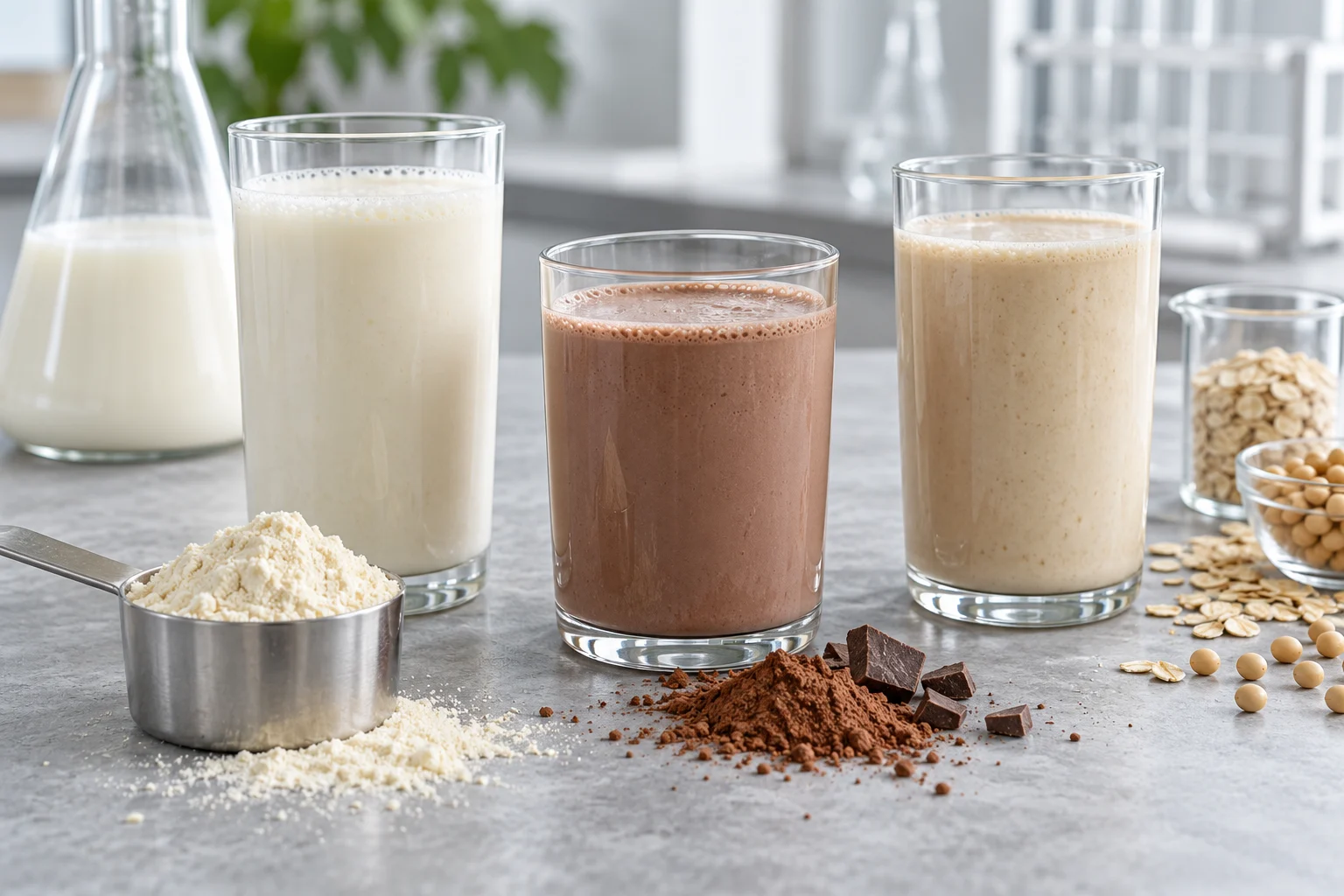
Specify protein source and concentration, mineral system, pH, viscosity, flavor and storage objective. The selected recipe must be assessed through the actual hydration, heat and packaging sequence.
Different protein and solids systems can change solubility, sedimentation, hydration and heat behavior. Define trials with qualified ingredient and process specialists rather than assuming a dairy recipe transfers unchanged.
Do not combine these with neutral shake requirements in one generic processing specification. The protein, acidity, desired appearance and preservation route require their own technical basis.
Set ingredient order, wet-out, mixing exposure, temperature and permitted holding before developing the automation recipe.
The formulation, acidity, intended storage and packaging determine the qualified route. Coordinate the blend with homogenization, heat treatment and filling OEMs.
Map dairy, soy, nut or other applicable ingredient transitions with the site quality team. Manage approved recipes, cleaning status and lot identity.
Review each system by its operating duty and the interfaces to be agreed before procurement.
Ingredient hydration, blending and permitted holds.
Support the actual product and allergen transitions.
Coordinate dosing, sequences and OEM handshakes.
Specialist product-process packages.
Swipe horizontally to compare all columns ↔
| System | Operating duty | Relevant DPS guide | Confirm before purchase |
|---|---|---|---|
| Mix / staging vessels | Ingredient hydration, blending and permitted holds. | DPS tanks and vessels ↗ | Agitation, working volume, temperature, venting and sanitation. |
| CIP equipment | Support the actual product and allergen transitions. | DPS CIP systems ↗ | Circuit boundaries, soils, monitoring and site verification. |
| Recipe / batch controls | Coordinate dosing, sequences and OEM handshakes. | Automation & controls ↗ | Approved recipe versions, traceability, alarms and acceptance tests. |
| Homogenization / thermal / filling | Specialist product-process packages. | Process integration ↗ | Supplier trials, utility conditions, product stability and performance boundaries. |
Start with the business outcome
A protein beverage project needs a product-qualified processing system, not only a blender and a filler. DPS can coordinate batching, ingredient addition, process and OEM interfaces, sanitation, utilities, controls and installation. Investment value comes from conforming product, lower avoidable loss, repeatable batches and the share of additional capacity that can actually be sold.
DPS’s dairy-beverage material includes protein drinks and its equipment guides cover liquid blending, tanks and CIP. Confirm formulation development, ingredient functionality, homogenizers, UHT / aseptic processing, filling and shelf-life responsibilities with the relevant specialists. No pharmaceutical or therapeutic capability is implied.
Agree protein source, solids, acidity, viscosity and storage objectives separately for neutral shakes, plant-protein blends and clear protein drinks.
Evaluate hydration, ingredient dosing, heat behavior and package compatibility with ingredient and processing specialists using representative formulas.
Check product stability, batch identity, rejected volume and accepted packaged output against the agreed product and storage evaluation.
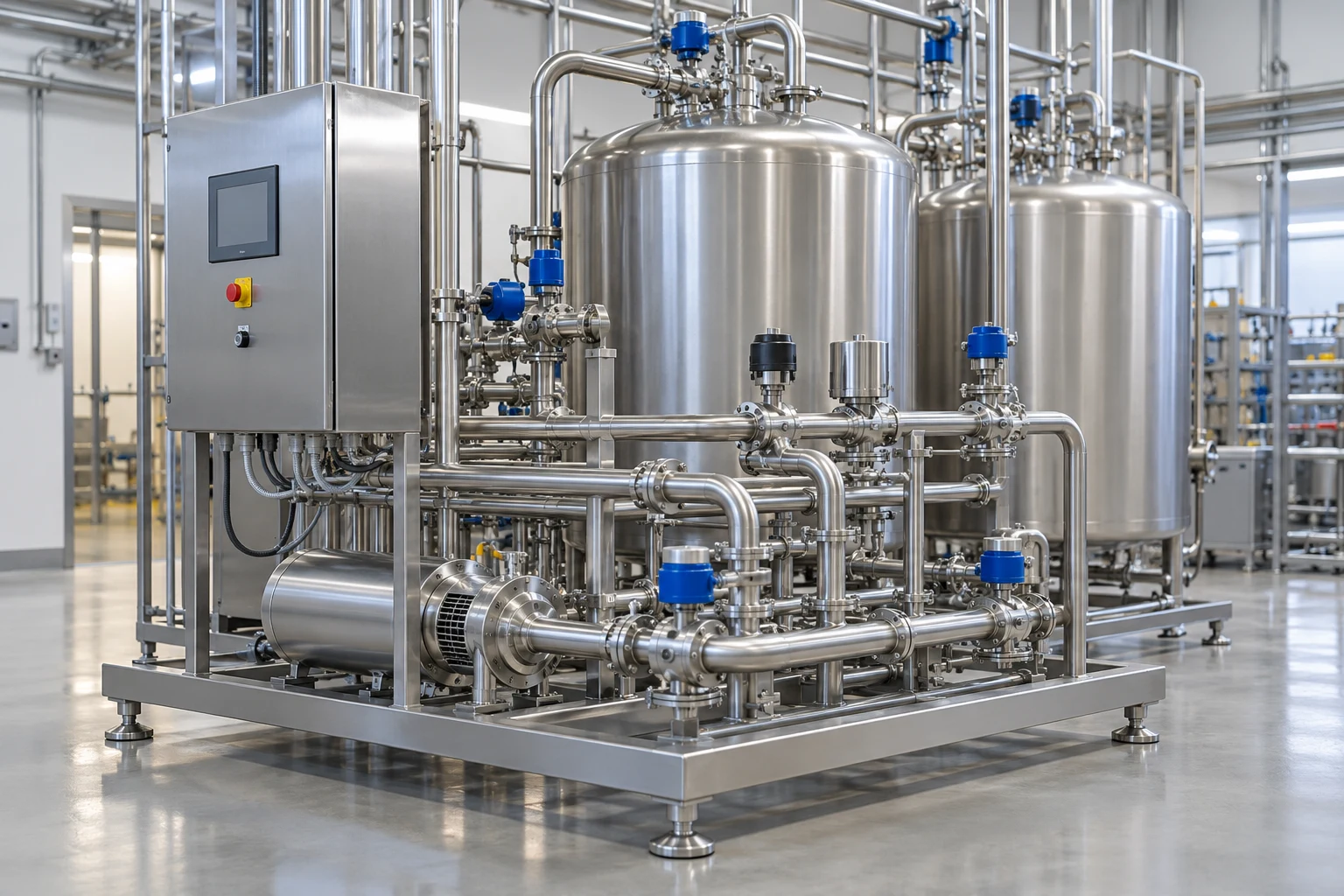
Review the scope, cost assumptions and operating case for your project. The examples and calculators below support early planning and are not DPS quotations.
Start with quality holds, hydration time, recipe deviations, thermal / filler waits and sanitation data. Determine which loss is controlled by the formulation, equipment, operating sequence or quality-release process.
Define the product and packaging envelope, commercial forecast, qualified preservation route and trial plan before equipment procurement. Include fixed payroll, rent, utility readiness and the launch cash requirement.
Swipe horizontally to compare all columns ↔
| Observed condition | Measure before design | DPS / team decision | Economic basis |
|---|---|---|---|
| Unstable or rejected product | Define conformance after the full process and intended storage evaluation. | Coordinate ingredient / process trials and operating envelope before scale-up. | Value genuinely avoided baseline rejects or purchases; never assume all experimental batches are sellable. |
| Long hydration or repeated mixing | Record time, additions and rework loops by recipe. | Compare addition sequence, mixing duty and recipe controls. | Recovered time becomes value only if thermal / filling capacity and demand permit extra sales. |
| Ingredient and dosing variance | Check actual quantities, material identity and recipe version control. | Coordinate dosing instruments, interlocks and batch records. | Verified reduction in baseline ingredient purchases and rework; not a claim about therapeutic nutrition. |
| Plant utilization risk | Use realistic customer demand and package mix. | Compare flexible and dedicated equipment with fixed operating expense. | Contribution margin, demand-capped volume, ramp and working capital determine ROI. |
Swipe horizontally to compare all columns ↔
| Decision | Targeted Work | Broader Scope |
|---|---|---|
| Hydration | Trial addition order, dosing and the existing mixing duty. | Reconfigure preparation when the formula exceeds the retained equipment envelope. |
| Product Stability | Resolve ingredient and full-process trial findings first. | Coordinate a different treatment or package route with specialists. |
| Useful Capacity | Improve qualified recipes and campaign scheduling. | Add capacity against realistic demand, package mix and fixed costs. |
Compare proposals with the same product duty, supplier boundaries and acceptance basis. The amount below is a transparent planning example, not a market price range, supplier estimate or DPS quotation.
| Cost bucket | Assumed amount |
|---|---|
| Process / product-trial engineering | $70,000 |
| Configured blending / utility components | $260,000 |
| Mechanical / electrical installation | $130,000 |
| Batch / dosing controls integration | $80,000 |
| Commissioning and OEM trials | $45,000 |
| Training and closeout | $15,000 |
| Defined project scope | $600,000 |
| Separate site / facility additions | $100,000 |
| Capital contingency (15%) | $105,000 |
| Separate one-time startup / shutdown cost | $40,000 |
| Incremental working capital | $60,000 |
| Total initial cash | $905,000 |
The defined scope assumes applicable freight, procurement charges and taxes are included in the owner’s estimate. Add missing civil, land / shell, OEM, environmental, validation and permitting costs explicitly. Site and field conditions, duty, production access and quoted supplier scope determine actual price. Financing is excluded.
Illustrative assumptions: 250 days × 0.8 recovered hour/day × 1,500 good kg/h × 55% realization = 165,000 additional sold kg/year. The example uses $4.80/kg net price and $3.05/kg incremental variable cost. A separate 0.5% baseline purchase reduction on 1,000,000 kg is assumed verified at unchanged baseline output; it is not a change in loss percentage points.
Calculated from these assumptions: steady annual net benefit $313,150; year-one net cash $158,733; cash payback 3.38 years; five-year NPV at 10% is $141,705. Change the assumptions below to test a different case.
Assumed new protein-RTD operation: ingredient hydration / batching, the selected specialist thermal / filling packages, CIP, utilities, engineering, controls, field installation and commissioning are included in $4.0M. The $1.8M separate site allowance defines the assumed facility / infrastructure boundary. Formulation and package qualification remain explicit owner / specialist responsibilities.
The $1.1M additional annual fixed cost assumes $720,000 fixed payroll / supervision, $240,000 occupancy and overhead, and $140,000 service / other fixed operation. Product, packaging and incremental production labor / utility costs are in the $3.05/kg variable input.
| Owner-budget item | Assumed or calculated amount |
|---|---|
| Defined equipment / engineering / installation scope | $4,000,000 |
| Separate site / facility allowance | $1,800,000 |
| Capital contingency (15%) | $870,000 |
| One-time pre-production startup expense | $250,000 |
| Incremental working capital | $450,000 |
| Total initial cash | $7,370,000 |
| Steady sold good output | 1,800,000 kg/year |
| Additional fixed operating cost | $1,100,000/year |
| First-year gross-benefit realization | 45% |
| First-year net operating cash | $317,500 |
| Steady net annual cash | $2,050,000 |
| Five-year NPV at 10% | −$1,173,887 |
Scheduled capacity is 250 days × 7 hours/day × 2,000 good kg/h; 55% realization and the 1,800,000 kg demand ceiling determine sold output. Historical material, payroll, energy, cleaning and maintenance savings are all zero. Startup expense covers separate pre-production activities; the year-one ramp already models unrealized gross operating benefit. Do not charge the same launch loss twice.
Use the New-facility example button below to inspect and change all assumptions. A negative NPV is a reason to revisit scope, utilization, contribution, timing or the decision horizon; it is not hidden by forcing a faster payback.
Replace the illustrative inputs with your own measured or quoted values. The five-year pre-tax model uses good kilograms, demand-capped contribution and separately verified baseline savings; it is not a project quotation.
Both presets are hypothetical owner-budget scenarios. Choose the existing-plant improvement or new-facility case; they have different cost boundaries. New-facility presets set all historic savings to zero and include additional fixed operating cost.
Includes contingency, startup and working capital
Incremental operating cash before tax
Includes year-one ramp assumption
At 10% annual discount
Net annual benefit ÷ initial cash
Net cumulative gain ÷ initial cash
Modeled incremental sales: 165,000 kg/year at $1.75/kg contribution. The base case has a nonnegative five-year NPV at the selected discount rate. Year-one net cash: $158,733.
Realization needed for the target operating payback
44.6%
Minimum capacity realization for a 4-year operating cash payback; terminal recovery excluded. Demand and unit margin must also hold.
CSV export is local. No inputs are submitted.
Swipe the chart to compare all five years ↔
Swipe horizontally to compare all columns ↔
| Year | Net cash | Cumulative cash | Discounted cash |
|---|---|---|---|
| Initial | −$905,000 | −$905,000 | −$905,000 |
| Year 1 | $158,733 | −$746,268 | $144,302 |
| Year 2 | $313,150 | −$433,118 | $258,802 |
| Year 3 | $313,150 | −$119,968 | $235,274 |
| Year 4 | $313,150 | $193,183 | $213,886 |
| Year 5 | $313,150 | $506,333 | $194,442 |
Swipe horizontally to compare all columns ↔
| Case | Annual benefit | NPV | Cash payback |
|---|---|---|---|
| Downside | $197,650 | −$409,881 | Beyond 5 years |
| Base | $313,150 | $141,705 | 3.38 years |
| Upside | $370,900 | $336,998 | 2.93 years |
Downside: installed and site costs +20%, realization ×0.75 and unit contribution reduced by 20% of its absolute value. Upside: realization ×1.15, capped at 100%, and unit contribution improved by 10% of its absolute value. The demand ceiling still applies.
Enter actual purchased kg at the same accepted baseline output before and after improvement. The defaults produce $11,000/year gross purchase savings, matching the main model. The $2,000 trial / disposal expense is part of the main $30,000 added fixed operating cost; the narrow worksheet shows $9,000 net. Do not transfer that net figure as gross savings and deduct the fee again. This operating worksheet refers to the existing-plant example and is independent of the financial preset selected above.
Prepare the information below, export the assumptions you have modeled, and discuss the unknowns with DPS. An unmeasured input is a question to resolve, not a reason to invent precision.
Checklist and model data stay in this browser until you choose to share them.
Bring your product requirements, operating priorities and site constraints to an initial scope discussion with DPS.