Automation & Controls That Scale With Your Production Goals
Your food and beverage operation runs on precision — every batch, every cycle, every shift. DPS designs, programs, and integrates full-scope process automation systems including PLC programming, SCADA architecture, recipe management, and batch control purpose-built for FDA- and USDA-regulated manufacturing environments. We turn manual bottlenecks into repeatable, data-driven processes that protect quality and drive throughput.
Schedule A Consultation →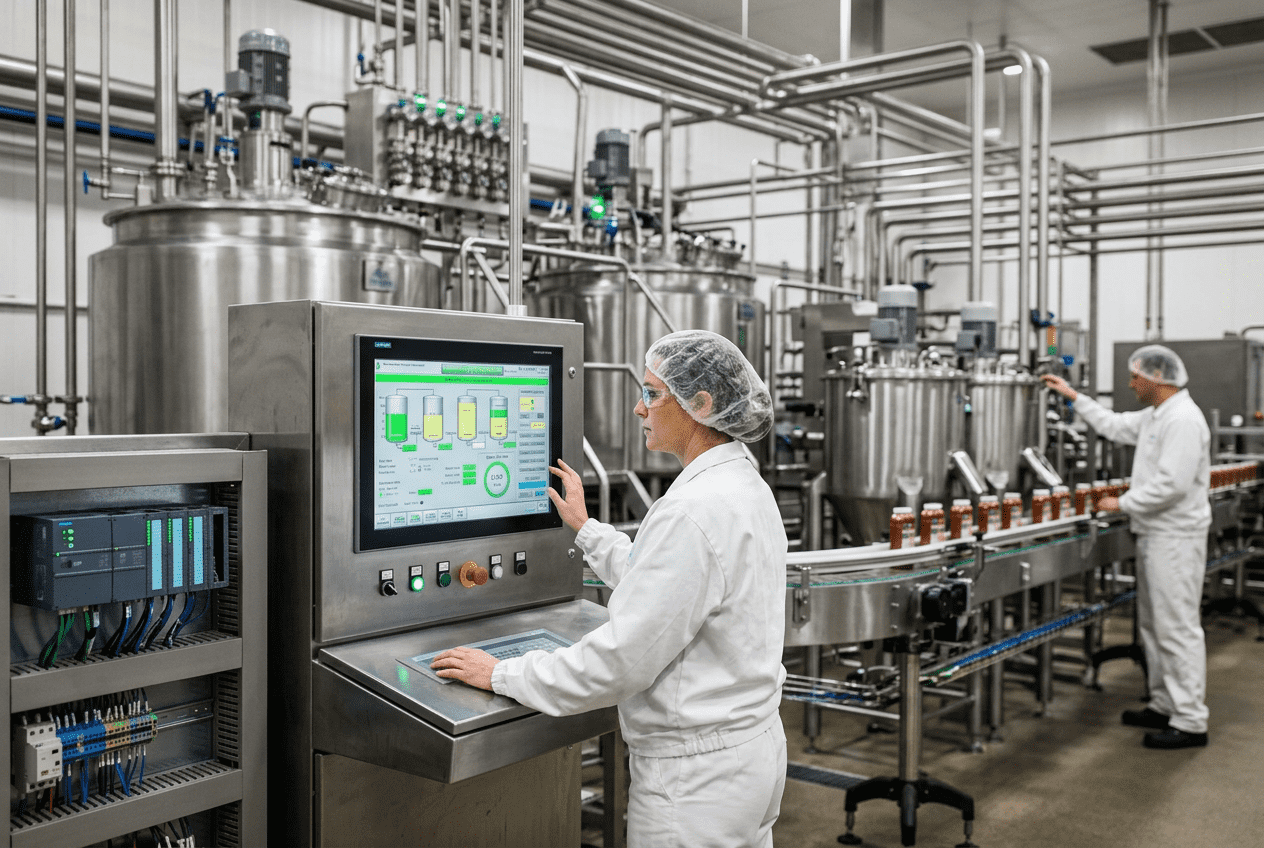
Challenges in Providing This Service in the Market
Most mid-market food and beverage manufacturers we encounter are running facilities where critical process knowledge lives inside one or two operators’ heads — not inside a control system. Production schedules depend on tribal knowledge, batch consistency varies shift to shift, and the data needed to make capital decisions simply does not exist in any accessible form. When a key operator leaves or a customer audit surfaces traceability gaps, the cost of that fragmentation becomes painfully real. These are not hypothetical risks. They are the conditions we walk into on nearly every initial site assessment across the United States.
-
Challenge 01
Inconsistent Batch Quality
Without standardized recipe management and automated batch control, product variation creeps in through manual ingredient additions, subjective temperature calls, and undocumented process deviations — all of which put SQF and BRC audit scores at risk. -
Challenge 02
Blind Spots in Production Data
Operators managing disconnected equipment have no unified view of throughput, downtime causes, or utility consumption, making it impossible to identify the true constraint on a line running below rated capacity. -
Challenge 03
Compliance Exposure
FDA’s Preventive Controls rule and USDA FSIS requirements demand verifiable electronic records for critical control points. Paper logs and disconnected PLCs cannot satisfy a modern food safety audit at scale. -
Challenge 04
Costly Over-Engineering
Without a controls partner who understands food process economics, manufacturers end up specifying automation platforms far beyond what the application requires — or worse, under-specifying and facing a full rip-and-replace within two years of commissioning.
Building Scalable and Efficient Production Systems
DPS approaches every automation and controls engagement through our Design-Build-Manage methodology, which means your control system is never an afterthought bolted onto someone else’s mechanical design. Our process engineers define the functional requirements, our controls engineers architect the PLC and SCADA platform, and our project management team coordinates physical installation and commissioning — all under one contract, one schedule, and one point of accountability. For food and beverage manufacturers operating in FDA- and USDA-regulated categories, this integration eliminates the specification gaps that typically surface when a separate controls integrator inherits a partially complete mechanical scope.
We begin every project with a detailed process review and controls narrative — not a generic quote. That means mapping each unit operation, defining control sequences in plain-language functional descriptions, and aligning the automation scope to your actual production targets and budget constraints. Our team has executed PLC programming and SCADA system deployments across beverage co-packing lines producing over 20 million cases annually, protein processing facilities running multi-species programs, and aseptic filling environments requiring validated CIP and SIP sequences. Every platform we deliver is built for the operator who will use it at 2 a.m. on a Saturday — intuitive HMI screens, clear alarm hierarchies, and recipe structures that production staff can manage without calling an engineer.
Because DPS operates as an owner’s representative and operational advisor — not just a controls contractor — we routinely identify automation-first solutions that eliminate the need for large capital expenditures. In one engagement, our team resolved a client’s $3 million capacity constraint through a targeted PLC logic adjustment at no charge, which subsequently led to a $6 million facility relocation project where the trust had already been established. That is the business-first philosophy behind everything we integrate.
Capabilities Supporting Modern Production Operations
Integrated engineering, operational, and project capabilities designed to support efficient, scalable, and reliable production environments.
-
PLC Programming & Logic Development
Custom ladder logic, structured text, and function block programs developed on Allen-Bradley, Siemens, and other major platforms for process control, safety interlocks, and high-speed sequencing across food and beverage unit operations. -
SCADA System Design & Deployment
Full supervisory control and data acquisition architecture including server configuration, real-time process visualization, historical trending, and role-based access designed for multi-line F&B production environments. -
Recipe Management & Batch Control
ISA-88-aligned recipe structures that allow production teams to manage formulations, ingredient scaling, and batch sequencing directly from the HMI — reducing changeover time and eliminating manual transcription errors. -
CIP/SIP Automation & Validation
Automated clean-in-place and sterilize-in-place sequences with full parametric data logging for FDA and USDA compliance, integrated with process scheduling to minimize non-productive time between production runs. -
Energy & Utility Management Systems
Real-time monitoring and automated control of boiler, compressed air, glycol, refrigeration, and HVAC systems to reduce per-unit energy cost while maintaining critical environmental parameters in temperature-sensitive processing areas. -
Controls Integration & Retrofits
Integration of new automation layers into existing brownfield facilities — migrating legacy relay logic or outdated DCS platforms to modern PLC/SCADA infrastructure without extended production shutdowns.
Engineering Scope & Deliverables
The table below outlines DPS’s standard automation and controls service scope across food and beverage facility projects. Actual deliverables are tailored to each engagement based on process complexity, regulatory requirements, and production scale.
| Domain | Scope | Deliverables |
|---|---|---|
| PLC Programming | Unit operation control, safety interlocks, motion control, high-speed counting | Functional description, PLC code (IEC 61131-3), I/O list, FAT/SAT protocols |
| SCADA / HMI | Process visualization, alarming, historical data, reporting dashboards | SCADA architecture drawing, HMI screen navigation map, alarm rationalization matrix |
| Batch Control | ISA-88 recipe structures, phase logic, batch reporting | Recipe master templates, batch records with electronic signatures, changeover procedures |
| Recipe Management | Multi-product formulation control, ingredient scaling, version tracking | Recipe database, access-controlled editor interface, audit trail configuration |
| CIP/SIP Automation | Sequence control, chemical dosing, parametric monitoring | CIP circuit P&IDs, validated cycle reports, deviation alarm configuration |
| Energy Management | Utility monitoring, load scheduling, demand response integration | Utility dashboard, baseline consumption report, automated setpoint optimization |
| Network & Infrastructure | Industrial Ethernet, managed switches, segmented VLANs, cybersecurity hardening | Network topology drawing, firewall rule set, remote access policy documentation |
| Commissioning & Startup | Loop checks, point-to-point verification, operational tuning, operator training | Commissioning punch list, training manuals, as-built control system documentation |
Common Questions About Automation & Controls Service
Quick answers to the questions we hear most often from prospective clients evaluating automation partners.