Dairy Processing Plant Design, Construction & Automation — From Milk Receiving to Packaging
DPS designs, builds, and manages complete dairy processing facilities — integrating milk pasteurization, cheese production lines, yogurt manufacturing systems, homogenization, CIP, and facility-wide automation under a single Design-Build-Manage contract. From capital feasibility through commissioning, we deliver turnkey dairy infrastructure for processors, co-packers, and private-label manufacturers across all 50 U.S. states and Canada.
Schedule a Consultation →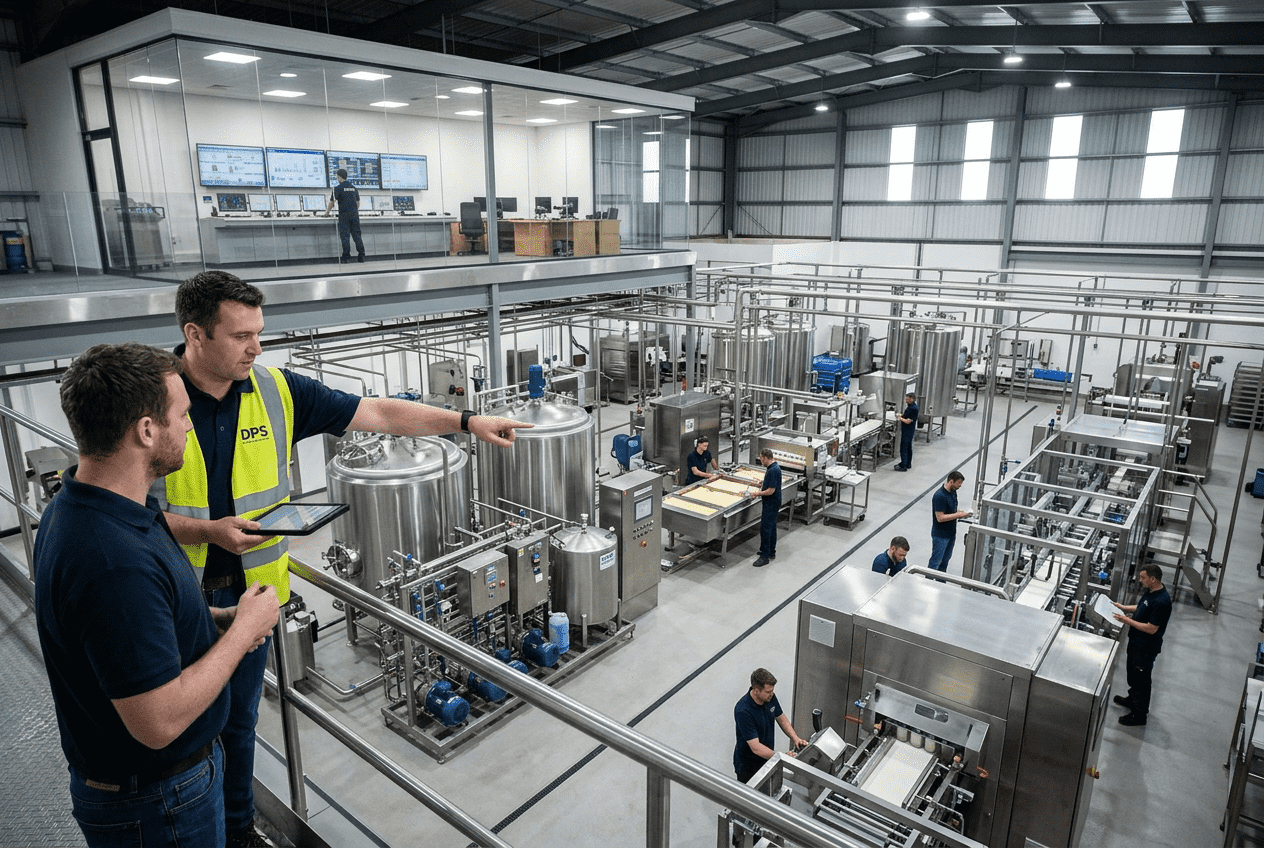
Helping Manufacturers Navigate Operational Complexity
The U.S. dairy industry is in the middle of a historic infrastructure cycle. Processors have committed over $11 billion in new and expanded manufacturing capacity between 2025 and early 2028, with more than 50 individual building projects underway spanning cheese, fluid milk, yogurt, butter, powder, and ice cream. That investment reflects surging consumer demand — U.S. per-capita dairy consumption reached a record 661 pounds per person in 2023, driven by protein-seeking consumers who have pushed yogurt production to an all-time 4.9 billion pounds in 2024 and cheese output to 14.66 billion pounds in 2025. Yet the scale of this buildout creates its own engineering complexity: every new dairy processing plant must balance raw milk receiving and separation with downstream thermal processing, fermentation or coagulation, CIP sanitation, wastewater management, and cold-chain logistics — all under continuous FDA and USDA-FSIS scrutiny where a single pasteurization deviation can trigger a recall across an entire production run.
What separates high-performing dairy facilities from those trapped in chronic downtime and margin erosion is whether the pasteurization, homogenization, separation, filling, and CIP systems were engineered as a coordinated throughput chain — or assembled piecemeal from disconnected vendor proposals. A milk pasteurization system designed without accounting for downstream filler speeds creates hold-time violations and thermal abuse. A cheese production line where the vat capacity outpaces the pressing, brining, and aging infrastructure generates bottlenecks that compress margins on every pound produced. A yogurt manufacturing facility where the incubation and cooling stages were sized for a single SKU — not the Greek, traditional, drinkable, and plant-based portfolio the marketing team is already planning — will require costly re-engineering within 18 months of commissioning. DPS eliminates these failure modes by engineering every dairy processing plant as an integrated business system, modeling throughput interdependencies before the first P&ID leaves our office.
What We Deliver to Manufacturers
Practical engineering solutions designed to improve efficiency, scalability, and operational performance.
-
1
Milk Pasteurization & Thermal System Design
DPS engineers HTST, UHT, and batch pasteurization systems calibrated to your specific product matrix — accounting for flow rates, fat content variability, downstream filler compatibility, and FDA Pasteurized Milk Ordinance (PMO) hold-time requirements. We size the balance tank, regeneration sections, holding tube, and diversion valve as an integrated thermal chain so the system delivers validated kill-step performance across your full production schedule without creating bottlenecks at the filler or CIP queue. -
2
Cheese Production & Cultured Product Facility Engineering
Cheese production demands precise coordination between milk receiving, pasteurization, vat filling, coagulation, cutting, draining, pressing, brining, and aging — each stage with different temperature, humidity, and timing requirements. DPS designs the complete process architecture from vat layout and whey drainage through brine system sizing and aging room environmental controls, ensuring the facility handles your full cheese portfolio (American, Italian, Hispanic, specialty) without dedicating separate lines to each variety. -
3
Yogurt Manufacturing & Fermentation Systems
DPS designs yogurt manufacturing lines for set-style, stirred, Greek, drinkable, and plant-based formats — engineering the incubation tanks, culture dosing systems, straining/separation equipment, fruit-on-bottom or blending stations, and cooling tunnels as a unified system. We size fermentation vessel capacity and cooling rates so the facility supports your current SKU count and absorbs planned portfolio expansion without requiring structural modifications to the process flow. -
4
Automation, Batch Control & Traceability
DPS programs PLC/SCADA systems that manage recipe sequencing, pasteurization temperature monitoring, CIP cycle automation, and full lot traceability from raw milk receiving through finished-product palletization — enabling operators to execute multi-product schedules through the HMI rather than manually adjusting valves, set points, and diversion parameters. Automated batch records capture every critical control point for FDA, USDA, SQF, and BRC audit documentation. -
5
In-House Equipment Manufacturing & Utility Integration
DPS fabricates process vessels up to 12,000 gallons, CIP skids, batch tanks, and blending systems at our own facilities — eliminating the multi-vendor coordination failures that stall dairy projects when tanks, piping, and controls arrive from suppliers who never validated against each other. We also engineer complete utility systems — steam boilers, glycol/chilled water, compressed air, process water, wastewater, and refrigeration — sized for simultaneous peak demand across production and CIP operations.
Integrated Delivery vs Traditional Execution
When dairy processing plant projects are split across a standalone process consultant, separate equipment OEMs for pasteurization, separation, and filling, an independent controls integrator, and a general contractor without dairy-grade experience, accountability fractures at every system interface — and the resulting facility underperforms from commissioning day forward.
| Dimension | DPS Integrated Approach | Fragmented / Traditional Model |
|---|---|---|
| Pasteurization & Fill-Line Balance | HTST/UHT system, holding tube, diversion valve, and downstream filler engineered as a synchronized throughput chain — hold times validated to PMO requirements, regeneration efficiency optimized for your product fat-content range and daily production schedule | Pasteurizer selected from OEM catalog based on peak flow rate; filler procured separately with no validated throughput match — hold-time violations and thermal abuse discovered during commissioning when the two systems cannot synchronize |
| Cheese & Whey Process Coordination | Cheese vats, drain tables, pressing, brining, and whey recovery designed as an integrated material-flow system — whey stream routed to separation and concentration equipment from Day One to capture protein value | Cheese line designed without whey recovery infrastructure; whey disposed as waste until a second capital project retrofits separation equipment 12–18 months later, losing protein revenue throughout |
| Yogurt Fermentation & Cooling | Incubation vessels, culture dosing, straining, cooling, and filling designed for your full product portfolio (Greek, traditional, drinkable, plant-based) with shared infrastructure and recipe-driven format switching via automation | Fermentation system sized for launch product only; adding Greek straining or drinkable yogurt filling within 18 months requires re-engineering incubation capacity, cooling rates, and CIP circuits that were never designed for multi-format operation |
| CIP & Sanitation Architecture | Multi-circuit CIP designed for dairy-specific soil loads (protein, fat, mineral deposits) with automated chemical sequencing, temperature profiling, and validated rinse cycles that satisfy SQF/BRC audit requirements across all product transitions | Single-circuit CIP sized for fluid milk; cheese and yogurt operations create different soil profiles that overwhelm the original system — resulting in extended cycle times, manual interventions, and audit findings on sanitation documentation |
| Utility Sizing & Refrigeration | Steam, glycol, chilled water, compressed air, refrigeration, and wastewater systems sized for simultaneous peak demand across pasteurization, CIP, and cold-storage — with Phase 2 expansion capacity pre-engineered into Day One infrastructure | Utilities sized for initial single-product operation; adding a second pasteurizer, expanding cheese aging capacity, or running CIP during production triggers boiler, chiller, or compressor upgrades requiring costly mechanical shutdowns |
| Single-Point Accountability | One Design-Build-Manage contract from feasibility through commissioning — DPS owns the schedule, coordinates all trades through a vetted national contractor network, and is accountable for the integrated outcome across all 50 states | 5–7 separate contracts with no single party responsible when the pasteurizer doesn’t match the filler throughput, the CIP can’t handle multi-product changeover, or the refrigeration system lacks capacity for the aging room expansion |