RTD Beverage Line Engineering for High-Speed, Multi-Format Production
The U.S. ready-to-drink market is the fastest-growing segment in beverage alcohol — and the most unforgiving for facilities that cannot handle multi-SKU changeovers, dual-jurisdiction compliance, and rapid volume scaling. DPS engineers and builds complete RTD production environments from batching and carbonation through high-speed canning and tunnel pasteurization, serving producers across all 50 states and Canada with a single-contract Design-Build-Manage model.
Schedule a Consultation →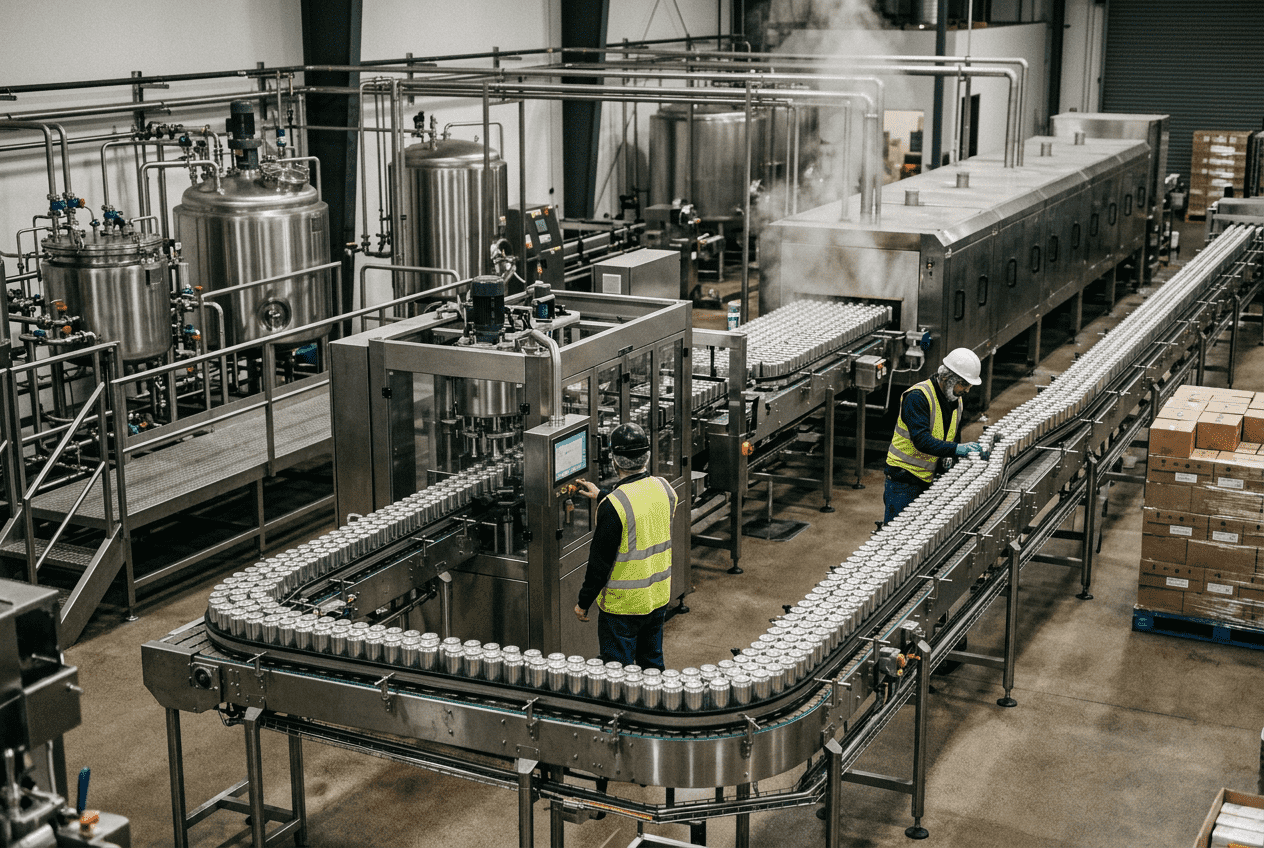
Helping Manufacturers Navigate Operational Complexity
Spirit-based RTD cocktails reached $3.8 billion in U.S. supplier revenue in 2025, growing 16.4% year-over-year while every other major spirits category declined. RTDs grew approximately 20% in volume during the same period, and spirit-based products have more than doubled their market share since 2021, gaining 11 percentage points while malt-based seltzers lost 14 points. The structural shift is clear: consumers are choosing real-spirit canned cocktails over flavored malt beverages, and that preference is pulling capital investment toward facilities capable of spirit-based batching, precision carbonation, and TTB-compliant production at scale.
But the production complexity behind a canned cocktail far exceeds what the format’s convenience suggests. Every spirit-based RTD requires a Distilled Spirits Plant permit, TTB formula approval, and a Certificate of Label Approval before a single can is filled. The facility itself must manage precise Brix and ABV targets across dozens of flavor variants, maintain dissolved oxygen levels below 50 ppb to prevent flavor degradation, run tunnel pasteurization calibrated to each product’s pH and sugar profile, and execute format changeovers — from 200 ml slim cans to 16 oz tallboys — without sacrificing line speed or fill accuracy. The brands capturing shelf space in 2026 are the ones whose production infrastructure was engineered for this complexity from the ground up, not retrofitted around it.
What We Deliver to Manufacturers
Practical engineering solutions designed to improve efficiency, scalability, and operational performance.
-
1
Multi-Base Batching & Blending Infrastructure
DPS engineers batching systems that handle spirit-based, malt-based, and wine-based RTD formulations on a single production platform — precision metering of base spirits, sweetener systems, citric acid, flavor concentrates, and carbonated water with real-time Brix and ABV verification at every stage. Our process design accounts for the ingredient-handling differences between a 5% ABV vodka soda and an 8% ABV tequila margarita with real juice, so your facility supports your full product portfolio from Day One without reconfiguration between product types. -
2
High-Speed Canning & Packaging Integration
Ready-to-drink manufacturing at competitive economics requires line speeds of 400+ cans per minute with minimal changeover downtime between can formats and SKUs. DPS designs packaging halls with filler-seamer integration, nitrogen dosing, date coding, multipacker feeds, and palletizing — all coordinated through a single controls architecture that manages format changeovers in under 15 minutes and provides complete batch traceability from batching tank through packed pallet. -
3
Pasteurization & Shelf-Stability Engineering
Canned cocktails containing natural juices, honey, or botanical ingredients are susceptible to secondary fermentation and microbial spoilage that destroy product quality in distribution. DPS engineers tunnel pasteurization systems calibrated to each product’s specific pH, sugar content, and alcohol level — delivering the pasteurization units (PUs) required for shelf stability without the heat damage that degrades delicate flavor compounds in premium RTD formulations. -
4
Dual-Jurisdiction Regulatory Compliance by Design
Spirit-based RTD production requires a TTB Distilled Spirits Plant permit, formula approval, and COLA — a regulatory pathway fundamentally different from malt-based products that may fall under FDA oversight. DPS engineers facilities with the process documentation, production controls, and premises configurations that satisfy both TTB and FDA requirements, including support for alternating premises arrangements where breweries add spirit-based RTD capability to existing operations. -
5
Utilities & CIP Scaled for RTD Production Demands
RTD beverage lines consume substantial volumes of process water, CO₂, glycol, and steam — and the CIP demands of flavor changeovers between products like a coconut rum punch and a dry gin spritz are significantly more intensive than single-product operations. DPS sizes utility infrastructure for peak simultaneous demand across batching, carbonation, pasteurization, and CIP, and manufactures CIP skids in-house — up to 12,000-gallon vessels — so cleaning cycles match your production schedule rather than constraining it.
Integrated Delivery vs Traditional Execution
The RTD category punishes disconnected project execution. When your process engineer specifies a batching system, your equipment supplier provides tanks to different tolerances, your controls integrator programs recipe management without understanding TTB documentation requirements, and your general contractor installs a packaging hall without coordinating utility drops to the filler — the result is a facility that cannot produce consistent product at target line speeds. DPS eliminates the gaps between engineering, equipment, controls, and construction that create these failures.
| Dimension | DPS Integrated Approach | Fragmented / Traditional Model |
|---|---|---|
| Batching & Recipe Control | Process engineering, tank specifications, metering hardware, and PLC recipe management co-designed by one team — ensuring Brix, ABV, and carbonation targets are hit consistently across every SKU from first production run | Process engineer writes a spec, separate equipment vendor supplies tanks, third-party integrator programs controls to secondhand documentation — recipe drift and batch inconsistency discovered during production trials |
| Regulatory Infrastructure | Facility layout, production controls, and documentation systems designed from the outset to satisfy TTB DSP permit requirements, formula approval workflows, and COLA traceability — including alternating premises configurations | Architect designs facility without TTB-specific knowledge; regulatory gaps identified during permit application, triggering costly redesign of premises boundaries, production flow, or record-keeping systems |
| Packaging Line Integration | Filler, seamer, nitrogen doser, pasteurizer, date coder, and palletizer designed as one integrated system with coordinated controls, unified HMI, and changeover sequences engineered for your specific can format matrix | Equipment purchased from multiple vendors with independent controls; integration gaps cause bottlenecks at filler-seamer handoff, inconsistent nitrogen dosing, and changeover times that exceed 45 minutes |
| CIP & Flavor Changeover | DPS-manufactured CIP systems with automated sequencing purpose-built for multi-flavor RTD production — verified rinse cycles that eliminate cross-contamination between product types without excessive water and chemical consumption | Generic CIP system designed for single-product brewing; flavor carryover between batches requires extended manual flushing, increasing water costs and reducing productive run time by 15–20% |
| Utility Capacity Planning | CO₂, glycol, steam, compressed air, and process water systems sized for peak simultaneous demand across batching, carbonation, pasteurization, and CIP — with Phase 2 capacity pre-engineered into Day One infrastructure | Utilities sized for current-state demand only; adding a second canning line or expanding batching capacity requires shutdown, utility infrastructure upgrades, and re-permitting |
| Timeline & Accountability | Single Design-Build-Manage contract from process engineering through commissioning — DPS owns the schedule, coordinates all trades through our vetted national contractor network, and delivers one integrated turnover | 5–7 separate contracts across engineer, equipment vendors, controls integrator, GC, and commissioning agent — schedule delays compound across trades, and no single party owns the outcome |