
Prepared Food Manufacturing Facilities Engineered for Scale, Safety, and Speed
DPS designs, builds, and manages complete prepared food manufacturing and food ingredients processing facilities — from sauce and dressing blending lines through ready meal production, retort systems, and high-volume co-packing operations — under a single Design-Build-Manage contract covering process engineering, equipment fabrication, installation, automation, and commissioning. Whether you are scaling a regional prepared foods brand into national distribution, building a new contract manufacturing kitchen, or upgrading an ingredients blending operation to meet SQF and FSMA Preventive Controls requirements, we deliver turnkey production infrastructure across all 50 U.S. states and Canada.
Schedule a Consultation →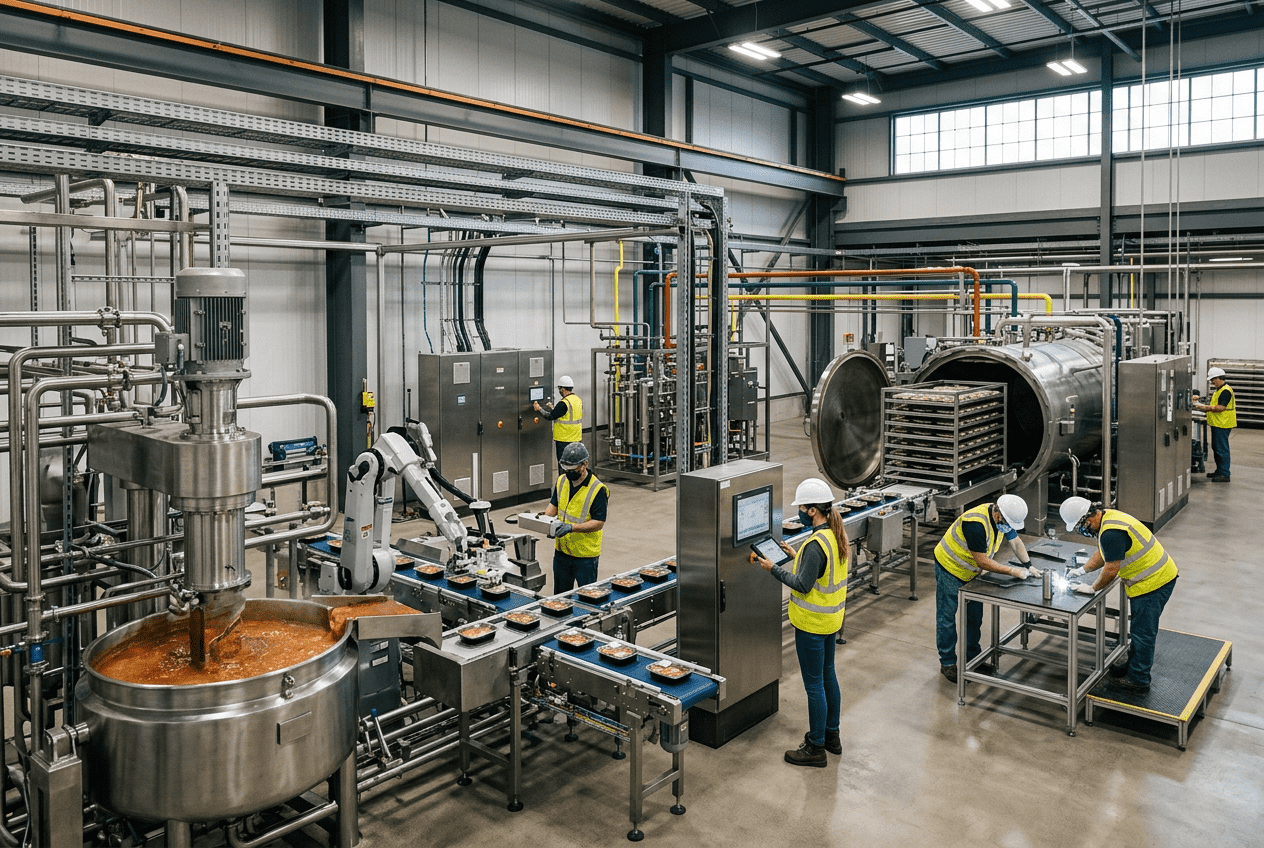
Helping Manufacturers Navigate Operational Complexity
The U.S. prepared food manufacturing sector sits at the intersection of the two most powerful forces reshaping the American food supply: the consumer demand for convenience and the regulatory mandate for safety. The U.S. processed food market is growing steadily from $204 billion in 2025, and the ready-to-eat meals segment alone amounts to nearly $60 billion in U.S. revenue, growing at 7.78% annually. But the operating environment for prepared food manufacturers has grown dramatically more complex. FSMA Preventive Controls for Human Food now requires every registered facility to maintain a written food safety plan with documented hazard analysis, risk-based preventive controls, and validated monitoring procedures — and FDA inspectors are actively enforcing compliance. Simultaneously, retailers and foodservice distributors are layering their own requirements on top of federal mandates: SQF Level 2 or 3 certification, BRC Global Standards, or proprietary supplier qualification audits that scrutinize everything from allergen management and foreign-material controls to process water treatment and environmental monitoring programs. For prepared food manufacturers and food ingredients processors, the cost of building a facility that passes these audits on the first attempt versus one that requires post-construction retrofits can represent a six-figure difference in project cost and a three-to-six-month delay in revenue generation.
What distinguishes high-performing prepared food facilities from those trapped in chronic compliance remediation is how the process architecture was engineered as an integrated system from the start. A ready meal production line where cooking kettles, cooling systems, portioning equipment, and packaging operate at mismatched throughput rates will create bottlenecks that cascade into hold-time violations, temperature excursions, and product waste. A sauce and dressing blending facility that sizes its CIP system for a single product but runs fifteen SKUs will spend more hours cleaning than producing. A food ingredients processing operation that doesn’t account for allergen segregation in its facility layout — separate airflow zones, dedicated ingredient staging, validated cleaning verification between product runs — will fail its first SQF allergen management audit and lose customer contracts before recouping its capital investment. DPS approaches every prepared food manufacturing project as a business-model problem first: analyzing your product portfolio, SKU complexity, throughput requirements, distribution temperature chain (ambient, refrigerated, or frozen), and regulatory exposure before drafting the first P&ID or sizing a single heat exchanger.
What We Deliver to Manufacturers
Practical engineering solutions designed to improve efficiency, scalability, and operational performance.
-
1
Complete Prepared Food Facility Process Design
DPS engineers full-facility process flows for prepared food manufacturing operations — from raw ingredient receiving and batching through cooking, cooling, portioning, packaging, and palletizing — with every processing zone designed to meet FDA 21 CFR 117 Preventive Controls requirements, your specific throughput targets, and the temperature-chain requirements of your distribution model (ambient, refrigerated, or frozen). We produce custom P&IDs, facility layouts with proper allergen zone segregation, and structural/mechanical/electrical load calculations that align every building system before construction begins. -
2
Sauce, Dressing & Ingredients Blending Systems
For food ingredients processors and sauce manufacturers, DPS designs batching and blending systems spanning ingredient handling, high-shear mixing, scraped-surface heat exchangers, cooking kettles, and filling lines — with process parameters engineered for the viscosity range, particulate size, and thermal sensitivity of your specific product formulations. We size vessels, agitators, pumps, and heat exchangers to handle your most demanding product (not your simplest), ensuring the system processes everything from a thin vinaigrette to a heavy cheese sauce without changeover compromises. -
3
Thermal Processing & Retort Integration
Prepared foods requiring shelf stability — soups, stews, meal components, and sauces in cans, pouches, or trays — demand thermal processing systems validated to FDA-required scheduled processes. DPS designs and integrates retort systems with upstream cooking, filling, and seaming operations as a coordinated process architecture, and coordinates directly with process authorities to validate time-temperature-pressure parameters for each product-package combination before commercial production begins. -
4
Automation, Recipe Management & Batch Traceability
DPS programs PLC/SCADA systems that unify recipe management, batch control, CIP sequencing, cook-time/temperature logging, and ingredient lot tracking across your entire prepared food operation — from raw material receiving through finished-goods labeling. Our controls architecture delivers automated batch records and full lot traceability that SQF, BRC, and FSMA Preventive Controls auditors require, while enabling rapid same-line changeover between product SKUs without manual re-configuration of process parameters. -
5
In-House Equipment Manufacturing & CIP Systems
DPS fabricates process vessels up to 12,000 gallons, CIP skids, batch kettles, mixing tanks, and marination tumblers at our own manufacturing facilities — eliminating the multi-vendor coordination failures that delay prepared food projects when tanks, piping, and controls arrive from vendors who never validated against each other. Every DPS-manufactured vessel is built to 3-A Sanitary Standards and integrates directly into the process architecture we design, ensuring seamless connection to your cooking, blending, and cleaning systems.
Integrated Delivery vs Traditional Execution
When prepared food manufacturing projects are divided across a standalone process consultant, separate equipment OEMs for cooking, mixing, cooling, and packaging lines, an independent controls integrator, and a general contractor with no food-grade facility experience, accountability fractures at every interface. The resulting facility suffers from mismatched throughput between processing stages, undersized utilities, allergen control gaps, and compliance documentation that doesn’t survive its first third-party SQF or BRC audit.
| Dimension | DPS Integrated Approach | Fragmented / Traditional Model |
|---|---|---|
| Process Flow & Throughput Balancing | Every processing stage — batching, cooking, cooling, portioning, packaging — engineered as a balanced system with matched capacities, buffer sizing, and hold-time validation to eliminate bottlenecks and temperature-abuse risk | Equipment purchased stage-by-stage from different OEMs; throughput mismatches surface after installation when the filler outruns the cooker or the portioner creates a 45-minute hold-time gap that violates the food safety plan |
| Allergen Management & Zone Segregation | Facility layout engineered with allergen zone separation — dedicated airflow design, physical barriers, segregated ingredient staging, and validated CIP protocols between allergen and non-allergen product runs — embedded into the engineering design before construction | Allergen zones addressed reactively post-build; HVAC cross-contamination paths, shared conveyors, and inadequate cleaning validation discovered during first SQF allergen management audit, requiring costly facility retrofits |
| FDA FSMA & Third-Party Audit Readiness | Preventive controls, CCP instrumentation, environmental monitoring points, and HARPC documentation architecture embedded into the process engineering scope from Day One — aligned with 21 CFR 117 and your target third-party standard (SQF, BRC) before construction begins | Food safety plan written post-construction by a consultant who wasn’t involved in facility design; monitoring points don’t align with actual process flow, requiring sensor relocation, piping modifications, and re-validation |
| CIP & Sanitation Design | DPS-manufactured CIP skids with automated multi-circuit sequencing designed for your specific product portfolio — separate circuits for allergen vs. non-allergen lines, validated chemical concentrations, and time-temperature documentation for every sanitation cycle | Generic single-circuit CIP designed for the initial product; adding SKUs with different allergen profiles, viscosities, or soil loads requires CIP re-engineering, additional circuits, and re-validation of cleaning effectiveness |
| Utility Infrastructure | Steam, hot/chilled water, compressed air, refrigeration, and process water systems sized for simultaneous peak demand across cooking, cooling, CIP, and HVAC — with Phase 2 expansion capacity pre-engineered into Day One infrastructure | Utilities sized for single-shift, single-product operation; adding a second line, running CIP during production, or increasing refrigeration demand for a frozen product extension triggers boiler, chiller, or compressor upgrades and mechanical shutdowns |
| Schedule & Single-Point Accountability | Single Design-Build-Manage contract from feasibility through commissioning and audit preparation; DPS owns the schedule, coordinates all trades through a vetted national contractor network, and is accountable for the integrated outcome | 5-7 separate contracts across process engineer, equipment OEMs, controls integrator, mechanical contractor, and GC — schedule slips compound across vendors, with no single party accountable when the facility fails its pre-operational SQF audit |

