Protein Processing Facility Engineering for Beef, Poultry & Plant-Based
Every protein facility is a food safety system first and a production asset second. DPS engineers, builds, and manages meat processing facilities, poultry plants, and plant-based protein lines that satisfy USDA-FSIS and FDA requirements by design — not by retrofit. From greenfield beef processing builds to plant-based extrusion line integration, we deliver projects where compliance, throughput, and capital efficiency are engineered into the same set of drawings.
Schedule a Consultation →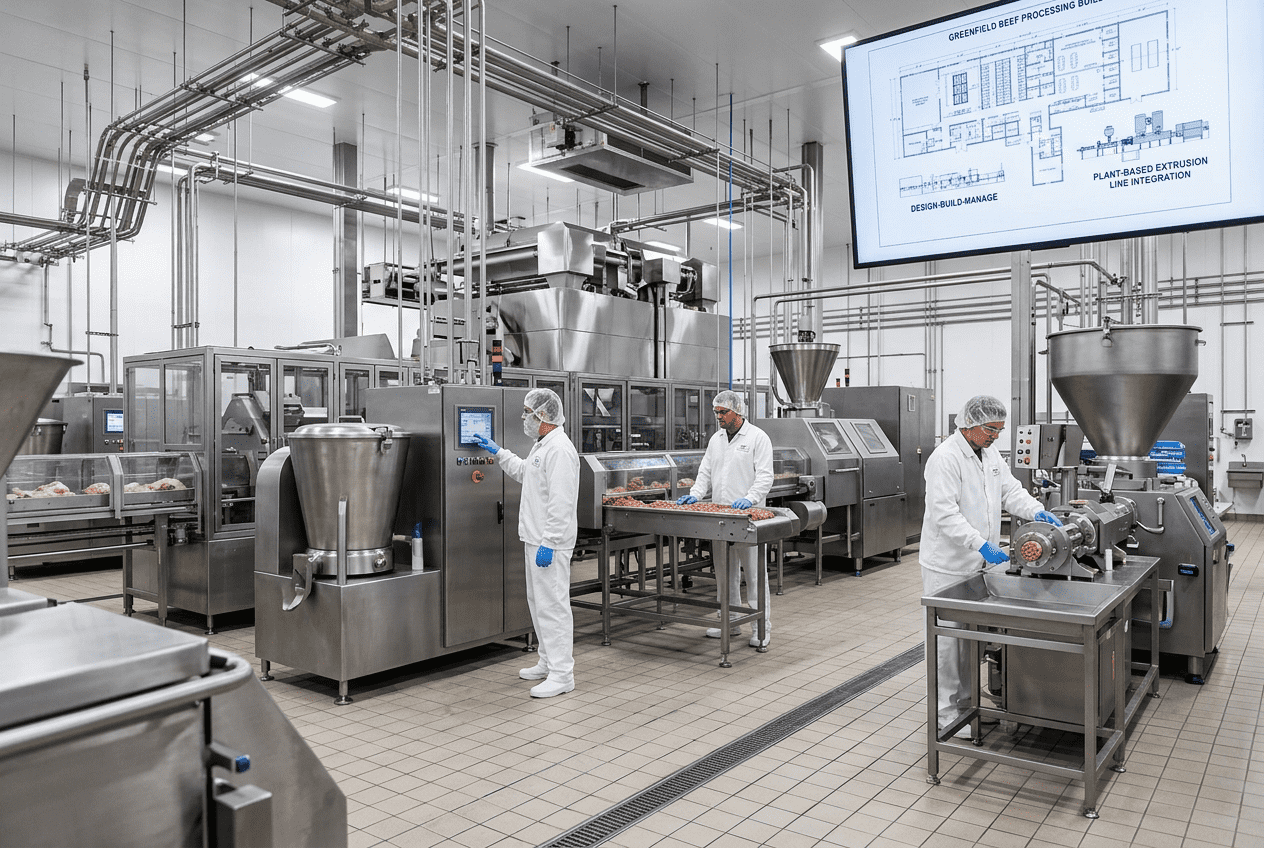
Helping Manufacturers Navigate Operational Complexity
The U.S. protein processing sector is a $346 billion industry that produces more than 100 billion pounds of beef, pork, poultry, and turkey products annually across roughly 1,200 federally inspected facilities. But the numbers mask a structural tension: consumer demand for protein-rich foods continues to climb — global meat consumption is projected to rise 14% by 2030 — while the operational capacity to meet that demand is under pressure from every direction. Chronic labor shortages now rank as the single largest operational challenge for 62% of processors. Aging infrastructure at mid-market plants cannot accommodate modern automation or the sanitary design requirements of current USDA-FSIS and SQF standards. Meanwhile, the USDA has invested over $1.4 billion in processing expansion grants through programs like MPPEP, signaling federal recognition that the supply chain needs more — and better — facilities.
What separates a profitable protein processing facility from one that stalls at capacity is the degree to which process, utilities, and controls were designed as a unified system. A beef processing line where refrigeration, HVAC zoning, wastewater pre-treatment, and CIP coverage were engineered together from the start will consistently outperform a facility that was stitched together by separate contractors across separate timelines. The same applies to the emerging plant-based protein segment — now a $20+ billion global market — where extrusion, high-shear mixing, and thermal processing demand the same rigorous process engineering as conventional animal protein, but with entirely different sanitary and allergen control considerations. Whether the project is a poultry plant retrofit, a new beef processing facility, or a plant-based protein line buildout, the engineering discipline is identical: every P&ID, every utility calculation, and every control sequence must serve the process.
What We Deliver to Manufacturers
Practical engineering solutions designed to improve efficiency, scalability, and operational performance.
-
1
Process Engineering for Multi-Protein Facilities
DPS designs complete process flows for beef, pork, poultry, seafood, and plant-based protein operations — from receiving and primary breakdown through cooking, smoking, forming, and packaging. Every facility layout begins with product flow analysis and USDA zone separation requirements, with custom P&IDs, load calculations, and sanitary piping specs that eliminate cross-contamination risk before construction begins. -
2
Utility Infrastructure Sized for Full Build-Out
Protein processing is utility-intensive: refrigeration, steam, compressed air, hot and chilled water, wastewater pre-treatment, and HVAC all run simultaneously at peak demand. DPS engineers these systems as an integrated utility plant — not as afterthoughts bid out to the lowest-cost mechanical contractor. We calculate thermal loads, refrigeration tonnage, and wastewater BOD projections against your full production forecast so Phase 2 expansion connects to headers that are already waiting. -
3
Automation, Controls & Production Intelligence
Our in-house controls team programs PLC and SCADA systems for protein processing environments — batch cook cycle management, smoker temperature profiling, CIP sequence automation, recipe-driven marination and tumbling controls, and real-time OEE dashboards. When less than half of protein plant floors are automated, targeted controls upgrades frequently deliver more throughput gains per dollar than new equipment. DPS has resolved multi-million-dollar capacity constraints with a single PLC logic adjustment at no charge. -
4
Equipment Manufacturing & System Integration
DPS manufactures tanks and vessels up to 12,000 gallons, CIP systems, tumblers, and kettles — purpose-built for the project, not pulled from a catalog. Our in-house fabrication means equipment arrives dimensioned to your floor plan, pre-piped for your utility connections, and warranted under the same contract as the installation. This eliminates the finger-pointing that plagues projects where equipment vendor, installer, and controls integrator are three separate companies. -
5
Capital Planning & USDA Compliance by Design
Before steel is cut, DPS builds your business case: ROI-backed feasibility studies, phased capital plans, and owner’s representative services that align every dollar of spend with a revenue or compliance outcome. We design to USDA-FSIS, FDA, SQF, and BRC standards from day one — zone separation, sanitary construction materials, slope-to-drain specifications, and full documentation packages — so your facility passes inspection and audit without remediation.
Integrated Delivery vs Traditional Execution
Protein processing projects are among the most compliance-intensive capital investments in the food industry. When process design, mechanical engineering, equipment fabrication, controls programming, and general contracting are split across five or more firms, the owner absorbs every coordination gap — and pays for it in change orders, schedule delays, and audit findings. DPS consolidates that entire scope under one Design-Build-Manage contract.
| Dimension | DPS Integrated Approach | Fragmented / Traditional |
|---|---|---|
| Project Delivery Model | Single-source Design-Build-Manage — process engineering, equipment fabrication, utility infrastructure, controls, and general contracting under one contract and one accountable team | 5–8 separate vendors with independent scopes and schedules; owner manages all interfaces, resolves conflicts, and absorbs coordination risk |
| USDA & FDA Compliance | Zone separation, sanitary material specs, slope-to-drain, CIP coverage, and FSIS documentation embedded in design from P&ID through as-built drawings; facility is audit-ready at commissioning | Compliance requirements interpreted independently by each contractor; documentation gaps and design inconsistencies surface during pre-operational inspections |
| Process Engineering | In-house process engineers model product flow, thermal loads, refrigeration demand, and CIP turnover against your actual production mix and SKU forecast — beef, poultry, plant-based, or multi-protein | Equipment vendor supplies standard-catalog machinery; facility designer adapts layout around whatever arrives, often discovering utility or space conflicts during installation |
| Equipment Integration | DPS-manufactured tanks, CIP skids, tumblers, and kettles (up to 12,000 gal) built to project specs, pre-piped for site utility connections, and warranted under the same contract as installation | Third-party equipment ships to site with generic connection specs; installing contractor field-adapts fittings, and warranty disputes arise between vendor and installer |
| Automation & Controls | Purpose-built PLC/SCADA programming by the same team that designed the process — cook cycle management, recipe control, batch logging, energy monitoring, and SQF/BRC audit trail data | Separate controls integrator programs to a spec written by another firm; commissioning becomes weeks of troubleshooting mismatched logic and communication protocols |
| Capital & Budget Integrity | ROI analysis and phased expansion roadmaps before design starts; DPS declines projects that do not pencil financially for the client; one contract means one budget with no inter-vendor change orders | Scope creep across multiple contracts; no single party accountable for total project cost or for whether the finished facility meets its production and financial targets |
| National Coverage | Licensed GC capability with vetted contractor network across all 50 states and Canada; offices in Cary, NC and Lake Forest, CA; consistent execution standards regardless of project location | Regional contractors require separate sourcing for multi-site or cross-state programs; quality and compliance standards vary by geography |