
Project & Program Management for Food and Beverage Facilities
Capital projects in food and beverage manufacturing fail at the coordination layer — where engineering, procurement, construction trades, and regulatory timelines collide without a single point of command. DPS delivers end-to-end project management and multi-phase program management built on six in-house engineering disciplines and direct construction experience across every major food processing category. We manage your capital investment from feasibility through commissioning so your facility produces on schedule, on budget, and at full compliance.
Schedule A Consultation →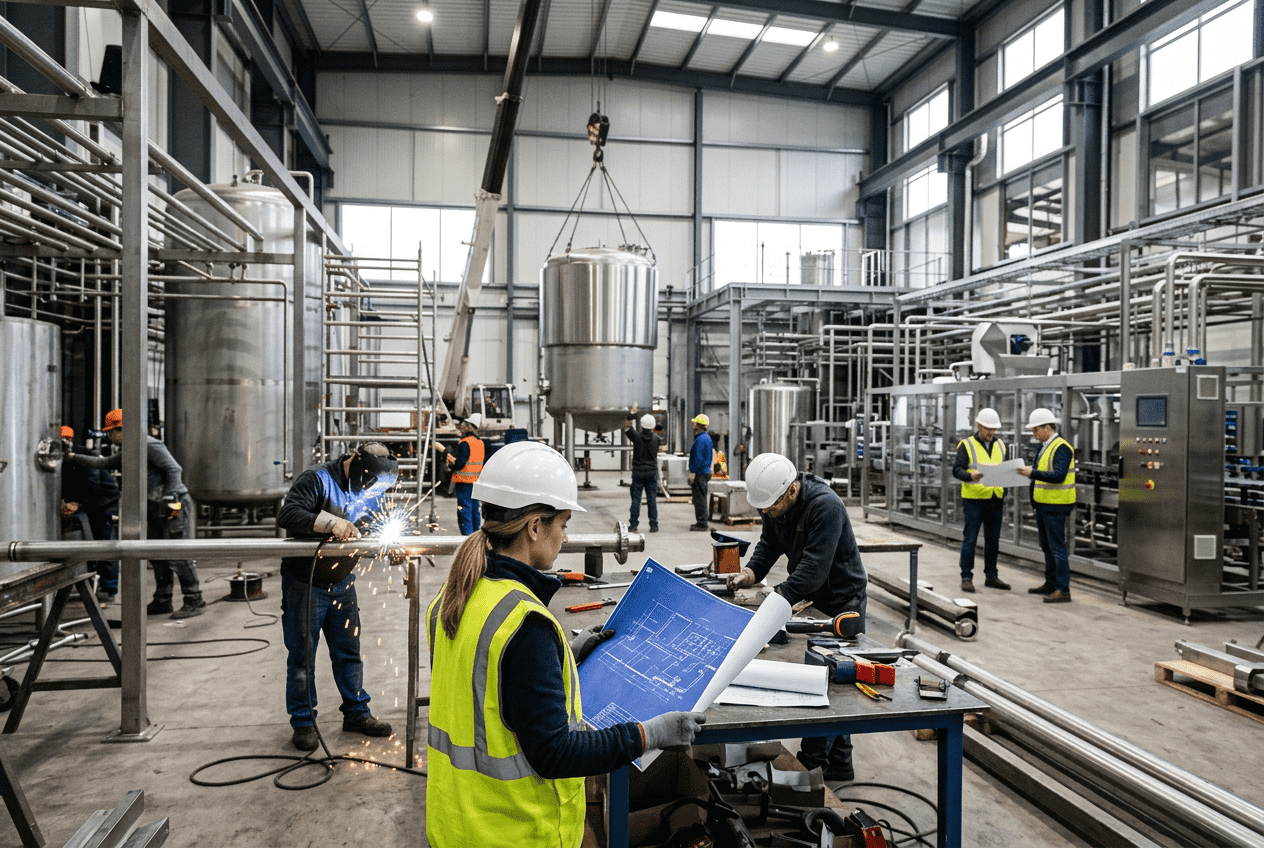
Challenges in Providing This Service in the Market
Most food and beverage manufacturers are experts at making product — not at managing the construction of the facilities that make it. A $2M processing line expansion involves mechanical contractors, electrical subcontractors, process piping crews, refrigeration specialists, controls integrators, concrete and structural trades, equipment vendors with staggered lead times, and a regulatory framework that demands FDA-compliant sanitary design at every junction. The typical mid-market manufacturer with $20M to $100M in revenue does not have an internal capital projects team capable of orchestrating that complexity, and the cost of learning on a live project is measured in six- and seven-figure overruns.
-
Challenge 01
Schedule fragmentation across trades
Food facility construction requires precise sequencing of ten or more specialty trades. When a refrigeration contractor runs three weeks late, the cascading impact on insulation, electrical termination, controls integration, and commissioning can push the entire project timeline by two months. Without a construction management team that understands interdependencies at the process engineering level, these delays compound silently until they become irreversible. -
Challenge 02
Budget erosion through unmanaged change orders
In food-grade construction, change orders are not anomalies — they are the primary mechanism through which projects exceed budget. Every field conflict between utility routing and process piping, every specification gap between the design engineer and the installing contractor, and every late-discovered regulatory requirement generates cost. The question is whether those changes are managed proactively at $5,000 each or reactively at $50,000 each. -
Challenge 03
Disconnection between design intent and field execution
P&IDs and facility layouts define what the plant should be. Field conditions, trade capabilities, and equipment as-shipped dimensions define what the plant becomes. Bridging that gap requires a project management team with the engineering depth to make real-time decisions in the field without cycling back through weeks of design revision. -
Challenge 04
Compliance gaps surfacing during commissioning
USDA grant-of-inspection requirements, FDA current Good Manufacturing Practice standards, SQF facility criteria, and state-level health department codes each carry design implications that must be embedded during construction — not patched during startup. Projects managed by general contractors without food-industry regulatory fluency routinely deliver facilities that pass building inspection but fail food safety audit.
Building Scalable and Efficient Production Systems
DPS approaches project management and program management as engineering functions, not administrative ones. Every project we manage is led by professionals who hold direct expertise in process engineering, mechanical systems, electrical design, and controls integration — because the decisions that determine whether a food facility project succeeds or fails are technical decisions made under time pressure in the field. Our project managers do not simply track Gantt charts and distribute meeting minutes. They evaluate contractor submittals against your process design, resolve field conflicts with engineering authority, and make scope decisions that protect both your budget and your production outcome.
This capability is native to the DPS Design-Build-Manage model. Because we engineer, fabricate, install, and commission food and beverage processing systems ourselves, our project management methodology is built on firsthand knowledge of what each phase actually requires — how long sanitary stainless welding takes at scale, what realistic lead times look like for custom vessels up to 12,000 gallons from our own manufacturing operation, where CIP system tie-ins create coordination bottlenecks, and which automation milestones must be sequenced before process commissioning can begin. That construction intelligence is embedded in every schedule we build and every budget we manage.
For multi-phase capital programs — phased expansions, multi-site rollouts, or long-horizon capacity roadmaps — DPS provides program management that maintains strategic alignment across individual projects. We establish standardized specifications, procurement frameworks, and lessons-learned protocols that reduce cost and compress timelines on each successive phase. Our team of approximately ten in-house experts is supported by a vetted national contractor network that provides trade execution capacity across all 50 states and Canada, giving clients the responsiveness of a focused team with the reach of a national firm.
Capabilities Supporting Modern Production Operations
Integrated engineering, operational, and project capabilities designed to support efficient, scalable, and reliable production environments.
-
PLC Programming & Logic Development
Custom ladder logic, structured text, and function block programs developed on Allen-Bradley, Siemens, and other major platforms for process control, safety interlocks, and high-speed sequencing across food and beverage unit operations. -
SCADA System Design & Deployment
Full supervisory control and data acquisition architecture including server configuration, real-time process visualization, historical trending, and role-based access designed for multi-line F&B production environments. -
Recipe Management & Batch Control
ISA-88-aligned recipe structures that allow production teams to manage formulations, ingredient scaling, and batch sequencing directly from the HMI — reducing changeover time and eliminating manual transcription errors. -
CIP/SIP Automation & Validation
Automated clean-in-place and sterilize-in-place sequences with full parametric data logging for FDA and USDA compliance, integrated with process scheduling to minimize non-productive time between production runs. -
Energy & Utility Management Systems
Real-time monitoring and automated control of boiler, compressed air, glycol, refrigeration, and HVAC systems to reduce per-unit energy cost while maintaining critical environmental parameters in temperature-sensitive processing areas. -
Controls Integration & Retrofits
Integration of new automation layers into existing brownfield facilities — migrating legacy relay logic or outdated DCS platforms to modern PLC/SCADA infrastructure without extended production shutdowns.
Engineering Scope & Deliverables
The table below outlines the management dimensions, execution methods, and deliverables DPS provides across the lifecycle of a food or beverage facility capital project.
| Management Dimension | DPS Execution Method | Owner Deliverables |
|---|---|---|
| Scope Definition | Collaborative scope workshops with owner operations, engineering, and finance stakeholders; gap analysis against production capacity targets | Scope of Work document, basis-of-design narrative, project charter with success criteria |
| Schedule Control | CPM scheduling with trade-level detail, weekly look-ahead updates, pull planning sessions with all contractors, milestone gating | Master project schedule, weekly status reports, schedule variance analysis with recovery plans |
| Budget Management | Line-item cost tracking, committed cost vs. forecast reporting, change order log with approval workflow, contingency drawdown monitoring | Monthly cost reports, change order impact summaries, final cost reconciliation at closeout |
| Procurement | Equipment specification development, vendor bid evaluation, purchase order management, expediting, factory acceptance test coordination | Procurement log, vendor evaluation matrices, delivery and lead-time tracker |
| Quality Assurance | Installation inspection protocols, sanitary weld inspection, material traceability verification, third-party testing coordination | Quality inspection reports, non-conformance logs, corrective action tracking |
| Safety Management | Site-specific safety plans, daily safety briefings, OSHA compliance monitoring, incident tracking and root cause analysis | Safety plan document, weekly safety metrics, incident reports |
| Risk Management | Project risk register with probability and impact scoring, bi-weekly risk review meetings, mitigation plan development and tracking | Risk register, mitigation action log, escalation protocols |
| Closeout & Turnover | Punch list management, as-built document collection, warranty registration, O&M manual compilation, lessons-learned workshop | As-built drawing package, warranty tracker, O&M documentation, lessons-learned report |
Common Questions About Automation & Controls Service
Quick answers to the questions we hear most often from prospective clients evaluating automation partners.

