Tanks & Vessels
DPS manufactures processing tanks, fermentation tanks, and storage vessels up to 12,000 gallons — designed, fabricated, and integrated by the same engineering team that builds your entire process system. When your tank supplier is also your process engineer, piping contractor, and controls integrator, nothing falls between scopes.
Discuss Your Equipment Requirements →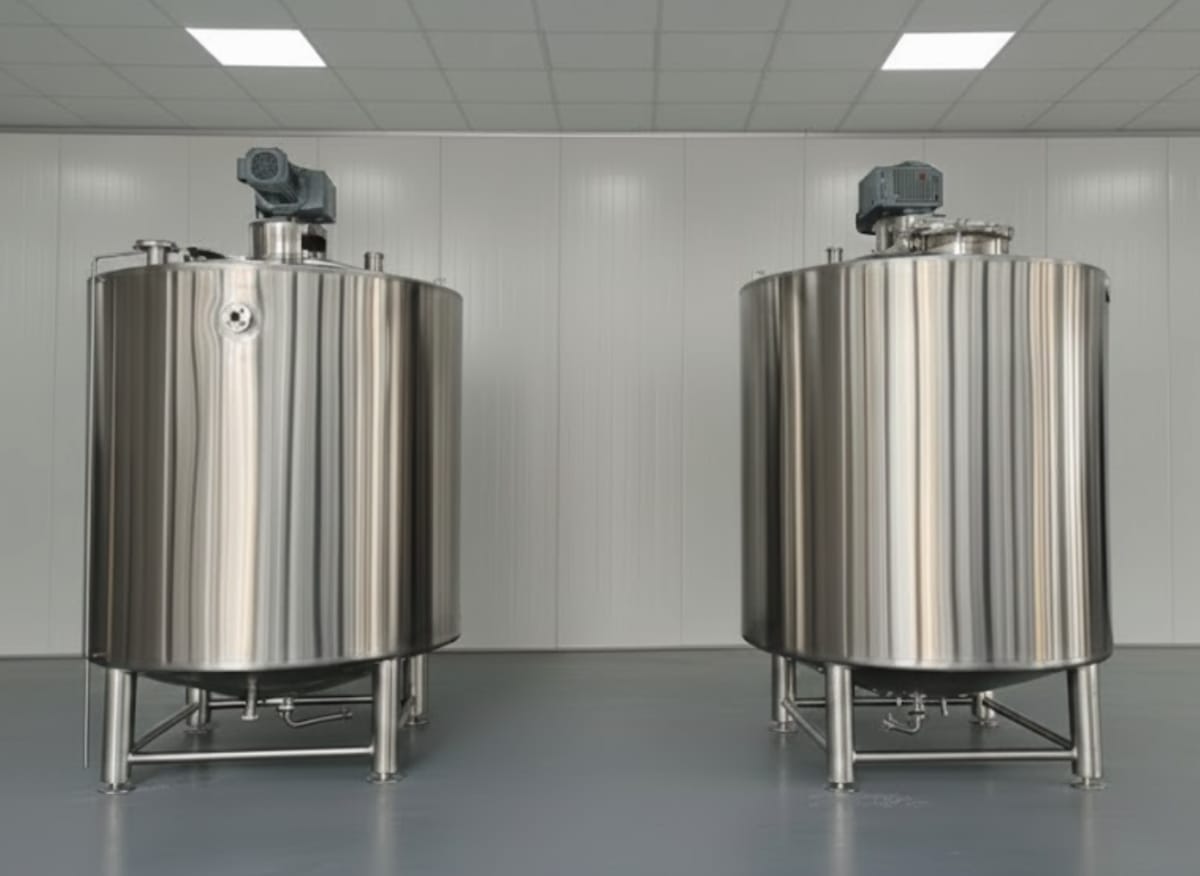
Process-Grade Tanks Built for the Line, Not the Catalog
Every food and beverage processing facility depends on vessels that hold, heat, cool, ferment, blend, or store product under exacting conditions. DPS manufactures a full range of custom stainless steel tanks and vessels — from 50-gallon batching tanks to 12,000-gallon fermentation and storage vessels — using 304 and 316L stainless steel built to ASME and 3-A Sanitary Standards. Unlike commodity tank suppliers, DPS engineers every vessel around your specific process parameters: flow rates, temperature profiles, CIP circuit compatibility, spatial constraints, and upstream/downstream equipment interfaces. The result is a tank that arrives ready to integrate — not a tank that forces your piping crew to improvise.
In-house manufacturing is central to the DPS Design-Build-Manage model. When the same engineering team that designs your process flow also specifies and fabricates the vessels within that flow, tolerance stackups shrink, lead times compress, and commissioning risk drops. This single-source approach means your fermentation tanks, bright tanks, mixing vessels, and holding tanks share consistent weld quality, surface finish standards, and documentation — all traceable to one accountable partner. For operations managers and plant engineers running FDA- and USDA-regulated facilities across the United States, that traceability is not a convenience. It is a compliance requirement.
Equipment Applications Across Food and Beverage Manufacturing
Practical engineering solutions designed to improve efficiency, scalability, and operational performance.
-
1
Sauces, Marinades & Dressings
Cooking kettles are the production backbone for tomato-based sauces, vinaigrettes, hot sauces, cheese sauces, and shelf-stable marinades. DPS specifies jacket capacity, agitator geometry, and steam flow rates to hit precise cook temperatures and hold times required by each product’s scheduled process, while high-shear agitation options ensure emulsion stability and particle-size consistency across batches ranging from pilot scale to full production volumes. -
2
Soups, Stews & Prepared Foods
Chunked-ingredient products such as soups and stews demand gentle agitation that maintains piece integrity while preventing scorching on the heat-transfer surface. DPS kettles for prepared foods applications incorporate slow-speed sweep agitators with PTFE scraper blades, zoned jacket heating to prevent localized hot spots, and large-diameter bottom outlets that discharge whole vegetable and protein pieces without damage. -
3
Dairy Processing
From pasteurized fluid milk bases and cultured products to cheese sauce, yogurt premixes, and ice cream bases, dairy applications require kettle specifications that satisfy both thermal performance and 3-A Sanitary Standards. DPS builds dairy kettles with electropolished product-contact surfaces, sanitary agitator shaft seals, CIP-ready nozzle configurations, and temperature instrumentation validated for HACCP critical control point monitoring. -
4
Confectionery & Sweetened Products
Sugar syrups, caramel, toffee, and fruit fillings require precise temperature ramping to achieve target Brix concentrations without scorching or crystallization. DPS configures cooking kettles for confectionery with high-pressure jacket ratings for rapid heat delivery, programmable multi-stage cook profiles, and scrape-surface agitation that keeps viscous product moving continuously across the heated wall. -
5
Co-Packing & Contract Manufacturing
Contract manufacturers running dozens of SKUs across multiple product categories need cooking kettles that change over rapidly and document every batch electronically for multi-standard audit compliance. DPS builds multi-recipe automation into the kettle’s PLC and SCADA architecture, enabling push-button recipe selection, automatic CIP sequencing between product changeovers, and electronic batch records that satisfy SQF, BRC, and retailer-specific food safety audit requirements simultaneously.
System Specifications and Design Parameters
All DPS tanks and vessels are fabricated to order against project-specific engineering documentation. The following parameters define our standard manufacturing envelope.
| Parameter | Specification |
|---|---|
| Capacity Range | 50 gallons to 12,000 gallons; custom sizes engineered to facility footprint and batch volume requirements |
| Material of Construction | 304 and 316L stainless steel standard; specialty alloys available on request for high-acidity, high-salinity, or pharmaceutical-adjacent applications |
| Surface Finish | Interior finish to ≤ 32 Ra (microinch) standard for sanitary food-contact applications; electropolish to ≤ 20 Ra available for dairy, aseptic, and cleanroom environments |
| Construction & Welding Standards | ASME-code fabrication available; all sanitary welds per AWS D18.1; 3-A Sanitary Standards compliant designs; borescope weld inspection documentation provided |
| Jacket & Insulation Options | Dimple jackets, half-pipe coils, and full conventional jackets for heating/cooling; polyurethane foam or mineral wool insulation with stainless cladding |
| Vessel Types | Fermentation tanks, brite tanks, storage vessels, mixing/blending tanks, CIP solution tanks, batch processing tanks, hot/cold liquor tanks, ingredient holding vessels, and tumblers/marination vessels |
| Nozzle & Port Configuration | All nozzle locations, sizes (Tri-Clamp standard), and orientations custom-specified per process P&ID; provisions for temperature probes, pressure transmitters, level sensors, sample valves, and CIP spray devices included |
| Agitation & Mixing | Top-mount, side-mount, or bottom-entry agitator mounting pads and drive provisions engineered to process viscosity and shear requirements; variable-speed drive integration supported |
| Regulatory Compliance | Designed and documented for FDA 21 CFR Part 117, USDA-FSIS, SQF, BRC, and 3-A Sanitary Standards; full material traceability and weld documentation packages included |
| Integration & Controls Readiness | All vessels delivered with instrumentation provisions mapped to DPS control system architecture; PLC/SCADA-ready wiring provisions and I/O tagging coordinated with automation scope |
| Delivery Coverage | All 50 U.S. states and Canada; domestic fabrication with project-coordinated delivery scheduling to align with installation timeline |