Chilled Assembled Meals
Map each component’s qualified process, ready time, permitted hold, assembly and package / cold-chain route. A fast sauce room may still wait on protein, starch or trays.
Coordinate component preparation, cooking / cooling, portioning, assembly, package and qualified release around the actual meal format.
Discuss Your Project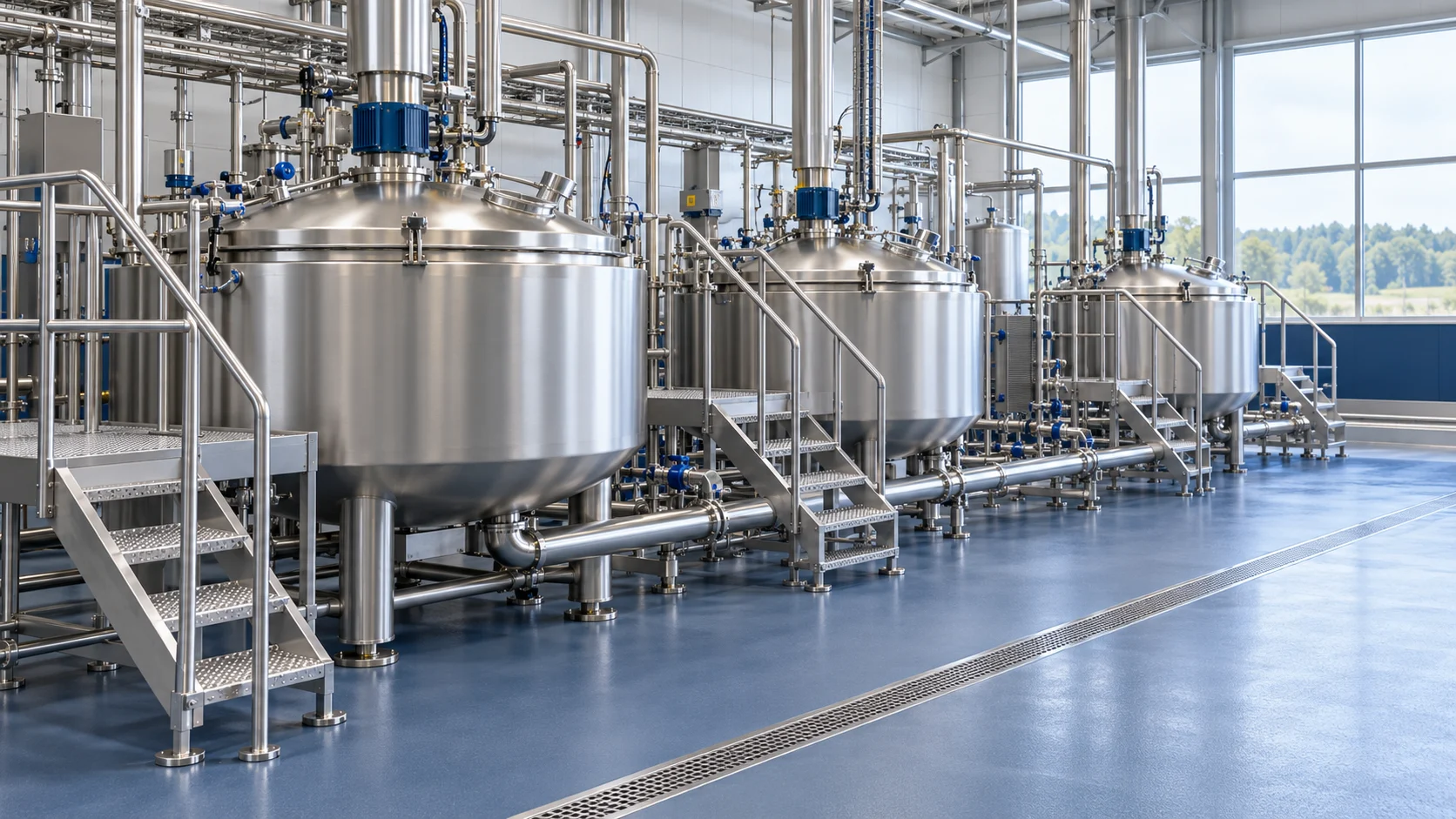
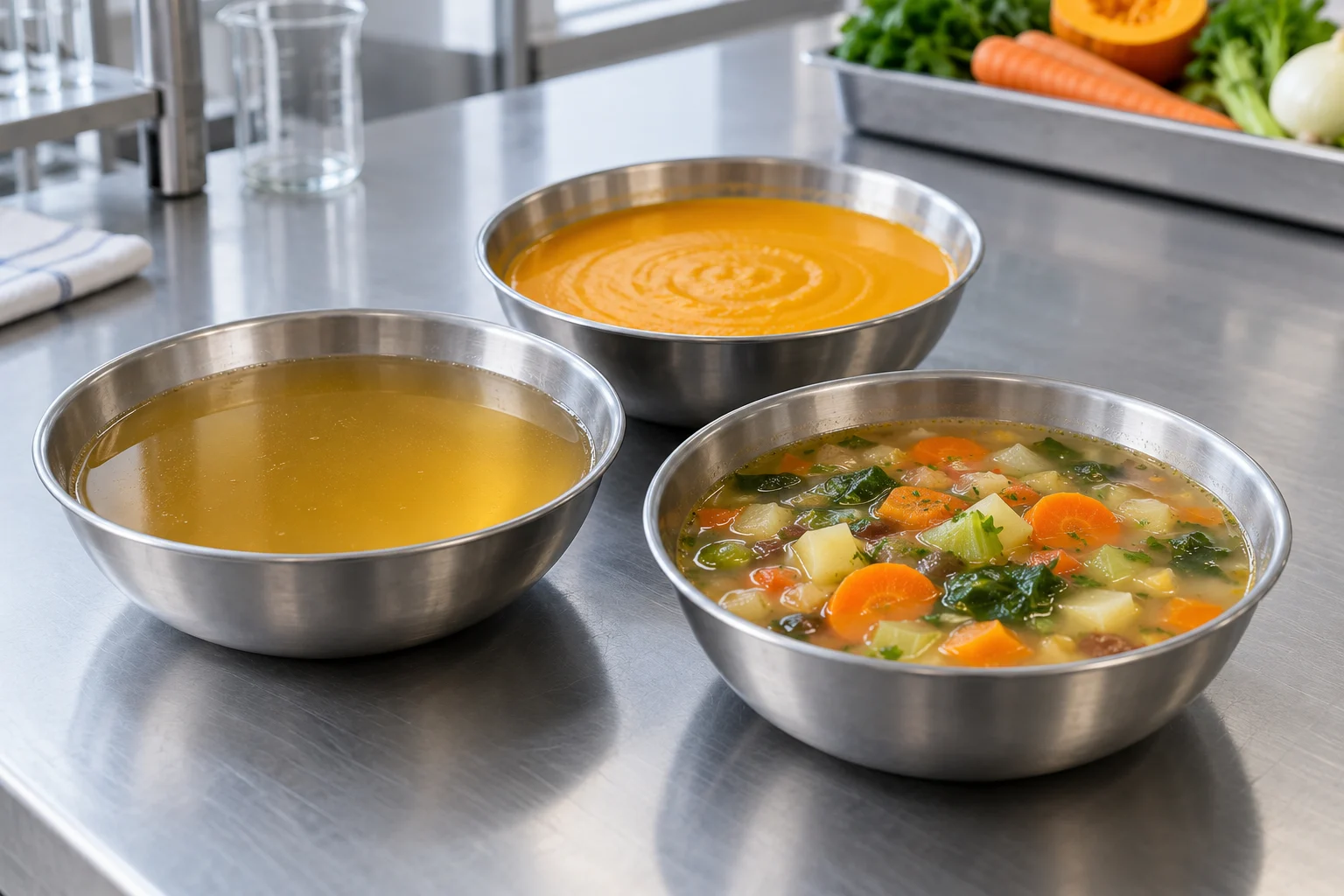
Map each component’s qualified process, ready time, permitted hold, assembly and package / cold-chain route. A fast sauce room may still wait on protein, starch or trays.
Freezing, packaging, component condition and cold storage become separate specialist duties. Define accepted quality after the actual process and handling train.
Have qualified specialists establish the actual product / particle / package preservation route. Do not infer shelf stability from the term ready-to-eat or a cooker outlet condition.
Synchronize component preparation and accepted release rather than adding each machine’s maximum rates.
Agree qualified routes and process conditions with product and package specialists.
Map ingredient identities, raw / cooked interfaces, cleaning and product / people flow.
Review each system by its operating duty and the interfaces to be agreed before procurement.
Agreed sauce / liquid component cooking duty.
Process heat, cold and shared services.
Component / assembly and recipe-state coordination.
Specialist portioning, preservation and packaging.
Swipe horizontally to compare all columns ↔
| System | Operating duty | Relevant DPS guide | Confirm before purchase |
|---|---|---|---|
| Configured cookers | Agreed sauce / liquid component cooking duty. | DPS kettles & cookers ↗ | Product, thermal / cooling and discharge requirements. |
| Process utilities and distribution | Process heat, cold and shared services. | Utility infrastructure planning ↗ | Qualified package / process peak and recovery. |
| Recipe / sequence controls | Component / assembly and recipe-state coordination. | Automation & controls ↗ | Identity, holds and exception handling. |
| Specialist equipment interfaces | Specialist portioning, preservation and packaging. | Installation & integration ↗ | Final-meal / package trials and qualified acceptance. |
Write a complete-meal design basis with component ready times, permitted holds, portion / package quality and qualified release. A component cooker quotation cannot be compared directly with a full assembly and preservation line. Define shared utilities and commissioning tests across suppliers before capital selection.
Swipe horizontally to compare all columns ↔
| Buying question | Evidence to prepare | Engineering decision |
|---|---|---|
| Which step sets final output? | Component-ready, assembly, preservation and package logs. | Locate the actual complete-meal constraint. |
| Can more buffer solve the gap? | Qualified product holds and hygienic / cold requirements. | Approve practical holding before adding storage. |
| What does accepted output mean? | Final good meal / package mass and quality. | Use consistent contribution and unit conversion. |
Start with the business outcome
Ready-meal plants are often constrained by component synchronizing, product-approved waiting, cooling, assembly or packaging rather than one cooker’s rate. DPS can coordinate agreed process equipment, utilities, controls, installation and project interfaces around specialist packages. The investment case should use complete accepted meal output and real paid costs while the qualified product / site team defines preservation, raw / cooked flow and release.
RTE is a product / use and qualified acceptance question, not a generic equipment guarantee. Thermal / cooling, portioning, assembly, freezing / HPP / retort or aseptic and packaging specialist technologies require explicit OEM scope. No validated cooking / cooling schedule or universal compliance declaration is supplied.
Agree every component’s preparation, qualified holds, assembly, preservation, package and cold-chain responsibilities for the actual meal.
Check matched component ready times, portioning, transfer and specialist cooking, cooling or freezing interfaces.
Confirm accepted portion weights, package quality, qualified meal transitions and release through the complete assembly route.
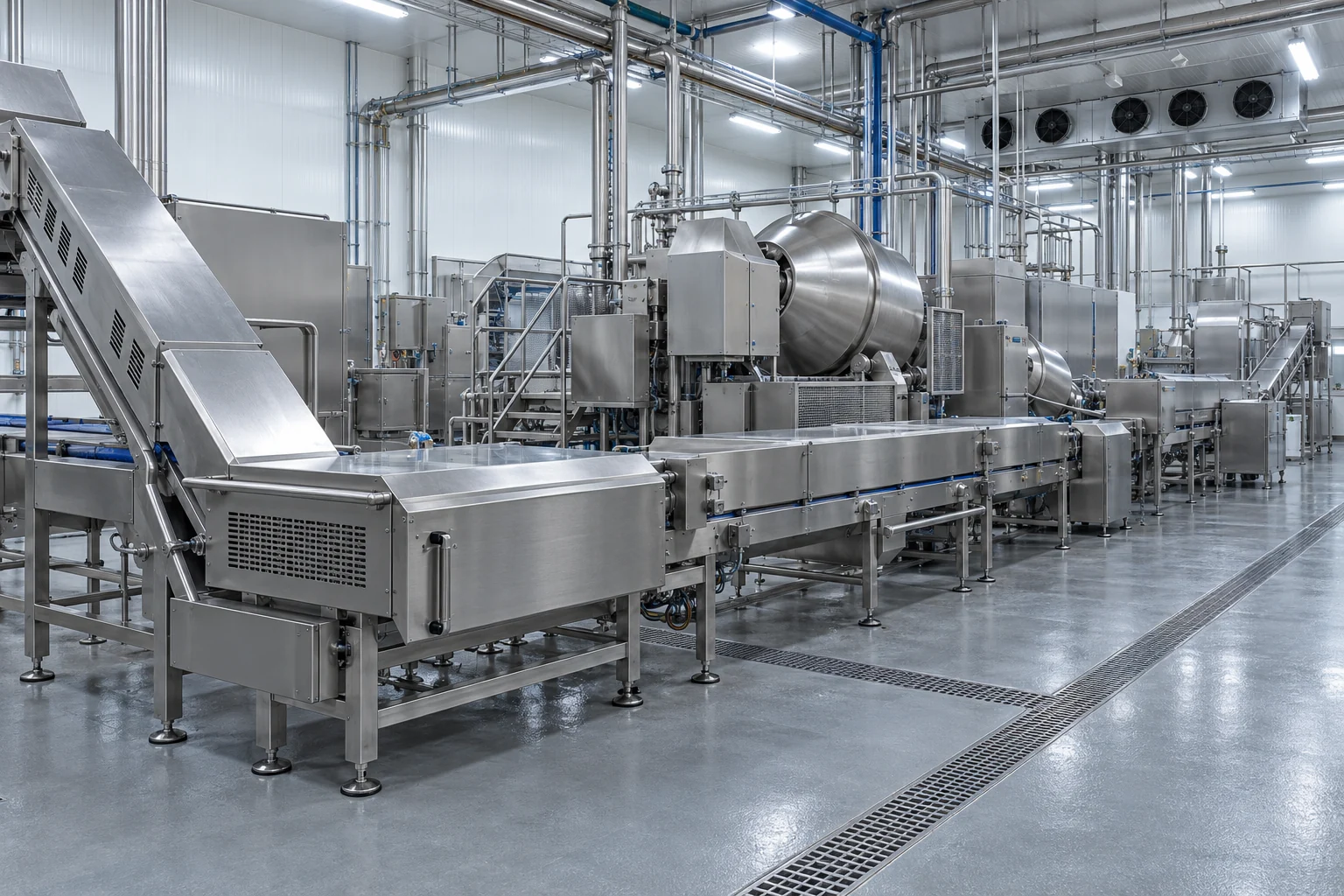
Review the scope, cost assumptions and operating case for your project. The examples and calculators below support early planning and are not DPS quotations.
Use component / assembly / package records and accepted whole-meal output. Correct the actual constraint while respecting qualified holds, cold-chain and hygienic boundaries.
Define product families, components, qualified preservation / package routes, raw-cooked flows, cold / utility demand, staffing and launch demand.
Swipe horizontally to compare all columns ↔
| Observed condition | Measure before design | DPS / team decision | Economic basis |
|---|---|---|---|
| Components ready at different times | Matched component and assembly-state timeline. | Correct the limiting schedule / transfer / buffer duty. | Accepted complete meals, not summed component rates. |
| Cooling / freezing limitation | Qualified product and delivered utility conditions. | Coordinate specialist packages and source / distribution. | Verified useful time and baseline resource cost. |
| Portion / package rejects | Actual accepted meal weights and rejects. | Review OEM settings and material / product handling. | Real input or disposal cost, not full sales value. |
| Long meal SKU transition | Qualified cleaning / setup / release record. | Coordinate recipes, flows and package states. | Useful time and independently avoided purchases. |
Swipe horizontally to compare all columns ↔
| Decision | Targeted Work | Broader Scope |
|---|---|---|
| Component Timing | Coordinate preparation, qualified holds and assembly schedules. | Add the component-stage capability that limits finished meals. |
| Thermal or Cold Duty | Correct measured utility and specialist-package interfaces. | Include new cooking, cooling or freezing duties within the selected meal route. |
| Portioning and Packaging | Improve handling and agreed OEM settings. | Integrate additional formats with complete component and release requirements. |
Compare proposals with the same product duty, supplier boundaries and acceptance basis. The amount below is a transparent planning example, not a market price range, supplier estimate or DPS quotation.
| Cost bucket | Assumed amount |
|---|---|
| Product / process and interface engineering | $78,000 |
| Defined configured / OEM component allowance | $273,000 |
| Mechanical / electrical field installation | $150,000 |
| Instrumentation and control integration | $78,000 |
| Commissioning and acceptance support | $46,000 |
| Training, documentation and closeout | $25,000 |
| Defined project scope | $650,000 |
| Separate site / facility additions | $125,000 |
| Capital contingency (15%) | $116,250 |
| Separate one-time startup / shutdown cost | $60,000 |
| Incremental working capital | $60,000 |
| Total initial cash | $1,011,250 |
The defined scope assumes applicable freight, procurement charges and taxes are included in the owner’s estimate. Add missing civil, land / shell, OEM, environmental, validation and permitting costs explicitly. Site and field conditions, duty, production access and quoted supplier scope determine actual price. Financing is excluded.
Hypothetical owner-budget case: 250 days × 0.5 useful recovered hour/day × 1,300 good kg/h × 60% realization gives 97,500 incremental sold kg/year after the 120,000 kg demand ceiling. Net price $6.2/kg less incremental variable cost $4.4/kg gives $1.8/kg contribution. The baseline inputs assume $22,000 energy, $18,000 water / chemistry and $12,000 maintenance reductions per year. Avoided payroll is 600 hours × $40 × 50% cash realization. Verified baseline purchase reduction contributes $0; its basis is unchanged accepted baseline output. Deduct $28,000 added annual fixed cost. Result: $211,500 steady net benefit; initial cash $1,011,250 includes the separate site, contingency, startup and working-capital inputs. These are original illustrative assumptions, not a quotation, price benchmark or achieved DPS result.
Calculated from these assumptions: steady annual net benefit $211,500; year-one net cash $115,700; cash payback Beyond 5 years; five-year NPV at 10% is −$296,590. Change the assumptions below to test a different case.
Replace the illustrative inputs with your own measured or quoted values. The five-year pre-tax model uses good kilograms, demand-capped contribution and separately verified baseline savings; it is not a project quotation.
All defaults are illustrative. The default case is an operating-plant improvement, not a greenfield quote. For a new operation, set baseline savings to zero and enter every additional operating and capital cost.
Includes contingency, startup and working capital
Incremental operating cash before tax
Includes year-one ramp assumption
At 10% annual discount
Net annual benefit ÷ initial cash
Net cumulative gain ÷ initial cash
Modeled incremental sales: 97,500 kg/year at $1.80/kg contribution. The base case does not recover the required discounted return within five years. Year-one net cash: $115,700.
Realization needed for the target operating payback
63.7%
Minimum capacity realization for a 5-year operating cash payback; terminal recovery excluded. Demand and unit margin must also hold.
CSV export is local. No inputs are submitted.
Swipe the chart to compare all five years ↔
Swipe horizontally to compare all columns ↔
| Year | Net cash | Cumulative cash | Discounted cash |
|---|---|---|---|
| Initial | −$1,011,250 | −$1,011,250 | −$1,011,250 |
| Year 1 | $115,700 | −$895,550 | $105,182 |
| Year 2 | $211,500 | −$684,050 | $174,793 |
| Year 3 | $211,500 | −$472,550 | $158,903 |
| Year 4 | $211,500 | −$261,050 | $144,457 |
| Year 5 | $211,500 | −$49,550 | $131,325 |
Swipe horizontally to compare all columns ↔
| Case | Annual benefit | NPV | Cash payback |
|---|---|---|---|
| Downside | $141,300 | −$715,425 | Beyond 5 years |
| Base | $211,500 | −$296,590 | Beyond 5 years |
| Upside | $258,007 | −$137,201 | 4.36 years |
Downside: installed and site costs +20%, realization ×0.75 and unit contribution reduced by 20% of its absolute value. Upside: realization ×1.15, capped at 100%, and unit contribution improved by 10% of its absolute value. The demand ceiling still applies.
The default reproduces the main retrofit energy input of $22,000/year before added maintenance. The narrow worksheet is not a product-process calculation and does not automatically transfer values into the ROI model. Additional annual service is included in the main added-fixed-cost allowance; deduct it once.
Prepare the information below, export the assumptions you have modeled, and discuss the unknowns with DPS. An unmeasured input is a question to resolve, not a reason to invent precision.
Checklist and model data stay in this browser until you choose to share them.
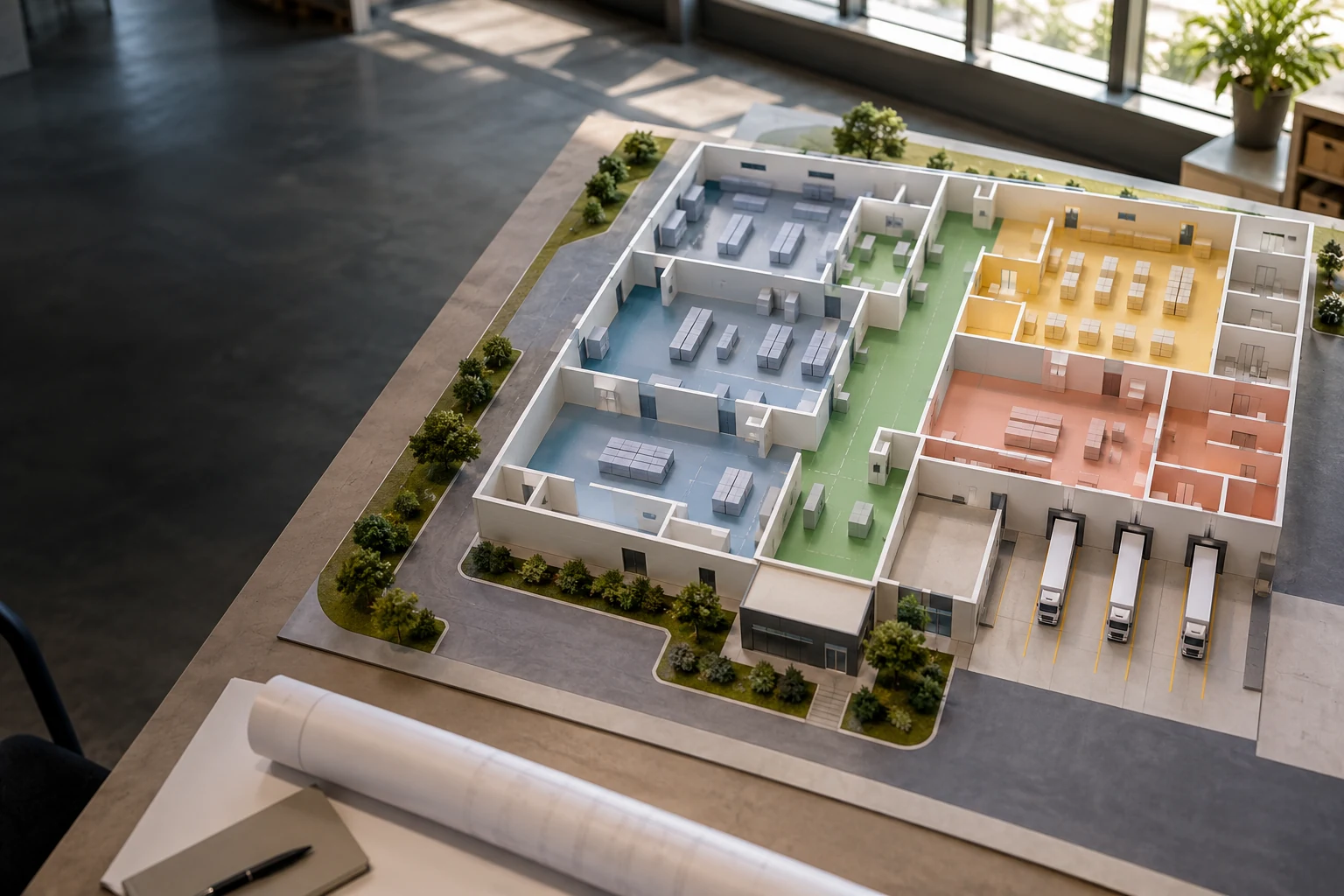
Plan a food processing plant layout around product, people, packaging and waste flows, then test space, access, storage and future expansion.

Plan food processing and packaging as one path. Compare rates, batch presentation, buffers, interfaces and staged capacity before selecting equipment.
Bring your product requirements, operating priorities and site constraints to an initial scope discussion with DPS.