
In This Article
Explore This Topic
Controls & Package Interfaces
Requirements & Design Basis
Project Delivery & Acceptance
QUICK ANSWER · FOOD PLANT DESIGN PROCESS
What Are the Main Stages of the Food Plant Design Process?
Begin with business requirements and feasibility, establish the production and design basis, develop coordinated process and facility concepts, then progress through defined engineering, supplier information, procurement and construction packages. Plan testing, operating readiness and handover while the design is being developed. At each gate, identify the owner decisions, evidence, interfaces and deliverables needed for the next commitment.
Stage names and contract boundaries vary. The useful test is whether the work supports the next decision, not whether the project uses a particular phase label.
A food plant can accumulate drawings faster than it resolves decisions. Equipment inquiries proceed, the building arrangement changes and utility assumptions remain open. When those workstreams do not share a controlled basis, later packages can become detailed versions of incompatible plans.
This guide explains the food plant design process from an owner’s perspective. It connects the decisions, disciplines and delivery packages so a capital sponsor can commission the right work and recognize what each stage has actually established.
1. Start with the Manufacturing Business and the Decision to Be Made
Define the products, market, packaging formats, saleable volume, launch objective and capital constraints. Identify the evidence behind demand and the scenarios management needs to compare. A design assignment should begin with a business problem that can be explained.
State the decision the first engagement must support. It may be site selection, process-route comparison, an initial investment screen or a phased development strategy. Different questions require different initial investigations and deliverables.
CRB’s production-strategy guidance links production planning with capital goals. For the owner, the practical implication is to approve the operating assumptions before separately developed technical packages begin to define the business by default.
Keep unknowns visible. A first brief can be useful without settling every product or site detail, provided it identifies what needs investigation and who will make the resulting decision.
2. Use Feasibility to Test Options Before Committing to Detail
Compare credible process, site and capacity alternatives against the same business objective. Identify major constraints, enabling scope, commercial assumptions and the work required to improve the evidence. Feasibility should test the preferred idea, not merely justify it.
Include the practical alternatives management is willing to consider. A staged plant, external supply arrangement or different site can change the investment path. Excluding them without discussion can make detailed design answer a narrower question than the owner intended.
DPS’s capital-planning and feasibility work can connect conceptual production, layout, utility and investment questions. Agree on a scoped decision package rather than ask for a single budget number detached from an operating basis.
At the gate, decide whether to proceed, revise, investigate or stop. That is a useful project outcome even when the first preferred concept is not selected.
3. Establish a Controlled Basis for the Selected Development Path
Record the agreed product envelope, capacity scenarios, operating calendar, quality inputs, site assumptions and package boundaries. Identify the evidence and approval status of important values. The basis should explain what all disciplines are using.
Separate firm requirements from provisional assumptions and future options. A concept-stage approval can contain open items, but their limits and consequences should remain clear. Approval does not make every assumption a verified fact.
Give the document a revision process and an owner. When the product mix, site or schedule changes, identify the affected engineering, estimate and supplier work. A common basis is valuable only if it remains current.
The design basis is not every project deliverable in one file. It is the controlled reference that connects detailed information and explains which issue governs the work.
4. Map Phases to Decisions and Outputs
Use a phase map adapted to the project and delivery arrangement. It should identify the purpose of each work package and the owner input required. Avoid treating familiar phase names as evidence that the contents are complete.
| Work Stage | Main Decision | Useful Outputs |
|---|---|---|
| Business and feasibility | Which path deserves development? | Requirements, alternatives and major constraints |
| Concept and basis | What operation is being designed? | Process concept, layout, utility assumptions and scope |
| Coordinated engineering | How will the selected scope work? | Developed calculations, interfaces and specifications |
| Procurement and construction packages | What can be purchased and built under defined conditions? | Issued packages, responsibilities and commercial information |
| Verification and handover | How is the installed scope transferred into operation? | Agreed testing, records, training and open-item resolution |
Keep feedback loops visible. Supplier information and investigations can require revisions; a phase map should organize that development rather than imply the project never needs to revisit an assumption.
Ask what evidence would allow each important assumption to advance from provisional to confirmed. A supplier response, site investigation and owner product decision are different inputs with different lead times. The phase plan should show those information dependencies alongside the technical work. This helps the sponsor understand why producing additional drawings may not resolve the issue currently controlling the project.
5. Develop the Process Concept Before Fixing the Building Arrangement
Identify the unit operations and material sequence appropriate to the product and preservation route. Define representative duties, holding requirements, product transfer and cleaning interfaces. Mark decisions requiring further development or qualified review.
Translate saleable output into a production schedule with consistent units. Include campaigns, changeovers and other planned activities. A machine speed alone cannot establish the operating requirement of the whole plant.
Use the concept to identify major equipment families and supplier information needs, without prematurely selecting every detailed solution. The early objective is to compare feasible arrangements and establish the interfaces that control the scope.
Keep product-processing approval separate from facility layout. A plausible flow diagram is not a validation of a product’s commercial process. The responsible specialists should define the relevant technical and quality work.
6. Connect Site and Existing-Condition Evidence with the Concept
For a new site, identify infrastructure, access and development questions. For an existing building, review geometry, conditions and modification scope. Use the same operating requirements so the alternatives remain comparable.
Keep provider and authority inquiries tied to the actual parcel and production basis. Nearby services, a previous tenant’s operation or a seller’s statement do not establish every condition the new plant requires.
Record the studies and approvals needed for the next commitment. Some findings can be developed later, while others may determine whether the site is suitable at all. The owner should understand that difference before proceeding.
Feed the results back into the process and capital options. A site investigation is useful when it can change the concept, scope or decision, rather than arrive as an isolated report after the property strategy is fixed.
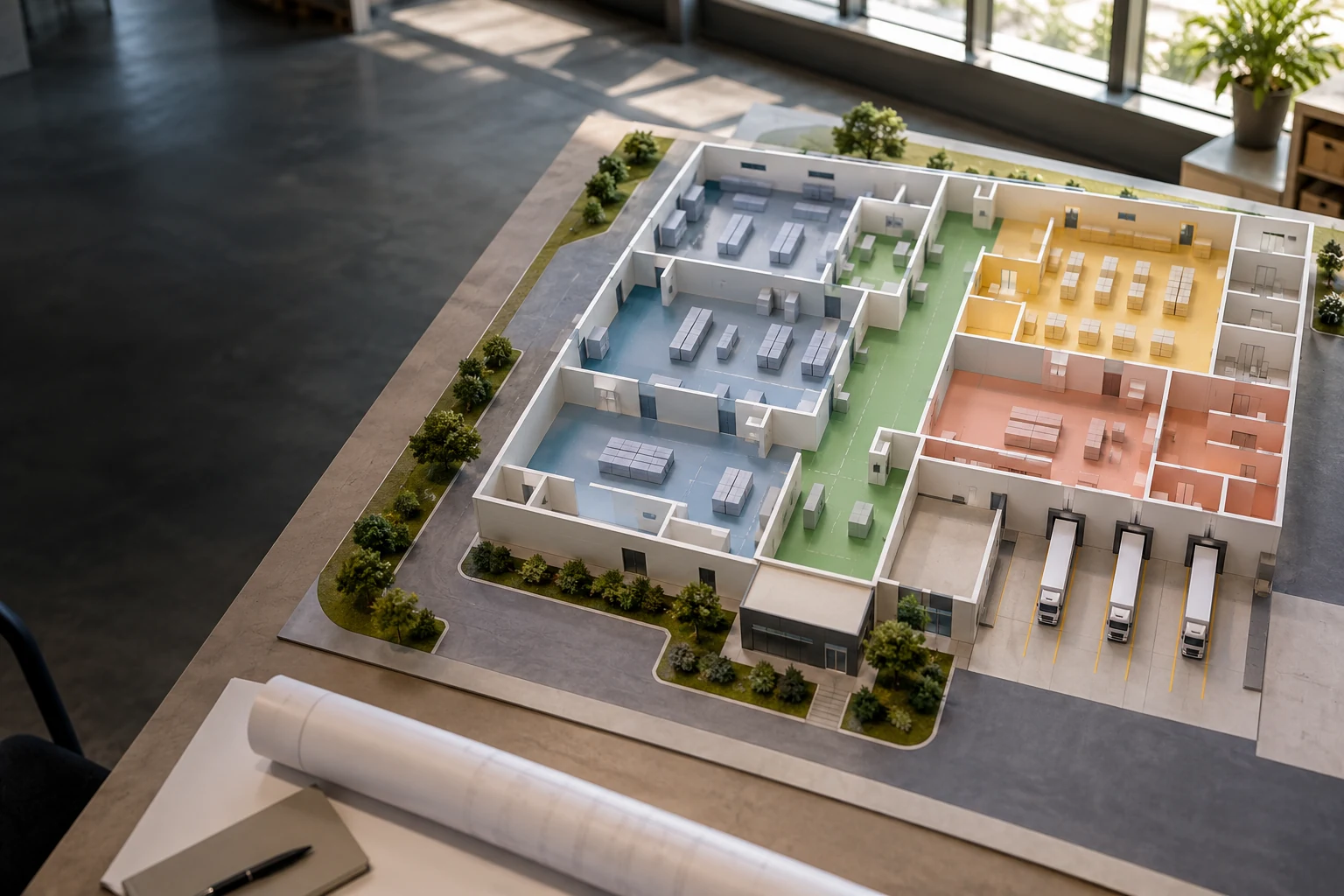
7. Coordinate the Process with the Complete Facility Layout
Develop product, people, ingredients, packaging, cleaning, waste and finished-goods flows together. Include storage, quality activities, people facilities, utilities, staging and access. Equipment footprints are only part of the spatial requirement.
Review the arrangement through actual operating scenarios. A normal campaign, product transition, cleaning event or delayed collection can expose interfaces not visible in a static plan. Assign the resulting actions to the relevant disciplines.
Hixson’s master-planning overview describes the connection between business goals, process concepts and facility development. In the design process, that connection helps keep future options and capital priorities visible while the first layout is developed.
Do not freeze the drawing only because it looks finished. Confirm what the current issue supports and which dimensions, supplier data or specialist decisions remain provisional.
Use a cross-functional walk-through in which participants describe the same campaign and interruption scenarios. An operations leader may assume a staging area is available while quality expects it to hold product awaiting disposition. The layout team needs a decision about that shared space before it develops the next issue. The review should preserve the operating assumption, not merely record that the drawing received comments.
8. Develop Utility Requirements Under the Same Operating Schedule
Identify users, conditions, operating modes, duration and simultaneous cases. Separate connected load, normal demand, peak demand and consumption. Define the connection boundaries between process packages, distribution and supply systems.
Include cleaning, startup and later phases where they affect the agreed scope. If the capacity basis depends on sequencing, operations and controls need to review how that sequence will be maintained.
DPS’s process and utility planning can help coordinate these inputs with the facility concept. Ask which values are calculated, supplier-confirmed, measured or assumed, and what evidence is needed before a consequential capacity commitment.
The utility basis should improve with the engineering. A preliminary total can support an inquiry, but it should not be presented as a completed distribution design or a final equipment selection.
9. Define Controls and Information Boundaries Before Procurement
Identify the functions required at launch and the interfaces among machine controls, plant-level systems and owner information processes. Recipe management, production records and business-system links can have different scope owners.
Ask who supplies the necessary data, programming, hardware, licenses and testing. A machine’s local control package does not automatically provide every plant-level function. Preserve those boundaries in the specifications and estimate.
Develop the control and operating narratives alongside the process. If an operating sequence is important to utility demand or product handling, the relevant functions need coordinated requirements rather than late assumptions.
Include handover and user preparation in the plan. A technically installed function still needs the agreed records, procedures and training to become useful to the operation.
10. Keep Cost Definition Aligned with Design Definition
The estimate should reference the design-basis and layout issues used to prepare it. Identify pricing dates, methods, allowances, exclusions and uncertainty. A revised concept should not continue carrying an unchanged old budget without explanation.
GAO’s estimating guide provides a general reference for a technical baseline, assumptions and updates. It is not a food-project price list. The practical value is traceability between the defined scope and the cost forecast.
Use the estimate to support the next decision at the appropriate maturity. An options study and a purchasing commitment need different evidence. More decimal places do not make an early allowance equivalent to a developed supplier proposal.
Separate owner changes from uncertainty within the approved scope. Both can affect the total, but their causes and approval decisions should remain visible.
11. Concept Issue vs Bid Issue vs Construction Issue
A drawing’s appearance does not establish its intended use. Give packages clear issue status under the project’s document process, and explain qualifications or incomplete inputs that affect how others can rely on them.
| Issue Purpose | Supports | Important Limit |
|---|---|---|
| Concept development | Options, fit and scope decisions | Not a complete construction instruction |
| Supplier or bid inquiry | Comparable proposals under stated conditions | Open items and commercial boundaries remain explicit |
| Construction development or release | Defined work under the project’s release process | Dependencies and revisions still need control |
| Record and handover information | Agreed installed-state documentation and operation | Scope and verification of records should be defined |
Control distribution so a superseded or limited-purpose issue does not remain the working reference simply because it is the file someone already has.
When a bid package contains provisional information, explain how bidders should respond. A common allowance or clearly stated exclusion can make proposals more comparable than allowing each bidder to guess independently. The appropriate commercial team should define the actual return requirements. The design process should provide the technical boundaries needed for that decision and retain unresolved items for later reconciliation.
12. Develop the Interfaces Through Coordinated Engineering
Detailed work turns the selected concept into calculations, specifications, layouts and other information appropriate to the packages. The disciplines need coordinated references and a process for resolving conflicts.
Review equipment data, structures, utility routes, access and control boundaries together. A local change can affect another package even when it improves one drawing. Assign the review and keep the decision traceable.

Define the deliverables for the actual scope. The project should not assume every engineering activity is included because a proposal uses the phrase “detailed design.”
13. Reconcile Supplier Information with the Approved Requirements
Supplier proposals can improve the technical basis, but they need review against the product, schedule and interface requirements. Identify the configuration and operating conditions behind each quoted performance or utility figure.
Resolve deviations explicitly. If an offer changes a pack format, capacity assumption or boundary, the owner and relevant specialists need to understand the consequence before it becomes part of the project.
Keep data status visible. Preliminary dimensions and final approved information do not provide the same confidence for building and installation work. The document schedule should identify when confirmed data is needed.
Coordinate related suppliers at shared interfaces. A complete set of individual offers does not automatically describe a complete line, particularly where each supplier assumes another party provides connections or integrated functions.
14. Plan Procurement Around Information Readiness and Delivery Needs
Identify the packages that control the schedule and the information required to release each responsibly. Commercial urgency can justify a staged procurement approach, but it does not remove the need to understand the commitment and unresolved conditions.
Keep early decisions visible to the sponsor. A release may secure a defined item while leaving interfaces or later options to be confirmed. Document those boundaries and the consequence of subsequent changes.
Compare proposals using a common return format and reconcile inclusions, exclusions, prerequisites and acceptance assumptions. Price alone cannot establish equivalence when the offers describe different scopes.
Connect payment milestones with the capital cash forecast. Design progress, contractual commitment, physical delivery and payment are different events that should be coordinated in the owner’s plan.
An early commitment deserves its own decision record. State the information that is fixed, the interfaces still developing and the potential consequence if an assumption changes. The appropriate advisers should review the commercial terms. This allows management to evaluate the schedule benefit and exposure deliberately, instead of treating procurement urgency as evidence that the technical basis is already complete.
15. Create Construction Packages with Usable Boundaries
Define the work, interfaces, applicable references and information needed by the receiving contractor. The package should make clear what is included, what others provide and which conditions or approvals apply.
Coordinate construction access and sequencing with equipment delivery and existing operations where relevant. A technically correct package can still be difficult to execute if the site logistics have not been considered.
Keep incomplete or future work explicit. The contractor should not have to infer an important process or utility decision from a drawing gap. Questions need an assigned route for clarification and controlled response.
Develop the release plan with the delivery team. A project may use several packages at different times, but their interfaces and shared assumptions need the same control as a single combined release.
16. Calculate a Simple Dependency Example Before Promising a Schedule
An invented planning sequence uses two weeks for an owner brief, four for concept work, five for a site and utility inquiry, six for coordinated design and three for package preparation. The concept and inquiry begin after the brief and run in parallel; coordinated design waits for both.
Under those simplified dependencies, the total is 2 + maximum of 4 and 5 + 6 + 3, or sixteen weeks. Treating every activity as sequential would total twenty. These are teaching durations, not a recommended food-plant design schedule or a delivery promise.
| Activity | Duration | Predecessor | Illustrative Finish |
|---|---|---|---|
| Owner brief | 2 weeks | Start | Week 2 |
| Concept work | 4 weeks | Brief | Week 6 |
| Site and utility inquiry | 5 weeks | Brief | Week 7 |
| Coordinated design | 6 weeks | Concept and inquiry | Week 13 |
| Package preparation | 3 weeks | Coordinated design | Week 16 |
The arithmetic shows why dependencies matter. It does not establish that real activities can overlap safely or that external responses will arrive on the assumed date.
17. Visualize the Consequence of the Assumed Dependencies
The chart compares the two teaching interpretations on the same scale. The difference comes only from the stated overlap. It is not evidence that a delivery method reduces every project schedule by a particular percentage.
Illustrative engineering sequence · weeks
All activities sequential · 20
Defined concept and inquiry overlap · 16
Original dependency calculation. Durations do not represent a construction or plant-launch forecast.
For a real project, use the actual information requirements, resources and external dependencies. Ask what happens if a controlling inquiry returns a different result, because the response may change scope as well as timing.
18. Give Owners a Clear Approval Question at Each Gate
Approval should identify the choice being made, the evidence available and the limitations being accepted. A broad instruction to approve the drawings can hide business decisions that have not been explained clearly.
| Gate | Owner Question | Supporting Evidence |
|---|---|---|
| Feasibility | Which option should be developed? | Common-basis comparison and constraints |
| Concept | Does the operating and spatial basis fit the business? | Flows, utilities, scope and open items |
| Major commitment | Is the package sufficiently defined for this decision? | Supplier data, boundaries and commercial conditions |
| Release and handover | Are responsibilities and readiness requirements clear? | Issued scope, verification and transfer plan |
Retain the decision record. It helps later participants understand why an assumption was accepted and when a change needs to return to the owner.
Distinguish review comments from an approval decision. A drawing may have been discussed by several departments while a consequential product or capital choice remains unresolved. The gate record should identify what was accepted, under which conditions and who retains the next action. This makes later changes easier to assess and prevents a meeting attendance list from being mistaken for an unconditional authorization.
19. Control Changes Across the Entire Design Basis
A new product, format, capacity target or site condition can affect several disciplines. Record the request and identify the impact on process, layout, utilities, controls, estimate and schedule before approving the response.
Distinguish clarification, design development and changed owner scope under the project’s definitions. The categories can have different approval and commercial consequences. The source of funding does not change what caused the work.
Maintain one authoritative issue of important inputs and references. A project can continue working from inconsistent files even after a decision has been made unless distribution and superseded documents are managed.
Use a change process that people can actually follow. The goal is coordinated, timely decisions, not a paperwork burden that encourages important revisions to be handled informally.
Check cumulative effects as well as individual requests. Several apparently small format, route or timing changes can alter the operating model materially when combined. The project needs a periodic reconciliation of the current scope with the approved business basis. That review can identify when management should reconsider the overall option, rather than continue approving local changes to a concept that no longer fits.
20. Plan Verification and Operating Readiness During Design
Identify how the installed scope will be checked and transferred into operation. Different activities may address equipment, integrated functions, product requirements and owner readiness. Their acceptance boundaries should be defined by the responsible parties.
Include required materials, people, utilities, records and supplier support in the schedule and budget. A test plan is not executable if its prerequisites remain unassigned.
DPS’s process, automation and integration coordination can connect technical design choices with later testing and handover requirements. Agree the actual deliverables and interfaces rather than assume every startup activity belongs to one contractor.
Keep quality and commercial release decisions with the qualified owners. Completion of a defined equipment test does not automatically establish that every product and customer condition has been met.
21. Define the Information the Operating Team Will Receive
Agree the records, instructions, training and installed-state information included in the handover scope. Identify who supplies, reviews and accepts each item. A collection of individual supplier manuals may not explain the integrated operating sequence.
Keep open items visible with their effect on operation and the plan for resolution. Do not let the physical transfer of a building erase unresolved responsibilities.

The appropriate handover detail depends on the contract and operation. Define it early enough that the team can produce the information as work progresses rather than reconstruct it at the end.
Define the status of record information and the verification included in producing it. A digital model, marked drawing and supplier manual can each describe different boundaries. The operating team should know which information reflects the agreed installed state and which qualifications remain. The handover scope needs to make those distinctions clear without implying that the existence of a file proves every field has been independently checked.
22. Select an Engagement by Capability, Continuity and Scope
Compare the work proposed for the current stage and the path to the next. A planning specialist and a delivery team may offer different strengths. The owner needs a clear interface if responsibilities change between stages.
Dennis Group’s service structure spans planning, design, construction management and startup. It illustrates the breadth of food project work, not a requirement to purchase every activity under one contract.
For a DPS discussion, provide the business brief, available studies, current design basis and the next decision date. Ask for the deliverables, owner inputs and exclusions to be stated plainly. The useful standard is a coordinated progression from business requirements to executable scope, with the remaining uncertainty visible.
If the delivery partner changes, plan the transfer of assumptions, calculations, source data, open items and decision history. Agree the responsibilities for reviewing inherited information and identifying missing work. A new team should not have to infer the reason for an important design choice from the final drawing alone. The continuity plan should protect the evidence behind the selected scope as well as the visible deliverables.
23. Food Plant Design Process FAQ
Is there one mandatory set of design phase names?
No. Phase names and delivery arrangements vary. Define what each work package supports, the evidence it produces and the commitments it enables. A familiar label does not establish that the scope or assumptions are complete.
Should detailed design begin before the business requirements are settled?
The project can investigate options while requirements develop, but important assumptions need control. Mark unresolved decisions and their consequences. Avoid developing separate packages under conflicting product, capacity or site assumptions.
Does an approved concept mean construction can start?
Not automatically. State the issue purpose, limitations and required next work. Procurement and construction decisions need packages suitable for their actual scope and release process, with interfaces and commercial conditions defined.
Does the sixteen-week example predict a project schedule?
No. It uses invented durations and simplified dependencies to demonstrate overlap. It excludes resource constraints, approvals, procurement and construction. A real schedule needs project-specific information and reviewed dependencies.
Why develop utilities during the process design?
Demand depends on products, operating modes, cleaning, startup and concurrency. Utility assumptions also affect the site, layout and capital scope. Coordinating them prevents the disciplines from designing different versions of the plant.
When should handover planning begin?
During design, early enough to define testing, records, training, prerequisites and responsibilities. The actual scope depends on the engagement. Waiting until construction ends can leave important information or operating preparation unassigned.
What should happen when supplier information changes?
Review the difference against the approved requirements and affected interfaces. Update the basis, drawings, estimate or schedule as needed under change control. Keep preliminary and confirmed data distinguishable.
How can DPS support the design process?
DPS can connect capital planning, process, facility, utility, automation and integration questions. Agree the stage-specific scope, deliverables and owner inputs. The engagement should support a defined next decision without implying that every future activity is already included.
Sources and Calculation Notes
Research checked October 27, 2026. Numerical illustrations and decision examples were prepared for this article; they are not supplier quotations, market benchmarks or DPS project results. Project-specific requirements and responsibilities belong in the agreed scope.
- Dennis Group — Services. Scope across planning, design, engineering and startup.
- Hixson — Food and Beverage Master Planning. Business requirements, facility planning and phased capital strategy.
- CRB — Food and Beverage Production Strategy. Aligning production strategy with capital goals.
- U.S. GAO — Cost Estimating and Assessment Guide. Scope, technical baseline, assumptions, risk and estimate updates.
- DPS — Capital Planning and Feasibility. Conceptual layouts, equipment and utility requirements, installed-cost planning and phased investment evaluation.