In This Article
Explore This Topic
Capacity & Production Strategy
- Batch vs Continuous Food Processing: Compare Capital Cost and Product Flexibility
- Food Plant Capacity Planning: How Much Production Should a New Factory Support?
- Increase Food Plant Capacity: Add a Shift, Reduce Changeovers or Install a New Line?
- One Flexible Line vs Two Dedicated Lines for a New Food Factory
QUICK ANSWER · CAPITAL PLANNING
Should a Food Manufacturer Expand Its Existing Plant or Build a New Facility?
Compare expansion and new construction at the same product scope, customer demand and planning horizon, including the transition between today’s operation and the future plant. Existing assets may reduce new work but can impose layout, infrastructure and production-interruption constraints. A new facility may offer more design freedom while requiring a larger initial scope and a different path to commercial readiness.
Start with a common operating baseline, verify what the current site can actually support, and price complete alternatives. Include incremental operating cash, disruption, funding timing and remaining flexibility. A lower construction total or a larger floor area alone does not establish the better investment.
The expansion-versus-new-build question often begins with two competing instincts. Operations wants to use the site it knows; growth leaders want room to design the next factory without inherited constraints. Both positions can contain useful information, but neither is a complete capital case.
For food manufacturers, the decision includes how to keep supplying customers while capacity changes. The best concept on opening day can be a difficult business choice if the transition creates an unfunded production gap. This guide organizes a comparable food plant expansion vs new construction study. Its financial illustration uses invented inputs and a defined five-year horizon; it is not a project estimate or a recommendation to finance either option.
1. Define the Business Outcome Both Alternatives Must Deliver
State the products, saleable volumes, package formats and customer-service requirements the future operation must support. Separate initial commitments from later demand scenarios. Without a common outcome, an expansion estimate can describe a modest addition while the new-build estimate includes capabilities the business has not actually approved.
Identify the strategic reasons for considering another site. Geography, distribution reach, raw-material access, staffing and future product scope may matter alongside capacity. Record which requirements are essential and which are preferences that can be traded against cost or time.
CRB’s greenfield-versus-brownfield discussion highlights the importance of project priorities and site conditions. For an owner’s decision, translate those priorities into explicit comparison criteria before selecting a preferred answer. The study should explain how each option supplies the same defined business, including any temporary external production or customer allocation required during the transition.
2. Establish What Happens if the Company Makes No Project Investment
A common baseline is necessary for incremental economics. Describe the output, operating costs, constraints and customer commitments of the existing operation without either major project. Identify credible interim actions already planned, so their benefits are not later credited to whichever option happens to be preferred.
Distinguish the cost of continuing current operations from new costs caused by expansion or relocation. Existing payroll, fixed commitments and usable assets may be treated differently depending on the decision and the company’s evaluation method. Finance should agree on the boundary rather than allowing separate teams to build incompatible models.
Use the baseline to explain the cost of waiting. That may include outsourced supply, missed opportunity or another defined consequence, but it should be supported by the commercial plan. Do not equate every unfilled theoretical production hour with lost sales. A disciplined baseline makes the alternatives comparable and helps the owner see what the project actually changes.
3. Verify the Current Plant’s Constraints with Evidence
Develop a constraint register for the existing site. Review production flow, space, storage, utilities, access, operating schedule and the ability to add the required functions. A familiar building can contain undocumented limitations that become material only when the next line or product family is proposed.
Use current drawings, operational information and site investigations appropriate to the project. Record which conditions are confirmed and which are assumed. If retained equipment or infrastructure is included in an option, document the basis for its intended role rather than assigning it useful value automatically.
Disruptive Process Solutions (DPS) can connect the production requirements with a conceptual facility and utility assessment. The planning scope should identify what the existing site can support, what work is needed and which assumptions require specialist confirmation. This provides a more useful expansion basis than the fact that unused floor area appears available.
4. Compare One-, Three- and Five-Year Operating Cases
A project can fit the launch year and become constrained soon afterward, or overshoot early demand while preserving later flexibility. Develop demand scenarios by product and package over the agreed horizon. Tie the scenarios to customer evidence and strategic decisions rather than using a single unchallenged growth percentage.
Show the operating calendar each option would need at those volumes. Additional shifts, seasonal production and outsourced supply can change both capital and operating costs. If an expansion depends on extended staffed hours while a new facility uses a different schedule, state the difference in the comparison.
The mature output target should not erase the initial years. A new factory may operate at lower utilization while customers and staff transition. An expanded site may experience a temporary interruption before its added capacity becomes useful. Include those paths so the business can evaluate the investment it will live through, rather than compare only two ideal steady-state factories.
5. Test the Expansion Layout and the New-Site Concept to the Same Standard
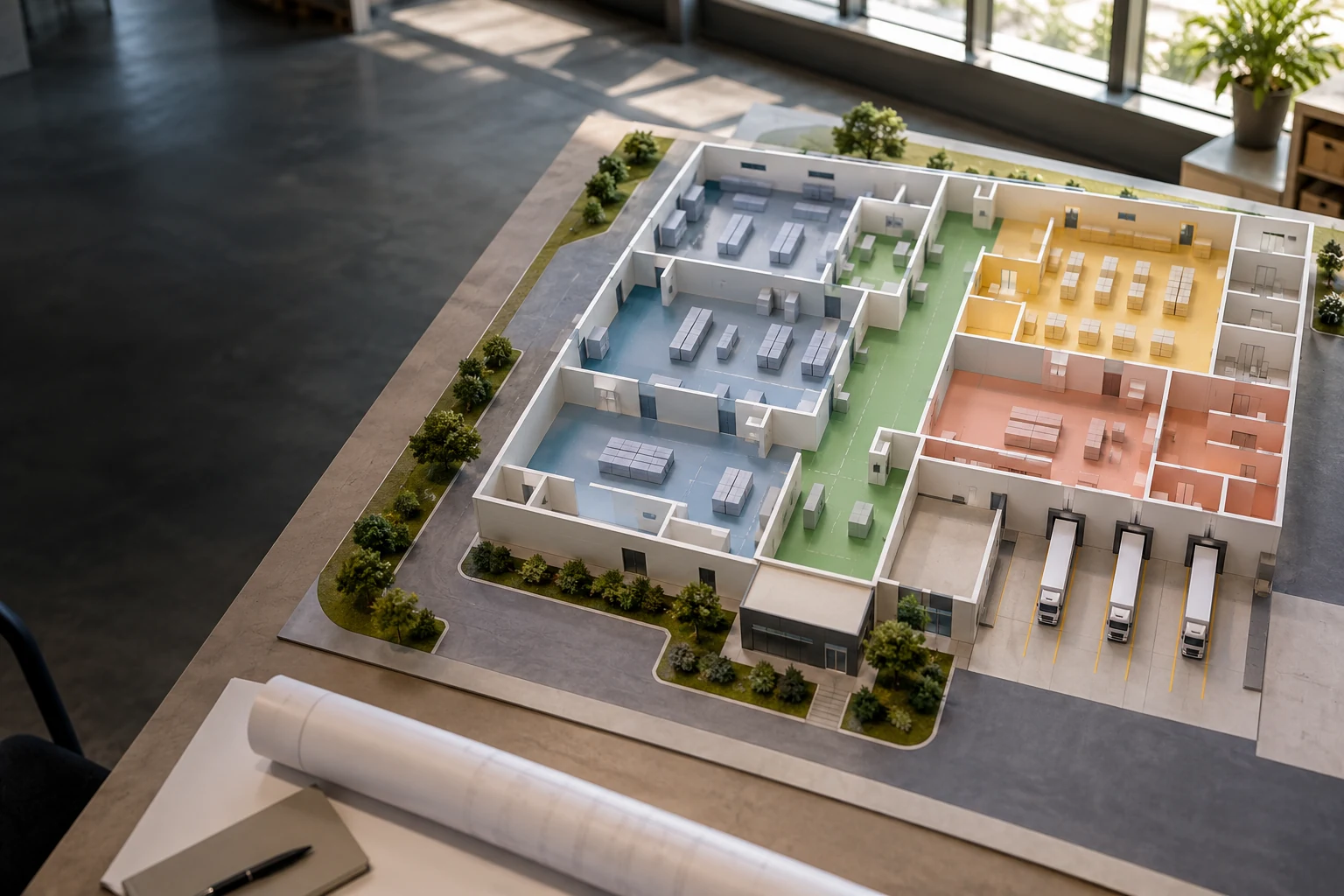
Prepare conceptual layouts for both alternatives using the same operating brief. Trace ingredients, products, people, packaging, finished goods and waste. Required separation and access should follow the actual food operation, not be deferred until after an area allocation has made the concept difficult to change.
For the existing site, examine columns, clearances, routes, retained rooms and the logistics of installing new work. For the new site, include the whole site arrangement, receiving, shipping and credible expansion space. An empty plot provides freedom, but its usable development and infrastructure still need investigation.
Compare the quality of the resulting flow rather than only total square footage. A larger plant can carry longer internal movements or more support space without improving saleable output. Record the layout compromises each option accepts and identify whether their operating consequences have been included in the financial model.
| Decision Factor | Existing-Site Expansion | New Facility |
|---|---|---|
| Retained assets | Verify suitability and intended remaining role | Identify what is transferred, replaced or left behind |
| Layout | Price and document inherited constraints | Develop flows around the approved production basis |
| Utilities | Confirm spare capacity and connected-system limits | Confirm new supply and off-site requirements |
| Customer supply during change | Plan work around retained production | Plan parallel supply, transfer and launch |
| Future options | Test the next realistic expansion constraint | Price specific provisions rather than unlimited future space |
6. Investigate Infrastructure Before Counting Retained Capacity as a Saving
Existing utility systems may contain useful capacity, but their available margin should be demonstrated. Review production and cleaning demands together, including the proposed added load. Connected equipment totals do not automatically describe simultaneous operating requirements or the capacity available at the needed conditions.
ADF Engineering’s packaging-line expansion case illustrates a real project where utility studies informed the upgrade scope. It is a competitor’s case, not a DPS project or a promise that another facility can avoid similar work. Its planning lesson is to investigate the actual system before assuming that an existing connection or generator is sufficient.
For the new site, include supply availability, generation, distribution, connections and identified off-site work. If the utility provider has not confirmed a requirement, state that uncertainty and its potential schedule consequence. Both concepts should carry a traceable utility basis so one does not appear cheaper simply because its infrastructure questions have been postponed.
7. Price Construction and Tie-in Disruption as Part of Expansion
An expansion can require work beside production, temporary routing, access restrictions and planned tie-ins. Develop the construction sequence with operations, quality and the relevant delivery team. Identify what can occur while production continues and what requires a controlled interruption.
Connect each interruption to the customer-supply plan. Inventory builds, temporary outsourcing or a changed shipping pattern may provide responses, but they carry costs and practical limits. Do not assign the project an undefined lost-sales amount without checking which demand would actually be affected and how the business could respond.
Keep the disruption estimate separate enough to review, while reconciling it with the operating model. If outsourcing or inventory costs already appear in the cash forecast, do not add a second blanket disruption allowance for the same event. The owner needs to understand the specific operational commitment required to expand the current site.
8. Include the Full Commitment Required by a New Facility
A new-building option needs more than a shell estimate. Include site development, required infrastructure, the process and packaging system, building services, controls, supporting functions and the work needed to reach commercial supply. Property and financing assumptions should be visible rather than hidden outside the option total.
Identify what happens to the old operation. Retained commitments, asset transfer, decommissioning or property disposition can affect the business case. Treat any recovery value cautiously and use supporting evidence; a possible future sale is different from cash the project can rely on receiving at a defined date.
Compare location consequences over the same planning horizon. A new site may alter inbound freight, customer distribution, labor availability and management coverage. These effects can support or weaken the investment case, but they should be modeled as explicit assumptions. The freedom to design a new plant does not automatically make the resulting operating economics superior.

9. Consider Phased Relocation and Parallel Supply as Real Alternatives
The decision need not be limited to one expansion or one complete relocation event. A staged option may move selected products first, retain a defined role for the old plant or add capability over several commitments. Give each phased concept its own schedule, scope and operating model.
Identify duplicated functions during overlap. Parallel sites may require additional staffing, inventory, utilities, quality coordination and management effort. A lower initial commitment can still create a costly transition if those responsibilities are not planned. Conversely, staged transfer may preserve customer supply while evidence about the new operation develops.
DPS’s phased capital planning can help compare which infrastructure and space provisions belong initially and what would trigger the next stage. Ask the study to show the operating consequence of each commitment, including what must remain available at the existing site. A phase plan is useful when it describes a workable transition rather than merely dividing one total into smaller payments.
10. Compare Incremental Cash Rather than Headline Project Size
For each option, identify the changes in revenue contribution, labor, utilities, logistics and other operating cash items relative to the common baseline. Use the same demand and product scope. Additional capacity creates value only where the business can use it, and operating savings need a realistic plan for how cash costs change.
Separate project capital from operating working-capital changes, financing and accounting measures. The exact evaluation should follow the company’s financial method, but the assumptions need to be consistent across options. Loan proceeds do not make a project cheaper, and depreciation should not be mixed with a cash operating benefit without explaining the purpose of the analysis.
Show the time pattern. A higher steady-state benefit may arrive later and require more initial funding. A project with a smaller five-year result may retain a useful option beyond the chosen horizon. These are reasons to deepen the evaluation, not to replace it with a single payback number.
11. Visualize a Five-Year Comparison with Transparent Invented Inputs
Consider an invented expansion option costing $3.2 million initially plus a separate $0.4 million transition outflow. Assume it generates $0.9 million of incremental operating cash per year for five years. The simplified undiscounted five-year result is $4.5 million of benefit less $3.6 million of initial and transition outflows, or $0.9 million.
For an invented new-facility option, assume a $6 million initial outflow and incremental operating cash of $0.75 million in year one followed by $1.5 million in each of years two through five. The simplified result is $6.75 million less $6 million, or $0.75 million. The lower first-year amount is already the model’s assumed ramp effect; it should not be deducted again.
These arbitrary inputs do not establish which real option is better. They omit discounting, taxes, financing, working-capital movements, residual values and years beyond the horizon. They illustrate why a larger mature benefit can coexist with a smaller early-horizon result. Replace the assumptions and apply the company’s full financial method before making a capital decision.
| Item | Expansion | New Facility |
|---|---|---|
| Initial project outflow | 3.20 | 6.00 |
| Separate transition outflow | 0.40 | 0.00 in this simplified boundary |
| Year 1 incremental operating cash | 0.90 | 0.75 |
| Years 2–5, each year | 0.90 | 1.50 |
| Five-year operating cash total | 4.50 | 6.75 |
| Simplified net after stated outflows | 0.90 | 0.75 |
12. Build a Funding Calendar for Construction and Transition
Project totals do not reveal peak cash requirements. Map equipment deposits, construction payments, operating inventory, parallel-site costs and customer collections over time. A transition can create a cash peak before the final steady-state benefit appears.
Reconcile the forecast with the package register and the operating model. Deposits are payments toward a purchase, not extra costs added above the full purchase price. Inventory purchases may already be represented in a detailed cash model, so a separate working-capital allowance needs careful reconciliation.
Test schedule slippage and slower transfer of customer volume. Expansion and new construction can have different exposures even when their final project totals are similar. Finance should identify the funding sources available at the relevant dates and the consequences if a milestone moves. An attractive long-term return does not remove the need to fund the actual path to commercial operation.
13. Compare the People and Organization Required by Each Option
A current site has an established workforce and operating knowledge, but additional capacity may require more roles or different shift coverage. A new location can change recruitment, training and management needs. Model the actual organization rather than assuming that existing knowledge transfers automatically with the equipment.
Identify which experienced staff can support the project while current production continues. A relocation plan may rely on the same people to run the old factory, train a new team and support startup. That resource conflict should appear in the transition schedule and cost plan.
Include operating readiness before commercial launch: procedures, responsibilities, training and the relevant system information. CRB’s operational-readiness publication emphasizes preparation for startup; it does not provide a universal ramp-up duration. Use a project-specific plan to establish what must be ready and who confirms each milestone.
14. Value Future Flexibility Through Specific Scenarios
Describe what each site could support after the initial project. Identify the next likely constraint: available land, internal space, infrastructure, material flow, staffing or logistics. A general statement that a greenfield site has room to grow is not enough to establish the cost or practicality of the next phase.
Price the provisions that preserve an option and distinguish them from installed future capacity. Reserved access or selected utility interfaces can have different timing logic from another process line. The owner should understand which commitments are difficult to change later and which can wait for stronger demand evidence.
Compare the future scenarios that matter to the business, such as a new product family, a second line or a different distribution footprint. The preferred choice may depend on the value of those options beyond the initial evaluation horizon. Document that reasoning so long-term flexibility becomes an assessable investment consideration rather than an unpriced advantage assigned to one concept.
15. Document Risks That Can Change the Ranking
Separate unresolved site conditions, operating assumptions and owner choices. Each can change scope, cost or timing, but they require different responses. A known required system belongs in the estimate; uncertainty around its detailed requirement belongs in the risk discussion. A decision to add another product family is a change to the approved scope.
Assign the next investigation and the date by which the evidence is needed. Site information arriving after a binding commitment can have a different consequence from the same finding during concept work. Link due diligence and trials to the commercial decision schedule.
GAO’s cost-estimating guide supports technical baselines, assumptions, risk and sensitivity as a general method. Apply that discipline by showing which uncertainties could reverse the ranking and which are unlikely to alter the decision. A useful capital paper makes the conditions of the recommendation visible instead of hiding them behind an apparently precise total.
| Issue | Expansion Question | New-Facility Question |
|---|---|---|
| Infrastructure | What retained capacity is demonstrated? | What supply and off-site work is confirmed? |
| Production continuity | Which work interrupts current campaigns? | How is customer supply transferred? |
| People | Can current staff support construction and operations? | What recruitment and training are required? |
| Future scope | What becomes the next site constraint? | Which expansion provisions are actually funded? |
| Cash timing | What inventory or outsourcing bridges interruptions? | What cash supports parallel operation and ramp? |
16. Use Pass/Fail Gates Before a Weighted Preference Score
Start with requirements an option must satisfy: acceptable product and process basis, site suitability, achievable customer supply and an operating organization the business can support. Do not allow a weighted score to compensate for failure of an essential requirement.
For viable options, compare investment, operating cash, transition exposure, timing and future flexibility using a shared evidence basis. Explain the scoring assumptions and show sensitivities that could alter the preference. If the outcome depends on one unresolved site or customer issue, identify that dependency plainly.
The decision can be staged. The owner may authorize targeted site work, a more developed layout or a refined cost estimate before committing to the full project. State what the next stage will resolve and what decision follows it. This is more informative than presenting early concepts as fully priced and equally certain proposals.
17. Prepare a Reviewable Owner Decision Package
The final planning package should contain the common production basis, baseline operation, concept layouts, utility findings, capital register, transition plan and financial comparison. Keep the assumptions and unresolved items connected to those outputs so a reviewer can trace why one option is preferred.
Include a concise recommendation with conditions. Explain the selected option’s principal tradeoff, the work needed before the next commitment and the circumstances that would cause reconsideration. A decision record should also identify who owns the relevant actions and when the estimate will be updated.
Preserve the alternatives that were considered. If a market or site assumption changes, the business can revisit the reasoning without starting from an unexplained conclusion. The aim is a durable investment basis that later design and procurement can use, including a clear distinction between approved requirements and ideas reserved for a future phase.
| Output | Purpose | Owner Should Be Able to Answer |
|---|---|---|
| Common production basis | Make the alternatives comparable | Do both concepts supply the same business? |
| Concept and utility findings | Expose site and system constraints | What is demonstrated and what is assumed? |
| Transition sequence | Protect customer supply | How does the business operate during the change? |
| Incremental cash model | Compare time-based economics | What changes relative to the baseline? |
| Decision and action record | Control the next commitment | What must be resolved before approval? |
18. Assign Retained Assets a Specific Role Rather than a Presumed Saving
An existing asset creates value in an alternative only when it can support a defined role in that operating concept. Identify the proposed duty, required modifications, interfaces and the evidence supporting its use. A zero new-purchase allowance does not establish that the asset needs no installation, adaptation or integration work.
Keep accounting values separate from engineering suitability. An item may have a remaining book value without fitting the future product or operating plan, while another may still provide useful service despite a different accounting treatment. Have finance and engineering evaluate their respective questions and reconcile the result in the capital model.
For a new-site option, trace the cost and timing of any asset transfer. Removal, transport, reinstallation, testing and the effect on customer supply belong in the transition scope where relevant. The comparison should explain which retained assets reduce new commitments and which create dependencies. This produces a more defensible investment basis than crediting the existing facility with every item currently on its floor.
19. Ask DPS to Scope the Decision Before Choosing the Construction Answer
Brief DPS with the current plant information, product and demand scenarios, known constraints and the business reasons for considering another site. Include existing drawings, utility information and supplier proposals, marking any gaps. State whether the immediate decision concerns site selection, expansion feasibility, relocation or a phased transition.
Agree on planning deliverables that make the options comparable: process and layout concepts, infrastructure assumptions, installed-cost boundaries, phase and transition implications, and investment evaluation. Identify specialist or owner inputs that the study depends on. This sets a practical scope for resolving the decision rather than asking for two broad prices with different contents.
The preferred answer should emerge from the evidence. It may preserve a useful current asset, justify a new facility or support a staged combination. A well-defined study makes the commitment understandable: the business outcome, the work required, the customer-supply path and the assumptions that support the owner’s next capital decision.
20. Food Plant Expansion vs New Construction FAQ
Is expanding an existing food plant usually cheaper?
There is no universal project answer. Retained assets can reduce new work, but layout constraints, utility upgrades and construction disruption can add scope. Compare complete options at the same production and customer-service basis using current site evidence.
Does a new facility always provide better long-term flexibility?
A new site offers design choices, but flexibility still depends on the land, infrastructure, layout and provisions actually planned. Define the future scenarios and price the relevant options rather than treating unused space as unlimited expansion capability.
Why is a common baseline important?
It identifies what changes because of each project. Without it, existing costs or already planned improvements can be counted differently across alternatives. Finance should agree on the incremental cash boundary before comparing returns.
Should lost production be included in an expansion estimate?
Identify actual interruptions and the business response, such as inventory or outsourced supply. Model the resulting incremental costs consistently. Avoid adding a second blanket allowance for effects already included in the operating cash forecast.
Can the five-year example determine my project choice?
No. Its dollar amounts and operating benefits are invented and omit several financial items. It illustrates time-based arithmetic only. Use project-specific data and the company’s full financial method, including the appropriate treatment of later years and residual values.
How should asset-sale proceeds be treated?
Keep possible recoveries distinct from confirmed funding. Use evidence for value and timing, and have finance apply the appropriate evaluation method. A hoped-for sale should not silently become cash the transition depends on receiving.
Is phased relocation a separate alternative?
Yes, when it represents a credible operating plan. Include duplicated functions, parallel inventory, staffing and supply coordination. Give the staged concept its own scope and cash schedule rather than simply dividing a complete relocation total into installments.
What can DPS help establish early?
A defined study can connect the production basis to alternative layouts, utility and site requirements, installed-cost planning and phased investment evaluation. Agree on deliverables, existing-data limitations and specialist interfaces before treating early concepts as a fixed delivery commitment.
21. Sources and Calculation Notes
Research checked October 27, 2026. Numerical planning examples are original illustrative calculations, not supplier quotations, market averages or DPS customer results.
- CRB — Greenfield vs brownfield developments. Priorities, site conditions and transition tradeoffs.
- ADF Engineering — Packaging Line Expansion. Competitor example of utility studies informing an expansion scope; not a DPS case.
- U.S. GAO — Cost Estimating and Assessment Guide. Technical baseline, risk, sensitivity and documentation methodology.
- CRB — Operational Readiness Report. Planning readiness and people before startup; no universal ramp duration adopted.
- DPS — Capital Planning and Feasibility. Relevant site, concept and phased investment planning scope.
Editorial draft prepared for DPS. Project-specific product, process, site and financial assumptions require confirmation before investment approval.