
Custom Process Equipment Built for Your Exact Production Line
DPS manufactures stainless steel tanks, vessels, CIP systems, and specialty process equipment designed, fabricated, and integrated as part of a complete food or beverage facility project — not sold as catalog items disconnected from your actual production reality. When your equipment is engineered by the same team that designs your process, builds your facility, and commissions your line, every weld, every nozzle placement, and every instrument connection exists for a reason tied directly to your throughput and profitability.
Schedule A Consultation →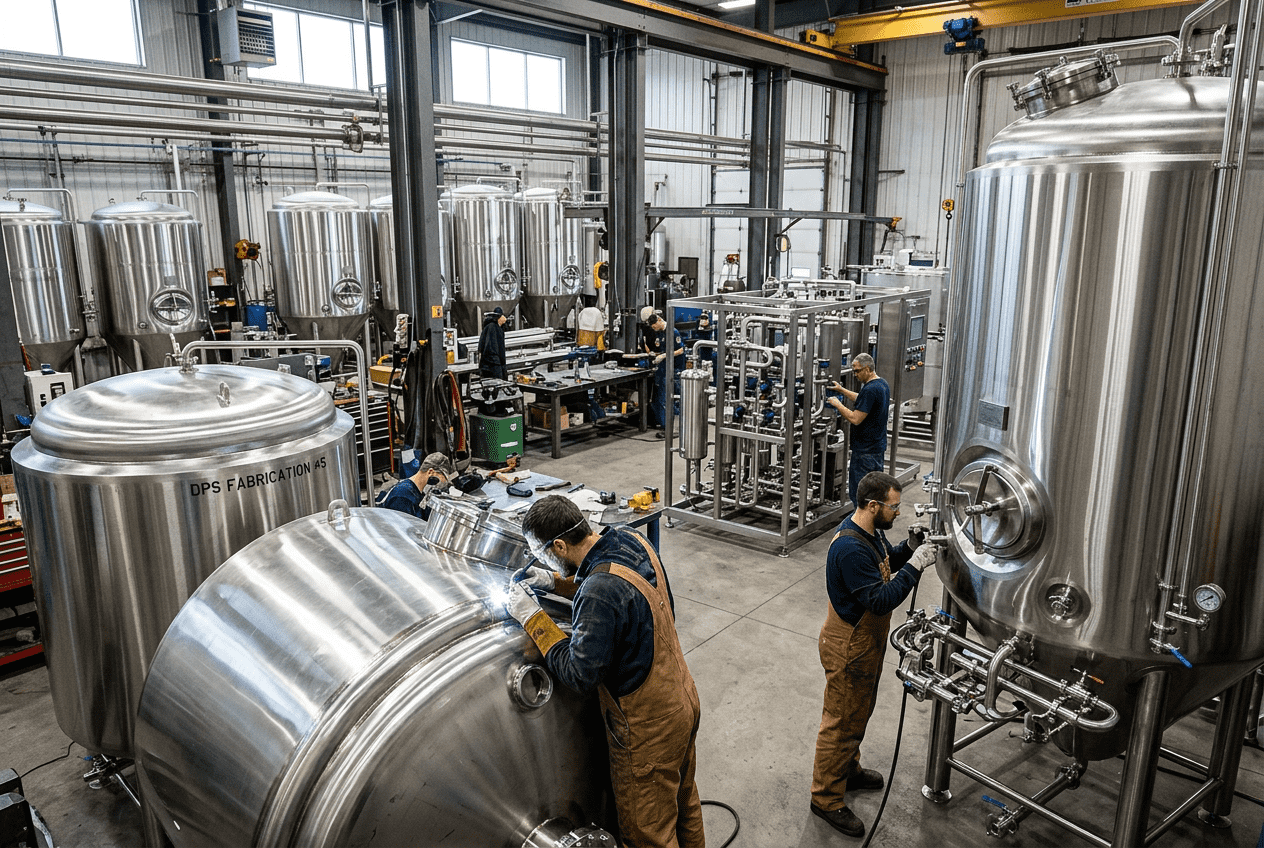
Challenges in Providing This Service in the Market
Food and beverage manufacturers spend significant capital on process equipment every year, and the majority of that equipment is purchased in isolation — specified from a catalog, quoted by a sales representative who has never visited the facility, and delivered to a loading dock where a separate contractor figures out how to make it fit the existing process. The gap between what an equipment vendor delivers and what a production floor actually requires is where projects bleed money, lose weeks, and introduce risk that compounds through every downstream phase of construction and commissioning.
-
Challenge 01
Specification misalignment
Standard catalog vessels and tanks are designed to serve the broadest possible market, not your specific batch sizes, temperature profiles, CIP circuit configurations, or headspace requirements. Manufacturers routinely accept equipment that is 15–30% oversized or undersized for the actual duty because no off-the-shelf option matches the process engineering. That mismatch costs you in energy consumption, chemical usage, cycle times, and floor space for the entire operational life of the asset. -
Challenge 02
Integration burden transferred to the owner
When equipment arrives from one vendor, process piping from another, and controls from a third, the owner inherits responsibility for making those three scopes connect — mechanically, electrically, and logically. Nozzle orientations that conflict with piping runs, instrument connections that require adapter fittings, control panel wiring that does not match the integrator’s I/O list — every interface between independently sourced components generates field rework billed at construction-phase labor rates. -
Challenge 03
Lead time unpredictability
Imported stainless steel vessels from overseas fabricators carry lead times of 16 to 28 weeks with limited owner visibility into production status, quality control processes, or shipping logistics. A single delay in vessel delivery can cascade across an entire facility construction schedule, idling trade crews, pushing commissioning past seasonal demand windows, and deferring revenue by months. -
Challenge 04
Quality verification gaps
Equipment manufactured offshore or by vendors without direct food-industry process engineering expertise frequently arrives with weld quality, surface finish, or dimensional tolerances that do not meet 3-A Sanitary Standards or the specific requirements of FDA and USDA-regulated production environments. Discovering these deficiencies at the point of installation — after the vessel has shipped across an ocean — leaves the owner with limited recourse and expensive field remediation.
Building Scalable and Efficient Production Systems
DPS manufactures process equipment as an integrated discipline within the Design-Build-Manage model — not as a standalone product line. Every tank, vessel, CIP skid, tumbler, and kettle that leaves our fabrication program exists because a DPS process engineer specified it against a defined P&ID, a defined batch recipe, a defined facility layout, and a defined commissioning sequence. The equipment is not adapted to the project after purchase; it is created from the project’s engineering requirements from the first weld to final hydrostatic test. This approach eliminates the specification gap, the integration gap, and the coordination gap that define conventional equipment procurement in food and beverage manufacturing.
Our custom fabrication capabilities encompass stainless steel tanks and pressure vessels up to 12,000 gallons, complete CIP systems engineered to your specific soil loads and circuit configurations, marination tumblers, processing kettles, and specialty vessels for applications including fermentation, blending, batching, cooking, and storage. Every unit is fabricated to 3-A Sanitary Standards with surface finishes, weld quality, and dimensional tolerances verified before shipment. Because DPS also performs the process piping, controls integration, and commissioning on the projects where this equipment is installed, we design every nozzle location, every instrument port, every support leg height, and every lifting lug position to align precisely with field installation conditions — not to satisfy a generic arrangement drawing.
DPS equipment manufacturing is based in the United States, giving clients direct access to our fabrication team for design reviews, in-process inspections, and accelerated delivery schedules that are impossible to achieve with offshore suppliers. Current equipment revenue represents approximately 5% of DPS total revenue and is scaling rapidly as clients recognize the cost and schedule advantages of sourcing process equipment from the same firm that engineers and builds their facility. For manufacturers operating across multiple sites nationally, DPS provides equipment supply with consistent quality standards and engineering documentation across all 50 states and Canada.
Capabilities Supporting Modern Production Operations
Integrated engineering, operational, and project capabilities designed to support efficient, scalable, and reliable production environments.
-
PLC Programming & Logic Development
Custom ladder logic, structured text, and function block programs developed on Allen-Bradley, Siemens, and other major platforms for process control, safety interlocks, and high-speed sequencing across food and beverage unit operations. -
SCADA System Design & Deployment
Full supervisory control and data acquisition architecture including server configuration, real-time process visualization, historical trending, and role-based access designed for multi-line F&B production environments. -
Recipe Management & Batch Control
ISA-88-aligned recipe structures that allow production teams to manage formulations, ingredient scaling, and batch sequencing directly from the HMI — reducing changeover time and eliminating manual transcription errors. -
CIP/SIP Automation & Validation
Automated clean-in-place and sterilize-in-place sequences with full parametric data logging for FDA and USDA compliance, integrated with process scheduling to minimize non-productive time between production runs. -
Energy & Utility Management Systems
Real-time monitoring and automated control of boiler, compressed air, glycol, refrigeration, and HVAC systems to reduce per-unit energy cost while maintaining critical environmental parameters in temperature-sensitive processing areas. -
Controls Integration & Retrofits
Integration of new automation layers into existing brownfield facilities — migrating legacy relay logic or outdated DCS platforms to modern PLC/SCADA infrastructure without extended production shutdowns.
Engineering Scope & Deliverables
The following table summarizes DPS equipment manufacturing parameters across our primary product categories. All specifications represent standard capabilities; custom requirements beyond these ranges are evaluated on a project-specific basis.
| Equipment Category | Capacity Range | Materials & Standards | Key Configuration Options |
|---|---|---|---|
| Process Tanks | 50–12,000 gallons | 304/316L SS; 3-A Sanitary Standards; ≤32 Ra µin standard product-contact finish | Insulated/non-insulated, agitated/static, jacketed (steam/glycol/electric), cone/dish/flat bottom, pressure-rated options |
| Storage Vessels | 100–12,000 gallons | 304/316L SS; atmospheric or low-pressure rated; ASME code available | Vertical/horizontal orientation, level instrumentation provisions, vent and overflow sizing, CIP spray device integration |
| Fermentation Vessels | 100–12,000 gallons | 316L SS standard; 3-A compliant; dual-zone glycol jacket capability | Carbonation stones, sample ports, blow-off assemblies, temperature probes per zone, dry-hop ports, CIP-optimized geometry |
| CIP Systems | 2–4+ circuit systems | 304/316L SS construction; supply and return manifolds; chemical dosing integration | Single-use/re-use configurations, heat recovery, automated chemical concentration control, PLC-integrated with DPS batch/recipe systems |
| Marination Tumblers | 200–2,500 lb batch | 304 SS drum and frame; food-grade seals; variable speed drive | Vacuum capability, brine injection integration, programmable tumble/rest cycles, CIP-compatible drum design |
| Processing Kettles | 50–1,000 gallons | 304/316L SS; steam-jacketed or electric; 3-A Sanitary Standards | Scrape-surface agitation, tilt/discharge mechanisms, temperature control integration, direct-steam injection option |
| Custom Skid Assemblies | Project-specific | 304/316L SS; carbon steel frames; fully piped and wired on skid | Blending skids, batching skids, heat exchanger assemblies, filtration skids — pre-tested before shipment |
| Surface Finish Options | All product categories | Standard ≤32 Ra µin; high-polish ≤20 Ra µin; electropolish available | Mechanical polish, electropolish, passivation per ASTM A967, surface finish certification with Ra measurement documentation |
Common Questions About Automation & Controls Service
Quick answers to the questions we hear most often from prospective clients evaluating automation partners.

