Process Equipment Installation and System Integration for F&B Facilities
DPS installs, pipes, wires, and commissions complete food and beverage processing systems — from a single equipment line to an entire greenfield facility — under one contract, one schedule, and one accountable team. Because DPS engineers the process before installing it, every pipe run, utility connection, and control point is built exactly as designed, eliminating the field improvisation that inflates cost and delays production on conventionally bid projects.
Schedule A Consultation →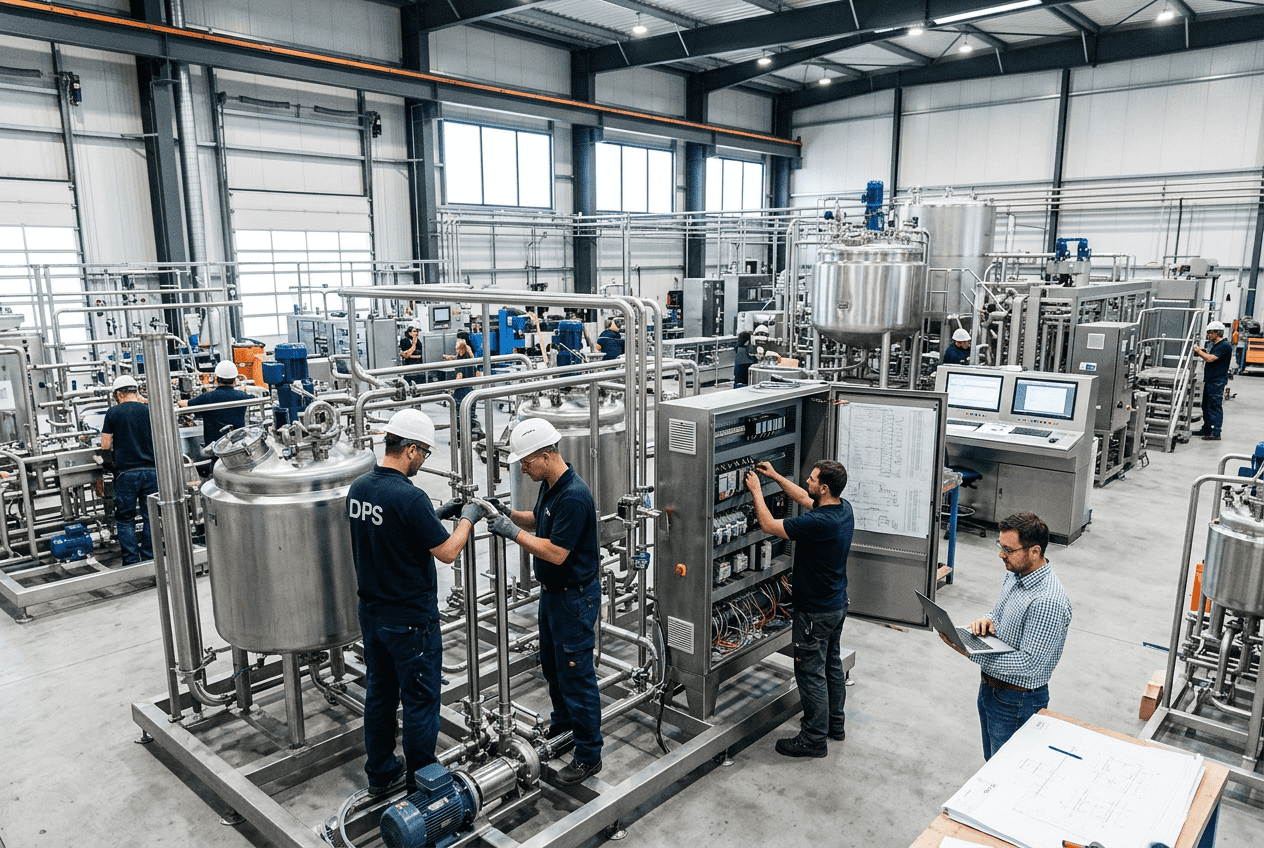
Challenges in Providing This Service in the Market
The installation phase is where food and beverage capital projects are most vulnerable. Engineering drawings transfer to a general contractor, who subcontracts mechanical piping to one firm, electrical to another, process equipment setting to a third, and controls wiring to a fourth. None of these subcontractors participated in the process design. None of them understand why a specific pipe slopes at 1/8″ per foot toward a drain point, why a valve actuator needs to be oriented for CIP return flow sequencing, or why a utility header was sized for a future expansion phase that is not in their scope of work. The result is a construction site where trades collide, RFIs multiply, and the owner — who may lack a dedicated technical project manager — absorbs every coordination failure as a change order, a schedule delay, or a system that does not run correctly at startup.
-
Challenge 01
Design-to-field information loss
When the firm that engineered the process is not the firm installing it, critical design intent is lost in the handoff. Pipe specifications get simplified, slope requirements get ignored for routing convenience, and instrument locations get moved to wherever the fitter finds room. These deviations may not surface until commissioning, when a CIP circuit will not drain, a temperature sensor reads inaccurately due to improper insertion depth, or a pump cavitates because suction piping was reconfigured in the field. -
Challenge 02
Multi-contractor coordination burden
On a typical mid-scale food facility project, the owner must coordinate between a mechanical contractor, an electrical contractor, a plumbing contractor, a controls integrator, a fire protection installer, and the equipment vendor’s startup technicians — six or more independent firms with separate schedules, separate shop drawing timelines, and competing claims to the same overhead space. Clash detection that should have happened in 3D modeling during engineering instead happens at 40 feet in the air with welders waiting. -
Challenge 03
Commissioning and startup risk
Equipment installation that is disconnected from process engineering produces systems that technically comply with the drawing set but do not function as an integrated production line. Utility capacities are not verified against simultaneous peak loads. Control interlocks between upstream and downstream equipment are tested in isolation rather than as a coordinated sequence. Manufacturers discover on day one of production that throughput, changeover times, or sanitation cycles do not meet the performance basis that justified the capital expenditure. -
Challenge 04
Regulatory and food safety exposure
Process piping installation in FDA- and USDA-regulated facilities demands strict adherence to sanitary welding procedures, material traceability, dead-leg elimination, and drainability standards. Mechanical contractors without food-industry specialization routinely install fittings, valve configurations, or piping geometries that create harborage points — deficiencies that food safety auditors will identify during SQF, BRC, or USDA pre-operational inspections and that require expensive remediation under operational time pressure.
Building Scalable and Efficient Production Systems
DPS performs physical installation and system integration as a continuous extension of the engineering that precedes it — not as a separate phase handed off to a separate organization. Within the Design-Build-Manage delivery model, the same DPS process engineers who developed your P&IDs, equipment specifications, and facility layout direct the installation scope: defining pipe routing, specifying weld procedures, sequencing equipment setting, coordinating utility tie-ins, and programming the controls that bring each system online. There is no handoff document, no reinterpretation of design intent by a third party, and no RFI cycle where field conditions force engineering rework weeks after the design was supposedly finalized.
Our installation execution is powered by a vetted national contractor network that DPS has qualified across all 50 states and Canada. DPS functions as the general contractor or construction manager on each project, deploying trade partners for mechanical piping, electrical, plumbing, structural steel, insulation, and specialty disciplines while retaining direct control over process piping installation, equipment setting and alignment, controls wiring, and system commissioning. This hybrid model delivers the on-the-ground trade capacity of a large regional contractor with the process engineering intelligence of the firm that designed the system — a combination that virtually no single contractor in the U.S. food and beverage construction market can replicate.
System integration at DPS means more than connecting equipment to utilities. It means verifying that every process line operates as a coordinated production system before the owner takes possession. DPS commissioning protocols test each unit operation individually, then validate integrated sequences — CIP circuits across multiple zones, batch control handoffs between upstream blending and downstream filling, simultaneous utility peak loads on steam, compressed air, glycol, and process water — under conditions that replicate actual production. The facility you receive on turnover day is not a collection of individually tested components; it is a functioning production line with verified throughput, documented sanitation cycles, and trained operators.
Capabilities Supporting Modern Production Operations
Integrated engineering, operational, and project capabilities designed to support efficient, scalable, and reliable production environments.
-
PLC Programming & Logic Development
Custom ladder logic, structured text, and function block programs developed on Allen-Bradley, Siemens, and other major platforms for process control, safety interlocks, and high-speed sequencing across food and beverage unit operations. -
SCADA System Design & Deployment
Full supervisory control and data acquisition architecture including server configuration, real-time process visualization, historical trending, and role-based access designed for multi-line F&B production environments. -
Recipe Management & Batch Control
ISA-88-aligned recipe structures that allow production teams to manage formulations, ingredient scaling, and batch sequencing directly from the HMI — reducing changeover time and eliminating manual transcription errors. -
CIP/SIP Automation & Validation
Automated clean-in-place and sterilize-in-place sequences with full parametric data logging for FDA and USDA compliance, integrated with process scheduling to minimize non-productive time between production runs. -
Energy & Utility Management Systems
Real-time monitoring and automated control of boiler, compressed air, glycol, refrigeration, and HVAC systems to reduce per-unit energy cost while maintaining critical environmental parameters in temperature-sensitive processing areas. -
Controls Integration & Retrofits
Integration of new automation layers into existing brownfield facilities — migrating legacy relay logic or outdated DCS platforms to modern PLC/SCADA infrastructure without extended production shutdowns.
Engineering Scope & Deliverables
DPS installation and system integration engagements are scoped as defined work packages with specific deliverables at each phase. The following table outlines our standard installation disciplines, scope boundaries, and documentation deliverables for a typical food or beverage processing facility project.
| Installation Discipline | Scope of Work | Owner Deliverables |
|---|---|---|
| Process Piping | Sanitary SS tubing (orbital and manual TIG), industrial process piping, valve assemblies, expansion joints, pipe supports, insulation, slope verification | Weld logs with welder ID, borescope inspection reports, passivation certificates, pressure test records, as-built isometric drawings |
| Equipment Setting | Rigging, lifting, precision placement, anchor bolt installation, leveling, alignment, vibration isolation mounting | Equipment placement records, laser alignment reports, anchor bolt torque documentation, seismic anchorage calculations |
| Mechanical Utilities | Steam/condensate, compressed air, glycol supply/return, process water, wastewater, refrigeration piping, HVAC ductwork | Utility load verification, pressure test records, insulation inspection, balancing reports, as-built utility drawings |
| Electrical Power | Main service entrance coordination, switchgear, panelboards, MCCs, VFDs, conduit and wire runs, grounding, arc flash labeling | Single-line diagram updates, panel schedules, wire pull sheets, megger test reports, arc flash study and labels per NFPA 70E |
| Instrumentation Wiring | Field routing of instrument cables, junction boxes, instrument mounting, tubing runs for pneumatic actuators | Cable schedule, instrument location drawings, cable continuity test records, instrument calibration certificates |
| Controls Integration | Panel termination, I/O point-to-point checkout, signal verification, network infrastructure, HMI/SCADA connectivity | I/O checkout sheets (signed per point), network architecture documentation, panel as-built drawings |
| CIP System Installation | Supply and return piping to all CIP circuits, chemical delivery piping, spray device installation, drain verification | CIP circuit matrix, spray coverage verification, drain slope confirmation, chemical supply P&ID as-built |
| Commissioning & Startup | Hydrostatic/pneumatic testing, loop checks, functional testing per system, integrated sequence testing, CIP validation, operator walk-through | Commissioning protocol with pass/fail records, punch list resolution log, CIP validation report, operator training sign-off, substantial completion certificate |
Common Questions About Automation & Controls Service
Quick answers to the questions we hear most often from prospective clients evaluating automation partners.