CIP Systems CIP
DPS designs and fabricates automated clean-in-place systems sized, circuited, and controlled as part of your total facility design. When your CIP supplier is the same team that engineers your tanks, process piping, and automation controls, every spray device, valve, and return line is positioned exactly where the process demands — delivering validated sanitary cleaning with less water, less chemical, and less downtime than retrofit alternatives.
Discuss Your Equipment Requirements →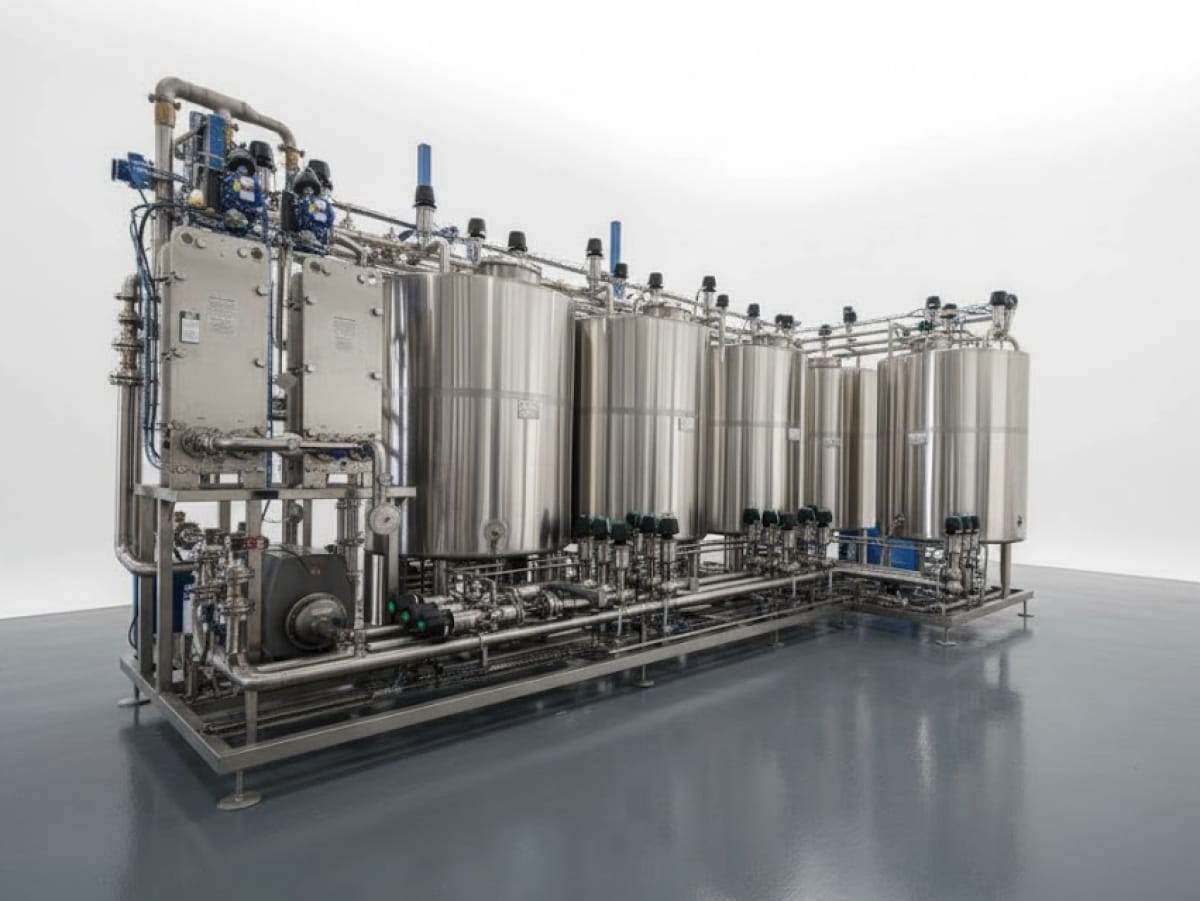
Clean-in-Place Systems Built Around Your Process — Not the Other Way Around
A CIP system is the sanitary backbone of every food and beverage processing facility. It circulates precisely heated cleaning and sanitizing solutions — caustic, acid, and rinse water — through tanks, heat exchangers, filling lines, and interconnecting piping without disassembly. When a CIP system is correctly engineered, it protects product safety, reduces water and chemical consumption, shortens changeover windows, and delivers repeatable sanitization that satisfies FDA 21 CFR Part 117, USDA-FSIS requirements, and third-party audit standards like SQF and BRC. When it is poorly designed, it becomes the single largest source of downtime, chemical waste, and audit findings in the plant.
DPS designs and fabricates automated CIP systems in-house because clean-in-place performance is inseparable from the process it serves. Circuit routing, flow velocity calculations, supply and return tank sizing, chemical concentration control, and temperature ramp profiles all depend on the specific vessels, piping geometry, and production schedule they support. By engineering CIP as a native component of every Design-Build-Manage project — rather than sourcing a generic skid from a catalog — DPS ensures that every spray device, every valve sequence, and every drain pitch is validated against your actual process before the system ships. For facilities operating across multiple production lines or managing multi-product changeovers, this integrated approach eliminates the mismatches that cause re-cleans, extended hold times, and failed ATP swabs.
Equipment Applications Across Food and Beverage Manufacturing
Practical engineering solutions designed to improve efficiency, scalability, and operational performance.
-
1
Sauces, Marinades & Dressings
Cooking kettles are the production backbone for tomato-based sauces, vinaigrettes, hot sauces, cheese sauces, and shelf-stable marinades. DPS specifies jacket capacity, agitator geometry, and steam flow rates to hit precise cook temperatures and hold times required by each product’s scheduled process, while high-shear agitation options ensure emulsion stability and particle-size consistency across batches ranging from pilot scale to full production volumes. -
2
Soups, Stews & Prepared Foods
Chunked-ingredient products such as soups and stews demand gentle agitation that maintains piece integrity while preventing scorching on the heat-transfer surface. DPS kettles for prepared foods applications incorporate slow-speed sweep agitators with PTFE scraper blades, zoned jacket heating to prevent localized hot spots, and large-diameter bottom outlets that discharge whole vegetable and protein pieces without damage. -
3
Dairy Processing
From pasteurized fluid milk bases and cultured products to cheese sauce, yogurt premixes, and ice cream bases, dairy applications require kettle specifications that satisfy both thermal performance and 3-A Sanitary Standards. DPS builds dairy kettles with electropolished product-contact surfaces, sanitary agitator shaft seals, CIP-ready nozzle configurations, and temperature instrumentation validated for HACCP critical control point monitoring. -
4
Confectionery & Sweetened Products
Sugar syrups, caramel, toffee, and fruit fillings require precise temperature ramping to achieve target Brix concentrations without scorching or crystallization. DPS configures cooking kettles for confectionery with high-pressure jacket ratings for rapid heat delivery, programmable multi-stage cook profiles, and scrape-surface agitation that keeps viscous product moving continuously across the heated wall. -
5
Co-Packing & Contract Manufacturing
Contract manufacturers running dozens of SKUs across multiple product categories need cooking kettles that change over rapidly and document every batch electronically for multi-standard audit compliance. DPS builds multi-recipe automation into the kettle’s PLC and SCADA architecture, enabling push-button recipe selection, automatic CIP sequencing between product changeovers, and electronic batch records that satisfy SQF, BRC, and retailer-specific food safety audit requirements simultaneously.
System Specifications and Design Parameters
The specifications below represent DPS’s standard CIP fabrication and engineering capability. Every system is custom-designed to match your facility’s specific circuit count, soil characteristics, production schedule, and regulatory environment.
| Parameter | Specification |
|---|---|
| System Configurations | Single-tank, multi-tank, and eductor-based recovery CIP; portable or centralized skid-mount |
| Supply Tank Capacity | 50 to 1,500 gallons per tank (wash, rinse, sanitize, recovery) |
| Circuit Capacity | Systems engineered from 2 to 20+ independent CIP circuits per facility |
| Materials of Construction | 304 and 316L stainless steel; all wetted surfaces food-contact grade |
| Sanitary Standards | 3-A Sanitary Standards compliant; tri-clamp connections; sloped drain construction |
| Supply Pump Sizing | Centrifugal sanitary pumps sized per circuit: 10–300 GPM at calculated system head |
| Spray Device Integration | Rotary spray heads, static spray balls, or high-impact tank cleaning devices; coverage validated per vessel geometry |
| Chemical Dosing | Automated concentration control via conductivity measurement; compatible with caustic, acid, PAA, and chlorinated sanitizers |
| Heating Method | Steam injection, electric immersion, or shell-and-tube heat exchange; wash temperatures up to 185°F |
| Controls & Automation | PLC-controlled sequencing with HMI touchscreen; SCADA integration, recipe-based cycle management, data logging |
| Regulatory Compliance | Designed for FDA 21 CFR Part 117, USDA FSIS, SQF, BRC, FSSC 22000, PMO/Grade A dairy requirements |
| Documentation | Functional design specification, I/O list, weld records, material certs, FAT protocol, CIP validation support package |