Tumblers & Marinators
DPS designs and fabricates vacuum tumblers and marination systems as fully integrated components of your protein processing facility — not isolated catalog purchases. When your tumbler manufacturer is the same engineering team that designs your process flow, utility connections, automation controls, and upstream/downstream equipment, every cycle parameter is optimized for your specific product, your throughput targets, and your USDA-inspected production environment.
Discuss Your Equipment Requirements →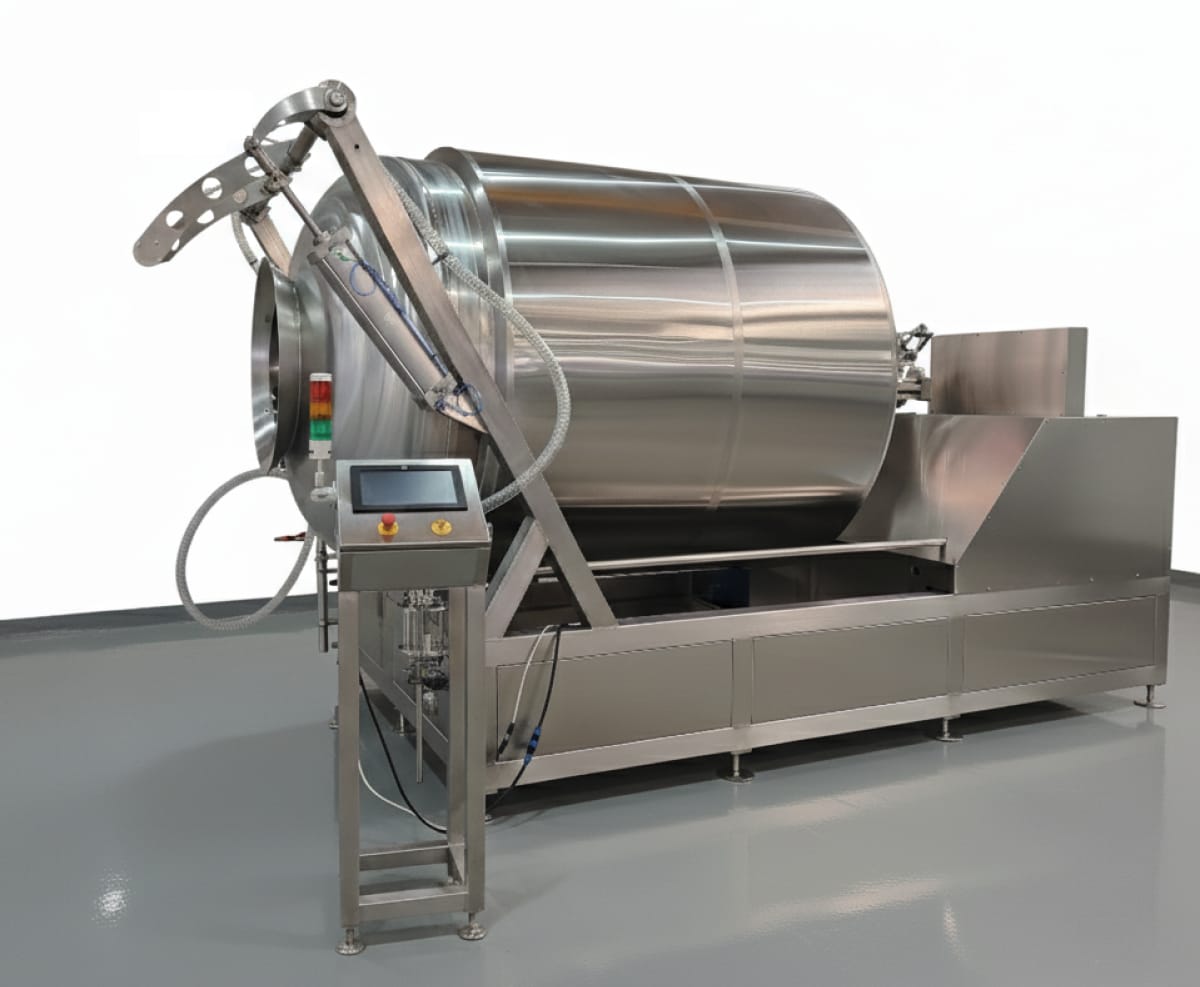
Protein Marination Equipment Designed Around Your Process — Not a Catalog Selection
Tumblers and marinators are the critical intersection of flavor, yield, and throughput in every protein processing operation. A properly engineered meat tumbler applies controlled mechanical action — rotation, tumbling, and vacuum cycling — to drive brine, marinades, and seasoning solutions deep into muscle fiber, producing consistent flavor penetration, improved bind, and measurable yield gains across beef, pork, poultry, seafood, and plant-based protein lines. The physics are straightforward, but execution demands precision: drum geometry, baffle configuration, rotation speed, vacuum depth, cycle timing, and temperature control must all be calibrated to the specific protein, the specific marinade viscosity, and the specific production target. Generic, off-the-shelf tumblers force processors to adapt their recipes and line speeds to the machine. DPS builds tumblers that adapt to the process.
DPS manufactures industrial vacuum tumblers and marination systems in-house because marination performance is a direct function of how the equipment interfaces with upstream brine preparation, downstream portioning or packaging, and plant-wide CIP and refrigeration infrastructure. When a single engineering team designs the tumbler, the brine mixing system, the CIP circuits that clean it, and the automation that sequences it all, every variable is accounted for before fabrication begins. This single-source approach eliminates the integration gaps that plague multi-vendor equipment floors — mismatched discharge heights, incompatible control protocols, orphaned utility connections — and gives operations teams one phone number to call when they need recipe adjustments, throughput optimization, or expansion support anywhere in the United States or Canada.
Equipment Applications Across Food and Beverage Manufacturing
Practical engineering solutions designed to improve efficiency, scalability, and operational performance.
-
1
Sauces, Marinades & Dressings
Cooking kettles are the production backbone for tomato-based sauces, vinaigrettes, hot sauces, cheese sauces, and shelf-stable marinades. DPS specifies jacket capacity, agitator geometry, and steam flow rates to hit precise cook temperatures and hold times required by each product’s scheduled process, while high-shear agitation options ensure emulsion stability and particle-size consistency across batches ranging from pilot scale to full production volumes. -
2
Soups, Stews & Prepared Foods
Chunked-ingredient products such as soups and stews demand gentle agitation that maintains piece integrity while preventing scorching on the heat-transfer surface. DPS kettles for prepared foods applications incorporate slow-speed sweep agitators with PTFE scraper blades, zoned jacket heating to prevent localized hot spots, and large-diameter bottom outlets that discharge whole vegetable and protein pieces without damage. -
3
Dairy Processing
From pasteurized fluid milk bases and cultured products to cheese sauce, yogurt premixes, and ice cream bases, dairy applications require kettle specifications that satisfy both thermal performance and 3-A Sanitary Standards. DPS builds dairy kettles with electropolished product-contact surfaces, sanitary agitator shaft seals, CIP-ready nozzle configurations, and temperature instrumentation validated for HACCP critical control point monitoring. -
4
Confectionery & Sweetened Products
Sugar syrups, caramel, toffee, and fruit fillings require precise temperature ramping to achieve target Brix concentrations without scorching or crystallization. DPS configures cooking kettles for confectionery with high-pressure jacket ratings for rapid heat delivery, programmable multi-stage cook profiles, and scrape-surface agitation that keeps viscous product moving continuously across the heated wall. -
5
Co-Packing & Contract Manufacturing
Contract manufacturers running dozens of SKUs across multiple product categories need cooking kettles that change over rapidly and document every batch electronically for multi-standard audit compliance. DPS builds multi-recipe automation into the kettle’s PLC and SCADA architecture, enabling push-button recipe selection, automatic CIP sequencing between product changeovers, and electronic batch records that satisfy SQF, BRC, and retailer-specific food safety audit requirements simultaneously.
System Specifications and Design Parameters
Every DPS tumbler is custom-engineered to your specific product, batch size, cycle requirements, and facility layout. The specifications below represent our standard fabrication range and configurable parameters.
| Parameter | Specification |
|---|---|
| Drum Working Capacity | 200 to 12,000 gallons; sized to match batch weight targets and production schedule requirements |
| Materials of Construction | 304 and 316L stainless steel; all product-contact surfaces polished to ≤32 Ra µin finish or better |
| Drum Drive & Speed | Variable-frequency drive (VFD) with adjustable rotation speed from 2 to 16 RPM; forward, reverse, and intermittent cycle programming |
| Vacuum System | Integrated vacuum pump capable of achieving and holding 25–29 inHg; automatic vacuum monitoring with leak detection and alarm |
| Internal Baffle Design | Configurable baffle height, angle, count, and profile — optimized per product type (whole muscle, tumbled pieces, ground/formed) to control mechanical action intensity |
| Loading & Discharge | Front-loading door with sanitary seal; hydraulic or pneumatic tilt discharge available for rapid unloading; optional bottom discharge valve for brine recovery |
| Temperature Management | Jacketed drum option for glycol or chilled water circulation; maintains product temperature below 40°F during extended marination cycles per USDA cold-chain requirements |
| Controls & Automation | PLC-controlled cycle management with HMI touchscreen; recipe storage for multiple product SKUs; SCADA integration, electronic batch records, and data logging |
| Sanitary Design | 3-A Sanitary Standards principles; fully drainable construction, no horizontal ledges, sealed bearings, tool-free removable baffles for inspection and cleaning |
| Regulatory Compliance | Designed for USDA FSIS inspection environments, FDA 21 CFR Part 117, HACCP/HARPC compatibility, SQF and BRC audit readiness |
| CIP/COP Compatibility | Integrated spray nozzle bosses for clean-in-place operation; designed to coordinate with DPS-engineered CIP systems or existing facility CIP infrastructure |
| Documentation Package | General arrangement drawings, electrical schematics, weld records, material certifications, O&M manual, FAT protocol, and commissioning support |