
Kettles & Cookers
DPS fabricates cooking kettles and processing vessels as integral components of a complete facility design — not aftermarket additions bolted onto someone else’s process flow. When the same engineering team that specifies your steam supply, process piping, CIP circuits, automation controls, and downstream filling also builds the kettle, every thermal parameter is dialed in for your formulation, your throughput, and your food safety program from day one.
Discuss Your Equipment Requirements →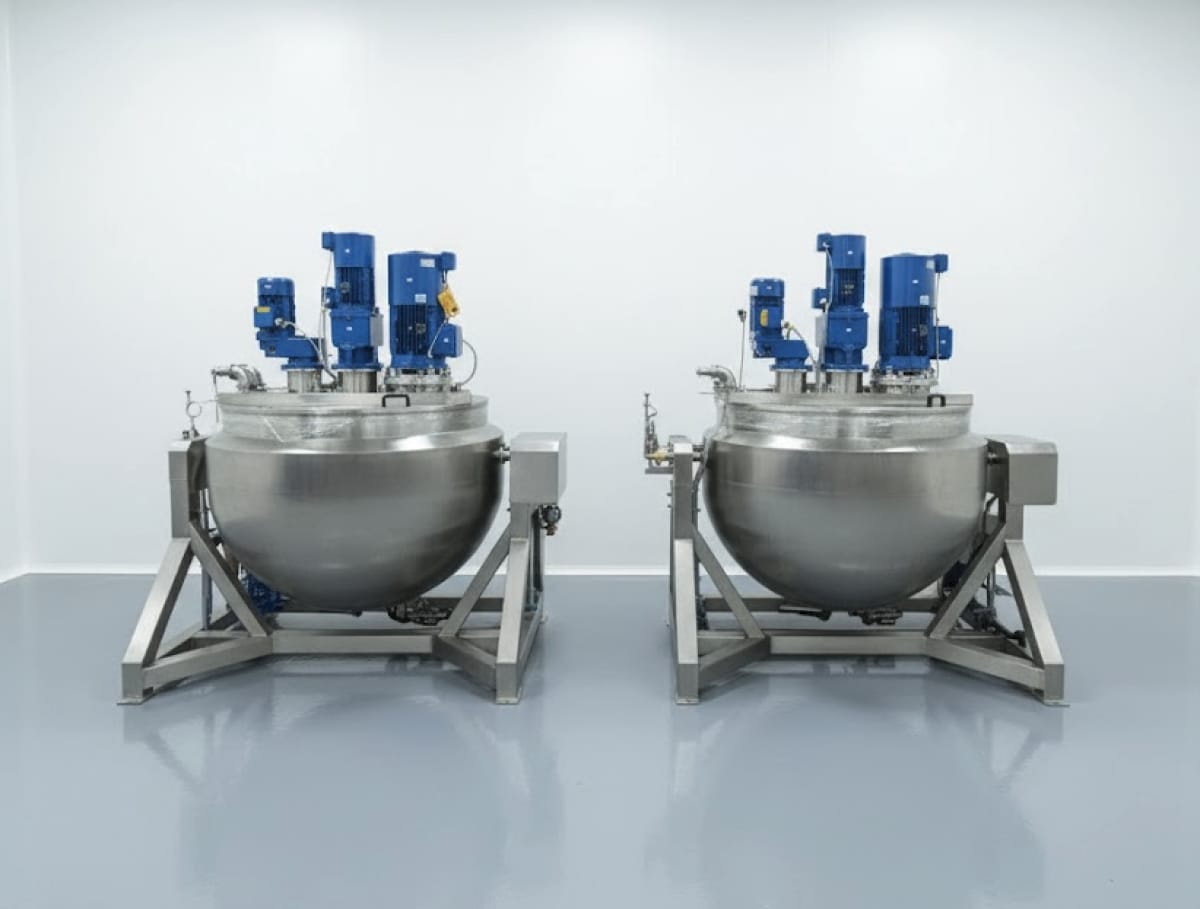
Processing Kettles and Cookers Designed for Your Thermal Process — Not Adapted from a Catalog
Industrial cooking kettles and processing cookers are the thermal core of sauce, soup, dairy, confectionery, and prepared-food production lines. A properly engineered steam kettle delivers precise, uniform heat transfer across the entire batch — controlling jacket pressure, agitation intensity, temperature ramp rate, and hold time to hit exact viscosity, color, Brix, and microbiological targets cycle after cycle. The variables that separate a high-performing cooking vessel from a chronic bottleneck are specific to each application: a cheese sauce with particulates demands different agitation geometry than a clear broth, a caramel cook requires different jacket zoning than a cream-based soup, and a 2,000-gallon batch vessel needs fundamentally different heat-transfer calculations than a 100-gallon recipe development kettle. Off-the-shelf cookers force compromises at every one of these decision points. DPS eliminates those compromises by engineering each vessel around the product it will cook.
DPS manufactures steam-jacketed kettles and industrial cookers in-house because thermal processing performance depends on tight integration between the vessel, the steam supply, the agitation system, the instrumentation, the CIP circuits, and the automation platform that sequences them. When one engineering team designs the kettle, calculates the steam load, specifies the agitator drive, programs the PLC recipe logic, and routes the CIP return line, every interface is resolved on paper before stainless steel is cut. This single-source approach — from initial process engineering through fabrication, installation, and controls commissioning — means no finger-pointing between a vessel supplier, a controls integrator, and a mechanical contractor when something does not perform. DPS delivers cooking systems across all 50 U.S. states and Canada, with domestic fabrication that keeps lead times predictable and quality under direct supervision from the same engineers who created the design.
Equipment Applications Across Food and Beverage Manufacturing
Practical engineering solutions designed to improve efficiency, scalability, and operational performance.
-
1
Sauces, Marinades & Dressings
Cooking kettles are the production backbone for tomato-based sauces, vinaigrettes, hot sauces, cheese sauces, and shelf-stable marinades. DPS specifies jacket capacity, agitator geometry, and steam flow rates to hit precise cook temperatures and hold times required by each product’s scheduled process, while high-shear agitation options ensure emulsion stability and particle-size consistency across batches ranging from pilot scale to full production volumes. -
2
Soups, Stews & Prepared Foods
Chunked-ingredient products such as soups and stews demand gentle agitation that maintains piece integrity while preventing scorching on the heat-transfer surface. DPS kettles for prepared foods applications incorporate slow-speed sweep agitators with PTFE scraper blades, zoned jacket heating to prevent localized hot spots, and large-diameter bottom outlets that discharge whole vegetable and protein pieces without damage. -
3
Dairy Processing
From pasteurized fluid milk bases and cultured products to cheese sauce, yogurt premixes, and ice cream bases, dairy applications require kettle specifications that satisfy both thermal performance and 3-A Sanitary Standards. DPS builds dairy kettles with electropolished product-contact surfaces, sanitary agitator shaft seals, CIP-ready nozzle configurations, and temperature instrumentation validated for HACCP critical control point monitoring. -
4
Confectionery & Sweetened Products
Sugar syrups, caramel, toffee, and fruit fillings require precise temperature ramping to achieve target Brix concentrations without scorching or crystallization. DPS configures cooking kettles for confectionery with high-pressure jacket ratings for rapid heat delivery, programmable multi-stage cook profiles, and scrape-surface agitation that keeps viscous product moving continuously across the heated wall. -
5
Co-Packing & Contract Manufacturing
Contract manufacturers running dozens of SKUs across multiple product categories need cooking kettles that change over rapidly and document every batch electronically for multi-standard audit compliance. DPS builds multi-recipe automation into the kettle’s PLC and SCADA architecture, enabling push-button recipe selection, automatic CIP sequencing between product changeovers, and electronic batch records that satisfy SQF, BRC, and retailer-specific food safety audit requirements simultaneously.
System Specifications and Design Parameters
Every DPS kettle is custom-specified to your product formulation, batch size, thermal process, and facility utility infrastructure. The parameters below represent our standard fabrication range and configurable options.
| Parameter | Specification |
|---|---|
| Working Capacity | 50 to 5,000 gallons per vessel; sized to batch weight, cook cycle duration, and daily production throughput targets |
| Materials of Construction | 304 and 316L stainless steel; all product-contact surfaces finished to ≤32 Ra µin or better per 3-A Sanitary Standards |
| Jacket Design | Full or zoned dimple/conventional jackets rated for steam pressures up to 150 psig; ASME Section VIII code-stamped where required; optional dual-zone heating and cooling jackets |
| Heating Method | Steam jacketed (indirect), direct steam injection, or combination; compatible with plant boiler systems from 15 to 150 psig supply pressure |
| Agitation System | Top-entering or bottom-mounted agitators; anchor, sweep, high-shear, or counter-rotating blade configurations; VFD-controlled from 5 to 120 RPM depending on product viscosity profile |
| Temperature Control | RTD or thermocouple instrumentation with ±1°F accuracy; PID-loop control via integrated PLC; programmable ramp, hold, and cool-down profiles for HACCP-validated cook processes |
| Discharge & Transfer | Bottom outlet valves (sanitary butterfly or mix-proof), tilt-pour mechanism on smaller kettles, positive-displacement pump packages for viscous products |
| CIP Integration | Built-in CIP spray devices and fully drainable interior geometry; nozzle placement coordinated with DPS-engineered or existing facility CIP supply and return circuits |
| Controls & Automation | PLC-based recipe management with HMI touchscreen; multi-recipe storage; SCADA integration for batch tracking, electronic cook records, and alarm management |
| Regulatory Compliance | Designed for FDA 21 CFR Part 117, USDA FSIS inspection environments, HACCP/HARPC critical control point documentation, SQF and BRC audit readiness |
| Insulation & Personnel Safety | Mineral wool or foam insulation with stainless cladding; surface temperatures maintained below OSHA burn-threshold guidelines; guarded agitator drives and emergency stop circuits |
| Documentation Package | General arrangement and fabrication drawings, ASME data reports (where applicable), weld records with material certifications, P&ID markups, O&M manual, FAT protocols, and on-site commissioning support |

