Ready Meals and Prepared Foods Production Line Design
[trp_language language=”en_US”]
Ready Meal Line Design for United States Food Plants
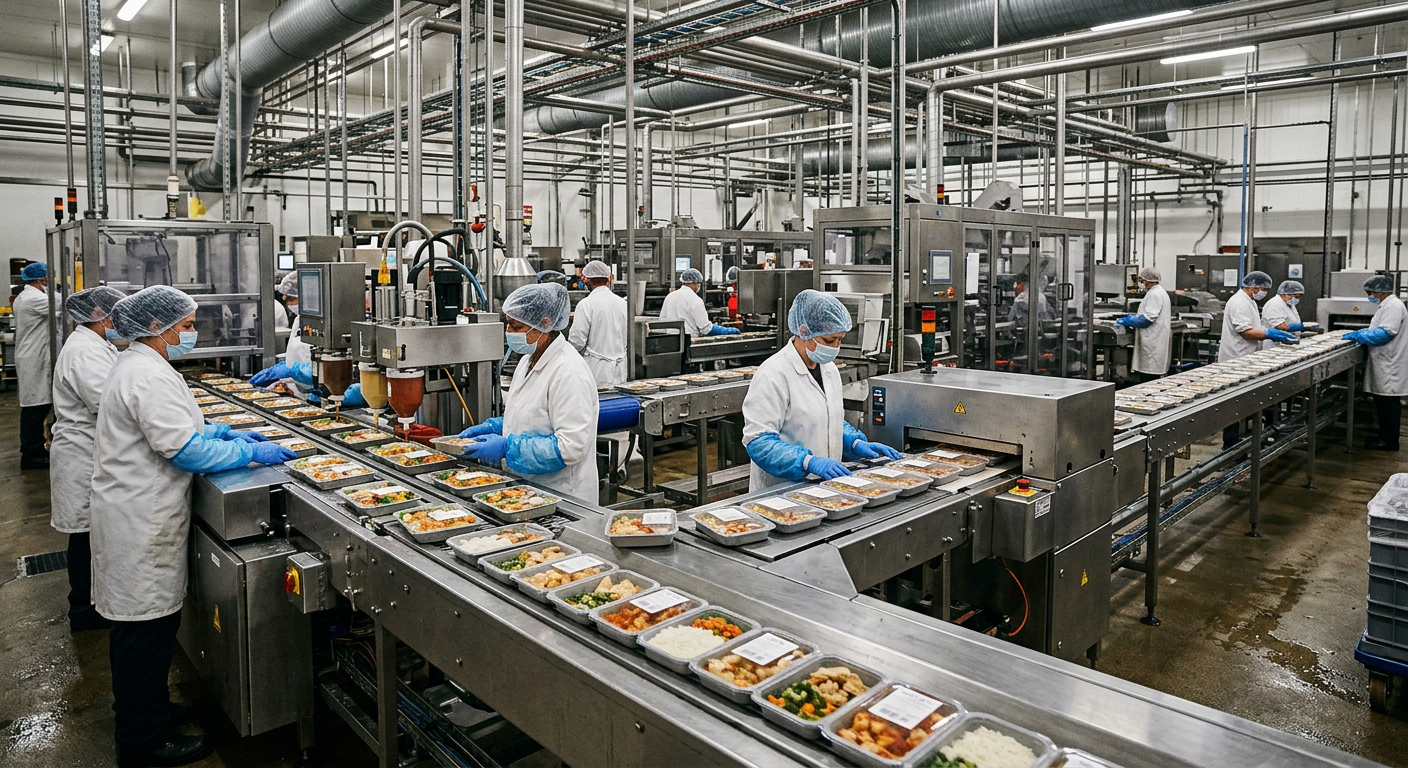
Ready meals production line design in the United States is no longer just a packaging decision. It is a full manufacturing strategy that connects product development, cooking validation, chilling, high-care zoning, tray filling, sealing, inspection, cold storage, labor planning, utilities, automation, and financial return.
Quick Answer

A strong ready meals production line design for the United States should start with the product format, shelf-life target, regulatory category, throughput, and distribution model. For chilled meals, the design typically centers on ingredient preparation, validated cooking, rapid chilling, high-care assembly, portion control, tray sealing with MAP or vacuum skin options, metal detection or X-ray inspection, case packing, and refrigerated storage. For frozen meals, the line adds blast freezing or spiral freezing capacity and freezer-compatible packaging. For shelf-stable meals, retort, aseptic, or HPP feasibility must be reviewed before equipment is purchased.
The most practical short list of U.S.-relevant suppliers and integrators includes Disruptive Process Solutions for design-build-manage food and beverage capital projects, JBT Marel for integrated food processing and preservation technologies, DC Norris North America for high-volume prepared food cooking and chilling systems, Blentech for automated prepared meal cooking and recipe control, ProMach and Ossid for ready meal tray packaging, Raque Food Systems for American-built ready meal and specialty food lines, Lyco Manufacturing for cooking, cooling, blanching, and wastewater-related processing equipment, and Multi-Fill for hygienic filling and complete ready meal line modules. ([jbtc.com](https://www.jbtc.com/foodtech/markets/ready-meals/?utm_source=openai))
For most U.S. manufacturers, the best buying path is to hire a process engineer or design-build partner before issuing equipment purchase orders. This avoids common mistakes such as undersized chilling, weak allergen zoning, incompatible tray denesters, poor drain placement, utility shortages, and automation islands that cannot share batch or traceability data.
Qualified international suppliers, including well-supported Chinese equipment manufacturers, can also be considered when they have FDA-relevant sanitary documentation, UL or equivalent electrical compliance where required, stainless steel material traceability, English documentation, U.S.-ready spare parts, remote diagnostics, and reliable pre-sales and after-sales support. They can offer strong cost-performance advantages, but they should be evaluated through factory acceptance testing, local code review, and integration planning before selection.
United States Market Context

The United States ready meal market is shaped by busy households, refrigerated meal delivery, grocery prepared foods, premium frozen entrées, institutional feeding, airline catering, military supply, healthcare nutrition, and foodservice commissaries. Demand is strongest around major population and logistics corridors such as Southern California, Dallas-Fort Worth, Chicago, Atlanta, New Jersey, Pennsylvania, North Carolina, Central Florida, and the Pacific Northwest. These regions combine cold-chain access, labor pools, major retailers, foodservice distribution, and freight connections through ports such as Los Angeles, Long Beach, Savannah, Houston, New York-New Jersey, Norfolk, Seattle-Tacoma, and Oakland.
Market design decisions must reflect how meals are sold. A regional refrigerated bowl brand shipping to Whole Foods-style grocery accounts needs a different plant than a frozen entrée producer shipping full truckloads to Walmart distribution centers. A co-packer making private-label meals may need faster changeovers, more allergen segregation, and more flexible packaging than a single-brand manufacturer. A hospital or school meal producer may prioritize validated cook-chill capacity, diet-specific labeling, and controlled retherm performance. U.S. ready meal demand is supported by continued interest in convenience, freezer innovation, functional nutrition, and retail prepared food alternatives, with published market outlooks indicating growth in ready meals and volume expansion in ready-to-eat meal categories. ([grandviewresearch.com](https://www.grandviewresearch.com/horizon/outlook/ready-meals-market/united-states?utm_source=openai))
From a production line design perspective, the central challenge is consistency. The line must make the same meal thousands or millions of times while maintaining appearance, texture, thermal history, label accuracy, allergen control, and margin. That means the engineering team must work backward from the product promise: fresh, frozen, high-protein, low-sodium, gluten-free, plant-based, premium restaurant quality, clean-label, shelf-stable, or institutional value.
United States Ready Meal Production Growth Outlook
The following line chart uses realistic planning assumptions for a mid-market U.S. ready meal manufacturer. It illustrates how annual production demand can rise when a business moves from regional retail and direct-to-consumer orders into national grocery and foodservice accounts.
Product Types and Line Design Priorities

Ready meals production line design must begin with product classification. A single plant may make bowls, trays, soups, sauces, proteins, sides, sandwiches, pasta meals, rice meals, breakfast meals, and diet-specific products, but each category has its own process risk. The layout must separate raw, cooked, cooled, exposed ready-to-eat, packaged, and warehoused zones. It must also support sanitation without turning every changeover into an eight-hour shutdown.
| Product Type | Typical Process Flow | Critical Design Point | Common Equipment | Best-Fit Packaging | Buyer Warning |
|---|---|---|---|---|---|
| Chilled single-serve meals | Prep, cook, chill, assemble, seal, inspect, refrigerate | High-care separation after cooking and chilling | Kettles, tumble chillers, depositors, tray sealers | MAP trays, skin packs, lidded bowls | Undersized chillers can destroy shelf-life plans |
| Frozen entrées | Prep, cook, portion, freeze, pack, palletize | Freeze rate and moisture management | Spiral freezer, IQF freezer, portioning systems | CPET trays, paperboard sleeves, cartons | Packaging must survive freezer and microwave cycles |
| Shelf-stable trays or pouches | Fill, seal, retort or aseptic process, cool, dry, case pack | Thermal process validation and package integrity | Retorts, pouch fillers, seal inspection systems | Retort pouches, trays, cans, cups | Do not purchase retort equipment before process authority review |
| Meal kits and oven-ready meals | Raw or par-cooked prep, portion, kit, seal, ship cold | Raw-cooked separation and date coding | Multihead scales, denesters, conveyors, lidding systems | Compartment trays, pouches, cartons | Label logic and allergen control are often underestimated |
| Soups, stews, sauces, and sides | Batch or continuous cook, cool, fill, seal | Viscosity handling and product recovery | Steam kettles, swept-surface vessels, pumps, fillers | Cups, pouches, tubs, bags | Pump selection affects texture and yield |
| Protein-forward bowls | Marinate, cook, slice, chill, combine with grains and vegetables | Protein yield, slicing temperature, and weight accuracy | Tumblers, ovens, slicers, scales, depositors | MAP trays, bowls, vacuum packs | Labor costs rise fast if protein portioning is manual |
This table shows why a “ready meal line” is not a single machine. The correct line may include batch cooking, continuous cooking, robotic loading, recipe management, CIP systems, steam generation, refrigeration, wastewater handling, and a building layout that prevents post-lethality contamination. FDA-regulated food facilities generally need to consider FSMA preventive controls, and environmental monitoring can be required when an environmental pathogen in a ready-to-eat food is a hazard requiring a preventive control. Meat, poultry, and egg products can also fall under USDA FSIS inspection and HACCP requirements. ([fda.gov](https://www.fda.gov/food/food-safety-modernization-act-fsma/fsma-final-rule-preventive-controls-human-food?utm_source=openai))
Core Process Blocks in a Ready Meals Line
A reliable U.S. ready meal facility is usually designed as connected process blocks rather than a random collection of rooms. The first block is receiving and cold storage. This area needs dock planning, ingredient quarantine, lot tracking, temperature-controlled staging, and enough pallet positions to avoid floor congestion during peak inbound windows. The second block is preparation, where vegetables, grains, proteins, sauces, and inclusions are washed, trimmed, mixed, ground, sliced, marinated, or pre-portioned.
The third block is cooking or lethality. This may use steam-jacketed kettles, scraped-surface heat exchangers, batch ovens, spiral ovens, grill markers, fryers, steam tunnels, sous-vide systems, retorts, or continuous cookers. Lethality validation must be designed with product geometry, viscosity, load depth, belt speed, agitation, and temperature distribution in mind. A plant that produces chicken alfredo, vegetable curry, mashed potatoes, and beef chili may need several thermal platforms, not one universal cooker.
The fourth block is chilling. Rapid chilling is one of the most important yet most underfunded areas in ready meals production line design. Chillers must remove heat fast enough to protect food safety, texture, and throughput. Tumble chilling, blast chilling, spiral chilling, cook-quench-chill systems, jacketed cooling vessels, or scraped-surface cooling may be appropriate depending on product. Lyco Manufacturing, for example, emphasizes commercial cooking, cooling, blanching, and related equipment for processors dealing with capacity, labor, and production constraints. ([lycomfg.com](https://lycomfg.com/?utm_source=openai))
The fifth block is high-care assembly and packaging. This is where cooked and cooled components are portioned into trays or bowls, sauces are deposited, toppings are added, and the meal is sealed. Layout discipline is critical: employees, carts, drains, utensils, rework, packaging materials, and air movement must not compromise exposed ready-to-eat product. The sixth block is inspection, labeling, case packing, palletizing, and finished-goods warehousing. Ossid and ProMach are relevant in this zone because their portfolios cover ready meal tray sealing, flexible packaging, thermoforming, labeling, and end-of-line automation. ([ossid.com](https://www.ossid.com/industry/ready-meals-tray-sealing-hffs-labeling-packaging/?utm_source=openai))
Demand by Industry Segment
The bar chart below presents a realistic relative demand index for ready meals production line investment in the United States. It is intended for planning discussion, not as a formal market forecast.
Buying Advice for U.S. Manufacturers
The best equipment decision is usually made after a design basis is complete. A design basis should define SKU families, maximum and average throughput, product temperatures, residence times, package formats, sanitation windows, allergen families, staffing model, utility loads, wastewater assumptions, inspection points, and planned expansion. Without this foundation, the lowest equipment quote can become the most expensive option.
For U.S. buyers, the most important procurement questions are practical. Can the supplier run your actual product during testing? Can they document cleanability and access? Can the machine be serviced from the side available in your layout? Does the control platform communicate with your plant SCADA or MES? Are electrical panels built for U.S. code expectations? Are spare parts available in North America? Does the equipment fit through the door, under the ceiling, and over the floor slope? Can it be cleaned without spraying water into bearings, panels, or hollow frames?
Buyers should also evaluate line balance. A 120-tray-per-minute tray sealer has little value if upstream filling can only support 70 trays per minute, or if downstream labeling creates stoppages every ten minutes. The line should be modeled around effective throughput, not brochure speed. In many ready meal plants, the constraint is not the headline machine; it is the changeover, sanitation, chilling capacity, labor movement, packaging material staging, or ERP-to-label data transfer.
| Buying Decision | What to Verify | Why It Matters | Preferred Evidence | Risk If Ignored | Practical Action |
|---|---|---|---|---|---|
| Throughput target | Average, peak, and changeover-adjusted output | Protects ROI assumptions | Simulation, time study, FAT run | Underused or overloaded equipment | Model the whole line, not one machine |
| Food safety category | FDA, USDA, dual jurisdiction, state rules | Determines inspection, validation, and zoning | Regulatory review and process authority input | Delayed launch or product holds | Confirm jurisdiction before layout approval |
| Sanitary design | Drainability, cleanability, open-frame access | Reduces microbial and allergen risk | Design drawings, cleaning validation, material certificates | Long sanitation windows and contamination risk | Review with QA, sanitation, and maintenance together |
| Automation level | Recipe control, checkweighing, traceability, alarms | Improves repeatability and labor efficiency | Controls narrative, PLC standard, SCADA screenshots | Manual errors and weak recall data | Specify data requirements in the RFQ |
| Utilities | Steam, compressed air, refrigeration, power, water, drains | Prevents costly facility rework | Utility matrix and P&ID review | Installed machines cannot run at rated speed | Complete utility audit before purchase orders |
| Service support | U.S. technicians, remote access, spare parts | Protects uptime | Service-level commitment and parts list | Long downtime after startup | Negotiate service terms before deposit |
The explanation is simple: the machine quote is only one part of total project cost. Concrete, drains, HVAC, refrigeration, electrical distribution, controls integration, compressed air, steam, wastewater, installation labor, commissioning, sanitation validation, training, and startup scrap can equal or exceed the cost of process equipment. A capital plan should compare options on total installed cost, operating cost, labor cost, yield, uptime, and margin contribution.
Industries and Applications
Ready meals production line design serves several overlapping industries in the United States. Retail CPG brands use lines for frozen entrées, chilled bowls, premium sides, family trays, breakfast meals, and heat-and-eat proteins. Grocery chains and club stores use centralized commissary production to feed refrigerated cases and private-label programs. Foodservice companies build commissaries for schools, universities, corporate campuses, sports venues, military feeding, correctional food, healthcare systems, and senior nutrition programs.
Meal delivery and e-commerce brands often require flexible lines because menus change frequently. A direct-to-consumer brand may run hundreds of SKUs per year, each with smaller batch sizes and different nutrition panels. This environment favors modular batching, quick-change depositing, strong label control, rapid chilling, and packaging lines that tolerate multiple tray sizes. In contrast, a frozen entrée plant may run fewer SKUs for longer periods and emphasize high-speed tray loading, continuous freezing, case packing, and palletizing.
Co-packers and contract manufacturers need the broadest capability. They must accommodate brand owners, retailers, distributors, and foodservice customers without rebuilding the plant for every product. This pushes design toward modular utilities, adjustable conveyors, multiple allergen zones, recipe-driven automation, flexible packaging, and well-documented sanitation procedures. For these operators, line design becomes a sales tool: customers choose the co-packer that can launch safely, scale quickly, document controls, and maintain consistent quality.
| Application | Typical Customer | Line Design Emphasis | Packaging Need | Distribution Mode | Best Automation Focus |
|---|---|---|---|---|---|
| Premium frozen bowls | National retail brand | Ingredient appearance, freeze quality, portion accuracy | Microwave-safe trays and sleeves | Frozen DC network | Tray loading, checkweighing, case packing |
| Fresh refrigerated meals | Grocery or DTC brand | Chill speed, high-care assembly, shelf-life control | MAP trays and tamper-evident labels | Cold chain parcel or retail DC | MAP sealing, labeling, traceability |
| Institutional meals | Healthcare, school, military | Nutrition accuracy, volume, cost control | Bulk packs or portion trays | Regional refrigerated delivery | Batch records and diet-code labeling |
| Airline catering | Travel catering provider | Compact portions, menu variety, chilled logistics | Small trays, lidded packs, carts | Airport commissary network | Scheduling and allergen verification |
| Meal kits | E-commerce or retail kit brand | Component segregation and rapid picking | Pouches, trays, cartons, ice packs | Parcel or grocery pickup | Pick-to-light and label validation |
| Private-label co-packing | Retailer or emerging brand owner | Flexibility, documentation, fast changeover | Multiple formats | Mixed regional and national | Recipe management and digital batch records |
This table explains why a line designed for one application should not be copied blindly into another. A plant serving Chicago-area hospitals, Los Angeles grocery chains, and Texas foodservice distributors could need different packaging rooms, traffic flows, and quality checks even if the meals look similar on the shelf.
Case Studies and Practical Scenarios
A regional refrigerated meal producer in the Southeast may begin with manual tray filling and a semi-automatic sealer. Once demand reaches regional grocery scale, the company often needs automated denesting, depositor-controlled portioning, in-line checkweighing, MAP sealing, metal detection, print-and-apply labeling, and case packing. The key project risk is usually not the tray sealer; it is chilled ingredient staging and post-cook room discipline. If cooked chicken, rice, vegetables, and sauce cannot arrive at the filler at the right temperature, texture, and timing, the line stops or quality suffers.
A frozen entrée manufacturer in the Midwest may focus on cooker throughput, freezer capacity, and labor reduction. The line may combine continuous rice or pasta cooking, sauce kettles, protein ovens, robotic or semi-automatic tray loading, spiral freezing, cartoning, and palletizing. The design should reserve space for future protein trends such as high-fiber bowls, global flavors, plant-based inclusions, and higher-protein breakfast items. A 2026-ready plant should also anticipate energy monitoring and refrigeration efficiency because frozen meal production is energy intensive.
A shelf-stable meal company serving emergency food, military supply, or export channels must begin with process authority review. Retort baskets, pouch thickness, headspace, seal integrity, product viscosity, particulates, and cooling water quality all influence safety and quality. Shelf-stable design can be highly profitable, but it is unforgiving. The line should not be engineered around speed alone; it must be engineered around validated lethality, container integrity, traceability, and controlled cooling.
A co-packer near a logistics hub such as Dallas-Fort Worth, Atlanta, or New Jersey may design for flexibility. Instead of one dedicated line, it may build shared cooking rooms, multiple cooling paths, interchangeable depositing skids, two tray-sealing lanes, and a packaging material supermarket near the high-care room. This allows the co-packer to support brand owners, retailers, foodservice distributors, and seasonal programs without shutting down production for major mechanical changes.
Trend Shift from Manual to Automated Ready Meal Production
The area chart below illustrates how U.S. plants commonly shift from manual labor to semi-automated and automated production as volume, retailer expectations, and labor pressure increase.
Top Local and U.S.-Relevant Suppliers
The supplier landscape includes full-line integrators, process equipment manufacturers, packaging specialists, controls partners, and design-build firms. The right selection depends on whether the buyer needs a complete facility, a cooking and chilling island, a tray packaging line, or a controls retrofit.
| Company | Service Region | Core Strength | Key Offerings | Best Fit | Practical Buyer Note |
|---|---|---|---|---|---|
| Disruptive Process Solutions | All U.S. states and Canada | Design-build-manage capital projects for food and beverage processors | Process engineering, installation, controls, utilities, commissioning, owner representation | Mid-market and enterprise manufacturers needing full project execution | Useful when the plant needs engineering, construction coordination, and integration under one accountable model |
| JBT Marel | North America and global | Integrated food processing, preservation, and prepared food systems | Cooking, freezing, portioning, coating, HPP, retort, ready meal processing technologies | Large processors and national brands | Strong option when preservation, automation, and lifecycle service are central requirements ([jbtc.com](https://www.jbtc.com/foodtech/markets/ready-meals/?utm_source=openai)) |
| DC Norris North America | United States and Canada | Prepared food cooking, chilling, and process design support | Jet Cook systems, kettles, cook-chill equipment, prepared food production systems | Soups, sauces, entrées, ready meals, sides | Relevant for high-volume manufacturers needing advisor-led equipment selection and installation support ([dcnorrisna.com](https://www.dcnorrisna.com/?utm_source=openai)) |
| Blentech | United States and international | Automated cooking, recipe repeatability, and prepared meal processing | Cookers, chillers, AutoChef automation, ARTIS data integration, CIP-ready systems | Prepared meals, entrées, proteins, sauces, sides | Good match for recipe-driven plants that need traceability and repeatable thermal processing ([blentech.com](https://blentech.com/prepared-meals-entrees-side-dishes/?utm_source=openai)) |
| Raque Food Systems | United States and worldwide | American-built industrial processing and packaging lines | Ready meal systems, pie lines, dessert systems, filling, tray handling, sealing | Specialty foods, ready meals, bakery-related prepared foods | Strong for custom mechanical systems where U.S.-built machinery and long operating history matter ([raque.com](https://raque.com/?utm_source=openai)) |
| Ossid, part of ProMach | United States and global | Tray sealing, thermoforming, labeling, and ready meal packaging | MAP tray sealers, VSP, HFFS, weigh-price labeling, case scales | Packaged chilled and frozen meals | Especially relevant when leak resistance, shelf presentation, and packaging speed drive ROI ([ossid.com](https://www.ossid.com/industry/ready-meals-tray-sealing-hffs-labeling-packaging/?utm_source=openai)) |
| Lyco Manufacturing | United States and global | Cooking, cooling, blanching, and process water-related equipment | Cookers, coolers, blanchers, peelers, screens, wastewater equipment | Pasta, rice, beans, vegetables, grains, and mixed meal components | Worth evaluating when continuous cooking and cooling are bottlenecks ([lycomfg.com](https://lycomfg.com/?utm_source=openai)) |
| Multi-Fill | North America and international | Hygienic ready meal filling and complete line modules | Tray denesting, filling, conveying, line integration for meals, salads, soups, pasta, proteins | Multi-component chilled and frozen ready meal lines | Useful when portioning accuracy and hygienic multi-ingredient filling are the main problems ([multi-fill.com](https://www.multi-fill.com/?utm_source=openai)) |
This supplier table should be used as a starting point, not a final award list. Before selecting a vendor, U.S. buyers should run product tests, review sanitary drawings, confirm controls compatibility, calculate total installed cost, and require startup support. For imported equipment, confirm UL, CSA, or field-labeling strategy, local spare parts, English manuals, and integration responsibility before paying deposits.
Supplier Capability Comparison
The following comparison chart scores representative supplier categories on a practical 100-point planning scale. Scores are illustrative and should be adjusted after formal RFQs, product testing, and site visits.
Our Company Perspective
Disruptive Process Solutions is a North America-focused food and beverage engineering partner headquartered in Cary, North Carolina, with a West Coast office in Lake Forest, California, giving U.S. buyers practical regional access rather than a remote-exporter relationship. For ready meals and prepared foods production line design, DPS combines process engineering, controls engineering, utility design, installation, commissioning, and project management through its Design-Build-Manage model, and its food-side experience covers protein processing, prepared foods and ingredients, sauces, dairy processing, aseptic and retort systems, co-packing, and FDA, USDA, SQF, and BRC compliance projects. Product strength is supported by sanitary process knowledge, stainless processing equipment manufacturing that includes tanks up to 12,000 gallons, custom CIP systems, marination tumblers, and cooking vessels, plus disciplined integration of utilities, PLC programming, automation, SCADA, batch control, and commissioning testing to meet demanding U.S. manufacturing benchmarks. DPS primarily serves end users, brand owners, co-packers, contract manufacturers, and enterprise food companies, while its in-house equipment capabilities also support flexible project-specific supply models for regional partners, distributors, dealers, and manufacturers that need custom equipment, OEM-style builds, turnkey installation, or broader integration support. Local service assurance comes from the company’s operating base in North Carolina, its California office, its curated national network of vetted partners, and its ability to manage local trades across the United States and Canada; buyers receive online and offline pre-sale support through feasibility studies, capital planning, owner’s representative work, and engineering consultation, then after-sale protection through commissioning, controls support, system integration, and project oversight that keeps accountability close to the plant floor.
For a deeper view of the company’s operating model, buyers can review the DPS engineering and project delivery background. Manufacturers evaluating custom process equipment can also explore DPS process equipment capabilities, including tanks, CIP systems, tumblers, and cooking vessels that can be integrated into ready meal production environments.
Design Checklist for a Profitable Line
A profitable ready meal production line is not the line with the most expensive automation. It is the line that meets food safety requirements, achieves target throughput, protects product quality, minimizes waste, and supports profitable labor and utility costs. The checklist should begin with commercial questions: who buys the meal, what price point must it hit, what distribution channel will carry it, what shelf life is needed, and how many SKUs must the line support?
Next, the project team should establish facility assumptions. These include ceiling height, floor loading, sanitary drains, refrigerated dock capacity, ammonia or glycol refrigeration, steam generation, compressed air quality, ventilation, electrical service, process water, wastewater permits, traffic flow, and fire protection. In many U.S. retrofit projects, the existing building is the main constraint. A beautiful line drawing is meaningless if the freezer cannot reject heat, the boilers cannot support kettles, or the wastewater system cannot handle starch load from pasta and rice operations.
Controls and data should be planned early. Recipe control, lot genealogy, ingredient scaling, cook records, chill records, label verification, metal detection logs, sanitation records, and maintenance alarms should be integrated into the plant’s operating system. FDA food facility registration and FSMA preventive control obligations should be reviewed where applicable, and FDA notes that food facilities required to register must renew registration every two years during the defined renewal period. ([fda.gov](https://www.fda.gov/animal-veterinary/animal-foods-feeds/animal-food-facility-registration-and-qualified-facility-attestation-frequently-asked-questions?utm_source=openai))
Finally, commissioning should be treated as a production phase, not a ribbon-cutting event. Dry commissioning confirms mechanical motion, utilities, controls, and safety devices. Wet commissioning runs water or test material. Product commissioning runs real recipes, real packaging, real operators, real sanitation, and real documentation. The line is not truly ready until operators, QA, maintenance, sanitation, and management can run it repeatedly without the project team standing beside them.
Future Trends for 2026 and Beyond
Future-ready ready meals production line design in the United States will be shaped by automation, labor pressure, sustainability, packaging regulation, digital traceability, and consumer demand for better nutrition. Robotics will expand beyond palletizing into tray loading, kit assembly, case packing, and visual inspection. AI-assisted scheduling and predictive maintenance will help plants reduce downtime, especially in co-packing environments with frequent changeovers.
Clean-label and functional meals will place new demands on process design. Higher protein, higher fiber, lower sodium, plant-based, gluten-free, and allergen-sensitive meals often behave differently during mixing, heating, filling, cooling, and freezing. A sauce with alternative starches may shear differently. A plant-based protein may dry out faster. A high-fiber grain bowl may absorb sauce during chilled storage. Engineering teams must validate these changes before committing to full-scale equipment.
Sustainability will affect both equipment and packaging. Plants will increasingly evaluate energy recovery, lower-temperature freezer strategies, water reuse, efficient CIP, lower-leak refrigeration, recyclable trays, fiber-based packaging, and reduced product waste. Packaging choices will be influenced by retailer expectations and state-level policy changes, so line design should avoid locking the plant into one tray material unless the commercial life is clear.
Policy and compliance pressures will continue to favor better documentation. Ready-to-eat foods are closely watched because post-lethality contamination, Listeria control, allergen errors, and temperature abuse can create serious risk. FDA’s preventive controls framework and environmental monitoring expectations for certain ready-to-eat situations mean that plant layout, sanitation access, and data capture are now business-critical design features, not back-office paperwork. ([fda.gov](https://www.fda.gov/food/food-safety-modernization-act-fsma/fsma-final-rule-preventive-controls-human-food?utm_source=openai))
FAQ
What is the first step in ready meals production line design?
The first step is defining the design basis: product types, package formats, throughput, shelf-life target, regulatory category, sanitation schedule, labor model, and distribution channel. Equipment selection should come after this work, not before it.
How much automation does a ready meal plant need?
Automation should match volume, SKU complexity, labor availability, and quality risk. A regional startup may begin with semi-automatic filling and sealing, while a national retail supplier may need automated denesting, depositing, checkweighing, sealing, inspection, labeling, case packing, and palletizing.
What is the biggest design mistake?
The biggest mistake is underestimating chilling, sanitation, and high-care zoning. Many lines can cook faster than they can chill, assemble, clean, or package safely. This creates bottlenecks and food safety risk.
Should I choose a full integrator or individual equipment suppliers?
Choose a full integrator when the project involves facility layout, utilities, controls, installation, permits, and multiple equipment islands. Choose individual suppliers when the need is narrow, such as replacing one tray sealer or adding one cooker, but still assign one party to own line integration.
Can Chinese equipment suppliers be used for U.S. ready meal plants?
Yes, but only when they can meet U.S. electrical, sanitary, documentation, service, spare-parts, and integration expectations. They can provide cost-performance advantages, but buyers should require product testing, material documentation, English manuals, remote support, and local code review.
What regulations matter most?
FDA-regulated ready-to-eat foods commonly require FSMA preventive controls analysis, and USDA FSIS requirements can apply to meat, poultry, and egg products. State and local health, building, wastewater, fire, refrigeration, and electrical codes also affect the final design. ([fda.gov](https://www.fda.gov/food/food-safety-modernization-act-fsma/fsma-final-rule-preventive-controls-human-food?utm_source=openai))
How do I compare supplier quotes fairly?
Compare total installed cost, not machine price alone. Include freight, rigging, utilities, controls, integration, spare parts, sanitation requirements, commissioning, training, downtime risk, product yield, labor savings, and service response.
What internal DPS resources are useful for project evaluation?
Manufacturers can review DPS project examples such as capital project execution experience, process improvement and integration work, and food and beverage facility project support to understand how a design-build-manage approach can reduce risk before major capital is committed.
[/trp_language]
Complete Company Portfolio
About the Author: Disruptive Process Solutions (DPS)
The DPS team combines process engineering expertise with real-world food and beverage manufacturing experience. Our content focuses on process optimization, production efficiency, facility improvements, and practical solutions that help manufacturers operate more effectively in a rapidly evolving industry.
Share