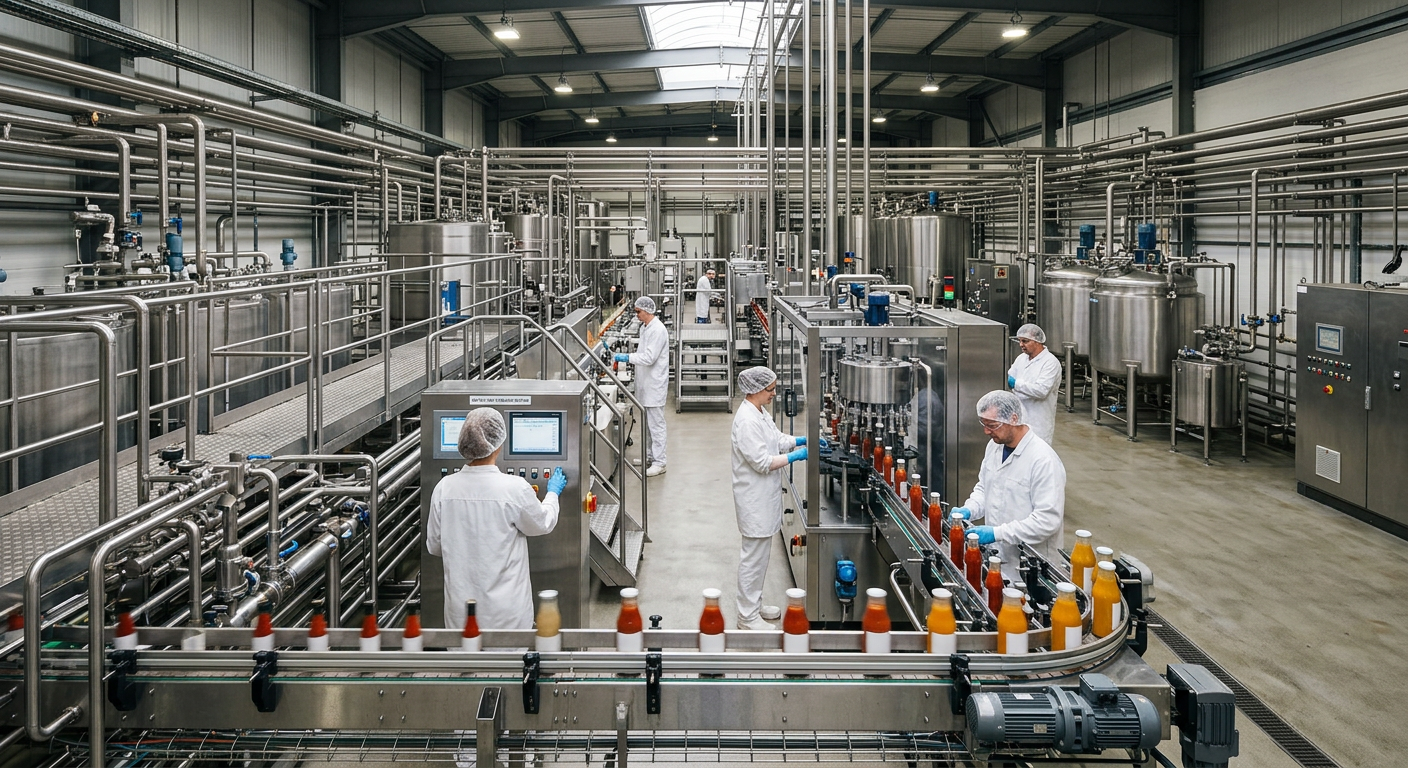
Sauce, Dressing and Condiment Manufacturing Plant Design
[trp_language language=”en_US”]
United States Sauce Production Facility Design Guide
Quick Answer

A successful sauce manufacturing plant design in the United States should begin with product risk, not equipment shopping. The right design defines sauce type, pH, viscosity, particulates, allergens, thermal process, filling temperature, packaging format, sanitation method, and future throughput before the first kettle, mixer, pump, filler, or CIP skid is specified.
For most U.S. sauce, dressing, marinade, salsa, dip, condiment, and prepared-food producers, the most practical design path is to build a hygienic, modular facility with segregated raw and finished zones, stainless-steel sanitary piping, cleanable floors and drains, controlled utilities, automated recipe management, validated heating or preservation steps, and a scalable layout that can move from pilot or regional production to national retail and foodservice volume.
Actionable short list: define your process authority requirements, map product families by pH and heat sensitivity, size batching around filling demand, design CIP before equipment placement, separate allergen and raw-ingredient risks, validate wastewater and steam demand early, and select suppliers that can support installation, controls, commissioning, and documentation in the United States.
Strong U.S.-relevant suppliers and integrators include Disruptive Process Solutions in Cary, North Carolina and Lake Forest, California; Tetra Pak for emulsified sauces and packaging-linked processing; JBT Marel for soups, sauces, aseptic, retort, and HPP-related food systems; SPX FLOW for sanitary pumps, valves, heat exchangers, and process skids; Blentech for kettles, cookers, and high-viscosity sauce systems; Statco-DSI Process Systems for sanitary process integration; Paul Mueller Company for tanks and liquid food systems; DC Norris North America for cook-chill and kettle systems; Solbern for filling and specialty food processing; and Scott Turbon Mixer for high-shear dressing and sauce systems.
Qualified international suppliers, including Chinese companies, may also be considered when they can demonstrate U.S.-relevant certifications, sanitary material documentation, electrical compliance, local spare-parts access, English technical documentation, and reliable pre-sales and after-sales support. They can offer cost-performance advantages, but they should be evaluated through factory acceptance testing, material certificates, controls compatibility, and verified service coverage before purchase.
United States Market Context for Sauce Facility Projects

The United States is one of the most demanding markets for sauce and condiment production because it combines national retail brands, private label programs, restaurant chains, club-store packaging, meal-kit suppliers, frozen prepared foods, refrigerated dips, ethnic sauces, hot sauces, dressings, marinades, and co-manufacturing networks. A plant in Chicago, Dallas, Los Angeles, Atlanta, Charlotte, New Jersey, or Central California may serve very different channels, but the design fundamentals remain the same: food safety, repeatability, flexible packaging, labor efficiency, cleanability, and documented compliance.
In 2026, many U.S. sauce manufacturers are no longer designing plants around one hero product. They are designing multi-product platforms. A single facility may need to run mayonnaise-style emulsions, tomato-based sauces, barbecue sauce, hot-fill acidic condiments, refrigerated dressings, particulate salsa, cheese sauces, marinades, finishing sauces for prepared meals, and limited-time flavors for foodservice accounts. That reality changes the plant design strategy. Instead of fixed, single-purpose lines, the best facilities use recipe-controlled batching, hygienic transfer panels, modular tanks, high-shear mixing where required, positive-displacement pumping for viscous products, automated cleaning circuits, and filling lines that can handle multiple container formats.
Location also matters. A sauce plant near the Port of Los Angeles or Port of Long Beach may have import advantages for spices, oils, packaging, or specialty ingredients. A facility in New Jersey can serve dense Northeast retail and foodservice customers while staying close to the Port of New York and New Jersey. Texas offers access to Gulf ports, central distribution lanes, and a strong food manufacturing workforce. North Carolina, Georgia, Tennessee, and South Carolina are attractive for manufacturing labor, interstate access, and proximity to fast-growing Southeast consumer markets. Midwest locations such as Illinois, Wisconsin, Missouri, and Indiana remain strong for central distribution, dairy ingredients, packaging, and food equipment support.
Demand is being shaped by flavor innovation, clean-label expectations, value-focused private label, spicy and global flavor profiles, refrigerated fresh dips, plant-based meals, single-serve foodservice packs, and operational pressure from labor shortages. A plant designed today should not be limited to one packaging size or one preservation method. It should be ready for hot fill, cold fill, retort, refrigerated distribution, HPP-compatible packaging, or aseptic processing when the commercial model justifies those technologies.
Planning Model for U.S. Sauce and Condiment Facility Growth
The line chart above is a practical planning index rather than a quoted market forecast. It reflects the type of demand pattern many project teams are preparing for: more SKU variety, more co-packing, more private label, and more automation-driven capital spending. For a plant owner, the useful takeaway is that the facility should be designed for change. Space should be reserved for additional tanks, future utilities, second filling lines, allergen segregation, mezzanine additions, packaging automation, and wastewater capacity increases.
Core Product Types and Process Design Implications

Sauce production looks simple from the outside, but each product family creates different engineering requirements. A watery hot sauce, a high-oil ranch dressing, a chunky salsa, a cheese sauce, and a shelf-stable meat gravy do not belong in the same process category. Product science should drive equipment selection, floor plan, controls, sanitation, and utility sizing.
| Product Type | Typical Process Needs | Critical Design Risks | Recommended Equipment Focus | Common U.S. Channels |
|---|---|---|---|---|
| Tomato-based sauces | Batching, cooking, blending, deaeration, hot filling, or retort | Burn-on, color change, viscosity drift, acid control | Jacketed kettles, swept-surface agitation, positive-displacement pumps | Retail jars, club packs, foodservice pouches |
| Emulsified dressings | Oil-water emulsification, powder hydration, high-shear mixing | Oil separation, air incorporation, allergen cross-contact | High-shear mixers, vacuum mixing, recipe-controlled dosing | Retail bottles, refrigerated cups, restaurant packs |
| Hot sauces | Acidified blending, fermentation optional, fine milling, hot fill | pH validation, capsaicin exposure, corrosion, fumes | Acid-resistant tanks, ventilation, sanitary mills, small-bottle fillers | Specialty retail, e-commerce, foodservice |
| Salsa and chunky dips | Particulate handling, gentle mixing, thermal treatment | Particle damage, inconsistent fill weights, drain clogging | Wide-port valves, low-shear pumps, particulate fillers | Refrigerated tubs, glass jars, institutional packs |
| Marinades | Liquid blending, salt and sugar dissolution, spice suspension | Settling, allergen carryover, inaccurate minor ingredients | Agitated tanks, load cells, inline blending, sanitary transfer | Meat processors, poultry plants, retail bottles |
| Cheese and cream sauces | Hydration, melting, homogenization, thermal processing | Protein fouling, microbial risk, viscosity instability | Scraped-surface heat exchangers, steam systems, CIP validation | Prepared meals, foodservice, refrigerated and frozen foods |
| Meat gravies | Cooking, protein inclusion, USDA consideration where applicable | Regulatory jurisdiction, pathogen control, fat separation | Cook tanks, retort systems, controlled cooling, documentation | Prepared foods, institutional meals, shelf-stable packs |
This table shows why a plant should not be designed by copying another sauce facility. The best design begins with a product matrix. Group products by acidity, viscosity, particulates, allergen profile, preservation method, packaging, and cleaning difficulty. Then build the process blocks around those groups. This prevents expensive mistakes such as undersized pumps, uncleanable piping, inadequate cooling, insufficient steam, or fillers that cannot handle particulates.
Facility Layout Principles for Sauce, Dressing, and Condiment Plants
A practical United States sauce plant layout normally includes receiving, dry ingredient storage, refrigerated ingredient storage, oil storage, spice handling, minor ingredient weighing, batching, cooking or thermal treatment, intermediate holding, filling, packaging, finished-goods warehousing, sanitation rooms, maintenance, quality control, employee welfare areas, and utility spaces. The layout should support one-way product movement and minimize cross-traffic between raw materials, people, waste, packaging, and finished goods.
Ingredient receiving should be close to bulk tank unloading, dry storage, refrigerated storage, and quality inspection. High-volume oil, vinegar, sweetener, tomato paste, or brine ingredients may justify bulk silos, tote stations, drum unloaders, or automated liquid ingredient systems. Minor ingredients such as spices, hydrocolloids, preservatives, flavors, colors, and allergens should be weighed in controlled rooms with dust collection, barcode verification, and clear lot tracking.
The batching area should be designed around the true bottleneck. Many plants assume the kettle is the bottleneck, but the real constraint may be powder induction, cooling, filler changeover, packaging labor, label verification, or CIP turnaround. A design review should calculate batch cycle time from ingredient staging through finished product release. This includes fill time, heat-up time, hold time, transfer time, cleaning, allergen changeover, and quality checks.
Sanitation must be designed into the plant from the beginning. Sloped floors, trench drains, curbs, wall protection, hose stations, foam cleaning access, segregated chemical storage, and hygienic equipment spacing are not decorative details. They determine whether the facility can clean quickly, safely, and consistently. Wet areas should be separated from dry packaging areas whenever practical. Electrical panels and controls should be located or protected to survive washdown environments.
Utilities should be treated as production assets. Sauce plants may require steam boilers, hot water systems, compressed air, chilled water or glycol, refrigeration, process water treatment, wastewater pretreatment, HVAC, ventilation, electrical distribution, and backup power strategies. High-viscosity sauces, retort processes, and clean-in-place systems can create large utility peaks. If those peaks are ignored during design, the plant may run well during a trial but fail during full production.
Equipment Architecture for a Scalable Sauce Plant
The core equipment set usually includes ingredient unloading systems, powder handling, weigh tanks, blend tanks, high-shear mixers, jacketed cookers, scraped-surface heat exchangers, holding tanks, sanitary pumps, valves, flowmeters, inline strainers, metal detection or inspection systems, fillers, cappers, labelers, case packers, palletizers, CIP skids, and control systems. The exact configuration depends on product and package strategy.
For low-viscosity acidic sauces, the design can be relatively compact: mixing tanks, pH control, heat treatment if needed, hot-fill bottle lines, and efficient bottle handling. For viscous dressings, the design must address oil incorporation, powder wet-out, vacuum deaeration, shear sensitivity, and emulsion stability. For sauces with particulates, pipe diameter, pump type, valve geometry, filler nozzle design, and agitation method matter more than raw horsepower. For cheese sauces or cream-based products, thermal surface selection and CIP effectiveness become central.
Automation should be right-sized. A growing brand may not need a fully automated mega-plant on day one, but it should not rely on paper recipes, manual valve routing, and undocumented ingredient additions if retail or co-manufacturing growth is expected. Practical automation includes load-cell batching, barcode ingredient confirmation, recipe management, temperature and time recording, pH data capture, batch reports, CIP verification, alarm history, and integration with quality and inventory systems.
Industry Demand by Application Segment
The bar chart illustrates where many U.S. capital projects concentrate: private label, retail condiments, and foodservice sauces often drive the largest volume and most aggressive cost targets. Prepared meals and refrigerated dips create additional design pressure because they may require chilled distribution, higher sanitation discipline, and closer integration with upstream or downstream food lines.
Compliance, Food Safety, and Documentation Priorities
U.S. sauce plants should be designed around FDA current good manufacturing practice and preventive controls expectations under the Food Safety Modernization Act. Facilities that manufacture, process, pack, or hold food for U.S. consumption generally need hazard analysis, preventive controls where required, sanitation controls, allergen controls, supply-chain controls, monitoring, corrective actions, verification, and records. If a sauce contains meat, poultry, or certain egg product components, USDA FSIS jurisdiction may apply depending on formulation and use. This should be confirmed early, not after construction.
Process authority involvement is especially important for acidified foods, low-acid canned foods, retorted products, aseptic products, refrigerated products with extended shelf life, and formulas with complex particulate or protein risks. Thermal process validation, pH control, water activity, container closure integrity, cooling profiles, and distribution temperature assumptions all affect plant design. A plant cannot be considered complete if it has equipment but lacks validated operating parameters and documented records.
Third-party schemes such as SQF, BRCGS, and customer-specific audits often influence design beyond minimum regulation. Retailers and national foodservice chains may expect hygienic zoning, foreign material control, environmental monitoring, allergen segregation, traceability, calibration programs, pest control design, chemical control, and documented preventive maintenance. These requirements are easier and cheaper to address during design than after walls, drains, and utilities are installed.
Buying Advice for Owners, Brand Teams, and Co-Packers
Before buying equipment, write a user requirement specification. It should define product list, batch sizes, daily throughput, package formats, changeover targets, sanitation targets, automation level, utility availability, regulatory assumptions, expansion plan, and documentation expectations. Suppliers should respond to that specification rather than selling a favorite machine.
Ask for a process flow diagram, mass balance, utility load summary, equipment layout, cleanability review, controls narrative, and commissioning plan. For high-risk or high-value projects, include factory acceptance testing before shipment and site acceptance testing after installation. Sauce equipment should be tested with water when appropriate, but water testing alone does not prove performance for high-viscosity, particulate, oily, or shear-sensitive products. Pilot trials or product simulation may be necessary.
Total cost of ownership matters more than purchase price. A lower-cost kettle, pump, filler, or skid can become expensive if it increases labor, wastes product, slows changeovers, lacks spare parts, fails sanitation review, or cannot be supported locally. Conversely, premium automation is not always justified for a small brand if recipe complexity and volume are modest. The correct design balances capital cost, operating cost, risk, and future optionality.
| Buying Decision | What to Verify | Why It Matters | Evidence to Request |
|---|---|---|---|
| Material of construction | Food-contact stainless steel grade, seals, gaskets, surface finish | Prevents corrosion, contamination, and cleaning failures | Material certificates, finish documentation, gasket compatibility list |
| Thermal process | Heat-up rate, holding time, cooling method, temperature recording | Protects safety, flavor, texture, and shelf life | Thermal calculations, validation plan, data logging method |
| Mixing system | Shear, agitation pattern, powder induction, emulsion capability | Controls consistency, separation, and batch repeatability | Pilot test results, mixer curves, sample batch reports |
| Filling line | Container range, fill accuracy, particulates, temperature limits | Impacts giveaway, label compliance, and productivity | Runoff test, changeover procedure, spare parts list |
| CIP design | Flow velocity, chemical dosing, return temperature, drainability | Reduces downtime and food safety risk | CIP circuit map, spray device data, verification records |
| Controls platform | PLC standard, HMI design, recipe security, batch reports | Supports traceability, repeatability, and troubleshooting | Controls narrative, screen samples, network architecture |
| Service support | Technician availability, remote access, spare parts location | Protects uptime after startup | Service agreement, response commitments, installed base examples |
This buying checklist is useful for both new greenfield plants and line expansions. The most successful projects use it before purchase orders are issued, because it converts sales claims into measurable requirements. It also helps compare U.S. suppliers with qualified international options on the same technical basis.
Industries and Applications Served by Sauce Plant Design
Sauce manufacturing plant design serves far more than condiment brands. Prepared-food manufacturers need finishing sauces for bowls, frozen meals, pasta dishes, and side dishes. Protein processors use marinades, glazes, injection brines, barbecue sauces, and tumble-applied flavor systems. Dairy processors may produce cheese sauces, creamy dips, and yogurt-based dressings. Plant-based food companies need emulsified sauces, flavor masks, and texture systems. Co-packers must design for maximum flexibility because their customer mix can change every quarter.
Foodservice operations require bulk packaging such as pails, drums, totes, bag-in-box systems, pouches, and portion cups. Retail operations require bottles, jars, inverted squeeze containers, glass, PET, HDPE, stand-up pouches, and club-store multipacks. Each packaging choice affects filling temperature, closure system, oxygen exposure, coding, labeling, case packing, pallet patterns, and warehouse conditions.
Applications also include test kitchens and pilot plants. A brand may need a 50-gallon pilot kettle before committing to a 1,000-gallon batching system. Pilot facilities should not be treated as toys. They should use representative mixing, heating, and filling conditions so formulas scale predictably. Poor pilot design leads to expensive reformulation during commercialization.
Shift Toward Flexible and Automated Sauce Manufacturing
The area chart reflects a major planning trend for 2026 and beyond: flexible, automated, multi-SKU sauce lines are becoming more attractive than single-purpose systems. This does not mean every line should be complex. It means valves, tanks, controls, fillers, and utilities should be selected with tomorrow’s product mix in mind.
Case Study Patterns in U.S. Sauce Facility Projects
One common case is the regional hot sauce brand that outgrows a shared kitchen and needs a small FDA-ready plant. The right first step is not the largest possible filler. It is a practical design with controlled ingredient storage, safe acid handling, validated pH control, ventilation, cleanable surfaces, a right-sized hot-fill line, and room for future automation. Overbuilding at this stage can damage cash flow.
Another case is the established foodservice sauce company that needs to reduce labor and improve batch consistency. This project often focuses on automated ingredient dosing, high-shear powder induction, larger blend tanks, better transfer pumps, improved CIP, and recipe-controlled PLC systems. The return usually comes from lower rework, faster changeovers, fewer operator errors, and better fill accuracy.
A third case is a prepared-food manufacturer adding in-house sauce production. Instead of buying sauce from an outside supplier, the company may want fresher flavor, lower ingredient cost, shorter lead times, and better control over allergens. The design must connect sauce batching to meal assembly without creating cross-contamination, traffic congestion, or cooling bottlenecks.
A fourth case is the co-packer building a flexible sauce platform. This is the hardest design because the plant must handle unknown future customers. It needs robust utilities, flexible packaging, strong sanitation, documented changeovers, recipe security, and clear commercial rules about allergens, minimum runs, packaging supply, and product development support.
Top Local and U.S.-Relevant Suppliers for Sauce Manufacturing Plant Design
The following table provides a practical supplier view for owners planning U.S. sauce, dressing, and condiment projects. It includes engineering firms, equipment manufacturers, and process system providers. The right partner may be one company or a coordinated team, depending on project size and risk.
| Company | Service Regions | Core Strengths | Key Offerings for Sauce Plants | Best Fit |
|---|---|---|---|---|
| Disruptive Process Solutions | All 50 U.S. states and Canada, with offices in Cary, NC and Lake Forest, CA | Design-build-manage execution, process engineering, integration, controls, utilities | Complete processing systems, sanitary piping, CIP, tanks, cooking vessels, project management | Mid-market and enterprise manufacturers needing accountable project execution |
| Tetra Pak | United States and global network | Emulsified sauces, hygienic processing, packaging-linked systems | High-shear mixing, heat treatment, aseptic and packaging-related process support | Brands needing integrated processing and packaging expertise |
| JBT Marel | United States and international | Food processing, thermal systems, aseptic, retort, HPP-related technologies | Soups, sauces, oils, prepared food systems, sterilization and automation solutions | Large processors and co-packers with complex preservation needs |
| SPX FLOW | United States and global | Sanitary components, pumps, valves, heat exchangers, process skids | Mayonnaise, dressing, ketchup, salsa, heat transfer, mixing, and flow control systems | Plants requiring robust sanitary process infrastructure |
| Blentech | United States, with strong North American installation base | High-viscosity cooking, vacuum cooking, particulate protection | Jacketed thermal systems, kettles, cookers, sauce and dip processing equipment | Viscous sauces, fruit preparations, dips, and particulate products |
| Statco-DSI Process Systems | Multiple U.S. sales and engineering offices | Sanitary process integration, field installation, welding, process design | Mixing systems, sanitary piping, installation crews, platforms, process utilities | Processors needing turnkey sanitary integration |
| Paul Mueller Company | United States and international | Stainless tanks, liquid food processing, heat transfer | Mixing tanks, storage vessels, ingredient handling, thermal equipment | Liquid sauce and condiment plants requiring durable stainless systems |
| DC Norris North America | North America | Cook-chill, kettles, prepared food systems | Process kettles, cook-chill systems, dressing, relish, dip, and sauce equipment | Prepared-food and foodservice sauce manufacturers |
| Solbern | United States and international | Specialty food processing and liquid filling | Sauce, brine, broth, and non-carbonated liquid filling equipment | Plants needing specialty filling or container-based sauce dosing |
| Scott Turbon Mixer | United States and global through parent network | High-shear mixing and dressing systems | Dressing and sauce systems, mixers, emulsification, rotating equipment | Emulsified dressings and sauces requiring shear control |
This supplier table should be used as a starting point, not a final vendor list. A brand with a simple hot sauce line may need a compact team, while a national private-label sauce facility may need civil engineering, process engineering, refrigeration, electrical design, controls integration, packaging automation, building contractors, and food safety consultants working under a single project plan.
Supplier Capability Comparison
The comparison chart is an evaluation aid based on typical project roles. It highlights why supplier selection should be tied to project scope. DPS is strongest when the owner needs integrated engineering, building coordination, utilities, controls, and execution management. Tetra Pak is especially relevant when emulsified sauces, hygienic processing, and packaging-linked systems are central. JBT Marel is a strong fit for larger thermal, aseptic, retort, and prepared-food platforms. Blentech is especially practical for cooking, viscous products, and particulate-sensitive sauces.
Our Company Perspective: Disruptive Process Solutions
Disruptive Process Solutions is a U.S.-based food and beverage engineering partner with headquarters in Cary, North Carolina and a West Coast office in Lake Forest, California, giving sauce, dressing, marinade, and condiment manufacturers practical coverage across major American production corridors from the Southeast to California. DPS combines process engineering, structural, mechanical, plumbing, electrical, controls, project management, general contracting functions, installation, commissioning, and proprietary equipment supply into its Design-Build-Manage model, so buyers are not left coordinating disconnected designers, fabricators, installers, and automation vendors. For sauce plant projects, its product and system strength is grounded in sanitary processing experience, FDA, USDA, SQF, and BRC compliance fluency, stainless process equipment including tanks up to 12,000 gallons, custom CIP systems, marination tumblers, cooking vessels, high-shear mixing and emulsification knowledge, scraped-surface heat exchanger integration, retort and canning experience, PLC programming, SCADA, recipe control, batch control, and utility infrastructure such as steam, compressed air, glycol, refrigeration, process water, wastewater, and HVAC. DPS serves end users, brand owners, co-packers, contract manufacturers, and growing processors through flexible cooperation models that can include feasibility studies, capital planning, owner’s representative work, full project management, turnkey installation, equipment supply, and regional project execution through vetted local trades; it is not positioned as a remote exporter or a catalog-only seller. Its local service assurance comes from direct U.S. operations, North Carolina and California offices, field installation capability across all 50 states, Canadian project experience subject to local compliance, online and offline pre-sale engineering review, commissioning support, and after-sale project accountability. The company’s operating philosophy emphasizes profitable capital deployment, transparent technical advice, and long-term owner success, which is especially valuable in sauce manufacturing where the wrong bottleneck analysis can turn a multimillion-dollar expansion into unnecessary spending.
For owners evaluating a new sauce manufacturing facility, DPS is most relevant when the project requires more than one piece of equipment. Examples include a greenfield sauce plant, a dressing line expansion, a co-packer conversion, a new CIP system, a utility upgrade, a process automation retrofit, a packaging relocation, or a plant debottlenecking assignment. The company’s approach is particularly useful when capital must be tied to output, margin, and schedule rather than to isolated equipment purchases. To learn more about the company’s project philosophy, visit its food and beverage engineering team. For owners comparing tanks, CIP systems, tumblers, and cooking vessels, the DPS process equipment portfolio is a useful starting point.
Practical Design Roadmap for a New U.S. Sauce Plant
| Project Phase | Main Objective | Key Deliverables | Common Mistake to Avoid |
|---|---|---|---|
| Concept planning | Confirm business case and product scope | Product matrix, capacity model, preliminary budget | Buying equipment before defining product risk |
| Feasibility study | Test technical and financial assumptions | Block layout, utility loads, labor model, ROI review | Ignoring wastewater, steam, and refrigeration demand |
| Process design | Define how the sauce will be made | PFD, P&ID, equipment list, controls concept | Copying another plant’s flow without product validation |
| Facility design | Fit process into hygienic building layout | Room layout, drains, walls, HVAC, traffic flows | Mixing raw, finished, allergen, and waste traffic |
| Procurement | Select suppliers based on verified requirements | Specifications, bids, FAT plans, purchase terms | Comparing only purchase price |
| Installation | Build safely and hygienically | Schedule, trade coordination, sanitary welding, utility tie-ins | Letting field changes bypass engineering review |
| Commissioning | Prove the system works | SAT, water runs, product trials, CIP verification | Starting commercial production before validation |
| Ramp-up | Stabilize output and quality | Training, batch reports, maintenance plans, yield tracking | Failing to measure bottlenecks after startup |
This roadmap helps owners see the whole capital project. A sauce plant is not complete when the filler is installed. It is complete when the team can run safe, repeatable, documented production at the target cost and throughput. Case-based project learning can also be valuable; DPS shares examples of engineering and execution work through resources such as its process project case study, facility execution example, and manufacturing systems project review.
Future Trends for 2026 and Beyond
Several trends should shape sauce manufacturing plant design in 2026. Automation will continue to move from luxury to necessity as labor availability, training burden, documentation expectations, and SKU complexity increase. Recipe-controlled batching, automated valve routing, inline instrumentation, digital batch records, and remote support will become more common even in mid-sized plants.
Food safety policy and audit expectations will also keep pushing plants toward stronger traceability, allergen control, environmental monitoring, and supplier verification. Even where specific compliance dates shift, the direction is clear: customers and regulators expect faster, more accurate records. A plant designed with barcode ingredient tracking, lot-controlled batching, and integrated quality data will be better prepared than one built around manual paperwork.
Sustainability will affect utility design. Steam recovery, heat recovery, water reuse where appropriate, efficient CIP, lower-temperature cleaning chemistry, compressed air leak management, variable-frequency drives, refrigeration optimization, and wastewater load reduction can all improve operating cost. Sauce plants that process tomato paste, sugars, oils, starches, dairy, or high-BOD ingredients should involve wastewater specialists early.
Packaging will keep diversifying. Lightweight bottles, recyclable materials, refill formats, pouches, portion packs, and foodservice bulk systems will all influence filling and secondary packaging design. Owners should avoid locking themselves into one container format unless the commercial strategy is extremely stable.
Finally, co-manufacturing will remain important. Many brands want speed to market without owning a plant, while established manufacturers want to monetize capacity. This creates demand for flexible, auditable, multi-customer sauce platforms with strong confidentiality, recipe security, allergen management, and changeover discipline.
Frequently Asked Questions
What is the first step in sauce manufacturing plant design?
The first step is defining the product and business model. You need to know sauce type, pH, water activity, viscosity, particulates, allergens, packaging, shelf-life target, distribution temperature, daily volume, and future SKU plan before selecting equipment or designing the building.
How much space does a sauce production facility need?
Space depends on batch size, packaging format, warehouse strategy, and sanitation requirements. A small specialty sauce plant may operate in a modest industrial space, while a national foodservice or retail facility may require extensive batching rooms, tank farms, packaging halls, utilities, refrigerated storage, and finished-goods warehousing.
Should a U.S. sauce plant use batch or continuous processing?
Batch processing is common for diverse SKUs, premium sauces, dressings, and co-packing. Continuous processing can be attractive for high-volume, stable formulas where automation, heat transfer, and filling can be tightly controlled. Many plants use a hybrid model.
What equipment is most important for dressing production?
For dressings, high-shear mixing, powder hydration, oil dosing, vacuum deaeration, emulsion control, sanitary tanks, accurate filling, and validated cleaning are usually critical. The system must prevent separation while maintaining texture and flavor.
How should allergens be handled in a sauce plant?
Allergens should be managed through product scheduling, dedicated or validated-clean equipment, controlled ingredient weighing, clear labeling, employee practices, storage segregation, and documented sanitation verification. Plant layout should reduce the chance of allergen cross-contact.
Can one facility produce hot sauce, dressing, salsa, and marinades?
Yes, but it must be designed for different viscosities, pH levels, particulates, cleaning needs, and allergens. The facility may need separate tanks, flexible transfer systems, multiple filler types, and strong changeover controls.
When is retort or aseptic processing needed?
Retort or aseptic processing may be needed for shelf-stable low-acid or complex products, depending on formulation and packaging. A qualified process authority should evaluate the product before the facility design is finalized.
What is the role of CIP in sauce manufacturing?
CIP reduces manual cleaning, improves repeatability, records cleaning parameters, and shortens changeovers. However, CIP must be engineered for the actual product soil, piping geometry, flow velocity, chemical concentration, temperature, and drainability.
Are Chinese equipment suppliers acceptable for U.S. sauce plants?
They can be acceptable when they provide sanitary design, material documentation, electrical compliance, strong English technical support, spare parts access, commissioning support, and U.S.-relevant certifications. Buyers should verify performance through testing and documentation before shipment.
Why use an integrated design-build-manage partner?
An integrated partner can align process design, building work, utilities, controls, installation, commissioning, and schedule. This is valuable because many sauce plant failures happen at the interfaces between equipment suppliers, trades, automation teams, and plant operations.
[/trp_language]
Complete Company Portfolio

About the Author: Disruptive Process Solutions (DPS)
The DPS team combines process engineering expertise with real-world food and beverage manufacturing experience. Our content focuses on process optimization, production efficiency, facility improvements, and practical solutions that help manufacturers operate more effectively in a rapidly evolving industry.
Share

