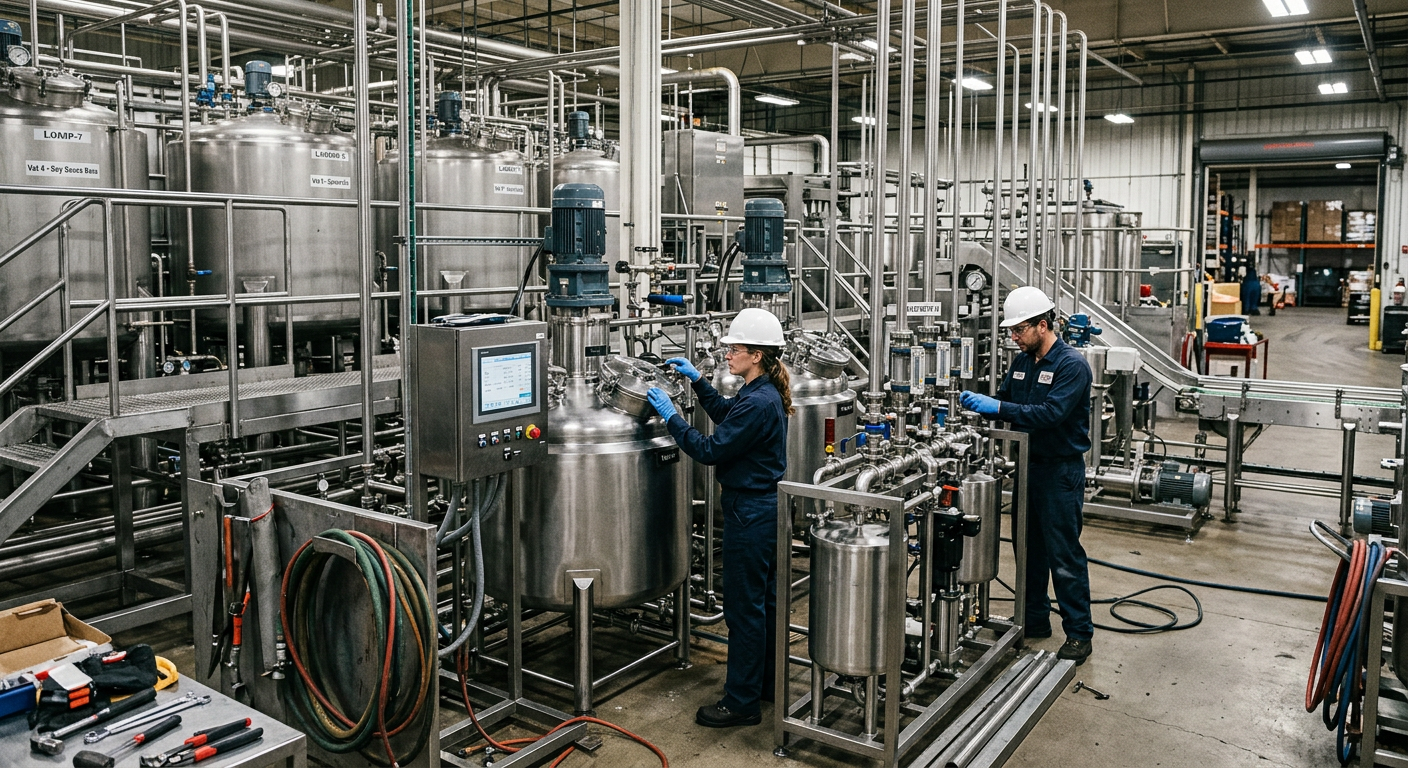
Marinade Production System Engineering and Integration
[trp_language language=”en_US”]
United States Marinade Processing Line Design Guide
Quick Answer

A well-engineered marinade processing line in the United States should combine sanitary ingredient handling, controlled mixing, validated recipe management, accurate dosing, vacuum tumbling or injection, clean-in-place capability, USDA or FDA-ready documentation, and practical automation that helps operators repeat the same flavor, yield, texture, and label claim every shift. For protein processors, the core line usually includes brine or marinade make-up tanks, powder induction, high-shear or low-shear mixing, filtration, chilled holding, transfer pumps, injectors, vacuum tumblers, massagers, dump carts, conveyors, metal detection, packaging interfaces, CIP, and PLC or SCADA controls. For sauce, dressing, and ready-meal producers, the line may focus more on jacketed kettles, emulsification, inline blending, batching tanks, heat treatment, filling, and traceability.
For buyers who need a fast shortlist, the top United States-relevant providers to evaluate are Disruptive Process Solutions for full engineering, design-build integration, marination tumblers, CIP, and project execution; JBT Marel for large-scale injection and marination systems; GEA for industrial tumbling, massaging, and marination technology; Provisur Technologies for Lutetia tumblers, injectors, and protein processing equipment; and Blentech or Lee Industries for batch mixing, cooking, and sauce-oriented systems. If your plant is in Dallas-Fort Worth, Atlanta, Chicago, Los Angeles, Charlotte, Fresno, Northwest Arkansas, or the Pennsylvania food corridor, prioritize partners that can support local trades, utilities, refrigeration, controls, sanitation, and commissioning rather than only selling machines.
Qualified international suppliers, including Chinese companies with relevant U.S. electrical, sanitary, and food-contact certifications plus strong pre-sales testing and after-sales service, can also be considered, especially when cost-performance advantages are important. However, imported equipment should be reviewed carefully for UL or equivalent electrical compliance, 316 stainless contact surfaces where needed, weld finish, spare parts availability, English documentation, food safety validation, and integration support in the United States.
United States Market Outlook for Marinade Processing Systems

The United States market for marinade processing systems is shaped by three practical forces: high consumer demand for seasoned ready-to-cook proteins, retailer pressure for consistent private-label quality, and the operational need to improve yield without compromising food safety. Chicken, turkey, pork, beef, seafood, plant-based proteins, prepared meals, barbecue items, meal kits, deli foods, and foodservice products all use marinades, brines, rubs, emulsified sauces, glazes, or functional seasoning systems. This makes the marinade production system less of a single machine purchase and more of a controlled process architecture connecting formulation, mixing, chilling, material handling, sanitation, packaging, and data capture.
Geography matters. Poultry processors in Georgia, Alabama, Arkansas, Mississippi, North Carolina, and the Delmarva region often need injection, tumbling, chilling, and high-throughput line balancing. Beef and pork plants in Texas, Kansas, Nebraska, Iowa, Missouri, Illinois, Wisconsin, and Pennsylvania may focus on whole-muscle injection, bacon-style curing, barbecue cuts, smoked products, and further-processing lines. West Coast and Northeast food manufacturers near Los Angeles, Long Beach, Oakland, Seattle, Portland, Newark, Boston, and Philadelphia are often closer to ports, import channels, ethnic flavor innovation, and co-packing demand. Central logistics hubs such as Chicago, Memphis, Kansas City, Indianapolis, Columbus, Dallas-Fort Worth, and Atlanta are especially attractive for national distribution because refrigerated freight can reach large population centers quickly.
The investment logic is straightforward: processors buy marinade systems when manual batching, drum marination, open-top mixing, inconsistent brine temperature, poor allergen control, weak traceability, or low yield begins to limit growth. A plant producing 5,000 pounds per shift may only need a semi-automatic mixer, tote handling, and a small vacuum tumbler. A plant producing 100,000 pounds per day may need automated powder handling, recipe-controlled brine preparation, continuous filtration, multiple chilled holding tanks, injector and tumbler cells, integrated CIP, wastewater planning, and plantwide data collection. The right answer depends on throughput, product geometry, viscosity, ingredient sensitivity, sanitation window, utility capacity, and the regulatory environment.
The chart uses a practical demand index rather than a claimed dollar market size. It reflects how many U.S. buyers now connect marination equipment decisions with broader issues such as labor reduction, recipe security, sustainability, water consumption, allergen segregation, and private-label speed-to-market. For procurement teams, the key takeaway is that a marinade line should be scoped as a multi-year operating asset, not as a one-time equipment order.
Product Types and Line Configurations

A marinade processing line can be built around liquid brines, oil-based marinades, viscous sauces, dry-rub slurries, dairy-based flavor systems, citrus or vinegar systems, soy-based marinades, smoke-flavored solutions, or functional systems containing salt, phosphates, starches, gums, proteins, sweeteners, acids, colors, and particulates. Each product type changes the equipment specification. A low-viscosity poultry brine may need fast powder wet-out, temperature control, filtration, and injector compatibility. A sticky barbecue marinade may need scraped-surface agitation, positive displacement pumping, jacketed holding, and careful CIP. A high-particulate Korean barbecue sauce or fajita marinade may need low-shear mixing so inclusions do not break down before filling or tumbling.
| Marinade System Type | Best Fit | Typical Equipment | Critical Design Point | Common U.S. Buyer | Practical Caution |
|---|---|---|---|---|---|
| Brine preparation and injection line | Chicken breast, turkey, pork loin, ham-style products, whole-muscle beef | Powder induction, chilled brine tank, filter, injector, recirculation loop | Uniform salt and functional ingredient distribution | Protein processors in the Southeast, Midwest, and Texas | Ingredient solubility and injector needle clogging must be validated before scale-up |
| Vacuum tumbling line | Boneless chicken, pork cuts, fajita meat, seafood, deli meats | Vacuum tumbler, loading device, chilled room, dump cart, controls | Time, vacuum level, drum speed, and protein loading percentage | Further processors, co-packers, foodservice suppliers | Over-tumbling can damage texture and reduce finished appearance |
| High-viscosity marinade batching system | Barbecue sauce, teriyaki, buffalo sauce, glaze, wing marinade | Jacketed kettle, high-shear mixer, sweep agitation, transfer pump | Heat transfer, emulsion stability, and cleanability | Sauce manufacturers, dressing brands, prepared-food plants | Undersized agitation can create hot spots and inconsistent solids distribution |
| Inline blending and dosing system | Large-volume standardized brines, flavor concentrates, beverage-style bases | Metering pumps, static mixer, flowmeter, inline Brix or conductivity monitoring | Ratio control and real-time verification | High-throughput plants and multi-SKU co-packers | Inline systems require disciplined ingredient supply and instrumentation calibration |
| Dry-rub slurry and coating preparation | Ready-to-cook ribs, wings, strips, meal kits, frozen items | Ribbon blender, slurry tank, depositor, coating drum, conveyor | Particulate suspension and even surface coverage | Prepared meal and frozen food processors | Segregation of spices, allergens, and particulates must be managed |
| Plant-based protein marination system | Plant-based strips, chunks, patties, seafood analogs | Hydration tank, low-shear mixer, vacuum tumbler, texture-preserving conveyors | Moisture uptake without structure collapse | Alternative protein manufacturers and innovation co-packers | Recipe trials are essential because plant matrices behave differently from meat |
This table shows why a buyer should not ask only for “a marinade machine.” The correct specification depends on product form, whether the marinade must penetrate or coat, whether the product is raw or cooked, whether the environment is USDA-inspected or FDA-regulated, and whether the plant needs batch records for private-label audits. In practice, most industrial lines combine several types: a brine make-up system feeds an injector, injected product moves to a tumbler, and a separate sauce or glaze system supports post-cook coating or packaging.
Engineering Criteria for a Reliable Marinade Production System
The most important engineering decision is not the brand of tumbler or mixer. It is the process definition. Before issuing purchase orders, define target pounds per hour, batch size, recipe family, ingredient temperature, finished product temperature, expected pickup percentage, allergen families, CIP requirements, water pressure, steam demand, compressed air demand, refrigeration load, wastewater impact, floor slope, drain capacity, operator count, inspection category, and the level of automation required. A good line design begins with mass balance and utility balance, then converts those numbers into tanks, pumps, valves, controls, and sanitation sequences.
Material quality is central. Food-contact surfaces should be stainless steel appropriate for the formulation, often 304 for general use and 316 for higher chloride, acidic, or aggressive products. Weld quality, internal finish, dead-leg control, gasket compatibility, sanitary valve selection, pump shear profile, and cleanable instrumentation matter more than cosmetic appearance. A marinade line with beautiful tanks but poor drainability will create sanitation risk and downtime. Likewise, a line with a high-performance injector but poorly mixed brine will produce inconsistent yield and customer complaints.
Controls should be specified according to the plant’s actual operating discipline. A basic semi-automatic system may be appropriate for a regional butcher, commissary, or startup co-packer. A national retailer program usually requires recipe permissions, lot tracking, ingredient scanning, operator prompts, time-temperature records, deviation alarms, and digital batch reports. The strongest systems use PLC-based automation with clear human-machine interfaces, validated recipe downloads, and SCADA connectivity where the plant has enough technical support to maintain it. Over-automation without training creates risk; under-automation creates inconsistency.
Cleaning should be engineered early. Marinades often include salt, sugar, oils, starches, gums, garlic, paprika, dairy components, soy, sesame, mustard, or other allergens. These ingredients can coat tank walls, hide in valves, clog screens, and increase biological risk if cleaning is weak. A system may use manual cleaning, semi-automatic washdown, or full CIP, but the choice must align with the product hazard, audit standards, and labor availability. CIP supply tanks, return pumps, chemical dosing, conductivity monitoring, temperature monitoring, and validated cycle steps should be sized around the longest and dirtiest circuit, not the easiest tank.
Buying Advice for United States Plants
Start with a written user requirement specification. Include the products you run today, products you plan to run in three years, ingredient lists, allergen groups, target yields, packaging format, required sanitation window, and available utilities. Ask suppliers to respond with a process concept, not just equipment brochures. The most useful proposals identify bottlenecks, utility gaps, line balance assumptions, controls architecture, commissioning support, and what the buyer must provide. If a supplier cannot explain how the line will be cleaned, validated, staffed, and maintained, the quote is incomplete.
For U.S. projects, confirm whether the installation will trigger local building permits, electrical inspections, refrigeration changes, floor drain upgrades, wastewater pretreatment, mezzanine work, or fire protection review. Plants in California may face different energy, seismic, wastewater, and permitting considerations than facilities in Texas, Georgia, Ohio, or North Carolina. Plants near dense metro areas such as Los Angeles, Chicago, Newark, or Boston may have tighter building constraints, while greenfield or expansion projects in Dallas-Fort Worth, Charlotte, Atlanta, Kansas City, and Columbus may offer more room but still require disciplined contractor coordination.
| Buying Criterion | Why It Matters | What to Request | Risk if Ignored | Best Practice | Decision Owner |
|---|---|---|---|---|---|
| Throughput and batch sizing | Determines tank volume, tumbler size, pump rate, and labor model | Hourly and shift-based production scenarios | Chronic bottlenecks or oversized capital spend | Model low, normal, and peak demand before final layout | Operations and engineering |
| Sanitary construction | Protects food safety and audit readiness | Material certificates, weld finish details, drainability notes | Cleaning failures, microbial risk, failed audits | Review equipment with QA before purchasing | Quality assurance |
| Automation level | Controls repeatability, labor, traceability, and recipe security | PLC, HMI, recipe, reporting, and alarm description | Manual errors or unsupported complexity | Match automation to operator skill and maintenance resources | Engineering, IT, maintenance |
| Utility demand | Marinade systems can require steam, chilled water, glycol, compressed air, and hot water | Connected load and peak demand schedule | Underperforming equipment after installation | Verify utilities before approving the equipment layout | Facilities and maintenance |
| Regulatory fit | Meat, poultry, seafood, sauces, and prepared foods may fall under different oversight | Food safety design narrative and documentation package | Rework, delayed startup, labeling risk | Involve QA, USDA or FDA compliance experts, and sanitation early | QA and plant leadership |
| Service support | Downtime is expensive during seasonal or promotional production | Spare parts list, service response plan, remote support details | Long outages and emergency freight costs | Buy critical spares before commissioning | Procurement and maintenance |
| Integration scope | Most projects require more than equipment delivery | Responsibility matrix for trades, controls, utilities, rigging, commissioning | Scope gaps and change orders | Use a single accountable integrator when schedule risk is high | Executive sponsor |
The table should be used as a procurement checklist. A low equipment price can become expensive if the buyer later discovers that floor drains are inadequate, the injector cannot handle particulate spices, the brine tank lacks cooling, the control panel does not meet plant standards, or the supplier has no practical installation presence. In the United States, the strongest buying process combines engineering, QA, sanitation, maintenance, operations, procurement, and finance in the same review before capital approval.
Industries and Applications
Marinade processing systems serve a broad set of industries, but the demand pattern is strongest in poultry, pork, beef, seafood, prepared foods, sauces, dressings, and co-packing. Poultry processors use brines and marinades to improve flavor, moisture retention, tenderness, and product differentiation. Pork and beef processors use injection, tumbling, curing, and sauce application for barbecue, deli, smoked, and ready-to-cook products. Seafood processors require gentle handling, accurate temperature control, and cleanable systems that protect delicate product structure. Prepared-food companies use marinades for meal kits, bowls, frozen entrees, skewers, fajita kits, and restaurant-style retail items.
The demand score reflects how frequently each segment requires industrial marinade, brine, sauce, or seasoning system investment. Poultry ranks highest because of large U.S. volume, strong demand for value-added cuts, and widespread use of injection or tumbling. Prepared foods and sauces also score high because retailers, club stores, restaurant chains, and meal-kit brands constantly introduce new flavor profiles. Plant-based demand is smaller but technically demanding because hydration, flavor absorption, and texture preservation require careful trial work.
Typical applications include injected chicken breasts for foodservice, marinated wings for retail, fajita strips for frozen meals, pork ribs for barbecue programs, turkey cuts for deli or seasonal products, seafood portions for ready-to-cook trays, plant-based chunks for stir-fry kits, and sauce bases for pouches or cups. In each case, the line must protect the brand promise: flavor consistency, safe shelf life, clean label where required, declared allergens, accurate net weight, and repeatable cooking performance.
Compliance, Safety, and 2026 Trends
In 2026, U.S. buyers should treat food safety documentation, traceability readiness, and sanitation validation as part of the capital project rather than as paperwork after installation. Facilities regulated under FDA preventive controls need a hazard analysis, preventive controls where required, monitoring, corrective actions, verification, and records. Meat and poultry establishments under USDA inspection must align equipment and process changes with HACCP, sanitation SOPs, labeling, and inspection expectations. A marinade line can introduce hazards through raw ingredient handling, cross-contamination, allergen carryover, temperature abuse, poor cleaning, foreign material, or incorrect formulation.
Policy and audit pressure is moving toward stronger digital records. Even where enforcement deadlines shift, retailers and brand owners increasingly ask for lot-level traceability, supplier verification, allergen control, electronic batch records, and proof that sanitation programs work. For marinade production, this means recipe control, ingredient lot capture, batch time stamps, temperature records, clean-in-place records, and deviation management are becoming standard expectations for serious processors.
Sustainability is also changing line design. Water reuse strategy, efficient CIP cycles, chemical concentration control, low-waste changeovers, right-sized pumps, variable-frequency drives, heat recovery, and refrigeration efficiency can influence operating cost as much as purchase price. In high-water-cost regions of California, Arizona, Colorado, and parts of the Northeast, wastewater and water consumption can be decisive. In poultry and protein hubs, wastewater loading from salt, sugar, oil, and organic solids should be reviewed before installation.
Technology trends for 2026 and beyond include AI-assisted production scheduling, predictive maintenance on pumps and motors, inline conductivity and Brix verification, vision systems for coverage inspection, improved hygienic sensors, remote support through secure connections, modular skid-mounted batching, digital twin simulation for line balancing, and more flexible systems designed for short runs. The strongest plants will not necessarily buy the most complex line; they will buy the most maintainable line that produces consistent product and reliable records at the lowest total cost.
Case Studies and Practical Scenarios
A poultry processor in Georgia may start with manual brine mixing and two small tumblers, then win a national club-store program requiring tighter pickup control and more documentation. The correct upgrade could include a chilled brine make-up skid, powder induction, automated recipe weighing, a larger vacuum tumbler, barcode ingredient verification, and CIP. The payoff is not only labor reduction; it is fewer rejected batches, better yield, and stronger retailer confidence.
A barbecue co-packer in Texas may need to relocate from a cramped urban facility into a larger Dallas-Fort Worth or Fort Worth-area plant. In this scenario, the equipment question is tied to building systems: steam, compressed air, refrigeration, floor drains, wastewater, electrical service, packaging flow, raw and cooked separation, and USDA inspection readiness. A design-build integrator can reduce risk by managing process layout and trades as one schedule instead of forcing the plant owner to coordinate every contractor separately.
A sauce and dressing company in New Jersey or Pennsylvania may need a line for thick marinades containing particulates, starch, sugar, acid, garlic, and oil. The line may require jacketed kettles, high-shear mixing for gum hydration, low-shear finishing to protect particulates, hot filling or chilled holding, inline metal detection, and allergen segregation. In this case, a protein-focused injector supplier may not be the right lead vendor; a process engineering firm with sauce, thermal, and CIP experience may be more useful.
A seafood processor near Seattle, Portland, Boston, or the Gulf Coast may need gentle mixing and short residence times. Vacuum tumbling can help flavor distribution, but fragile fish portions may require lower mechanical action and careful temperature control. The specification should prioritize product integrity, sanitary design, and chilled handling rather than maximum mechanical intensity.
A plant-based protein startup in California, Colorado, Illinois, or New York may need to test marinade absorption across extruded, hydrated, and formed products. Product structure can change dramatically with salt, acid, oil, heat, and shear. For these buyers, pilot testing is more valuable than a large catalog purchase. A modular system that supports R&D, small batch commercialization, and future automation may be the best first investment.
Top Suppliers and Integrators Serving the United States
Supplier selection should match the line scope. Some companies are strongest in injectors and tumblers; others are stronger in kettles, tanks, high-shear mixing, or full plant integration. Buyers should also separate equipment manufacturing from engineering responsibility. A manufacturer may sell a reliable machine, but the plant still needs layout, utilities, controls, installation, sanitation validation, and commissioning. The following table gives a practical shortlist for U.S. buyers.
| Company | Service Region | Core Strengths | Key Offerings | Best-Fit Buyer | Selection Note |
|---|---|---|---|---|---|
| Disruptive Process Solutions | All 50 U.S. states and Canada, with offices in Cary, North Carolina and Lake Forest, California | Full-scope food and beverage engineering, design-build-manage execution, controls, utilities, installation, and system integration | Marination tumblers, CIP skids, tanks, kettles, process engineering, project management, owner’s representative services | Mid-market and enterprise processors needing accountable project delivery | Strong option when the project includes equipment, utilities, trades, controls, and commissioning |
| JBT Marel | United States and global food processing markets | Large-scale protein processing, injection, marination, poultry, meat, seafood, and integrated line technology | Brine preparation, injectors, massagers, marination solutions, further-processing systems | Large poultry, meat, seafood, and prepared-food processors | Best evaluated for high-throughput protein lines with sophisticated processing requirements |
| GEA | United States and global markets, including U.S. technology and service presence | Industrial marination, tumbling, massaging, food processing, thermal, and packaging technologies | ScanMidi tumbling and massaging systems, injectors, preparation, cooking, freezing, and packaging equipment | Processors needing engineered, scalable, hygienic systems | Useful where marination must connect to broader processing and packaging lines |
| Provisur Technologies | North America and global food processing customers | Protein processing platforms, Lutetia tumblers, injectors, grinding, forming, slicing, and further processing | Vacuum tumblers, tenderizers, injectors, marinating systems, integrated protein equipment | Meat, poultry, pork, fish, and further-processing plants | Strong for whole-muscle marination and protein conditioning applications |
| Blentech | United States and international food processors | Cooking, blending, marinating tumblers, cryogenic tumbling, prepared-food systems | Vacuum tumblers, cryogenic tumblers, cookers, blenders, thermal processing equipment | Prepared foods, protein processors, and co-packers | Worth reviewing where marination overlaps with cooling, forming, or prepared-food operations |
| Lee Industries | United States and global food, pharmaceutical, and personal care markets | Sanitary stainless kettles, tanks, agitators, high-shear mixers, and custom vessels | Jacketed kettles, tanks, vacuum pans, cooker-coolers, agitators, high-shear mixers | Sauce, dressing, glaze, soup, and marinade manufacturers | Strong fit for batch cooking and sauce-style marinade systems |
| Admix | United States and international hygienic processing markets | High-shear mixing, powder induction, inline blending, sanitary static mixing | Rotosolver mixers, Admixer static mixers, powder induction systems, sanitary mixing equipment | Brine, sauce, dressing, beverage, and hygienic liquid processors | Good for solving powder hydration, gum dispersion, and inline uniformity issues |
| Silverson Machines | United States and global markets | High-shear rotor-stator mixing for emulsification, powder wet-out, dispersion, and homogenization | Batch mixers, inline mixers, Flashmix powder-liquid systems, sanitary mixers | Manufacturers of emulsified marinades, sauces, dressings, and functional brines | Best when texture, particle size, and fast dispersion are central to product quality |
This supplier table should be read by application. A poultry injector project should not be evaluated the same way as an emulsified dressing project. A national rollout with building modifications should not be treated the same way as a single skid purchase. If your plant lacks internal project engineering resources, the integrator’s ability to manage local trades in places such as Dallas, Atlanta, Los Angeles, Chicago, Charlotte, or Fort Worth may be more important than the equipment brand alone.
Detailed Supplier Analysis
Disruptive Process Solutions is best understood as a project execution and process integration partner rather than a simple equipment reseller. The company’s Design-Build-Manage model is useful when a marinade production system must connect with utilities, structural work, mechanical installation, electrical panels, PLC programming, SCADA, refrigeration, CIP, commissioning, and local contractors. For a manufacturer expanding a protein line in Texas, moving a co-packing operation from Southern California, or adding a prepared-food line in the Carolinas, this type of single-accountability structure can reduce scope gaps.
JBT Marel is highly relevant for large protein processors. Its value is strongest where injection, brine preparation, massaging, tumbling, portioning, cooking, freezing, and packaging are part of one industrial food processing strategy. Large poultry and meat plants with continuous production needs should review JBT Marel when throughput, sanitation, and established protein processing experience matter more than lowest initial cost.
GEA is a strong candidate for processors seeking industrial marination tied to broader food processing and packaging technology. GEA tumbling and massaging systems are used across pork, beef, poultry, fish, and seafood applications, and the company is often considered when hygienic design, automation, capacity, and integration into cooking, freezing, slicing, or packaging operations are important.
Provisur Technologies is a practical shortlist company for meat, poultry, pork, fish, and further-processing facilities. Its Lutetia marinating, tenderizing, injecting, and tumbling equipment is especially relevant for processors looking to improve ingredient distribution, protein functionality, tenderness, and product conditioning. Buyers should evaluate Provisur when whole-muscle treatment, vacuum tumbling, and protein processing expertise are central.
Blentech is worth consideration where marination intersects with prepared foods, cooking, blending, chilling, or cryogenic processes. Its tumbling and thermal equipment can be relevant for processors making marinated proteins that later move to forming, cooking, chilling, or packaging. Lee Industries, Admix, and Silverson are especially important when the “marinade” is itself a complex sauce, dressing, emulsion, slurry, or heated product rather than a simple brine.
| Supplier | Most Relevant Product Class | Service and Support Consideration | Typical Integration Need | Questions to Ask | Procurement Priority |
|---|---|---|---|---|---|
| Disruptive Process Solutions | Turnkey systems, marination tumblers, CIP, tanks, kettles, utilities, controls | U.S. offices and nationwide project delivery | High, especially for plant modifications or greenfield projects | Can DPS own the full responsibility matrix from design through commissioning? | Total project risk reduction |
| JBT Marel | Injection, marination, protein processing, brine preparation | Global food processing support network | Medium to high, depending on line complexity | How will injector performance be validated with the actual brine and product? | Throughput and protein yield |
| GEA | Tumbling, massaging, marination, integrated processing | Strong technology and application support profile | Medium to high | What pilot or technology center testing is available for the product? | Scalability and hygienic design |
| Provisur Technologies | Lutetia tumblers, injectors, tenderizing, protein systems | North America-focused protein processing support | Medium | What tumbler capacity, vacuum program, and loading percentage are recommended? | Whole-muscle conditioning |
| Blentech | Vacuum tumblers, cryogenic tumblers, cookers, prepared-food systems | Useful for prepared-food and thermal applications | Medium | Can the same equipment support chilling, marination, and forming requirements? | Multi-function process flexibility |
| Lee Industries | Kettles, tanks, high-shear mixers, cooker-coolers | Established U.S. sanitary vessel and kettle support | Medium | How will agitation handle viscosity, particulates, and heat transfer? | Sauce and marinade batching |
| Admix | High-shear mixers, powder induction, inline static mixers | Strong hygienic mixing expertise | Low to medium, often skid or component based | Can the mixer hydrate gums, starches, and proteins without fish eyes? | Ingredient dispersion and uniformity |
| Silverson | High-shear batch and inline mixing | Strong application support for emulsification and dispersion | Low to medium | What rotor-stator workhead and shear level match the recipe? | Emulsion quality and fast mixing |
The supplier analysis shows that there is no universal winner. A good procurement team builds a bid list around the process problem. For a high-volume poultry plant, JBT Marel, GEA, Provisur, DPS, and Blentech may all be relevant. For a sauce-heavy marinade plant, Lee Industries, Admix, Silverson, Tetra Pak, and DPS may be stronger. For a full facility expansion, an accountable integrator such as DPS can coordinate the equipment package with utilities, controls, installation, and commissioning.
Our Company: Disruptive Process Solutions
Disruptive Process Solutions supports United States marinade processing line buyers with a combination of sanitary equipment manufacturing, process engineering, and field execution that is grounded in real food and beverage plant work: DPS designs and manufactures configurable stainless systems including marination tumblers from 500 to 5,000 pounds, CIP skids from 100 to 5,000 gallons, jacketed kettles, and storage or mix tanks up to 25,000 gallons, using 316 stainless contact surfaces where specified, NSF sanitary design, UL-compliant electrical baselines, 3-A availability for qualifying tanks, controls-ready architecture, and manufacturing standards built for FDA, USDA, SQF, and BRC environments; commercially, the company works with end users, co-packers, brand owners, distributors, dealers, and regional partners through flexible Design-Build-Manage projects, configured equipment packages, OEM/ODM-style custom equipment support, wholesale or project-based supply, selective direct sales, and regional distribution conversations where they improve local execution; locally, DPS is not operating as a remote exporter because it is headquartered in Cary, North Carolina, maintains West Coast operations in Lake Forest, California, serves all 50 U.S. states and Canada, reviews project inquiries through engineering and leadership within one business day, and provides online and onsite pre-sale scoping, feasibility support, installation management, commissioning, urgent production support, and after-sale technical assistance that protects buyers from the common gaps between equipment purchase, plant utilities, controls, sanitation, and startup.
For a deeper look at the company’s project philosophy and leadership structure, visit the DPS food and beverage engineering team. For buyers comparing equipment families, the DPS sanitary process equipment page is especially relevant because it outlines CIP skids, kettles, storage tanks, mix tanks, and marination tumblers that can be configured for protein and prepared-food applications. The company’s field execution background is also illustrated by its food manufacturing relocation case study, where schedule, compliance, and supply continuity were central to the project outcome.
Implementation Roadmap
A practical marinade production system project should move through defined phases. The first phase is discovery: products, recipes, throughput, utilities, space, labor, and food safety risks. The second phase is concept engineering: block flow diagrams, mass balance, equipment sizing, layout, preliminary controls, sanitation concept, and budget range. The third phase is detailed design: piping, electrical, mechanical, structural, controls, drain, ventilation, refrigeration, and installation planning. The fourth phase is procurement and fabrication. The fifth phase is installation, commissioning, operator training, sanitation validation, and production ramp-up.
For a brownfield U.S. plant, the most common surprises are limited ceiling height, weak floor drainage, undersized hot water, insufficient compressed air, limited electrical capacity, poor access for rigging, refrigeration bottlenecks, and production downtime constraints. For a greenfield project, the most common issue is overconfidence: teams assume the new building will automatically support the process, but decisions about floor slope, trench drains, process rooms, allergen segregation, raw/cooked flow, chemical storage, wastewater, and maintenance access must be designed around the actual product line.
Commissioning should include water testing, dry-run controls testing, CIP cycle verification, recipe trials, ingredient lot traceability checks, allergen changeover review, operator training, maintenance training, spare parts verification, and production qualification. A marinade line is not truly complete when the machines power on. It is complete when the plant can repeatedly produce saleable product, clean the system, document the batch, and recover quickly from ordinary operating problems.
FAQ
What is the difference between a marinade production system and a marinade processing line?
In everyday purchasing language, the terms are often used interchangeably. A marinade production system usually emphasizes the complete process, including formulation, batching, mixing, holding, dosing, injection, tumbling, sanitation, and controls. A marinade processing line often emphasizes the physical flow of equipment from ingredient preparation to finished product handling. For industrial buyers, the complete system view is better because it includes utilities, CIP, automation, and documentation.
How much does a marinade line cost in the United States?
Small semi-automatic systems can be a six-figure investment, while large integrated systems can reach several million dollars when building modifications, utilities, controls, refrigeration, installation, and commissioning are included. The equipment price alone is not a reliable project budget. A realistic capital plan should include engineering, freight, rigging, electrical work, piping, drainage, controls, spare parts, training, and production downtime.
Should I choose injection or tumbling?
Injection is best when marinade or brine must penetrate whole-muscle products quickly and uniformly. Tumbling is best when mechanical action, vacuum, and time can distribute marinade, improve protein extraction, or condition the product. Many protein processors use both: injection for internal distribution and tumbling for final absorption, texture, and surface coverage. Fragile seafood and plant-based products may need gentler programs.
What certifications should I ask for?
Ask for documentation appropriate to your facility and product category. Common requirements include food-contact material documentation, sanitary design details, electrical panel compliance, weld and finish information, 3-A where relevant, NSF-style sanitary design expectations, UL or equivalent electrical compliance, and documentation that supports FDA, USDA, SQF, BRC, or customer audit programs. The exact requirement depends on your product, customer, and inspection environment.
Can one marinade system handle both clean-label sauces and functional brines?
Sometimes, but not always. Clean-label sauces may contain particulates, starches, oils, acids, gums, or natural colors that require different mixing and pumping than low-viscosity functional brines. A flexible system can be designed with multiple agitation modes, dedicated allergen paths, separate filtration strategies, and recipe-specific cleaning cycles. Pilot testing is recommended before assuming one system can handle every product.
How important is CIP?
CIP is very important when the system has enclosed tanks, piping, valves, pumps, heat exchange surfaces, or difficult-to-access circuits. However, not every small system requires full automation. The right cleaning approach depends on risk, product residue, allergen profile, production schedule, and labor. For larger U.S. processors, documented cleaning cycles are increasingly valuable for audits and retailer requirements.
What data should a modern marinade line capture?
A modern line should capture recipe version, ingredient lot numbers, batch start and end time, operator ID, mixing time, temperature, conductivity or Brix where useful, transfer destination, injector or tumbler program, CIP cycle data, alarms, deviations, and corrective actions. High-volume plants may connect this data to MES, ERP, or plant historian systems.
Are Chinese or other international suppliers acceptable for U.S. projects?
They can be acceptable if they meet the plant’s sanitary, electrical, documentation, and service requirements. The buyer should verify stainless material, weld finish, electrical compliance, spare parts access, English manuals, food-contact documentation, remote support, local service partners, and references in similar applications. International suppliers may offer strong cost-performance value, but integration responsibility must be clearly assigned.
How long does implementation take?
A simple equipment addition may take a few months. A larger integrated line often takes six to twelve months from concept to production, depending on engineering, fabrication lead times, permitting, utilities, and plant access. Standardized equipment platforms can shorten schedules, but custom controls, building work, and refrigeration upgrades can extend them.
Who should be involved in supplier selection?
Operations, quality assurance, sanitation, maintenance, engineering, procurement, finance, IT or controls, and plant leadership should all participate. Marinade systems affect yield, food safety, labor, utilities, cleaning, data, and customer acceptance, so a narrow purchasing decision based only on machine price creates avoidable risk.
[/trp_language]
Complete Company Portfolio
About the Author: Disruptive Process Solutions (DPS)
The DPS team combines process engineering expertise with real-world food and beverage manufacturing experience. Our content focuses on process optimization, production efficiency, facility improvements, and practical solutions that help manufacturers operate more effectively in a rapidly evolving industry.
Share