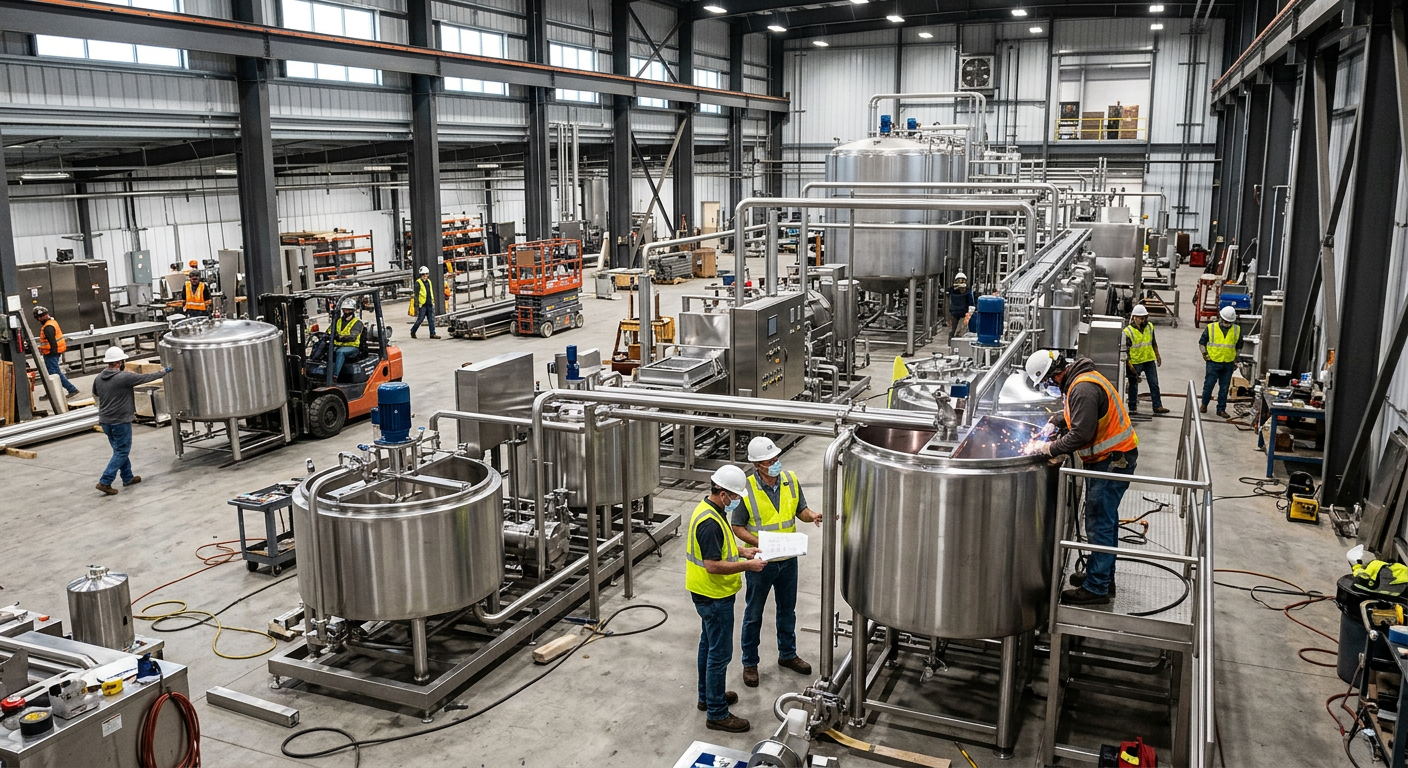
Cheese Processing Plant Engineering and Build
[trp_language language=”en_US”]
Cheese Processing Plant Engineering in the United States
Quick Answer

If you need cheese processing plant engineering in the United States, the best choice depends on your plant size, cheese type, automation target, food safety requirements, and expansion timeline. For most U.S. manufacturers, the most practical partners are full-scope engineering firms and equipment integrators that can design process flow, utilities, sanitation systems, controls, installation, and commissioning as one coordinated package.
Strong options for U.S. projects include Tetra Pak, GEA, SPX FLOW, Paul Mueller Company, Krones, and Disruptive Process Solutions. These companies are relevant for cheese milk intake systems, pasteurization, separation, cheese vats, curd handling, whey processing, CIP, packaging integration, and full plant utilities. Regional engineering contractors in dairy-heavy states such as Wisconsin, California, Idaho, New York, and Texas can also be highly effective when paired with a proven process specialist.
For buyers who want a concise shortlist, focus on suppliers that can support feasibility, sanitary design, automation, USDA and FDA expectations, wastewater planning, and startup support. Also, qualified international suppliers, including Chinese manufacturers with relevant certifications, hygienic fabrication capability, and dependable pre-sales and after-sales support in North America, can be worth considering for selected tanks, CIP skids, and utility modules because of their cost-performance advantage.
- Tetra Pak: ideal for large integrated dairy and cheese plants with strong automation depth
- GEA: strong in separators, cheese technology, evaporation, and whey systems
- SPX FLOW: useful for pumps, valves, heat exchangers, mixing, and sanitary process integration
- Paul Mueller Company: well known for stainless process vessels and dairy equipment packages
- Krones: relevant where beverage-style utilities, process control, and packaging integration overlap
- Disruptive Process Solutions: attractive for U.S. manufacturers seeking agile design-build-manage execution and practical capital planning
United States Market Outlook for Cheese Plant Engineering

The United States remains one of the most attractive markets for cheese processing plant engineering because cheese consumption is mature, product variety keeps expanding, and processors continue investing in capacity, labor efficiency, and traceability. Engineering demand is especially active in Wisconsin, California, Idaho, Minnesota, New York, and Texas, where dairy production, warehousing, and interstate distribution infrastructure support both commodity and specialty cheese lines.
Market activity is not limited to new greenfield plants. A large share of spending goes into brownfield modernization: milk receiving upgrades, HTST or UHT integration where needed, whey valorization, brine system redesign, packaging automation, refrigeration improvement, energy optimization, and wastewater handling. In many U.S. facilities, the engineering challenge is not only making more cheese but making more profitable cheese with lower giveaway, better yield, lower labor dependence, and cleaner audit performance.
Ports and inland logistics matter as well. California processors may think in terms of Oakland and Los Angeles logistics, Midwest operators often prioritize Chicago freight corridors, and East Coast specialty cheese projects may align with New York and New Jersey cold-chain distribution. These realities shape building layout, raw material storage, finished goods flow, and future export readiness.
In 2026, buyers are increasingly asking engineering firms to deliver more than process diagrams. They want integrated capital planning, realistic utility load modeling, faster installation windows, remote support capability, and expansion logic built into the first phase. That shift favors firms that understand not only dairy technology but also project finance, local permitting, contractor coordination, and startup risk control.
The chart above shows a realistic upward demand trend for engineering services related to cheese processing projects in the United States. Growth is being supported by capacity expansion, replacement of aging sanitary equipment, sustainability upgrades, and more sophisticated automation standards.
What Cheese Processing Plant Engineering Actually Includes

Cheese processing plant engineering covers the full technical and commercial framework required to turn raw milk into consistent, safe, profitable cheese products at scale. It is broader than equipment purchasing. It combines process design, utility design, building integration, controls architecture, hygienic layout, and commissioning planning into one coordinated execution path.
A complete scope usually includes milk receiving, standardization, pasteurization, culture handling, coagulation, cutting, curd cooking, whey drainage, pressing, molding, salting or brining, ripening support, packaging, CIP, refrigeration, steam, compressed air, water treatment, wastewater interface, controls, and data reporting. In modern plants, engineering also includes allergen zoning, employee movement logic, forklift traffic, and future line expansion.
For U.S. buyers, engineering must also align with practical realities such as state inspections, sanitary weld quality, local utility constraints, labor availability, and spare parts access. A beautiful process flow on paper is not enough if it creates cleaning bottlenecks, oversizes refrigeration, or leaves no room for curd handling maintenance.
Main Product Types and System Modules
Cheese plants are rarely built around a single machine. They are built around modules that must work together under hygienic, thermal, mechanical, and operational constraints. The right engineering partner should be able to map these modules to your cheese style, throughput, and staffing model.
| System Module | Main Function | Typical Use in U.S. Plants | Key Engineering Focus | Common Cheese Types | Expansion Consideration |
|---|---|---|---|---|---|
| Milk Receiving and Storage | Unload, test, cool, and buffer raw milk | High-volume dairy intake with tanker scheduling | Flow rate, temperature control, sampling, sanitary routing | All cheese categories | Add parallel silos and truck bays |
| Pasteurization and Separation | Heat treat and standardize milk composition | Fluid milk prep for consistent curd performance | Heat recovery, fat control, automation, CIP | Cheddar, mozzarella, Monterey Jack | Skid-based future capacity increase |
| Cheese Vat and Curd Handling | Coagulation, cutting, cooking, curd transfer | Core production zone for yield and texture control | Agitation profile, residence time, curd damage prevention | Natural and specialty cheeses | Duplicate vat trains |
| Whey Recovery | Capture and process whey streams | Revenue recovery and waste reduction | Separation, membrane interface, storage logistics | Cheddar, mozzarella, Swiss | Future protein concentration systems |
| Brining and Salting | Flavor, preservation, moisture management | Batch or continuous salt application | Brine hygiene, temperature, circulation, filtration | Feta, mozzarella, semi-hard cheeses | Tank enlargement and recirculation upgrade |
| Packaging and End-of-Line | Cut, wrap, seal, code, and palletize | Retail and foodservice formats | Product changeover, metal detection, traceability | Blocks, slices, shreds, retail packs | Additional packaging lanes |
This table shows why plant engineering decisions must be modular. A processor making retail shredded cheese in Idaho will prioritize very different throughput, whey handling, and end-of-line automation than a specialty cheese maker in upstate New York focused on aging rooms and artisan consistency.
Industries and Applications Served
Cheese processing plant engineering supports a broad mix of business models in the United States. Some facilities are vertically integrated dairy operations. Others are co-manufacturing sites producing private label cheese for retailers, foodservice groups, or ingredient customers. Still others focus on value-added cheese ingredients for prepared foods, frozen meals, bakery fillings, sauces, and snack products.
The strongest engineering demand tends to come from retail cheese, private label production, and foodservice formats because these segments often require scale, packaging flexibility, and strong margin control. Ingredient applications are also growing as cheese components are used in prepared foods and convenience products.
| Industry Segment | Typical Cheese Formats | Main Engineering Priority | Key Risk to Manage | Recommended Automation Level | Typical U.S. Locations |
|---|---|---|---|---|---|
| Retail Dairy Brands | Blocks, slices, shreds | Throughput and packaging flexibility | SKU complexity | High | Wisconsin, California, Idaho |
| Foodservice Suppliers | Mozzarella, blends, diced cheese | Large batch consistency | Downtime during peak season | High | Texas, Illinois, Wisconsin |
| Ingredient Manufacturers | Processed cheese bases, powders, inclusions | Yield recovery and formulation control | Whey and solids loss | Medium to High | Minnesota, Iowa, California |
| Private Label Producers | Consumer packs and club-store packs | Fast changeover and traceability | Frequent packaging variation | High | Pennsylvania, New York, Wisconsin |
| Specialty Cheese Makers | Artisan, aged, regional styles | Process control without losing character | Inconsistent maturation conditions | Medium | Vermont, New York, California |
| Co-Packers and Contract Manufacturers | Multi-brand custom formats | Flexible line architecture | Sanitation between campaigns | High | Texas, Ohio, California |
This application table helps buyers match the engineering approach to the commercial model. A co-packer may care more about rapid changeover and audit-ready documentation, while an ingredient plant may focus on solids recovery and utility intensity.
How to Buy Cheese Plant Engineering Services in the United States
Buying engineering services for a cheese plant should start with business decisions, not equipment catalogs. Buyers should first define target capacity, product mix, desired labor model, utility constraints, and expected gross margin. Those commercial inputs drive process design choices. Without that discipline, it is easy to overspend on automation that does not pay back or underspend on hygienic design that later causes chronic sanitation issues.
A practical buying process includes a feasibility phase, concept layout, budgetary equipment plan, utility balance, implementation schedule, and then detailed engineering. U.S. manufacturers should push suppliers to show how design choices affect yield, cleaning time, staffing, energy use, and expansion cost. Cheese plants are long-life assets, so the cheapest initial layout can become the most expensive operating model.
Important bid questions include whether the partner can manage local trades, how they validate sanitary weld quality, what their controls integration strategy looks like, whether they understand whey byproduct economics, and how they support startup. Buyers should also ask who owns the process responsibility when several vendors are involved. A fragmented project often creates interface failures between vats, pumps, refrigeration, CIP, and packaging.
For U.S. projects with aggressive timelines, the best partners are often those that combine engineering, procurement coordination, field management, and commissioning support under one accountable team. That reduces the risk of schedule drift and conflicting vendor assumptions.
Top Suppliers and Engineering Partners in the United States
The companies below are widely relevant to cheese processing plant engineering in the United States. They do not all serve the exact same role. Some are global process technology leaders, some are strong in stainless equipment, and some are agile design-build partners suited to mid-market or expansion projects. The right choice depends on whether you need a greenfield plant, a debottlenecking upgrade, a sanitary utility package, or a full integration program.
| Company | Service Region | Core Strengths | Key Offerings | Best Fit | Notes for U.S. Buyers |
|---|---|---|---|---|---|
| Tetra Pak | Nationwide U.S. and global | Integrated dairy process technology, automation, aseptic expertise | Pasteurization, cheese lines, CIP, plant integration | Large dairy and cheese processors | Strong when deep automation and standardization are required |
| GEA | Nationwide U.S. and global | Separation, cheese technology, whey and evaporation systems | Separators, vats, membrane systems, controls | Plants focused on yield and byproduct value | Especially useful for technical dairy process optimization |
| SPX FLOW | United States and Canada | Sanitary components and process systems | Pumps, valves, heat exchangers, mixers, homogenization | Brownfield upgrades and component-heavy projects | Commonly specified in sanitary process environments |
| Paul Mueller Company | United States focus with broader reach | Stainless fabrication and dairy processing equipment | Tanks, vessels, process modules, thermal systems | Processors needing robust vessel packages | Practical option where stainless equipment quality is central |
| Krones | United States and international | Automation, utilities, packaging integration | Process support systems, filling, end-of-line integration | Plants linking dairy processing with sophisticated packaging | Useful when controls and packaging interface matter heavily |
| Disruptive Process Solutions | All 50 U.S. states and Canada | Agile design-build-manage model, food and beverage integration | Process engineering, capital planning, GC coordination, installation, controls | Mid-market and enterprise projects needing accountable execution | Strong fit for manufacturers seeking commercial and technical alignment |
This supplier table is useful because it separates general brand recognition from actual project fit. A national dairy processor building a multi-line facility in Wisconsin may prefer a global OEM-led solution, while a fast-moving processor upgrading a Texas site may benefit from a more agile engineering and integration partner.
Supplier and Capability Comparison
Comparing suppliers on price alone leads to poor project outcomes. Cheese processing plants succeed when process technology, local execution, utility planning, and service support stay aligned from concept to startup. The chart below gives a practical comparison across common buying criteria.
This comparison emphasizes that the strongest global technology companies are not always the most agile for every U.S. project. Mid-sized processors, co-packers, and phased expansion programs often need a partner that can bridge design, field execution, and fast commercial decision-making.
Trend Shift Through 2026 and Beyond
The engineering landscape for cheese plants is shifting toward smarter, cleaner, and more adaptable facilities. U.S. processors are under pressure to control labor costs, reduce water and energy intensity, and create digital visibility across production and sanitation. These trends are pushing investment toward automation, skid-based expansion, recipe control, predictive maintenance, and better utility integration.
Policy and sustainability pressures are also influencing project specifications. Wastewater capacity, heat recovery, water reuse opportunities, refrigerant choices, and packaging-related line flexibility are increasingly discussed during front-end engineering rather than after construction starts. Buyers also want lines that can shift between foodservice and retail formats when demand changes.
The area chart illustrates a realistic shift in buyer priorities. The trend is clear: future cheese plants in the United States will be judged not only by production capacity but by data visibility, utility efficiency, resilience, sanitation performance, and expansion readiness.
Case Study Patterns Seen in Successful U.S. Projects
Successful cheese plant projects tend to follow a few repeatable patterns. First, they identify the real production bottleneck before approving major capital. In many older facilities, the constraint is not vessel size but controls logic, CIP scheduling, curd transfer timing, or packaging throughput. Second, they treat utilities as part of the product system rather than an afterthought. Steam, glycol, compressed air, process water, and wastewater capacity determine whether a line can actually hit nameplate output.
Third, they phase expansion intelligently. A plant may install a process backbone capable of future duplication even if only one production line is commissioned initially. This lowers future disruption. Fourth, they align the building and sanitary zoning with labor movement and cleaning access from the start. Plants that ignore this often struggle with sanitation overtime, maintenance delays, and cross-traffic issues.
In practice, the best projects are run by teams that think commercially as well as technically. That means balancing first cost against yield, uptime, labor demand, maintenance burden, and future market flexibility.
You can also review practical project perspectives through the company’s experience pages, including insights shared in the plant execution case overview, the process integration example, and the capital project delivery story, which reflect the kind of cross-functional work often required in modern food and beverage facilities.
Local Supplier Selection by Region
Regional proximity can matter in cheese plant engineering because field supervision, installation coordination, and service response often affect startup more than quoted equipment lead times. U.S. processors should shortlist suppliers based not only on technical strength but on where their people and trade networks can realistically support the work.
| Region | Important States and Cities | Typical Project Type | Recommended Supplier Profile | Main Local Advantage | Watch-Out |
|---|---|---|---|---|---|
| Upper Midwest | Wisconsin, Minnesota, Chicago corridor | Large natural cheese and whey projects | Dairy-specialized OEM or integrator | Strong dairy labor and supplier base | Competition for qualified contractors |
| West Coast | California, Central Valley, Los Angeles logistics | High-throughput dairy and specialty lines | Full-service engineering team with utility depth | Export logistics and dense food manufacturing network | Permitting and labor cost pressure |
| Mountain West | Idaho, Utah, Colorado | Expansion of efficient large-format plants | Process-driven firm with automation focus | Room for greenfield growth | Service distance for some vendors |
| Northeast | New York, Vermont, Pennsylvania | Specialty cheese and flexible packaging | Hybrid artisan-industrial engineering support | Access to premium regional markets | Space constraints in brownfield sites |
| South | Texas, North Carolina, Georgia | Co-manufacturing and distribution-oriented projects | Agile design-build partner | Fast population growth and logistics reach | Heat load and utility planning complexity |
| Cross-Border North America | U.S.-Canada flows, Great Lakes region | Multi-site and multi-jurisdiction projects | Partner with North American execution experience | Broader sourcing flexibility | Compliance coordination across jurisdictions |
This regional view helps narrow the field. For example, a California processor focused on large-volume mozzarella might need a supplier with stronger utility, wastewater, and logistics planning than a smaller specialty producer in Vermont.
Our Company Fit for Cheese Processing Plant Engineering
For U.S. manufacturers evaluating a partner that can bridge process design and real-world execution, Disruptive Process Solutions stands out as a locally active engineering and integration company with a practical North American footprint. Headquartered in Cary, North Carolina, with an additional West Coast office in Lake Forest, California, the company supports projects across all 50 states and Canada, giving buyers real regional presence rather than remote-only support. Its capabilities matter for cheese projects because DPS combines process engineering, capital planning, owner’s representation, project management, GC-led coordination where licensed, installation, controls integration, and commissioning within one Design-Build-Manage model. From an E-E-A-T standpoint, the evidence is operational, not promotional: DPS has direct experience with dairy processing systems including cheese-making, homogenization, cream separation, CIP, boilers and steam, glycol and refrigeration, process water and wastewater, SCADA, batch control, and utility integration, while also manufacturing selected branded stainless equipment such as tanks up to 12,000 gallons and custom CIP systems. That manufacturing and integration background signals control over material quality, fabrication discipline, and testing standards expected in sanitary food environments. Commercially, the company is flexible enough to serve end users, co-manufacturers, brand owners, and channel partners through tailored project delivery, equipment supply, and integration-led models rather than a one-size-fits-all contractor approach. Local service assurance is reinforced by the company’s East and West Coast operations, vetted trade network, and both pre-sale planning and post-installation support designed for long-term plant performance in the U.S. market. Buyers who want to understand its operating philosophy can review the company background, and those interested in packaged equipment can explore the process equipment range.
Practical Buying Checklist
Before selecting a cheese processing plant engineering partner, use a disciplined checklist. Make suppliers explain their assumptions in writing. Confirm capacities, sanitation logic, expansion path, and utility loads. Ask for a realistic startup plan with operator training. Review spare parts strategy and controls access. Verify whether the partner can coordinate civil, mechanical, electrical, plumbing, and process scopes instead of leaving the interfaces to the owner.
- Define target cheese types, daily milk intake, and packaging mix
- Request a phased expansion strategy, not just a day-one layout
- Model CIP time, water use, steam load, glycol load, and wastewater output
- Clarify USDA, FDA, SQF, and customer audit expectations
- Ensure automation architecture supports traceability and recipe control
- Review service coverage in your state and startup staffing plan
- Ask how whey and byproduct streams affect project economics
- Compare total lifecycle cost, not only equipment price
FAQ
What is the ideal engineering model for a new cheese plant in the United States?
The ideal model is usually a phased design-build or engineering-integration approach that combines process design, utilities, automation, installation planning, and commissioning under a single accountable team. This reduces interface risk and improves startup speed.
How much automation should a cheese plant have?
That depends on throughput, labor costs, SKU count, and sanitation strategy. Large retail and foodservice plants usually justify high automation, while some specialty cheese operations perform better with selective automation around utilities, CIP, and packaging rather than full mechanization of every step.
Which states are strongest for cheese processing projects?
Wisconsin, California, Idaho, Minnesota, New York, and Texas are among the most relevant U.S. locations because of dairy supply, labor pools, logistics, and existing food manufacturing infrastructure.
Should U.S. buyers consider international equipment suppliers?
Yes, for the right scope. International suppliers, including qualified Chinese manufacturers, can be competitive for tanks, skids, and utility modules if they meet sanitary fabrication requirements, documentation standards, and local service expectations. The key is strong certification support, clear QA records, and dependable North American after-sales capability.
What are the biggest mistakes in cheese plant projects?
Common mistakes include buying equipment before finalizing process flow, underestimating utilities, ignoring whey value, poor sanitary zoning, and choosing multiple vendors without clear process responsibility.
What trends will matter most after 2026?
The most important trends are deeper automation, stronger data visibility, water and energy efficiency, better wastewater planning, modular expansion, labor-light operating models, and more resilient supply chains for sanitary components and controls hardware.
[/trp_language]
Complete Company Portfolio
About the Author: Disruptive Process Solutions (DPS)
The DPS team combines process engineering expertise with real-world food and beverage manufacturing experience. Our content focuses on process optimization, production efficiency, facility improvements, and practical solutions that help manufacturers operate more effectively in a rapidly evolving industry.
Share