Yogurt and Cultured Dairy Production Line Design
[trp_language language=”en_US”]
Yogurt Production Line Design in the United States
Quick Answer

If you need a practical yogurt production line design in the United States, the best approach is to choose an engineering-led integrator that can match formulation goals, throughput, sanitation requirements, filling format, and future expansion plans. For most U.S. dairy processors, the most relevant partners include Tetra Pak, SPX FLOW, GEA, Paul Mueller Company, and Disruptive Process Solutions. These companies are known for different strengths such as process engineering, pasteurization, fermentation systems, hygienic design, automation, CIP integration, and complete plant execution. In regions like Wisconsin, California, Idaho, New York, and Texas, processors often prioritize partners that understand local labor realities, utility constraints, wastewater requirements, and dairy compliance expectations.
For shortlisting, focus on suppliers that can design the full process from raw milk reception through standardization, homogenization, pasteurization, fermentation, fruit blending, cooling, filling, cold storage, and clean-in-place systems. Also evaluate whether they can support Greek yogurt, stirred yogurt, set yogurt, drinkable yogurt, and cultured dairy extensions such as kefir or sour cream. Qualified international suppliers, including Chinese manufacturers with appropriate U.S.-relevant material documentation, sanitary fabrication standards, and dependable pre-sales and after-sales support, can also be considered when cost-performance is a deciding factor, especially for tanks, CIP skids, utility modules, and selected non-critical equipment.
United States Market Outlook for Yogurt Processing

The United States remains one of the most attractive markets for yogurt and cultured dairy investment because demand is spread across retail grocery, club store, foodservice, school nutrition, health-focused channels, and private label. The market is not limited to traditional cup yogurt. Growth opportunities increasingly come from high-protein cultured dairy, low-sugar formulations, drinkable yogurt, probiotic products, lactose-aware offerings, and premium clean-label lines. This means a modern yogurt production line must be flexible rather than narrowly optimized for one SKU.
Geographically, dairy processing investment tends to cluster around milk supply, logistics efficiency, and distribution reach. Wisconsin remains important for dairy infrastructure and processing talent. California supports large-scale dairy and West Coast distribution. Idaho continues to grow as a production hub with strong milk availability. New York supports Northeast demand and legacy dairy operations. Texas and the Southeast are increasingly attractive for new investment because of population growth, lower distribution times into Sun Belt markets, and expanding food manufacturing footprints. For imported components, ports such as Los Angeles/Long Beach, Savannah, Houston, and Newark can materially affect lead times, freight planning, and spare-parts strategy.
In the current U.S. environment, line design decisions are shaped by more than output volume. Buyers are paying closer attention to labor efficiency, automation depth, CIP turnaround time, utility intensity, wastewater load, allergen segregation, shelf-life consistency, and speed to commercialization for new products. Plants that were originally designed only for commodity yogurt are often being upgraded to support more SKUs, smaller runs, cleaner labels, and stronger traceability.
The chart above illustrates a realistic investment trend for yogurt processing capacity and modernization activity in the United States. The main takeaway is not explosive growth in basic volume, but steady expansion in line upgrades, automation, line flexibility, and value-added cultured dairy formats. For processors entering the market in 2026 and beyond, designing for modular expansion is often a better strategy than installing a rigid, single-product line.
What a Complete Yogurt Production Line Design Includes

A complete yogurt production line design starts with product definition. Before any equipment is sized, the processor should define milk base, fat and solids targets, culture profile, target viscosity, package formats, annual production volume, sanitation regime, and whether the line will handle fruit, sweeteners, inclusions, protein fortification, or drinkable variants. These choices directly affect homogenization pressure, heat treatment method, fermentation vessel design, agitation strategy, cooling curve, and filler selection.
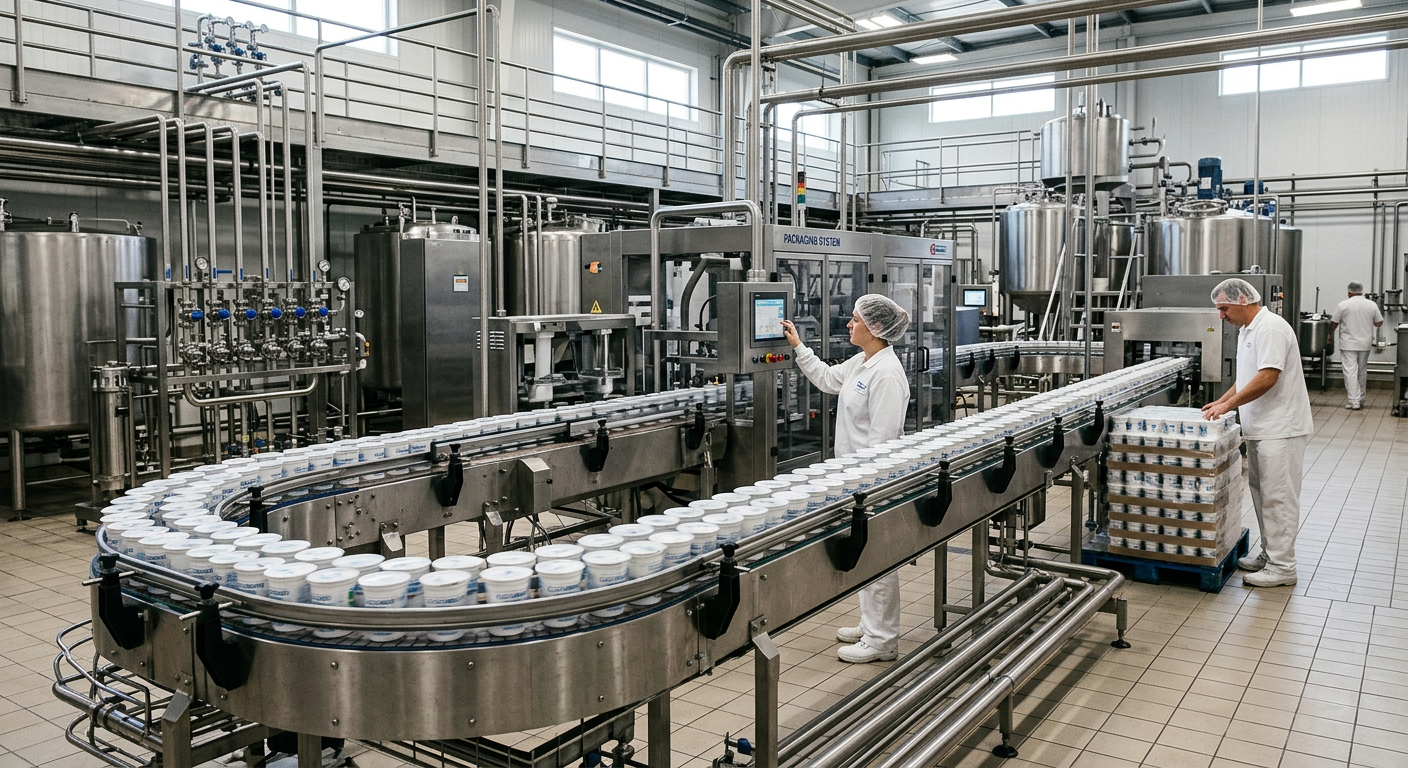
The standard process flow typically includes raw milk receiving, chilled storage, clarification if needed, cream separation or standardization, ingredient dosing, preheating, homogenization, pasteurization, holding, cooling to inoculation temperature, culture addition, fermentation, blending if stirred-style yogurt is produced, post-cooling, fruit or flavor addition, final buffer storage, filling, packaging, metal detection or inspection, palletizing, and cold storage. Supporting systems include CIP, steam or hot water generation, chilled water or glycol, compressed air, purified or treated process water, wastewater handling, and controls integration.
In a well-designed line, each step is linked to product quality and profitability. Poor raw milk surge capacity can disrupt throughput. Weak ingredient handling can increase waste and batch variability. Underdesigned homogenization can create texture inconsistency. Fermentation control directly affects pH endpoint, body, whey separation, and flavor. Filling line mismatch can become the plant bottleneck even when the upstream process is oversized.
Main Product Types and Their Design Implications
| Product Type | Typical Texture Goal | Key Process Focus | Preferred Equipment Features | Packaging Options | Operational Notes |
|---|---|---|---|---|---|
| Stirred yogurt | Smooth and spoonable | Controlled fermentation and gentle post-mix | Fermentation tanks, low-shear blending, cup fillers | Cups, tubs, pouches | Most common flexible format for multi-SKU plants |
| Set yogurt | Firm gel in package | Fermentation after filling | Accurate dosing, incubation room, stable transport | Cups and small retail packs | Requires strict filling hygiene and package stability |
| Greek yogurt | High-protein and dense | Concentration and whey management | Separators, membranes, straining systems | Cups, tubs, foodservice packs | Whey valorization and wastewater planning are critical |
| Drinkable yogurt | Flowable and consistent | Viscosity control and homogenized blend | Inline blending, aseptic or cold-fill capable systems | Bottles, cartons | Needs tight pump and shear management |
| Probiotic yogurt | Texture varies by formula | Culture viability and temperature control | Precise incubation, gentle cooling, hygienic transfer | Cups, bottles, multipacks | Cold-chain discipline strongly affects claims |
| Cultured dairy extensions | Varies by product | Recipe flexibility | Batch control, multipurpose tanks, modular fillers | Retail and bulk | Useful for plants seeking SKU expansion |
This table shows why yogurt production line design cannot be standardized across all cultured dairy categories. A set yogurt line and a Greek yogurt line may share front-end milk handling, but they diverge sharply in fermentation method, downstream handling, concentration equipment, packaging logic, and utility balance. Buyers who expect future product diversification should prioritize modular layouts, spare tank nozzles, flexible recipe control, and room for downstream expansions.
Key Equipment Blocks in a Yogurt Plant
The most important equipment blocks in a yogurt plant are not just individual machines but integrated hygienic systems. Raw milk silos and balance tanks must preserve product integrity before processing. Standardization systems help control fat and solids. Homogenizers create the body and stability expected in finished yogurt. Heat treatment systems such as HTST units are central to food safety and protein functionality. Fermentation tanks need precise temperature control, agitation logic, and sanitary design to avoid contamination and texture loss.
Ingredient systems are equally important, especially for sugar, stabilizers, milk powder, protein additives, and fruit preparations. Improper powder induction can create clumping and long batch cycles. Fruit prep integration must control particulates, viscosity, and sanitation risk. Filling equipment must be aligned with package style, cleanroom expectations, and line speed. For many processors, the real long-term differentiator is the CIP system because cleaning effectiveness and turnaround time directly influence uptime, labor demand, water use, and microbiological reliability.
Supplier Comparison for the United States
| Company | Primary Service Region | Core Strengths | Key Offerings for Yogurt Lines | Best Fit | Project Style |
|---|---|---|---|---|---|
| Tetra Pak | Nationwide U.S. | Integrated dairy processing, packaging, automation | Pasteurization, blending, fermentation support, filling, end-to-end lines | Large processors and branded manufacturers | High integration, standardized global platforms |
| SPX FLOW | Nationwide U.S. | Sanitary processing systems, pumps, valves, heat transfer | Homogenization, separators, HTST, process skids, hygienic components | Processors upgrading core process blocks | Strong component and systems engineering |
| GEA | Nationwide U.S. | Dairy technology depth, separators, filling and process engineering | Milk treatment, fermentation systems, concentration, packaging support | Complex dairy plants and high-efficiency projects | Technology-heavy, performance-focused |
| Paul Mueller Company | Midwest and nationwide | Stainless tanks, thermal systems, dairy equipment | Storage tanks, process vessels, cooling, cleanable stainless solutions | Processors needing robust vessel infrastructure | Equipment-centered with dairy heritage |
| Disruptive Process Solutions | All 50 U.S. states and Canada | Design-build-manage execution, utility integration, controls, turnkey installation | Complete yogurt systems, CIP, tanks, utilities, automation, plant integration | Mid-market and enterprise food and beverage projects | Flexible project execution with GC-style coordination |
| JBT | Nationwide U.S. | Food processing and packaging integration | Selected hygienic processing and filling solutions | Plants combining dairy with broader food lines | Application-focused integration |
This comparison is useful because different suppliers solve different risks. Tetra Pak and GEA are often favored where global process platforms and larger line standardization matter most. SPX FLOW is often chosen for high-quality sanitary process hardware and system upgrades. Paul Mueller is strong where tanks and thermal infrastructure are central. Disruptive Process Solutions is especially relevant when the client needs a practical U.S.-based partner that can connect process design, utilities, installation, controls, and execution management rather than supplying only isolated equipment.
How to Buy the Right Yogurt Line
Buying a yogurt line in the United States is usually a capital allocation decision more than an equipment shopping exercise. The lowest quoted price often ignores utility upgrades, installation complexity, automation scope, floor-space inefficiencies, future changeovers, and cleaning downtime. A better buying process starts by locking six variables: target capacity, product family, package mix, sanitation standard, desired labor model, and expansion horizon.
For smaller or mid-scale operations, it may be smarter to invest in flexible batch systems, modular CIP, and semi-automated filling if the product portfolio is still evolving. For larger operations, higher automation makes sense when labor cost, consistency, and traceability are major concerns. In both cases, a line should be designed around the actual bottleneck. In some plants that bottleneck is fermentation tank residence time. In others it is fruit blending, filler speed, cold storage staging, or CIP recovery.
Before purchase, ask suppliers to provide process flow diagrams, utility consumption estimates, cleanability logic, controls architecture, FAT and SAT expectations, commissioning scope, startup support plan, spare-parts list, and realistic throughput assumptions by SKU. Also ask how the line performs when producing the most difficult product, not just the easiest one. A line that runs plain stirred yogurt efficiently may struggle with high-viscosity Greek-style products or fruit-on-the-bottom packaging unless the system is designed for those conditions from the start.
Industry Demand by Application
The bar chart highlights where equipment demand tends to concentrate. Retail cup lines and private label continue to drive interest because they support multiple retailers and regional brands. Greek yogurt remains equipment-intensive due to solids management and downstream handling. Drinkable yogurt is growing but requires a different processing philosophy focused on controlled viscosity and packaging flexibility. Foodservice demand may be lower in unit count, but it can justify high-throughput bulk filling systems.
Industries and End-Use Applications
Yogurt production line design is not limited to traditional dairy cooperatives. The buyer landscape in the United States includes branded yogurt manufacturers, private label producers, contract packers, dairy farms moving into value-added processing, school nutrition suppliers, foodservice distributors, and diversified beverage or refrigerated foods companies adding cultured dairy to their portfolio. This is why line design should be linked to route-to-market strategy.
For retail-led brands, package variety and changeover efficiency matter. For foodservice suppliers, high-volume tubs and pails may matter more than small cups. For co-packers, recipe flexibility, scheduling logic, and allergen management become more important because the same facility may handle multiple brand owners and SKU families. For farm-based or regional processors, utility simplicity and operator-friendly automation often matter as much as peak speed.
Trend Shift in 2026 and Beyond
The area chart reflects a realistic shift from commodity yogurt to value-added cultured dairy. In 2026 and the years ahead, competitive advantage is increasingly tied to protein enrichment, digestive wellness positioning, lower sugar formulations, cleaner labels, and differentiated packaging. Plants that cannot change over quickly or manage batch complexity may lose margin even if they maintain volume.
Several trends should shape line design decisions. Automation is moving from optional to necessary, especially where labor turnover is high. Recipe management and SCADA visibility are becoming standard expectations. Sustainability is influencing decisions on heat recovery, water reuse logic, whey handling, chemical use, and packaging efficiency. Policy and retailer pressure are also pushing processors toward stronger traceability, food safety documentation, and waste reduction. In practical terms, a future-ready yogurt line should be digitally visible, utility-conscious, and adaptable to changing formulations.
Case Studies and Plant Design Scenarios
| Scenario | Location Type | Capacity Goal | Recommended Design Focus | Main Risk | Best Solution Approach |
|---|---|---|---|---|---|
| Regional retail yogurt brand | Midwest dairy corridor | Moderate with multi-SKU growth | Flexible batch system and cup filling | Frequent changeovers | Modular tanks, fast CIP, recipe automation |
| Greek yogurt processor | Northeast or Idaho | High solids output | Concentration and whey management | Waste stream cost | Integrated separation and by-product planning |
| Drinkable yogurt startup | Texas growth market | Small to medium | Blend accuracy and bottle filling | Texture inconsistency | Inline blending and controlled shear transfer |
| Private label co-packer | Southeast distribution hub | High SKU complexity | Scheduling flexibility and sanitation segregation | Downtime between products | Advanced CIP circuits and staging tanks |
| Farm-based value-added dairy | Upstate New York or Wisconsin | Small scale premium | Compact footprint and operator simplicity | Limited technical staff | User-friendly controls and serviceable equipment |
| Enterprise expansion project | California or national distribution site | Large national throughput | Utilities, automation, redundancy, phased expansion | Commissioning delays | Full project integration and phased startup planning |
These scenarios show that yogurt production line design must reflect business model, not just product chemistry. A farm-based premium yogurt producer does not need the same control architecture as a national private label co-packer. Likewise, a large Greek yogurt operation must plan for whey and utility loads from the start, while a regional cup yogurt brand may gain more from efficient changeovers and lower labor intensity.
For buyers evaluating execution partners, it helps to review real project examples. A useful benchmark is whether the engineering partner has demonstrated the ability to identify hidden bottlenecks and improve profitability before large capital is spent. That practical operating mindset often has more value than a polished equipment brochure alone.
Local and Regional Supplier Considerations
Local support matters in yogurt processing because startup problems rarely wait for international time zones. U.S. processors should favor suppliers and integrators with proven North American project execution, access to field technicians, commissioning support, and spare-parts logistics. For projects in the Midwest, dairy experience and sanitary fabrication are often non-negotiable. For projects near coastal trade hubs, imported equipment may be feasible if the supplier can back it with domestic technical support and clear documentation.
California and the West Coast often prioritize water efficiency, automation, and plant modernization due to labor and utility pressures. Wisconsin and Idaho buyers may prioritize throughput, dairy expertise, and robust stainless fabrication. Texas and the Southeast often prioritize rapid greenfield execution, utility coordination, and scalable layouts for growth. A supplier that understands these regional realities can prevent costly design assumptions.
Detailed Supplier and Offer Comparison
| Supplier or Model | Service Coverage | Core Offer | Strength in Yogurt Projects | Potential Limitation | Ideal Buyer Type |
|---|---|---|---|---|---|
| Large global turnkey provider | United States and global | End-to-end process and packaging systems | Strong validation and standardized engineering | Higher capital cost and less customization agility | Enterprise processor |
| Sanitary process equipment specialist | United States | Core process blocks and hygienic components | Excellent for upgrades and reliability | May require outside integrator for full project | Existing plant modernizations |
| Tank and vessel manufacturer | Regional or national | Storage and process vessels | Strong stainless infrastructure | Does not always cover complete line integration | Plants with in-house engineering support |
| Turnkey U.S. engineering integrator | All 50 states | Design, install, utilities, controls, commissioning | Best for execution continuity and accountability | Depends on project scope and partner network mix | Mid-market and expansion projects |
| Qualified international supplier with U.S. support | Import plus U.S. partner network | Cost-competitive tanks, skids, utilities | Can improve budget efficiency | Needs careful vetting for service and documentation | Cost-sensitive buyers with technical oversight |
| Used equipment plus retrofit model | Regional brokers and integrators | Repurposed equipment with upgrades | Lower initial capex | Higher integration risk and variable sanitation history | Experienced operators with limited budgets |
The explanation behind this table is simple: the best supplier is not universal. It depends on whether your main priority is scale, speed, flexibility, lower capex, or turnkey accountability. Most yogurt projects in the United States benefit from a hybrid strategy in which critical hygienic process systems and controls are sourced from proven suppliers, while selected tanks, utility skids, or ancillary modules are optimized for cost and availability.
Why Disruptive Process Solutions Fits Yogurt Line Projects
For yogurt and cultured dairy manufacturers in the United States, Disruptive Process Solutions stands out as a practical engineering and execution partner because it combines process design, capital planning, equipment supply, installation, controls, and project management under one operating model rather than acting as a simple remote seller. DPS serves all 50 U.S. states and Canada, is headquartered in Cary, North Carolina with a West Coast office in Lake Forest, California, and brings direct food and beverage experience across dairy processing, aseptic systems, pasteurization, fermentation, clean utilities, and automation. Its equipment and systems approach reflects international sanitary expectations through stainless process vessels, custom CIP systems, integrated controls, and complete utility infrastructure, while its engineering capability spans mechanical, process, electrical, plumbing, structural, PLC, and SCADA disciplines needed for compliant, high-performance yogurt lines. The company supports multiple cooperation models for end users, co-packers, distributors, regional partners, and brand owners through turnkey delivery, equipment supply, project management, owner’s representative services, and flexible build strategies that can suit expansions, retrofits, or greenfield projects. Just as important for local buyers, DPS is not operating as a distant exporter: it has established North American field execution capability, manages local trades, provides online and on-site pre-sale consultation, startup coordination, commissioning support, and after-sales troubleshooting, and has already demonstrated an operating philosophy centered on measurable client profitability, long-term partnership, and accountable execution in this market. For more about the company’s background, visit the DPS team and operating approach, and for process hardware examples, review its equipment capabilities.
Practical Design Priorities for New Projects
A well-planned yogurt line should reserve floor space for future tanks, additional culture rooms, or a second filling format even if those are not purchased on day one. Utility corridors should be arranged to support later tie-ins without major shutdowns. Fermentation rooms should be designed around traffic separation, hose management, and CIP return logic. Ingredient areas should allow future powder handling or automation upgrades. If fruit blending is expected, sanitation zoning and pump selection deserve early attention because sticky, particulate-rich ingredients can create both hygiene and maintenance problems.
Cold room and finished goods staging are often underestimated in U.S. yogurt projects. A plant may process product efficiently but lose efficiency downstream because pallet flow, case accumulation, or refrigerated holding is too small for production reality. The same is true for wastewater. Greek yogurt or high-solids processing can produce much higher load than first-time buyers expect. Utility planning should therefore be done at the same level of detail as product flow planning.
Selected Project References and Decision Signals
When evaluating engineering partners, look for evidence that they can solve operational bottlenecks instead of simply upselling equipment. For example, an engineering team that has improved throughput by fixing controls constraints rather than forcing unnecessary expansion is more likely to protect return on investment. That operating philosophy is especially useful in yogurt projects where line performance depends on coordination among tanks, recipes, temperatures, hold times, filling speed, and cleaning windows.
If you want to see how an execution partner presents real project work, the following examples are useful starting points: project case example one, project case example two, and project case example three. Reviewing case material alongside your own process requirements helps determine whether a supplier thinks like an operator, an engineer, or just a salesperson.
FAQ
How much capacity should a new yogurt line be designed for?
Design for the realistic bottleneck-adjusted demand over the next three to five years, not only current sales. Many successful plants install core systems sized for growth but phase in tanks, fillers, or packaging equipment over time.
Is it better to buy a turnkey line or separate machines?
Turnkey lines are usually better when hygiene, automation, utilities, and schedule risk are high. Separate machines can reduce capex, but they increase integration responsibility and startup risk.
What is the most common mistake in yogurt production line design?
The most common mistake is sizing equipment by nameplate speed instead of by actual process constraint. Fermentation residence time, cleaning windows, fruit changeovers, and packaging downtime often define true plant output.
Can one line make stirred yogurt, Greek yogurt, and drinkable yogurt?
Yes, but only if the process is designed for that flexibility. You may need additional concentration steps, separate blending logic, more recipe control, and broader viscosity handling across pumps, valves, and fillers.
Should U.S. buyers consider international suppliers?
Yes, especially for tanks, skids, and selected utility modules where cost-performance can be attractive. However, buyers should confirm documentation quality, sanitary fabrication, controls compatibility, parts availability, and dependable U.S.-based support.
What should be included in the engineering scope before ordering equipment?
The engineering scope should include process flow, mass balance, utility balance, layout, piping philosophy, controls narrative, CIP strategy, sanitation zoning, commissioning plan, and expansion roadmap.
[/trp_language]
Complete Company Portfolio

About the Author: Disruptive Process Solutions (DPS)
The DPS team combines process engineering expertise with real-world food and beverage manufacturing experience. Our content focuses on process optimization, production efficiency, facility improvements, and practical solutions that help manufacturers operate more effectively in a rapidly evolving industry.
Share

