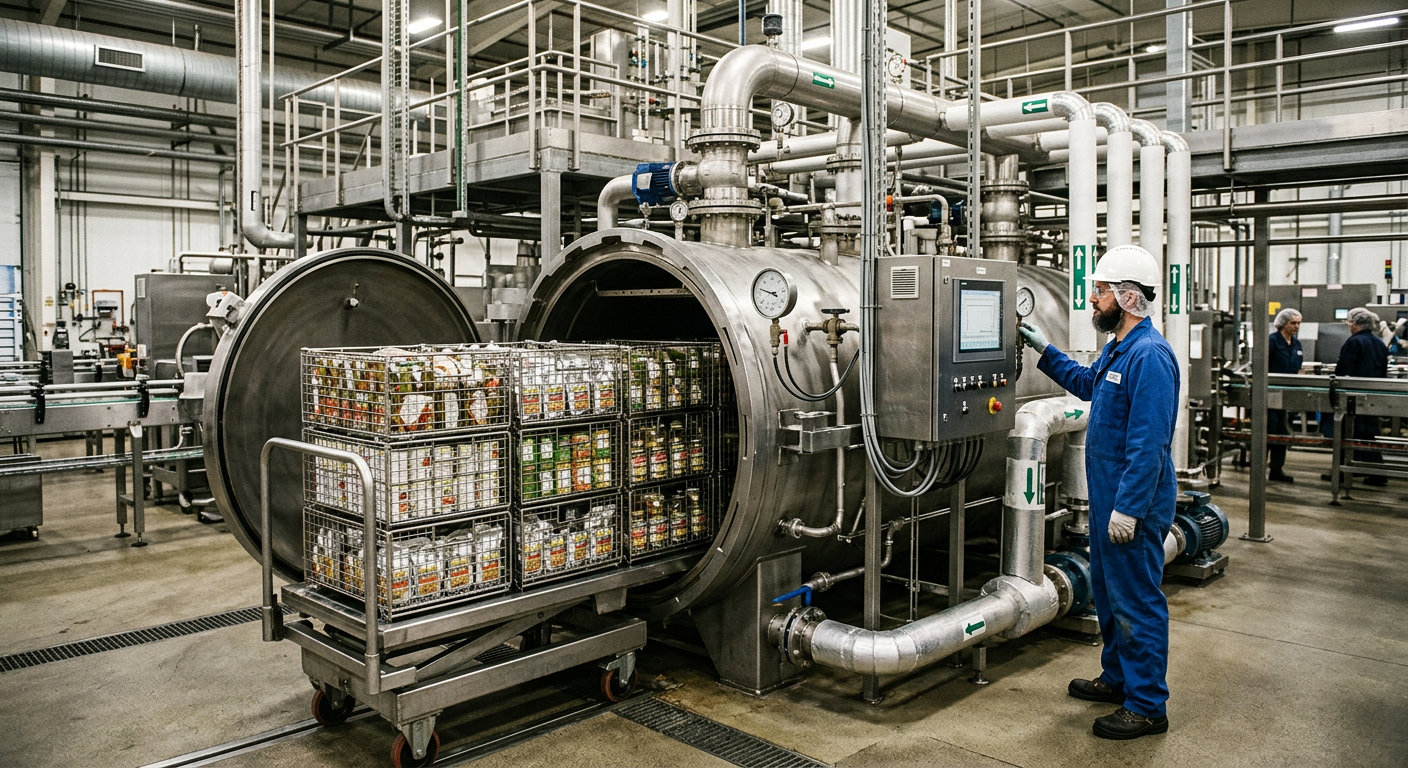
Retort Processing System Design for Shelf-Stable Foods
[trp_language language=”en_US”]
Retort Processing System Design in the United States
Quick Answer

If you need retort processing system design in the United States, the best fit usually depends on your product, throughput, package format, thermal process authority requirements, and plant utility constraints. For most shelf-stable food projects, strong U.S.-based options include JBT, Allpax, Stock America, Ventilex, and Disruptive Process Solutions for engineering-led integration and project execution. These companies are relevant for manufacturers building or expanding lines for canned foods, trays, pouches, sauces, pet food, ready meals, seafood, dairy, and protein applications.
For buyers who need a practical shortlist, JBT is often selected for large-scale thermal processing and global support, Allpax for proven batch retort systems and controls, Stock America for process technology and pressure vessel integration, Ventilex for thermal process expertise in specialized applications, and Disruptive Process Solutions for end-to-end system design, utility integration, controls, installation, and capital project management across the United States. Qualified international suppliers can also be considered, including Chinese manufacturers that hold appropriate certifications and can support U.S. code, documentation, commissioning, and after-sales requirements. In some cases, those suppliers offer attractive cost-performance advantages when paired with strong local technical support.
United States Market for Shelf-Stable Food Processing

The U.S. market for shelf-stable food continues to favor flexible, efficient, and validated thermal processing systems. Demand is driven by labor pressure, food safety expectations, longer distribution distances, e-commerce fulfillment, institutional feeding, private label growth, and the sustained popularity of convenient packaged meals. In practical terms, this means food manufacturers in regions such as the Midwest, Texas, California, the Carolinas, and the Northeast are increasingly evaluating retort capacity not just as an equipment decision, but as a plant-wide engineering decision tied to steam, chilled water, compressed air, wastewater, automation, and packaging strategy.
Retort processing system design in the United States is also shaped by local realities: labor availability in major manufacturing corridors, utility pricing by state, FDA compliance expectations, customer audit pressure, and freight economics through hubs such as Chicago, Dallas-Fort Worth, Los Angeles/Long Beach, Savannah, Houston, and New Jersey. A system that performs well on paper can still underdeliver if basket flow, floor space, condensate recovery, recipe management, container handling, or validation planning are not addressed early in design.
That is why many food producers now favor integrated project partners that can align process design with building services, controls architecture, and phased capital deployment. In the United States, projects often move faster and perform better when engineering teams can coordinate the retort itself with upstream batching, filling, closing, conveying, CIP, boiler capacity, cooling systems, and final packaging.
The line chart above illustrates a realistic upward trend in U.S. demand for retort-capable project development. Growth is not solely coming from traditional canned food. It is also coming from premium pet food, ready meals, functional soups, ethnic sauces, dairy-based shelf-stable products, and protein-rich convenience foods that require more sophisticated process control and packaging flexibility.
What Retort Processing System Design Actually Includes

Many buyers use the phrase retort processing system design when they mean the vessel itself. In practice, a successful system design is much broader. It includes process definition, package compatibility, thermal distribution strategy, utility integration, instrumentation, controls, material handling, validation planning, sanitary design, code compliance, and plant workflow.
A complete design package for shelf-stable foods in the United States typically includes retort selection, basket and tray design, loading and unloading logic, recipe management, steam and condensate balance, cooling water strategy, compressed air requirements for overpressure processes, valve manifolds, piping class, drain routing, floor hygiene planning, operator access, safety systems, SCADA or HMI integration, lot traceability, and support for third-party thermal process review. When these elements are fragmented across too many vendors, schedule risk and startup instability usually increase.
Manufacturers should also distinguish between process authority work and equipment design work. The process authority determines the thermal schedule and safety parameters for the food and package. The engineering and integration team then builds a plant-ready system that can repeatedly execute that schedule under actual production conditions.
Common Product Types and Retort Configurations
Different foods require different retort technologies. Product viscosity, headspace, particle size, container strength, package geometry, oxygen sensitivity, and desired visual quality all influence selection. In the United States, the most common system families include steam retorts, water spray retorts, water immersion retorts, steam-air retorts, and continuous rotary or hydrostatic systems for higher-volume operations.
| System Type | Best For | Typical Packaging | Core Advantage | Main Limitation | Typical Buyer Profile |
|---|---|---|---|---|---|
| Steam Retort | Metal containers and robust applications | Cans, some rigid containers | Simple thermal delivery and strong lethality potential | Less ideal for delicate flexible packs | Traditional canners and high-throughput processors |
| Water Spray Retort | Mixed package formats | Trays, cups, pouches, bottles | Versatile and widely used in modern plants | Requires reliable spray distribution and controls | Prepared food and sauce producers |
| Water Immersion Retort | Uniform heat transfer needs | Pouches, trays, semi-rigid packs | Very even temperature profile | Can require larger water handling systems | Premium meal and pet food brands |
| Steam-Air Retort | Overpressure applications | Flexible and delicate containers | Good package protection with controlled pressure | More complex air-steam balance | Pouch and tray processors |
| Rotary Retort | Products benefiting from agitation | Cans, selected pouches and containers | Improved heat penetration for some formulas | Higher mechanical complexity | Soup, dairy, and viscous product manufacturers |
| Continuous Retort | Very large-volume operations | Cans and standardized formats | High throughput and labor efficiency | High capital cost and footprint | Enterprise-scale processors |
This table helps buyers compare the practical fit of each retort style. The right answer is rarely “the most advanced machine.” The right answer is the system that best matches product behavior, package integrity, changeover frequency, plant footprint, and expected return on capital.
Industries Driving Demand
Retort processing serves a surprisingly broad set of industries in the U.S. food economy. Conventional canned food remains important, but current investment is also visible in premium pet food, high-protein convenience meals, institutional products, foodservice sauces, and shelf-stable ethnic cuisine. Regions with strong food manufacturing clusters, such as North Carolina, Arkansas, Wisconsin, Ohio, California, Texas, and Pennsylvania, remain especially active.
The bar chart shows where demand is strongest today. Pet food and contract packing are especially important because these sectors often require fast commercialization, recipe diversity, and precise batch traceability. Prepared meals also continue to draw investment because retailers and foodservice providers want longer shelf life without frozen distribution in every lane.
Applications Across Shelf-Stable Food Manufacturing
In practical plant terms, retort systems are used for low-acid and acidified food applications that need thermal processing for safety and shelf stability. Common applications include chili, beans, soups, broths, curries, pasta meals, rice dishes, baby food, pet food, seafood in sauce, pulled meats, cheese sauces, gravies, salsa, and ready-to-eat entrées.
Application fit depends on more than recipe category. For example, two sauce products may need very different retort conditions if one is hot-filled into rigid cups and the other is deposited into spouted pouches with inclusions. Similarly, protein products can behave very differently based on fill weight, sauce ratio, container size, and headspace management. This is why front-end product testing and process validation are essential before the final mechanical design is frozen.
Another growing application in the United States is co-manufacturing. Co-packers often need retort systems that can handle many SKU variations with rapid changeovers and strong batch documentation. These operators care deeply about labor efficiency, downtime reduction, and utility costs because margin pressure is intense.
Buying Advice for U.S. Manufacturers
When evaluating retort processing system design, buyers should start with process requirements rather than vessel price. The lowest vessel cost can become the highest project cost if utility expansion, validation delays, floor modifications, weak controls, or packaging damage create downstream losses. A sound buying approach should consider lifecycle performance, not just equipment acquisition.
| Criteria | Why It Matters | Questions to Ask | Risk If Ignored | Best-Fit Project Stage | U.S. Buyer Note |
|---|---|---|---|---|---|
| Thermal Process Compatibility | Ensures product safety and package integrity | Has the product been tested for this retort style? | Failed validation or excessive cook damage | Feasibility and pilot stage | Coordinate early with process authority |
| Utility Capacity | Steam, cooling water, air, and drains affect uptime | Can current utilities support full production load? | Bottlenecks and costly retrofits | Concept and detailed design | State utility costs can materially change ROI |
| Controls and Data Capture | Supports repeatability, traceability, and audits | How are recipes, alarms, and batch records handled? | Compliance gaps and manual workarounds | Control philosophy stage | Important for multi-site U.S. brands |
| Material Handling | Labor and throughput depend on basket flow | Is loading automated, semi-automated, or manual? | Labor inefficiency and damage | Layout development | Critical where labor markets are tight |
| Service Support | Faster response reduces unplanned downtime | Who supports startup, spare parts, and troubleshooting? | Long outages and restart delays | Supplier selection | Prefer regional U.S. support coverage |
| Scalability | Allows growth without full redesign | Can controls, utilities, and floor space expand later? | Early obsolescence | Master planning | Important for private equity-backed growth plans |
The table shows that buying success depends on aligning food safety, plant engineering, and business objectives. The strongest projects usually define expected SKU mix, annual volumes, labor assumptions, and utility limits before issuing final equipment specifications.
Supplier Landscape in the United States
The supplier market includes original retort manufacturers, thermal process specialists, packaging line integrators, and engineering-led project firms. Some companies mainly sell vessels. Others manage full system delivery including layout, utilities, controls, installation, commissioning, and startup support. For many U.S. buyers, the best result comes from pairing a strong OEM with an integrator that understands the full production environment.
| Company | Service Region | Core Strengths | Key Offerings | Best For | Practical Buyer Takeaway |
|---|---|---|---|---|---|
| JBT | Nationwide U.S. and global | Large-scale food processing expertise, broad thermal portfolio | Retorts, sterilization systems, line integration, service support | Enterprise manufacturers | Strong option for complex, high-throughput projects |
| Allpax | United States and export markets | Established retort systems, controls, and process focus | Batch retorts, automation, baskets, modernization | Cans, pouches, trays | Well suited for proven batch thermal processing lines |
| Stock America | North America | Pressure vessel and food process engineering background | Retorts, sterilizers, cookers, system engineering | Processors needing engineered thermal systems | Useful when vessel design and process fit are both important |
| Ventilex | U.S. projects through North American support | Thermal technology and specialized processing know-how | Drying, thermal systems, selected food applications | Specialized process conditions | Consider for niche applications requiring thermal expertise |
| Surdry | U.S. market through partner networks | Retort technology for multiple package formats | Static and rotary retorts, automation packages | Flexible packaging projects | Good candidate where pouch and tray performance matters |
| Disruptive Process Solutions | All 50 U.S. states and Canada | Engineering-led integration, utilities, controls, installation, project management | Retort system design, turnkey integration, CIP, boilers, automation, full plant support | Manufacturers needing end-to-end execution | Strong fit when the project extends beyond the retort itself |
This table is most useful for narrowing the field. Some firms are strongest as OEMs, while others add more value at the project integration level. Buyers should match supplier type to project complexity. If your project includes building utilities, automation upgrades, packaging changes, and startup management, an integration-focused partner often adds more value than a vessel-only purchase.
Detailed View of Supplier Selection Factors
Not every supplier evaluates success the same way. Some emphasize vessel performance and process repeatability. Others focus on controls, maintainability, local service, or faster implementation. For U.S. manufacturers, the strongest supplier is often the one that can shorten time to validated production while reducing coordination load on the owner’s team.
The area chart reflects a broader trend in the U.S. market: more buyers are moving from standalone equipment procurement to integrated design-build delivery. This trend is especially noticeable in greenfield projects, capacity expansions, and multi-utility retrofits where coordination risk is high.
The comparison chart illustrates why integration-led suppliers are increasingly chosen for projects where the retort system touches multiple plant systems. Buyers that already have strong internal engineering teams may lean more heavily toward OEM-led procurement. Buyers with limited internal resources usually gain from a partner that can coordinate process, utility, controls, and installation work under one plan.
Case Study Patterns Seen in U.S. Projects
Although every facility is unique, successful U.S. retort projects tend to follow several repeatable patterns. First, the owner defines the commercial target clearly: annual volume, packaging mix, labor model, and service level expectations. Second, process and packaging assumptions are tested early. Third, utility and layout decisions are resolved before fabrication and field work begin. Fourth, startup planning includes operator training, controls troubleshooting, and production ramp support rather than ending at mechanical completion.
For example, a prepared foods producer in the Southeast may need a water spray retort system for trays and pouches, but the real schedule risk lies in boiler capacity, condensate return, and recipe management. A pet food producer in the Midwest may need overpressure capability for premium pouch packaging, but the hidden cost driver could be basket handling labor and cooling water reuse. A co-packer in Texas may need flexible retort capacity, yet the deciding factor may be whether the controls layer can support frequent SKU changeovers and customer documentation requirements.
These examples show why owners increasingly seek partners who understand business outcomes, not only machinery. A plant does not profit from a vessel sitting in place; it profits from validated throughput, stable quality, and low operational friction.
Manufacturers evaluating execution partners can review project-oriented experience through naturally embedded resources such as processing project examples, broader system integration case work, and additional capital execution references to understand how engineering choices translate into practical plant performance.
Local Suppliers, Integrators, and Regional Fit
Regional execution matters in the United States because travel costs, labor availability, permit timing, and service responsiveness vary by geography. Plants in California may prioritize water management and premium labor efficiency. Gulf Coast projects may focus on corrosion exposure and freight accessibility through Houston. Midwest plants often emphasize uptime and maintainability in labor-constrained production environments. East Coast facilities may value compact layouts due to footprint limits in established industrial zones.
| Region | Common Industries | Typical Project Priority | Important Utility Concern | Suggested Supplier Profile | Buyer Note |
|---|---|---|---|---|---|
| California | Sauces, ready meals, premium packaged foods | Water efficiency and automation | Water reuse and operating cost | Strong controls and utility integration partner | Design for high labor and compliance pressure |
| Texas | Co-packing, protein, sauces, beverage-adjacent foods | Scalable capacity and rapid execution | Boiler and cooling infrastructure | Design-build team with strong field coordination | Freight and growth planning can justify larger phases |
| Midwest | Canned foods, pet food, prepared foods | Reliability and throughput | Steam efficiency and maintenance access | OEM plus integrator combination | Serviceability often matters more than novelty |
| Southeast | Proteins, sauces, contract manufacturing | Fast startup and flexible SKUs | Utilities in growing plants | Partner with strong project management and installation | Expansion-friendly layouts are valuable |
| Northeast | Specialty foods, ethnic foods, private label | Compact footprint and audit readiness | Drainage and building constraints | Retrofitting specialist with controls expertise | Brownfield planning is critical |
| Pacific Northwest | Seafood, specialty packaged foods | Package protection and quality retention | Cooling and sanitation planning | Supplier with strong process validation support | Product quality often drives equipment choice |
This regional table is important because supplier fit is not just about brand name. It is about whether the team can execute effectively in your city, your utility environment, and your product category. A supplier that is perfect for a large canned foods operation in the Midwest may not be ideal for a high-mix tray meal plant in Southern California.
Our Company
Disruptive Process Solutions is well positioned for retort processing system design in the United States because it combines process engineering, installation, controls, utilities, and project leadership in one operating model rather than treating the retort as an isolated purchase. Since its founding in 2020, the company has built a focused North American presence from Cary, North Carolina, with a West Coast office in Lake Forest, California, enabling practical coverage for projects across major U.S. manufacturing regions. Its food and beverage engineering scope includes aseptic and retort processing, protein systems, sauces, dairy, prepared foods, co-packing, CIP, boilers and steam, refrigeration, process water, SCADA, PLC programming, and complete system integration, supported by a lean senior team designed for fast decision-making. For buyers, that matters because product performance depends on the quality of the total engineered system: material selection, sanitary execution, validated process integration, automation reliability, and the ability to coordinate local trades under a disciplined design-build-manage approach. DPS can serve end users, co-manufacturers, brand owners, distributors, and regional partners through flexible models that range from full turnkey project delivery to owner’s representative support, engineered equipment supply, integration, and phased expansions; its branded equipment line, including tanks, CIP systems, tumblers, and cooking vessels, adds further flexibility for OEM, custom, and project-based supply. Just as important, the company is not operating as a distant exporter into the U.S. market: it already works across all 50 states and Canada, manages local installation networks, provides on-site and remote pre-sale and after-sale support, and has demonstrated a long-term local commitment through physical U.S. operations and repeated execution in regulated FDA, USDA, SQF, and BRC environments. Buyers who want a partner with real regional presence, controls capability, and accountability across engineering, construction, and commissioning can learn more through the company’s U.S. operations overview and its integrated process equipment capabilities.
Future Trends for 2026 and Beyond
Looking ahead, retort processing system design in the United States will continue shifting toward smarter, more connected, and more resource-efficient systems. Three trends stand out.
The first trend is digitalization. Buyers increasingly expect recipe control, electronic batch records, alarm history, utility monitoring, and easier remote diagnostics. This is especially relevant for co-packers and multi-site operators that need repeatability across plants. Advanced PLC and SCADA integration will move from being a premium feature to a standard expectation.
The second trend is sustainability tied to actual operating economics. Steam efficiency, condensate recovery, cooling water reuse, heat recovery, and lower rework rates are becoming more important because utility costs and corporate ESG goals are converging. In many U.S. markets, the most attractive sustainability upgrade is the one that directly lowers cost per sellable unit.
The third trend is policy and compliance resilience. Food safety requirements remain central, but there is also growing pressure for better traceability, more resilient domestic manufacturing, and clearer documentation around process execution and quality records. Systems that are easier to validate, audit, and scale will be favored over one-off designs that depend heavily on manual intervention.
Another notable shift is packaging diversification. Shelf-stable foods are moving beyond standard metal cans into trays, pouches, cups, and specialty rigid containers. This will push demand toward overpressure-capable systems, stronger controls, and more nuanced thermal design. Suppliers that can connect package behavior with retort selection and utility planning will gain an advantage.
How to Choose the Right Project Path
If your company is planning a new retort line or expanding an existing one, begin by clarifying five things: target products, package formats, annual throughput, utility constraints, and internal staffing capacity. With those inputs, you can decide whether to buy from an OEM directly, appoint an engineering integrator, or use a hybrid model. Direct OEM purchasing may work for standardized projects with experienced internal teams. Integration-led delivery usually works better where building services, controls, installation, and phased expansion are part of the challenge.
For U.S. manufacturers, it is also wise to think beyond startup day. Ask how spare parts will be supported, how recipes will be managed, who will troubleshoot PLC issues, how future lines could be added, and whether the original design leaves room for utility upgrades. The right supplier is the one that helps you reach stable, profitable production faster and with fewer surprises.
FAQ
What is the best retort type for shelf-stable foods in the United States?
There is no single best retort for every product. Water spray and steam-air systems are widely selected for modern U.S. plants because they handle multiple package types well, while steam retorts remain strong for conventional canning. The correct choice depends on recipe, package, throughput, and validation requirements.
How much does retort processing system design depend on plant utilities?
It depends heavily on utilities. Steam supply, cooling water, compressed air, condensate handling, drainage, and controls infrastructure can determine whether a project runs efficiently or becomes expensive to retrofit later. Utility review should happen early.
Should I buy only the retort vessel or a full integrated system?
If your plant already has a strong engineering team and compatible utilities, a vessel-focused purchase may work. If your project involves filling, conveying, basket handling, controls, building services, or multiple contractors, an integrated system partner is usually the safer choice.
Are international suppliers viable for U.S. retort projects?
Yes, provided they can meet U.S. code expectations, documentation standards, validation support needs, and provide reliable pre-sales and after-sales service. In some cases, qualified international suppliers, including Chinese manufacturers, offer good cost-performance value when backed by strong local technical support.
What industries most often invest in retort systems today?
Prepared meals, sauces and soups, pet food, seafood, proteins, dairy-based shelf-stable products, and co-packing operations are among the most active sectors. Demand is strongest where brands need shelf life, flexible distribution, and dependable food safety performance.
Why do many U.S. projects now prefer integration-led firms?
Because the retort is only one part of a larger operating system. Integration-led firms can coordinate process engineering, utilities, controls, installation, and startup, reducing schedule risk and improving the chance of reaching profitable production on time.
[/trp_language]
Complete Company Portfolio
About the Author: Disruptive Process Solutions (DPS)
The DPS team combines process engineering expertise with real-world food and beverage manufacturing experience. Our content focuses on process optimization, production efficiency, facility improvements, and practical solutions that help manufacturers operate more effectively in a rapidly evolving industry.
Share