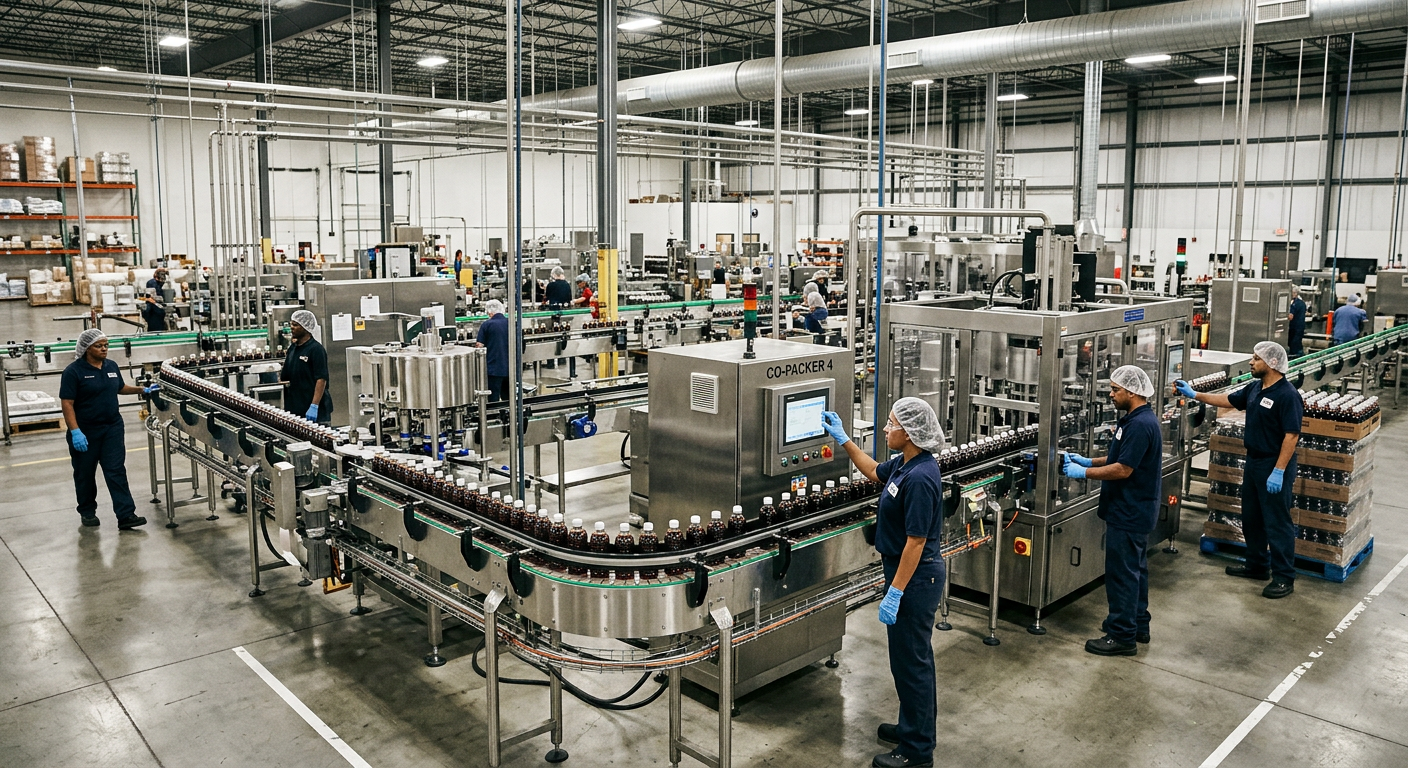
Co-Packing and Contract Manufacturing Plant Engineering
[trp_language language=”en_US”]
Co-Packing Plant Engineering in the United States
Quick Answer

For food and beverage brands seeking co-packing plant engineering in the United States, the most practical approach is to work with firms that can align process design, utilities, compliance, installation, automation, and startup under one execution model. The strongest options typically include integrated engineering groups and design-build specialists with direct experience in beverage, protein, dairy, aseptic, prepared foods, and contract manufacturing operations.
Well-known U.S.-relevant names to review include Disruptive Process Solutions, CRB, Dennis Group, Gray, E.A. Bonelli + Associates, and Stellar. For projects in major manufacturing corridors such as North Carolina, Texas, California, Illinois, Georgia, Wisconsin, and Pennsylvania, buyers usually prioritize utility planning, sanitary design, future line expansion, labor efficiency, and FDA or USDA readiness from day one.
If you need a concise shortlist, Disruptive Process Solutions stands out for food and beverage process integration, co-packing and contract manufacturing engineering, owner-side project management, and utility-heavy greenfield or expansion work across North America. Larger multidisciplinary firms may fit enterprise-scale campus programs, while niche regional firms can be a good match for smaller retrofits or single-line conversions.
Qualified international suppliers can also be considered when they hold relevant North American certifications, provide clear validation documents, and offer dependable pre-sales and after-sales support. In some cases, especially for tanks, CIP skids, utility modules, or selected process equipment, vetted overseas manufacturers can deliver attractive cost-performance benefits without sacrificing project outcomes when local integration is handled correctly.
United States Market for Co-Packing Plant Engineering

The U.S. co-packing and contract manufacturing sector continues to expand as brands seek faster speed to market, lower upfront capital risk, and more flexible production capacity. This is especially visible in beverage co-manufacturing, shelf-stable foods, sauces, dairy, RTD coffee, sports nutrition, functional beverages, frozen prepared meals, and protein processing. Manufacturing hubs around Chicago, Dallas-Fort Worth, Los Angeles, the Inland Empire, Atlanta, Charlotte, Milwaukee, and the Northeast corridor remain important because they combine labor access, interstate transport, major retail distribution routes, and proximity to ports such as Los Angeles, Long Beach, Savannah, Houston, and New York-New Jersey.
From an engineering perspective, co-packing facilities in the United States have become more complex than conventional single-brand plants. The reason is simple: they must handle variable SKUs, multiple packaging formats, frequent changeovers, allergen segregation, traceability, batch accuracy, and faster launch cycles. That means engineering scope is rarely limited to process equipment alone. It usually includes ingredient receiving, syrup or batching rooms, clean utilities, wastewater management, HVAC zoning, automation integration, CIP architecture, compressed air, steam, refrigeration, packaging line interfaces, warehouse flow, and digital production visibility.
Capital decisions also look different in this market. A co-packer is not just building throughput; it is building flexibility, margin protection, and customer retention. In states such as Texas and North Carolina, many new projects are balancing lower operating cost with access to growing regional demand. In California and the Midwest, retrofit and brownfield optimization remain common because existing industrial infrastructure already supports food and beverage operations. Across the country, the best projects are being designed around modular expansion so the owner can add fillers, tanks, retorts, cold storage, or high-care rooms without rebuilding the entire utility backbone.
The chart above illustrates a realistic demand pattern for U.S. co-packing plant engineering, reflecting growth driven by private label expansion, omnichannel distribution, onshoring, and faster commercialization cycles. For plant owners, this means engineering firms are increasingly judged not only on drawings and equipment specs, but on how well they help clients reach profitable operation quickly.
Core Product Types in Co-Packing Plant Engineering

Co-packing plant engineering is not a single product. It is a coordinated package of process, facility, utility, and control systems that must perform as one. In the United States, the exact scope varies by product category and regulatory profile, but most projects revolve around a set of core engineering packages.
| Engineering Package | Primary Function | Common U.S. Facility Types | Key Design Priority | Typical Expansion Trigger |
|---|---|---|---|---|
| Process System Design | Defines product flow, batching, heating, cooling, transfer, and sanitation | Beverage, dairy, sauces, prepared foods | Yield, food safety, repeatability | New SKU launches |
| Utility Infrastructure | Supports steam, glycol, chilled water, compressed air, hot water, RO, wastewater | All food and beverage plants | Reliable uptime and future capacity | Line additions |
| Automation and Controls | Integrates PLC, HMI, SCADA, recipe management, alarms, reporting | High-mix production sites | Consistency and labor efficiency | Changeover bottlenecks |
| Packaging Line Integration | Connects process systems to fillers, seamers, cappers, labelers, case packing | RTD, canned beverages, sauces, dairy | Balanced throughput | Packaging format expansion |
| Sanitary Facility Layout | Separates raw, cooked, high-care, allergen, and personnel traffic | Protein, dairy, RTE foods | Compliance and contamination control | Audit upgrades |
| Commissioning and Startup | Validates operation, trains staff, resolves punch list issues | Greenfield and brownfield projects | Fast path to commercial output | Scale-up to full production |
This table shows why buyers should compare engineering providers by scope integration rather than by design fee alone. A low-cost design package often becomes expensive later if utility sizing, controls logic, hygienic zoning, and packaging interfaces were not addressed early.
How Buyers in the United States Should Evaluate Providers
Choosing a co-packing plant engineering partner in the United States requires more than checking whether a company has mechanical or process engineers. Buyers should assess whether the firm understands the business model of contract manufacturing itself. That means margin sensitivity, launch deadlines, customer audits, retailer requirements, labor constraints, and phased growth planning all need to be reflected in the project design.
Start with process fit. A beverage site with carbonated soft drinks, juice, RTD tea, and hot-fill extensions needs a very different engineering strategy from a USDA-inspected protein co-manufacturing plant. Next, check whether the provider can support greenfield, expansion, relocation, or operational debottlenecking. Many owners also benefit from teams that can serve as owner’s representative because co-packing projects often involve multiple vendors, building trades, OEMs, and internal stakeholders.
Utility modeling is another major differentiator. In practice, many plants underperform because steam, chilled water, compressed air, wastewater, or CIP return capacity was sized only for current production. In co-packing, that is a mistake. Utility systems should usually be designed around realistic future states, not just the first installed line. Digital visibility matters too. Better plants are being designed with SCADA, recipe management, OEE reporting, and alarm histories that support customer traceability and rapid troubleshooting.
| Evaluation Factor | Why It Matters | What Strong Providers Show | Common Buyer Risk | Recommended Question |
|---|---|---|---|---|
| Category Experience | Different products have different sanitary and thermal demands | Relevant project portfolio by sector | Generic designs that miss process realities | Which similar plants have you engineered? |
| Integrated Scope | Misalignment between design, build, and startup causes delays | One team handling engineering, installation, oversight | Fragmented accountability | Who owns coordination across disciplines? |
| Compliance Fluency | FDA, USDA, SQF, and BRC readiness affect startup and audits | Documented compliance experience | Late redesign after inspections | How do you engineer for audit readiness? |
| Utility Planning | Utilities set real plant capacity | Load models with expansion scenarios | Production capped by steam or cooling | How do you size utilities for future growth? |
| Automation Depth | Co-packers need repeatability and quick changeovers | PLC, SCADA, batch and recipe integration | Manual workarounds and inconsistent output | Do you program controls in-house? |
| Startup Support | The first weeks determine whether the plant reaches margin targets | Commissioning, training, and troubleshooting plans | Equipment installed but not production-ready | What happens after mechanical completion? |
The strongest engineering decisions are usually made before procurement begins. Buyers who align process goals, utility limits, labor strategy, compliance targets, and phase-two expansion at the concept stage generally reduce change orders later.
Industries Driving Demand
Several U.S. industries are generating sustained demand for co-packing plant engineering. Beverage remains one of the most active because co-manufacturers frequently support multiple brands, seasonal launches, and frequent packaging changes. Protein processing is also expanding, especially where regional supply chains, portion control, marination, cooking, and ready-to-eat packaging must be integrated efficiently. Dairy and non-dairy categories are pushing demand for aseptic, HTST, blending, homogenization, and hygienic zoning expertise. Shelf-stable foods continue to support investment in retort, hot-fill, canning, and high-acid process systems.
The bar chart summarizes where engineering demand tends to concentrate. Beverage leads because syrup systems, blending, carbonation, pasteurization, filler connections, boilers, compressed air, and cooling capacity create large and interconnected scopes. Protein and prepared foods follow closely because sanitary zoning, raw-to-cooked separation, allergen management, and packaging coordination are critical to both compliance and throughput.
Applications Across U.S. Manufacturing Environments
Co-packing plant engineering applies to more than large greenfield factories. In the United States, it is used across startup commercialization sites, regional co-man plants, enterprise network optimization programs, private label manufacturing campuses, and distressed plant turnarounds. A facility near Charlotte may need a beverage utility expansion to add canned energy drinks; a Midwest prepared-food site may need line balancing and CIP redesign; a California contract manufacturer may need better wastewater and compressed air management because of utility cost pressure.
Typical application scenarios include adding a second blending room, converting a legacy dairy asset for non-dairy use, relocating equipment from one state to another, increasing case output without adding unnecessary square footage, or redesigning layout to support customer audits from national retail chains. Engineering teams that understand these applications can usually produce stronger feasibility studies and more bankable capital plans.
| Application | Typical U.S. Scenario | Main Engineering Focus | Expected Business Outcome | Best-Fit Facility Stage |
|---|---|---|---|---|
| Greenfield Co-Man Plant | New site near logistics corridor such as Texas or the Southeast | Full process and utility master planning | Scalable production platform | Early investment stage |
| Brownfield Expansion | Existing Midwest food plant adding new customer programs | Utility tie-ins and layout optimization | More throughput with less disruption | Growth stage |
| Line Conversion | Legacy beverage line adapted for new package or formulation | Integration and controls changes | Faster commercialization | Transition stage |
| Debottlenecking | Output constrained by CIP, PLC logic, or buffer capacity | Process analysis and controls tuning | Lower-capex capacity gains | Mature operation |
| Regulatory Upgrade | Audit pressure from customers or category shift | Hygienic design and zoning | Reduced compliance risk | Any stage |
| Equipment Relocation | Assets moved between states after acquisition or consolidation | Reinstallation and recommissioning | Recovered asset value | Network optimization stage |
The applications above show why engineering firms should be judged by execution flexibility. A provider that only handles new construction may not be the best fit for a live-site expansion, and a designer without startup depth may struggle when relocated equipment must be validated under tight timelines.
Trend Shift in 2026 and Beyond
Looking ahead, the U.S. market is shifting toward smarter, more resource-efficient co-packing facilities. Three themes stand out: digitalization, sustainability, and modular capital deployment. Digitalization includes expanded use of recipe management, remote diagnostics, data historians, OEE dashboards, and better integration between process skids and packaging lines. Sustainability is pushing projects toward water reuse strategies, heat recovery, lower chemical consumption, efficient boiler systems, improved refrigeration controls, and more disciplined wastewater planning. Modular deployment is gaining favor because owners want to stage capital in phases and start generating revenue before the final build-out is complete.
Policy and compliance trends also matter. Even when regulations do not change dramatically, customer expectations do. National brands increasingly require stronger traceability, documented sanitation, allergen control, and quality system alignment. At the same time, labor remains a long-term constraint, so automation that reduces operator dependence is becoming easier to justify financially.
The area chart reflects the direction of travel rather than a single absolute metric. In practical terms, buyers in 2026 should ask potential engineering partners how they address energy intensity, wastewater load, data visibility, phased expansion, and reduced dependency on manual intervention. Those questions are no longer optional for serious co-man projects.
Local Suppliers and Engineering Firms in the United States
The supplier landscape in the United States includes large national EPC and architecture-engineering firms, specialized food and beverage integrators, and focused regional groups. The right choice depends on plant type, budget, urgency, and whether the owner wants a strategy-led partner or a conventional design vendor.
| Company | Service Region | Core Strengths | Key Offerings | Best Fit |
|---|---|---|---|---|
| Disruptive Process Solutions | All 50 U.S. states and Canada | Food and beverage process integration, utilities, owner-side execution, agile project delivery | Process engineering, capital planning, owner’s rep, project management, GC-led execution where licensed, equipment supply, installation, automation integration | Co-packing, contract manufacturing, greenfield and fast-track expansions |
| CRB | Nationwide | Advanced industrial and regulated facility design | Architecture, engineering, construction support, validation-oriented facility design | Large regulated and technically complex plants |
| Dennis Group | Nationwide | Food and beverage plant design-build expertise | Master planning, engineering, construction management, process and packaging integration | Major food and beverage manufacturing programs |
| Gray | Nationwide | Integrated design-build and large industrial delivery | Facility design, construction, automation-related project coordination, expansion programs | Large campuses and enterprise rollout projects |
| E.A. Bonelli + Associates | United States with strong food facility focus | Food processing architectural and engineering specialization | Plant layout, sanitary design, processing and packaging planning | Food plant upgrades and specialized process environments |
| Stellar | Nationwide | Food, beverage, and cold-storage project delivery | Engineering, design, refrigeration-related facility support, construction services | Plants needing strong cold-chain or integrated facility expertise |
This comparison is useful because it separates enterprise-scale multidisciplinary firms from more focused food and beverage specialists. Owners should match provider size and style to project complexity instead of assuming the biggest firm is always the best choice.
Detailed Supplier Comparison by Capability
Below is a practical comparison focused on what many U.S. buyers actually care about during procurement: category familiarity, utility planning, controls integration, field execution, and flexibility on project scale.
The comparison chart presents a realistic market view rather than a laboratory benchmark. It highlights a common buying pattern in the United States: some firms are optimized for massive programs, while others provide stronger responsiveness and tighter alignment for mid-market and upper-mid-market co-packing projects where speed and accountability are decisive.
Case Study Patterns Buyers Should Look For
When evaluating suppliers, case studies are often more useful than marketing claims. The best case examples show measurable outcomes such as increased throughput, reduced utility cost per unit, lower downtime, improved sanitation reliability, or faster startup after commissioning. In co-packing, another valuable proof point is whether the engineering partner understood commercial reality and prevented unnecessary spending.
A strong pattern is debottlenecking through controls and process logic rather than through heavy equipment overbuild. Another is designing utility systems and layout around staged growth, allowing a plant to open profitably and expand later. Buyers should also look for evidence that the provider can support major relocations, live-site expansions, or highly compressed schedules without losing process discipline.
For example, a project involving a new beverage co-packing facility with phased capacity growth from roughly 20 million cases in the first year to 80 million cases at full build-out demonstrates the kind of commercial planning that matters in the U.S. market. In such facilities, syrup rooms, boilers, compressors, cooling towers, clean utilities, and line integration are not isolated technical items; they are central to first-year profitability. Similarly, evidence that a team has resolved a client bottleneck through PLC reprogramming instead of forcing a multimillion-dollar expansion signals real operational judgment rather than revenue-driven engineering.
Prospective buyers can also review practical project examples through the company’s food and beverage project case studies, including additional examples at recent implementation highlights and project execution examples. These references help owners compare whether a provider truly understands the pace and complexity of co-manufacturing environments.
Our Company
Disruptive Process Solutions operates in the United States as a full-scope food and beverage engineering partner with active delivery capability across all 50 states and a physical base in Cary, North Carolina, plus West Coast operations in Lake Forest, California, which gives clients regional access rather than remote-only support. Its product strength is grounded in real process and utility execution across beverage, dairy, aseptic, protein, sauces, prepared foods, and co-packing applications, supported by in-house and branded equipment such as process tanks up to 12,000 gallons, CIP systems, marination tumblers, and cooking vessels, alongside deep competence in controls, PLC programming, SCADA, sanitation-critical design, and compliance projects tied to FDA, USDA, SQF, and BRC expectations. The company works flexibly with end users, brand owners, contract manufacturers, distributors, and regional partners through design-build-manage delivery, owner’s representative support, equipment supply, turnkey installation, and project-specific collaboration models that function similarly to OEM, custom-engineered, wholesale, or regional execution partnerships depending on client needs. Because DPS is already structured around North American field execution, local trade management, and hands-on commissioning rather than simple offshore export, U.S. buyers receive both online and on-site pre-sales and after-sales support, including feasibility input, capital planning, installation oversight, startup assistance, troubleshooting, and long-term expansion guidance. This market presence is reinforced by a practical operating record in U.S. manufacturing environments, a lean senior team able to make rapid decisions, and a business model built around measurable client profitability rather than selling unnecessary scope. Readers can learn more about the company’s operating approach on the about our engineering team page and review available process equipment solutions for integrated project delivery.
Buying Advice for U.S. Plant Owners and Brand Teams
If you are planning a co-packing plant in the United States, begin with the business model before you begin with equipment lists. Define customer mix, expected SKU count, package formats, sanitation regime, operating shifts, utility rates, labor assumptions, and phase-two growth targets. From there, validate whether the engineering concept supports profitable output instead of theoretical nameplate capacity.
Ask for a utility basis of design. Request a block layout with personnel and material flow. Review allergen zoning, raw and finished separation, maintenance access, CIP logic, and future tie-in points. Confirm whether the provider will coordinate with local AHJs, building teams, OEMs, and trades. If your plant will face customer audits soon after startup, design for audit readiness from the outset rather than after installation. For retrofit projects, insist on a clear shutdown strategy and live-site risk plan.
It is also wise to compare at least three supplier types: a specialist food and beverage integrator, a large multidisciplinary firm, and a regional or niche provider. This helps reveal whether you truly need enterprise overhead or whether a more focused team can deliver faster and with better accountability. If overseas equipment is part of the solution, confirm code compatibility, materials documentation, FAT protocols, spare parts availability, and who will own startup support on U.S. soil.
FAQ
What does co-packing plant engineering include?
It typically includes process design, sanitary layout, utility infrastructure, automation, equipment integration, installation planning, commissioning, and startup support for contract manufacturing facilities.
Which U.S. states are most active for these projects?
Texas, North Carolina, California, Illinois, Georgia, Wisconsin, Pennsylvania, and parts of the Midwest and Southeast are especially active because of logistics access, labor pools, and existing industrial infrastructure.
Is a design-build model better than separate engineering and construction contracts?
For many co-packing facilities, yes. A unified model usually improves coordination across process, utilities, controls, and installation, which helps reduce delays and conflicting responsibilities.
How important is automation in a co-manufacturing plant?
It is increasingly critical. Automation improves recipe consistency, traceability, changeover management, alarm response, labor efficiency, and commercial scalability.
Can smaller companies compete with large national engineering firms?
Absolutely. In many cases, smaller specialist firms provide better responsiveness, stronger category focus, and more direct senior-level involvement, especially for mid-sized food and beverage projects.
Should buyers consider international equipment suppliers?
Yes, if those suppliers can provide compatible materials and certification records, reliable spare parts, documented testing, and strong U.S.-based integration and support. This can be particularly attractive for tanks, skids, or modular utility systems where cost-performance matters.
What is the biggest mistake in co-packing plant planning?
Designing only for initial output and underestimating utilities, changeovers, sanitation flow, and future expansion. Many expensive plant constraints begin with an incomplete basis of design.
How can a buyer tell whether an engineering firm understands co-packing economics?
Look for evidence that the firm discusses profitability, throughput by SKU mix, labor strategy, expansion phases, audit readiness, and debottlenecking options rather than just equipment counts and square footage.
[/trp_language]
Complete Company Portfolio
About the Author: Disruptive Process Solutions (DPS)
The DPS team combines process engineering expertise with real-world food and beverage manufacturing experience. Our content focuses on process optimization, production efficiency, facility improvements, and practical solutions that help manufacturers operate more effectively in a rapidly evolving industry.
Share