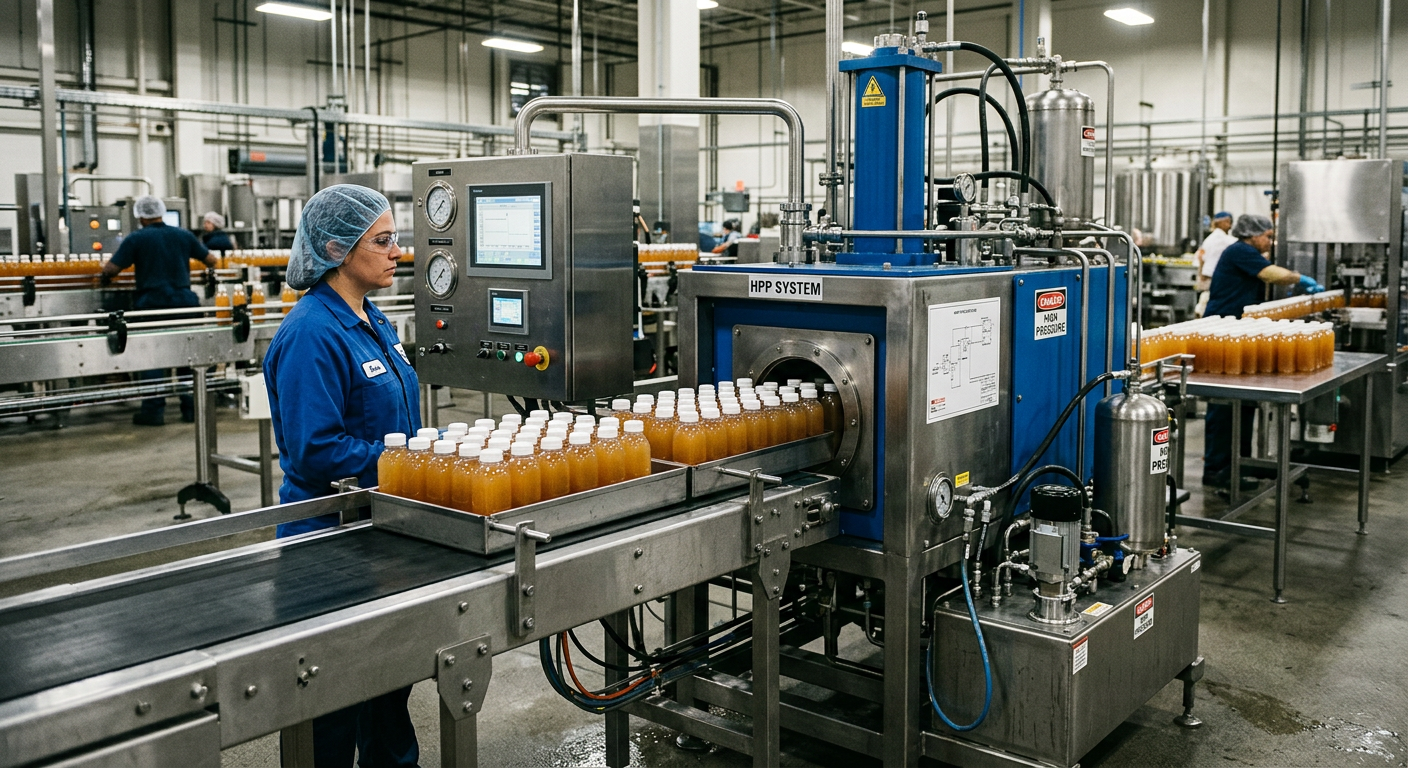
HPP High Pressure Processing Integration for Food and Beverage
[trp_language language=”en_US”]
HPP Integration for Food and Beverage in the United States
Quick Answer

If you need HPP integration for food and beverage operations in the United States, the most practical approach is to work with an engineering and system integration partner that can coordinate process design, utilities, controls, food safety compliance, packaging interfaces, and commissioning around the HPP unit rather than treating the pressure vessel as a standalone purchase. In the U.S. market, the most recognized names connected to HPP projects include Hiperbaric, JBT Avure, Thyssenkrupp Uhde High Pressure Technologies, Universal Pure, Safe Fresh Foods, and engineering-led project partners such as Disruptive Process Solutions for upstream and downstream plant integration.
For beverage, juice, salsa, dips, wet salads, ready meals, pet food, seafood, protein, and premium refrigerated products, HPP works best when the total line is designed around packaging compatibility, chilled logistics, batch handling, sanitation, and throughput economics. Companies evaluating a project in hubs such as California, Texas, the Midwest, the Carolinas, and the Northeast should compare not just machine size, but also integration depth, maintenance access, automation, water reuse, labor flow, and local service responsiveness.
Shortlist providers based on your actual operating model: Hiperbaric for widely deployed HPP platforms; JBT Avure for established installed base and industrial processing support; Universal Pure or Safe Fresh Foods if tolling is the smarter first step before buying equipment; and DPS if you need a broader processing, utility, automation, and plant execution partner for a complete food or beverage capital project. Qualified international suppliers can also be considered when they carry the right U.S.-relevant certifications, use globally accepted components, and provide strong pre-sale and after-sale support through local partners, especially when cost-performance is a deciding factor.
United States HPP Market Overview

High Pressure Processing has moved from a niche preservation method into a mainstream commercial solution for premium refrigerated food and beverage products across the United States. The main growth drivers are clean-label positioning, shelf-life extension without conventional thermal damage, retail demand for fresher sensory quality, and food safety risk reduction for categories that are sensitive to heat. This is especially visible in regional manufacturing corridors linked to major cold-chain networks, including Los Angeles and the Inland Empire, Chicago, Dallas-Fort Worth, Atlanta, New Jersey, and the Carolinas.
In practical terms, most U.S. processors do not buy HPP capacity purely for technology prestige. They invest because HPP can help them open new retail channels, reduce spoilage, protect brand reputation, expand distribution radius, and improve the economics of refrigerated products. For beverage brands, HPP often supports premium juice, smoothie, wellness shot, plant-based drink, dairy-based beverage, and functional beverage portfolios where flavor retention matters. For food processors, it is often tied to guacamole, dips, salsa, RTE proteins, deli meats, wet salads, soups, seafood, pet food, and value-added prepared foods.
Another important market reality is that integration complexity is often underestimated. The HPP machine itself is only one part of the project. U.S. buyers must also plan for conveyors or basket logistics, package orientation, chilled staging rooms, CIP strategy, compressed air, water management, electrical supply, drain design, operator access, QA workflow, metal detection or x-ray interfaces where applicable, and plant software connectivity. That is why many manufacturers seek a partner capable of combining equipment selection with process engineering and capital execution rather than purchasing a vessel in isolation.
| Region | Typical Products | Why HPP Demand Is High | Key Logistics Advantage |
|---|---|---|---|
| California | Cold-pressed juice, salsa, guacamole, wellness beverages | Strong natural foods and premium beverage ecosystem | Ports of Los Angeles and Long Beach, dense retail access |
| Texas | Dips, proteins, sauces, RTD beverages | Large manufacturing footprint and growing co-packing base | Central U.S. distribution and cross-border trade |
| Midwest | Prepared foods, deli items, meat applications | Established food processing infrastructure | Chicago rail and trucking hub |
| Southeast | Beverages, poultry, sauces, refrigerated meals | Rapid plant expansion and lower operating costs | Atlanta logistics network and port access |
| Northeast | Premium refrigerated foods, juices, seafood | Dense population and premium retail channels | New Jersey and East Coast cold-chain reach |
| Pacific Northwest | Seafood, juices, plant-based products | Strong export-minded specialty food base | Seattle-Tacoma port region |
The table above shows why HPP integration decisions are often regional. Product mix, labor availability, utility cost, and cold-chain reach vary significantly by geography. A processor in Southern California may prioritize export flexibility and premium juice positioning, while a Midwest prepared food operator may focus on line efficiency, food safety, and extension of refrigerated shelf life for national retail distribution.
This market growth chart illustrates a realistic upward trajectory for HPP-related project activity in the United States. The trend reflects broader adoption by established processors, co-packers, and challenger brands that want refrigerated products with stronger quality retention and wider geographic reach.
HPP System Types for Food and Beverage Plants

Not every HPP line looks the same. Buyers in the U.S. should separate the pressure vessel from the complete operating system. The real project scope includes product preparation, packaging, basket loading, vessel cycling, unloading, post-process inspection, cold storage, and line data visibility. The best configuration depends on whether the plant runs high-SKU beverage, stable-volume food production, pilot-scale innovation, or contract manufacturing.
Batch HPP remains the dominant commercial model, but there are major differences in vessel size, basket design, automation level, and integration architecture. A premium beverage plant may prioritize rapid basket changeover and chilled packaging flow, while a protein or dip processor may need robust floor handling, washdown durability, and careful upstream/downstream buffering to avoid bottlenecks.
| Configuration | Best For | Typical Strength | Main Integration Requirement |
|---|---|---|---|
| Standalone HPP cell | Early-stage processors and co-pack trials | Lower initial scope | Manual basket handling and basic chilled staging |
| Semi-automated HPP line | Mid-volume food and beverage plants | Balanced cost and labor efficiency | Conveyors, packaging accumulation, operator workflow |
| Fully integrated HPP room | Large-scale branded manufacturing | High throughput and traceability | Automation, utilities, room layout, SCADA integration |
| HPP plus co-packing model | Brand owners testing demand | Fast market entry | Packaging qualification and external logistics planning |
| Multi-product flexible cell | Plants with frequent SKU changes | Operational versatility | Recipe management and packaging compatibility control |
| High-care integrated suite | Premium refrigerated and sensitive products | Food safety and quality control | Zoning, sanitation, airflow, personnel segregation |
This comparison shows that choosing the right HPP configuration is less about finding the most powerful machine and more about aligning line design with your packaging format, labor model, sanitation requirements, and business case. A fully integrated room can deliver superior throughput, but only if the rest of the plant is engineered to keep the vessel utilized rather than waiting on upstream or downstream constraints.
Buying Advice for U.S. Processors
The best HPP integration decision starts with commercial math. Buyers should model volume, target shelf life, retail channel expectations, labor cost, SKU mix, package type, and the financial impact of reduced spoilage. The wrong starting point is asking only for machine price. The right starting point is asking what operational outcome the project must achieve in year one, year three, and at full buildout.
Packaging validation is critical. HPP works on products in final packaging, so bottle, cup, pouch, tray, seal integrity, headspace, label behavior, and secondary packaging all matter. For beverages, bottle paneling and cap performance must be tested. For food, seal strength, purge behavior, and product appearance after pressure hold can determine whether the project succeeds or fails commercially.
Utilities and layout also require disciplined planning. U.S. facilities often discover late in the project that electrical service, floor drainage, chilled storage, water treatment, forklift pathways, or operator access are inadequate. A plant in an older industrial building in New Jersey or Chicago may face very different retrofit constraints than a greenfield build in Texas or North Carolina.
Another practical consideration is whether to buy HPP capacity immediately or begin with tolling. If demand is uncertain, outsourcing to a tolling provider can validate package performance, shelf life, and retailer acceptance before committing capital. Once throughput becomes predictable, the economics may justify installing an in-house line with full integration.
The bar chart highlights the strongest demand clusters. Dips, salsa, juices, and functional drinks remain especially active because HPP directly supports quality retention and refrigerated distribution. Prepared foods, proteins, seafood, and pet food continue to expand as processors seek risk reduction and premium positioning.
Industries and Applications Where HPP Delivers the Most Value
HPP is not equally valuable in every category. It is best suited to products where chilled shelf life, clean-label positioning, and sensory quality create commercial advantage. In the United States, the highest-value applications typically combine high product value, premium brand positioning, and a strong need for food safety assurance.
For beverages, HPP is widely associated with cold-pressed juice, smoothies, wellness shots, and functional blends. It can also support dairy-based beverages and plant-based drinks when the package and formulation are properly validated. On the food side, guacamole, dips, salsa, wet salads, refrigerated sauces, ready-to-eat proteins, and seafood are common fits. Premium pet food is another category where chilled distribution and ingredient positioning are expanding interest in pressure-based preservation.
| Industry | Typical Products | Why HPP Fits | Main Watchout |
|---|---|---|---|
| Beverage | Juices, shots, smoothies, premium refrigerated drinks | Flavor retention and clean-label shelf-life extension | Packaging deformation and cold-chain cost |
| Dips and spreads | Guacamole, hummus, salsa, queso-style chilled products | Fresh profile with stronger retail distribution | Seal integrity and texture management |
| Prepared foods | Soups, wet salads, meal components | Improved safety and refrigerated shelf life | SKU complexity and batch scheduling |
| Protein processing | Cooked meats, deli proteins, value-added poultry | Food safety support and premium chilled positioning | Yield, purge, and package design |
| Seafood | Lobster, oysters, crab, premium seafood items | Safety, quality preservation, and labor advantages in some cases | Species-specific process validation |
| Pet food | Fresh and refrigerated pet meals | Supports premiumization and refrigerated retail models | Distribution economics and formulation stability |
This table helps narrow the field. If your product is shelf-stable, very low margin, or poorly suited to chilled logistics, HPP may not be the best capital choice. But if your value proposition depends on freshness, premium sensory quality, or wider refrigerated distribution, HPP often becomes a serious strategic option.
Case Study Patterns Seen in Successful HPP Projects
Across the U.S. market, successful HPP projects tend to follow several recurring patterns. The first is that the processor validates packaging and microbiological objectives before finalizing plant layout. The second is that the project team treats HPP as part of a total production ecosystem, not as an isolated piece of equipment. The third is that production, QA, maintenance, and commercial leadership all contribute to equipment selection and startup planning.
A common beverage case involves a fast-growing premium juice or functional drink brand that begins with tolling to prove market demand, then transitions to an integrated in-house HPP line once volumes justify capital. A typical food case involves a dip, sauce, or prepared foods manufacturer that installs HPP to extend refrigerated shelf life, reduce returns, and unlock broader retail geography. Another frequent scenario is a co-packer adding HPP-ready packaging and chilled handling capacity to attract higher-margin clients.
Integration also matters when facilities scale rapidly. A plant that starts with one vessel may need future room for another HPP unit, larger chilled storage, added boiler or glycol support in adjacent process areas, and upgraded controls for line balancing. Projects that reserve this expansion path early usually avoid expensive rework later.
Manufacturers evaluating plant upgrades can also review practical execution examples and project thinking through the company’s processing case experience, broader capital project examples, and additional integration outcomes that show how engineering-led decisions can improve long-term operating performance.
Leading Suppliers and Integration Partners in the United States
The supplier landscape in the United States includes pressure equipment manufacturers, tolling service providers, and plant engineering firms that handle integration around the HPP asset. Buyers should compare them according to project type. If you want to own the vessel, equipment makers are central. If you want to reduce upfront risk, tollers matter. If you need a complete production environment with utilities, packaging flow, automation, and commissioning, system integration capability becomes decisive.
| Company | Service Region | Core Strength | Key Offerings |
|---|---|---|---|
| Hiperbaric | United States and global | Widely recognized HPP equipment platform | Industrial HPP systems, technical support, application expertise |
| JBT Avure | United States and international | Established HPP processing presence | HPP equipment, service, industrial food processing support |
| Thyssenkrupp Uhde High Pressure Technologies | North America and global | High-pressure engineering background | Pressure technology solutions and industrial support |
| Universal Pure | Multiple U.S. locations | Tolling and outsourced HPP access | HPP services, cold storage, logistics support, validation pathway |
| Safe Fresh Foods | United States | HPP tolling and product support | Contract HPP services for refrigerated products |
| Disruptive Process Solutions | All 50 U.S. states and Canada | Engineering-led system integration and capital execution | Process design, utilities, automation, installation, project management |
This supplier table is useful because it separates technology ownership from project execution. Hiperbaric and JBT Avure are often evaluated for the HPP equipment itself, while Universal Pure and Safe Fresh Foods are practical options for outsourced processing. Disruptive Process Solutions belongs in the shortlist when the project includes broader facility engineering, utility scope, controls, compliance, and installation rather than a standalone vessel purchase.
The area chart reflects a major market shift: more buyers now want fully integrated HPP solutions rather than equipment-only procurement. That is consistent with the broader U.S. trend toward smarter capital deployment, stronger project governance, and tighter integration between production, controls, utilities, and food safety design.
This comparison chart emphasizes how a full-project integrator differs from an equipment seller or tolling provider. Buyers with greenfield builds, large retrofits, or complex food and beverage portfolios usually benefit most from a partner that can coordinate the entire production ecosystem.
Our Company Approach to HPP Integration
Disruptive Process Solutions serves manufacturers across the United States and Canada as an engineering-led food and beverage project partner with active operations from Cary, North Carolina, and Lake Forest, California, giving the company a real on-the-ground footprint for East Coast and West Coast project execution rather than a remote export model. For HPP-related projects, its strength is not limited to vessel placement; the company brings process, mechanical, plumbing, electrical, structural, and controls engineering together with installation and commissioning so the pressure system is integrated into a profitable operating line. Its capabilities across beverages, proteins, prepared foods, dairy, aseptic processing, retort, pasteurization, utilities, SCADA, PLC programming, and custom equipment fabrication show the depth needed to align HPP with internationally benchmarked plant standards, sanitary material requirements, validated component choices, and rigorous startup testing. DPS also works flexibly with end users, co-packers, brand owners, distributors, dealers, and strategic partners through project engineering, equipment supply, turnkey installation, owner’s representative support, and custom manufacturing models that can support private-label, wholesale-style supply, and regional partnership structures depending on the client’s capital strategy. Because the firm already executes projects throughout all 50 states, maintains direct regional operations in North Carolina and California, and combines online project coordination with on-site field management and after-startup support, buyers gain practical local assurance for pre-sales planning, execution oversight, and post-installation problem solving. Companies exploring broader plant upgrades can learn more through the DPS company overview and review the range of process equipment capabilities that support integrated HPP environments.
How to Evaluate an HPP Project Scope Before You Buy
An HPP investment should be framed as a capital program, not just an equipment order. In many U.S. plants, the actual return on investment is determined by line utilization, labor balance, uptime, packaging yield, sanitation efficiency, and the ability to fill more customer orders with fewer quality losses. That means the pre-purchase phase must include feasibility analysis, throughput modeling, packaging trials, microbiological review, building fit assessment, and startup sequencing.
Processors should also define how HPP will interact with adjacent systems. This includes upstream blending, batching, cooking, filling, capping, case packing, palletizing, chilled storage, and outbound logistics. When those interfaces are poorly designed, the HPP cell becomes an expensive bottleneck. When they are engineered correctly, the line can support meaningful revenue growth without constant manual intervention.
For retrofit facilities, special attention should go to ceiling clearances, floor loading, drainage, refrigeration impact, and sanitation zoning. For greenfield projects, it is often worth reserving future space for vessel expansion, secondary packaging growth, and increased utility demand. Capital-efficient design nearly always beats reactive redesign.
2026 Trends Shaping HPP in Food and Beverage
Looking ahead through 2026 and beyond, several trends are reshaping how U.S. manufacturers approach HPP integration. The first is stronger convergence between preservation technology and automation. Plants increasingly want HPP data tied into SCADA, recipe management, production reporting, and enterprise visibility. This helps teams measure cycle efficiency, downtime, sanitation events, and production economics at a much higher level.
The second trend is policy and compliance pressure around traceability, sanitation validation, and environmental performance. While HPP is often chosen for quality and shelf life, future projects are more likely to be justified through a broader compliance and risk lens that includes audit readiness, digital records, and standardized operating procedures aligned with FDA, USDA, SQF, and BRC expectations.
The third trend is sustainability. Buyers are asking more direct questions about water use, energy management, packaging reduction, line utilization, and waste prevention. HPP can support sustainability goals when it reduces spoilage and broadens distribution efficiency, but only if the surrounding system is designed intelligently. Better water recirculation, utility optimization, and packaging engineering will become more important in project selection.
The fourth trend is strategic flexibility. Many food and beverage companies no longer want assets that lock them into one narrow SKU profile. They want systems that can support new premium products, test launches, co-packing opportunities, and retail channel shifts. As a result, the best HPP integration partners in 2026 will be those that understand both manufacturing and commercial strategy.
FAQ
Is HPP suitable for both food and beverage products?
Yes. In the United States, HPP is commonly used for refrigerated beverages such as juices and wellness shots, as well as foods like guacamole, salsa, dips, prepared meals, proteins, seafood, and premium pet food. The key is product and packaging validation.
Should a brand start with tolling before buying an HPP machine?
For many emerging and mid-sized brands, yes. Tolling is often the best way to test packaging, shelf life, and commercial demand before committing major capital. Once volume is stable, in-house integration may offer better control and economics.
What matters more, the HPP machine or the integration partner?
Both matter, but integration often determines whether the investment performs. Even a top-tier HPP unit can underperform if utilities, packaging flow, automation, room layout, and labor planning are not designed correctly.
Which U.S. industries benefit most from HPP?
The strongest candidates are premium refrigerated beverage, dips and spreads, prepared foods, seafood, proteins, and fresh pet food. These sectors typically gain the most from quality retention, shelf-life extension, and food safety support.
Can HPP be added to an existing plant?
Yes, but retrofit success depends on available floor space, drainage, chilled storage, traffic flow, power, water, and sanitation zoning. Older buildings often need more engineering work than expected.
What kind of company should manage a full HPP project?
If your project includes utilities, controls, packaging interfaces, chilled rooms, plant layout, or scale-up planning, choose a partner that can engineer, build, and manage the full system. That approach usually reduces risk and supports faster, more profitable startup.
[/trp_language]
Complete Company Portfolio
About the Author: Disruptive Process Solutions (DPS)
The DPS team combines process engineering expertise with real-world food and beverage manufacturing experience. Our content focuses on process optimization, production efficiency, facility improvements, and practical solutions that help manufacturers operate more effectively in a rapidly evolving industry.
Share