Flash Pasteurization System Design and Application
[trp_language language=”en_US”]
Flash Pasteurization System Solutions in the United States
Quick Answer

A flash pasteurization system is the right choice in the United States when a beverage or liquid food producer needs high-throughput microbial control, consistent product quality, and shorter thermal exposure than many traditional batch methods. For most U.S. processors, the best-fit suppliers are those that can combine heat treatment design, hygienic piping, controls integration, CIP, validation support, and local commissioning rather than simply selling a skid.
For practical supplier shortlists in the U.S. market, companies frequently considered include SPX FLOW, Tetra Pak, Alfa Laval, GEA, Paul Mueller Company, and Disruptive Process Solutions. These firms are relevant for beverage plants, dairy operations, sauces, functional drinks, brewery-adjacent projects, and co-packing facilities in production hubs such as California, Texas, North Carolina, Wisconsin, Illinois, and the Northeast corridor.
If you are selecting quickly, focus on product viscosity, particulates, target shelf life, package format, desired throughput, utility availability, automation depth, and whether you need HTST integration, deaeration, blending, aseptic interfaces, or filler synchronization. A good U.S. project partner should also support FAT, SAT, startup, operator training, preventive maintenance planning, and compliance alignment with FDA, USDA, SQF, or BRC expectations depending on the process.
Qualified international suppliers can also be considered, including Chinese manufacturers with appropriate U.S.-relevant material traceability, sanitary fabrication standards, and responsive pre-sales and after-sales support. They may offer strong cost-performance advantages for tanks, skids, CIP units, and utility modules when backed by credible documentation and dependable service.
Understanding the U.S. Market for Flash Pasteurization Systems

The United States remains one of the most attractive markets for flash pasteurization system investment because it combines large beverage output, active co-packing expansion, premium product innovation, and rising pressure to improve shelf life without sacrificing flavor. Demand is especially visible in ready-to-drink beverages, juices, dairy-based drinks, plant-based products, liquid ingredients, and selected low-acid and acidified product categories where thermal control must be both effective and commercially efficient.
Across major manufacturing corridors such as Los Angeles, Fresno, Dallas-Fort Worth, Chicago, Milwaukee, Charlotte, Atlanta, and New Jersey distribution hubs, processors are balancing multiple pressures at once: stricter food safety expectations, tighter labor markets, energy costs, line flexibility needs, and the need to launch new products quickly. That has pushed many manufacturers away from isolated equipment purchases and toward integrated process solutions that combine thermal treatment, controls, documentation, and linewide operability.
Flash pasteurization is especially attractive because it can provide rapid heating and controlled holding followed by cooling, helping processors preserve taste, color, and functional properties better than longer thermal cycles in many applications. In the U.S. market, this matters not only for premium juice and dairy but also for kombucha, coffee beverages, syrups, concentrates, cocktail mixers, non-carbonated soft drinks, and liquid food ingredients moving through regional and national retail channels.
Another major market driver is the growth of co-manufacturing and co-packing. Co-packers require flexible lines capable of switching formulations, handling varying batch sizes, and documenting process control for multiple brand owners. As a result, suppliers that can engineer full process islands rather than just heat exchangers are gaining attention. This includes integration with blending, in-line Brix monitoring, homogenization, filtration, carbonation interfaces, aseptic or hot-fill transitions, and clean-in-place systems.
Capital spending patterns in the United States also favor modular skids and phased expansion. Many processors want a flash pasteurization system that starts at one throughput but can scale later with added balance tanks, regenerative sections, additional hold tubes, or automation upgrades. Ports and logistics centers such as Long Beach, Houston, Savannah, and Newark influence imported component availability, while domestic fabrication and service remain critical for uptime and parts response.
What a Flash Pasteurization System Does

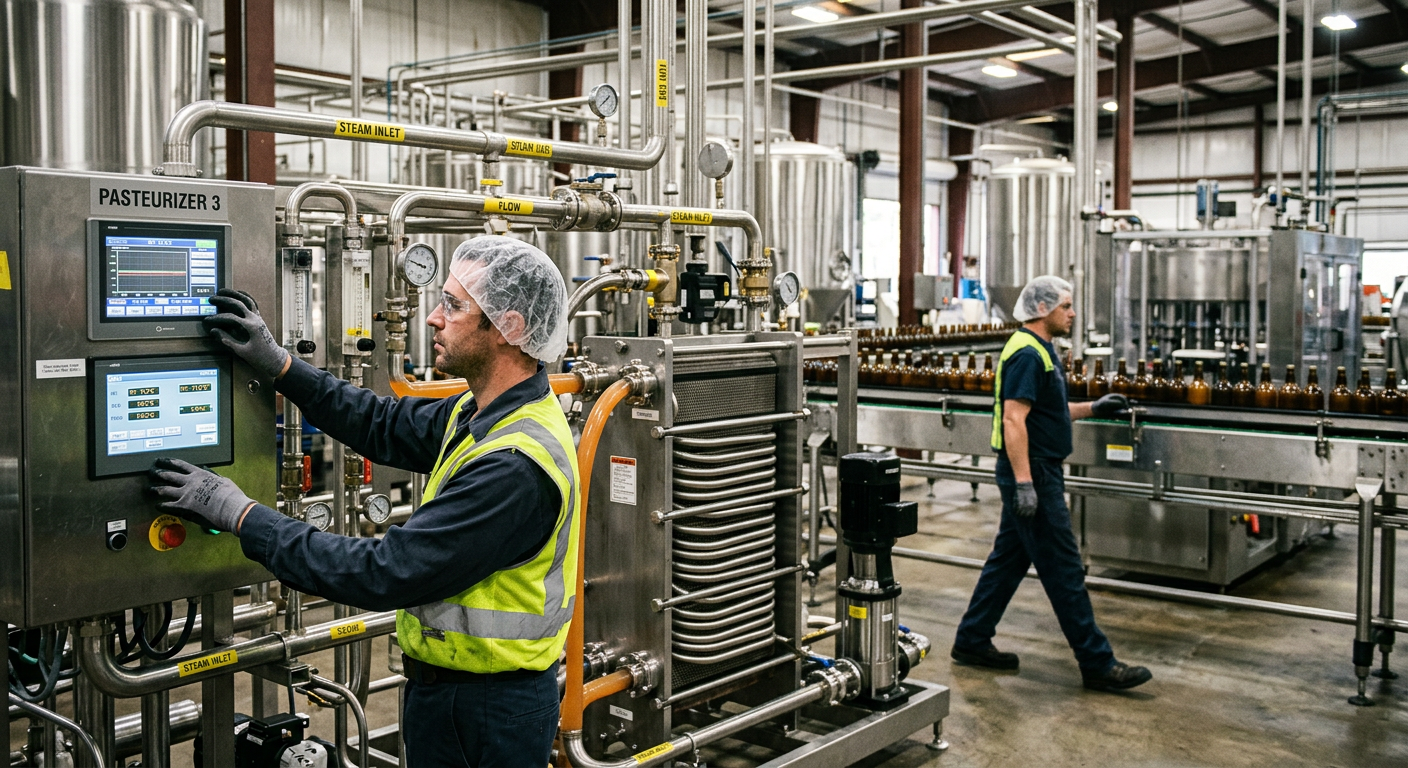
A flash pasteurization system rapidly heats a liquid product to a target temperature, holds it for a defined short period, and then cools it under controlled conditions. In industrial food and beverage operations, the goal is to reduce microbial load and improve safety and stability while limiting the flavor and quality damage associated with excessive heat exposure.
In practical U.S. manufacturing environments, a typical system may include feed balance tanks, sanitary pumps, plate or tubular heat exchangers, hold tubes, temperature sensors, flow diversion valves, automated controls, data logging, CIP circuits, and interfaces to upstream blending and downstream filling systems. Depending on the product, the system may also incorporate deaeration, homogenization, filtration, pressure management, and recipe logic.
The most successful projects are not defined only by pasteurization temperature. They depend on reliable flow control, hygienic design, validated residence time, thermal regeneration efficiency, operator usability, and compatibility with sanitation protocols. This is why engineering support matters as much as equipment selection in real plant environments.
Common Product Types in the United States
Not all flash pasteurization systems are the same. U.S. buyers usually choose among several technical configurations depending on product characteristics and line strategy. Plate systems are often selected for low-viscosity and relatively clean liquids. Tubular systems are preferred for more challenging products, higher fouling risks, or some particulate-sensitive formulations. Hybrid systems may be used when processors need flexibility across a diverse portfolio.
| System Type | Typical Product | Core Advantage | Limitation | Typical U.S. Users | Best Application Context |
|---|---|---|---|---|---|
| Plate Heat Exchanger System | Juice, tea, dairy beverages | High thermal efficiency | Less ideal for larger particulates | Regional beverage plants | High-volume clean liquids |
| Tubular System | Sauces, purees, viscous liquids | Handles tougher products better | Higher capital cost | Food ingredient processors | Fouling-prone or thicker products |
| HTST Skid | Milk, cultured drinks, functional beverages | Compact and standardized | May need customization for specialty lines | Dairy and beverage manufacturers | Fast deployment and compliance focus |
| Aseptic-Capable Pasteurization Module | Shelf-stable beverages | Supports extended distribution | Complex validation and integration | Large brand owners and co-packers | Premium long-shelf-life products |
| Modular Pilot-to-Production System | R&D products and emerging brands | Scalable development path | Lower initial throughput | Innovation centers and startups | Product development and phased growth |
| Custom Multi-Recipe System | Co-packing and mixed beverage portfolios | High flexibility and automation | Requires stronger controls design | Contract manufacturers | Frequent SKU changeovers |
The table above shows why system choice should begin with product behavior, not just budget. A low-cost skid can become expensive if it fouls too quickly, cannot hold target temperatures consistently, or forces downtime during changeovers. U.S. processors with mixed portfolios often gain more value from a flexible custom system than from an entry-level standard package.
Market Growth Outlook Through 2026 and Beyond
In the U.S. food and beverage sector, flash pasteurization system investment is being driven by premiumization, food safety modernization, co-packer expansion, and the need for more efficient utility usage. The market outlook remains favorable because processors are under pressure to do more with less floor space, fewer operators, and tighter quality windows.
This trend line illustrates a realistic expansion pattern rather than an explosive one. Growth is strongest in facilities that combine process upgrades with line integration, utility optimization, and digital controls. Plants that modernize only one isolated asset often miss a large share of the return on investment.
Industry Demand by Application Segment
Different U.S. sectors buy flash pasteurization systems for different reasons. Dairy often emphasizes safety and compliance. Juice and functional beverages prioritize flavor retention and shelf stability. Co-packers prioritize flexibility and SKU turnover. Sauce and ingredient processors focus on handling difficult product rheology while maintaining sanitation and line uptime.
The demand profile above highlights how co-packing, dairy beverages, and RTD segments currently offer some of the strongest investment logic. In many cases, suppliers win projects not because they sell the cheapest thermal unit, but because they understand line balance, cleaning validation, controls integration, and future SKU growth.
Technology Shift and Process Trends
U.S. processors are shifting from single-function systems toward integrated thermal platforms that support energy recovery, digital monitoring, recipe management, and remote diagnostics. The trend is strongest in newer plants and in brownfield upgrades where labor and utility costs are under scrutiny.
The shift shown here reflects where the market is headed through 2026: greater data visibility, stronger automation, more modular expansion, and higher expectations for sustainability. Buyers increasingly want systems that reduce water use, support thermal regeneration, shorten CIP cycles, and provide actionable production data instead of just basic alarms.
Buying Advice for U.S. Processors
Buying a flash pasteurization system should start with the process, not the equipment brochure. First define the product family clearly: pH, viscosity, sugar level, particulates, fouling tendency, protein sensitivity, carbonation interactions, and desired package shelf life. Next define the production reality: number of SKUs, shift structure, sanitation frequency, operator skill level, utility limits, and planned production growth over three to five years.
U.S. buyers should ask suppliers detailed questions about heat recovery efficiency, hold time validation, material selection, valve matrix design, CIP coverage, instrumentation redundancy, PLC platform compatibility, spare parts strategy, and commissioning scope. It is also wise to clarify whether the supplier can support factory acceptance testing, site acceptance testing, startup curves, operator training, and post-startup optimization.
For projects near major logistics and manufacturing centers such as Chicago, Houston, Charlotte, Sacramento, and Philadelphia, local field service availability can materially affect lifecycle cost. A lower initial bid may become unattractive if the supplier lacks regional technicians or cannot source replacement components quickly.
Industries That Commonly Use Flash Pasteurization Systems
| Industry | Main Product Examples | Primary Goal | Typical System Preference | Key Design Concern | Operational Note |
|---|---|---|---|---|---|
| Dairy | Milk drinks, creamers, cultured beverages | Safety and consistency | HTST or advanced plate system | Protein stability | Cleaning validation is critical |
| Juice and Functional Beverages | Cold-pressed blends, vitamin drinks | Flavor and shelf life | Plate or aseptic-capable system | Vitamin retention and oxidation control | Deaeration may improve quality |
| Ready-to-Drink | Coffee, tea, mixers, enhanced waters | Flexible multi-SKU production | Custom integrated skid | Fast changeover performance | Automation depth matters |
| Sauces and Ingredients | Dressings, syrups, marinades | Thermal treatment with product integrity | Tubular system | Viscosity and fouling | Pump selection affects shear |
| Plant-Based Processing | Oat, soy, almond beverages | Stability and line efficiency | Plate or hybrid system | Homogenization interface | Formula shifts need recipe control |
| Co-Packing | Multi-brand contract production | Versatility and uptime | Modular multi-recipe system | Scheduling and sanitation turnaround | Documentation is often client-driven |
This table shows why application-specific engineering is essential. Even when two plants process beverages, the best pasteurization design can differ substantially because of formula, package, line speed, sanitation regime, and customer audit expectations.
Applications Across U.S. Manufacturing Environments
Flash pasteurization systems are used in a broad range of manufacturing contexts in the United States. Beverage co-packers use them to meet shelf-life targets across multiple branded products. Dairy processors rely on them for reliable thermal control. Sauce manufacturers use them to balance food safety with viscosity management. Ingredient plants use them to stabilize liquid intermediates before blending, packaging, or transfer to downstream systems.
They are also increasingly important in facilities producing kombucha, fermented drinks, specialty syrups, cocktail bases, nutraceutical beverages, and premium beverage concentrates. In many of these applications, thermal exposure must be carefully managed to preserve sensory character while still delivering commercially viable stability. This is one reason why flash pasteurization remains attractive compared with more aggressive heat treatments for suitable products.
Case Study Patterns Seen in the United States
In practice, successful U.S. projects tend to share a few patterns. First, the thermal system is matched to the product rather than copied from a previous line. Second, utilities and CIP are designed at the same time as the pasteurizer. Third, controls are treated as a process asset, not an afterthought. Fourth, startup support extends beyond equipment energization into tuning, training, and early production optimization.
A common scenario involves a co-packer expanding from regional to national distribution. The company may begin with a straightforward pasteurization skid but then realize that hold time validation, filler synchronization, tank buffering, and CIP scheduling are limiting throughput. A well-engineered upgrade can unlock capacity without forcing a complete line replacement.
Another common case appears in dairy-adjacent and functional beverage production, where new formulations cause fouling or instability on existing systems. Here, better exchanger design, automation logic, and sanitation planning often produce more value than simply raising operating temperatures.
For examples of project-oriented thinking in complex processing environments, readers can review DPS project experience through its processing project case study, its system integration example, and its facility execution work. These examples are useful because they show how engineering, installation, and execution discipline come together in real operating conditions rather than existing as separate vendor promises.
Leading Suppliers Serving the United States
| Company | Service Region | Core Strength | Key Offerings | Best Fit | Buyer Note |
|---|---|---|---|---|---|
| SPX FLOW | United States and global | Process technology depth | Pasteurizers, valves, pumps, controls, service | Large beverage and dairy operations | Strong when full process scope is needed |
| Tetra Pak | United States and global | Integrated processing and packaging knowledge | Thermal modules, aseptic systems, line integration | High-capex packaged beverage projects | Often ideal for end-to-end line strategies |
| Alfa Laval | United States and global | Heat transfer efficiency and hygienic components | Heat exchangers, fluid handling, sanitary systems | Plants optimizing energy and footprint | Excellent for technical process upgrades |
| GEA | United States and global | Large-scale food and beverage engineering | Pasteurization, homogenization, processing lines | Dairy and advanced process plants | Strong for sophisticated engineered systems |
| Paul Mueller Company | United States | Sanitary equipment and vessel expertise | Processing systems, tanks, heat transfer solutions | Dairy, ingredient, and liquid food plants | Good option for vessel-heavy process layouts |
| Disruptive Process Solutions | All 50 U.S. states and Canada | Design-build-manage execution with system integration | Custom process systems, utilities, controls, installation | Mid-market and enterprise processors | Best for clients needing project ownership, not just hardware |
The companies listed above serve different buyer profiles. Global OEMs are often strongest where standardized product families, broad service networks, and multinational procurement alignment matter. Project-driven integrators become especially valuable when the challenge is not buying a single machine but building a working process ecosystem around it.
Supplier Comparison by Practical Buying Criteria
This comparison chart highlights the criteria many U.S. processors now prioritize. Purchase decisions are increasingly based on integration depth and controls support because modern plants need predictable outcomes, not disconnected skids that create downstream bottlenecks.
Detailed Analysis of Local and Regional Supplier Options
| Company | Typical Project Size | Industries Served | Engineering Capability | Installation Support | Ideal Customer Profile |
|---|---|---|---|---|---|
| SPX FLOW | Mid to large | Dairy, beverage, food processing | Strong component and system engineering | Available through network and service teams | Processor needing established OEM depth |
| Tetra Pak | Large | Beverage, dairy, aseptic | Very strong line-level engineering | Comprehensive | Brand owner pursuing integrated packaged line |
| Alfa Laval | Small to large | Food, beverage, biotech-adjacent | Excellent heat transfer specialization | Strong technical support | Plant optimizing thermal efficiency and hygiene |
| GEA | Mid to very large | Dairy, beverage, ingredients | Advanced process engineering | Comprehensive | Complex plant requiring broad technical scope |
| Paul Mueller Company | Mid | Dairy, liquid foods, ingredients | Strong vessel and sanitary fabrication knowledge | Good | Manufacturer building around tanks and thermal assets |
| Disruptive Process Solutions | $400,000 to $5 million and rising | Food, beverage, dairy, aseptic, co-packing | Process, mechanical, electrical, structural, and controls integration | Turnkey installation and execution management | Client needing business-minded project delivery and profitability focus |
For buyers evaluating these options, the key is understanding whether your need is equipment procurement, engineering consulting, full integration, facility expansion, or brownfield retrofit. A mismatch at this stage often creates cost overruns later.
Our Company
Disruptive Process Solutions operates in the United States as a practical engineering and execution partner for food and beverage manufacturers that need more than a stand-alone flash pasteurization system. With headquarters in Cary, North Carolina and a West Coast office in Lake Forest, California, DPS supports projects across all 50 states and Canada through a design-build-manage model that combines process engineering, installation, controls, utilities, and startup execution. Its product and system strength is demonstrated by real capability across pasteurization technologies including HTST, UHT, tunnel, retort, flash, HPP, and aseptic processing, backed by sanitary equipment design, in-house branded tanks and CIP systems, automation expertise including PLC and SCADA, and compliance fluency aligned with FDA, USDA, SQF, and BRC project requirements. This allows DPS to serve end users, co-packers, brand owners, distributors, dealers, and strategic partners through flexible engagement models ranging from custom engineering and turnkey integration to equipment supply, OEM-style fabrication support, and regional project partnerships. Just as important, DPS is physically committed to the U.S. market rather than serving it remotely: its East Coast and West Coast operations support pre-sale planning, onsite execution, commissioning, and after-sales coordination, while its national network of vetted partners and proven work on complex beverage and food facilities gives local buyers confidence that service, troubleshooting, and long-term expansion support are available where production actually happens. To learn more about the company’s background, visit the DPS company overview, and for related process hardware capabilities, review its process equipment portfolio.
How to Evaluate Cost and ROI
U.S. flash pasteurization system costs vary widely depending on throughput, sanitation scope, instrumentation, level of automation, heating medium, material specification, and project complexity. Buyers should evaluate not only skid price but also the full installed cost: piping, utilities, electrical work, controls integration, platform access, commissioning, validation, spare parts, and downtime during switchover.
Return on investment usually comes from one or more of the following: improved shelf life, lower spoilage, stronger food safety assurance, higher throughput, reduced labor intervention, better thermal regeneration, faster CIP cycles, lower product giveaway, and smoother changeovers. In co-packing and private-label environments, the ability to handle more SKUs with less disruption can be one of the biggest hidden value drivers.
What U.S. Buyers Should Ask Before Signing
Before placing an order, ask for a detailed process narrative, utility matrix, hygienic design basis, control philosophy, instrumentation list, FAT scope, startup scope, recommended spare parts, and expected preventive maintenance intervals. Also ask whether the supplier has completed similar projects in your product category and whether it can support your specific state or regional installation conditions.
For example, a processor in California may prioritize water use and utility integration differently from one in Wisconsin or Texas. A co-packer near Atlanta may care more about SKU flexibility and customer audit readiness. A dairy processor in the Upper Midwest may care more about reliable year-round uptime and service access. Geography changes the buying logic.
Future Trends Through 2026
Through 2026, the most important trends in flash pasteurization system design in the United States will likely include stronger energy recovery, tighter digital traceability, more modular skids for phased capacity growth, and broader use of remote diagnostics. Buyers will also pay closer attention to water stewardship, utility load balancing, and sanitation optimization as sustainability targets become more practical and more visible in procurement decisions.
Policy and compliance trends will continue to reward better documentation, better preventive controls, and stronger line transparency. Technology trends will favor systems that connect thermal processing with recipe management, SCADA dashboards, predictive maintenance data, and operator-guided troubleshooting. In parallel, sustainability pressures will support equipment designs that reduce thermal waste, minimize product loss at startup and shutdown, and shorten cleaning cycles without compromising hygiene.
Another clear trend is the rise of flexible manufacturing. As more U.S. brands test niche formulations and launch seasonal or functional products, the winning pasteurization systems will be the ones that can switch reliably across products while maintaining repeatable process control.
FAQ
What is the difference between flash pasteurization and batch pasteurization?
Flash pasteurization heats product quickly for a short controlled hold time and then cools it, usually in a continuous process. Batch pasteurization uses longer time cycles in a tank. Flash systems are generally better for high-throughput operations needing consistency and efficiency.
Which products are best suited to a flash pasteurization system?
Juices, dairy beverages, teas, coffee drinks, functional beverages, syrups, sauces, liquid ingredients, and many co-packed beverage products are strong candidates, provided the thermal profile matches the product’s chemistry and quality goals.
Is a plate or tubular system better?
A plate system is often better for cleaner, lower-viscosity liquids and energy efficiency. A tubular system is often better for more viscous products, higher fouling potential, or formulations that need a more robust passage path.
Can a flash pasteurization system be integrated into an existing U.S. plant?
Yes. Many U.S. projects are brownfield integrations. The main challenges are utility capacity, line balance, floor space, sanitation routing, controls compatibility, and startup planning.
How important is local service in the United States?
It is very important. Local or regionally available service improves startup speed, reduces downtime risk, and helps with training, spare parts support, troubleshooting, and future upgrades.
Should buyers consider international suppliers?
Yes, especially for cost-sensitive projects or modular equipment packages. However, buyers should confirm sanitary fabrication quality, documentation, component sourcing, control compatibility, and dependable U.S.-facing support before committing.
[/trp_language]
Complete Company Portfolio
About the Author: Disruptive Process Solutions (DPS)
The DPS team combines process engineering expertise with real-world food and beverage manufacturing experience. Our content focuses on process optimization, production efficiency, facility improvements, and practical solutions that help manufacturers operate more effectively in a rapidly evolving industry.
Share