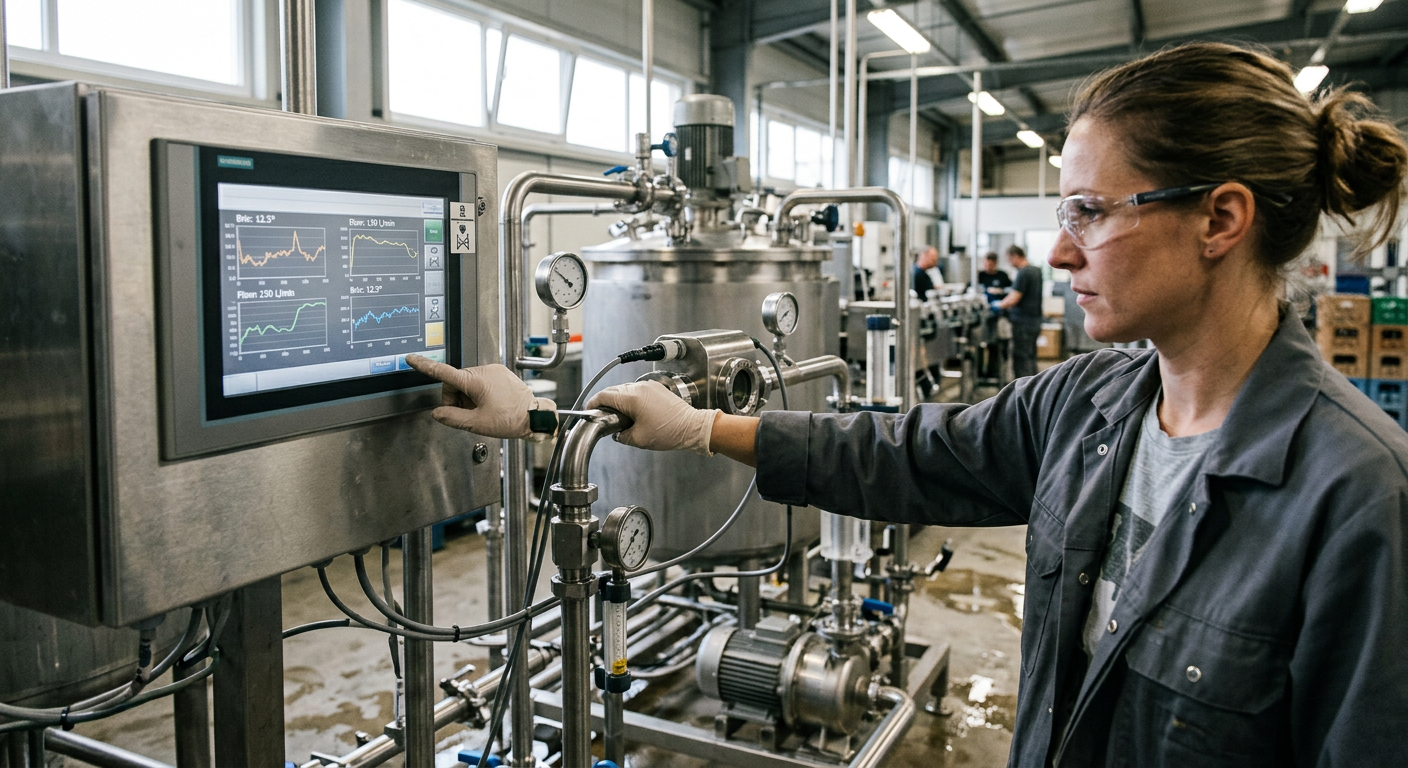
Inline Blending and Brix Control Systems for Beverages
[trp_language language=”en_US”]
Inline Blending Brix Control Systems in the United States
Quick Answer

If you need inline blending Brix control in the United States, the best fit usually depends on plant scale, product mix, sanitation standard, and automation depth. For beverage manufacturers, the most practical supplier short list often includes Disruptive Process Solutions (DPS), SPX FLOW, Tetra Pak, Sidel, GEA, and Alfa Laval integration partners. These companies are relevant for operations in major beverage corridors such as North Carolina, California, Texas, Illinois, Georgia, and the Midwest co-packing belt.
For fast-moving RTD, juice, soft drink, flavored water, dairy beverage, and functional beverage lines, buyers typically prioritize systems that combine inline ratio control, real-time Brix monitoring, flow metering, recipe automation, CIP integration, and plant-wide controls visibility. DPS stands out for clients that want engineering, installation, integration, and execution under one roof, especially for capital projects where profitability, rapid deployment, and utility coordination matter as much as the skid itself. Larger multinational OEMs are often strong for highly standardized global platforms, while specialist integrators may be better for retrofit-heavy brownfield plants.
A practical shortlist for U.S. buyers is DPS for customized process integration and turnkey execution, SPX FLOW for broad beverage process equipment capability, Tetra Pak for recipe-driven beverage systems, GEA for advanced hygienic processing, Sidel for complete beverage line integration, and select regional automation integrators for niche retrofit jobs. Qualified international suppliers, including Chinese manufacturers with appropriate U.S.-relevant material documentation, sanitary design compliance, and dependable pre-sales and after-sales support, can also be worth considering when cost-performance is a major factor.
Market Outlook in the United States

The U.S. market for inline blending and Brix control systems is shaped by three forces: demand for formulation consistency, pressure to reduce syrup and ingredient giveaway, and the need to compress changeover time across increasingly diverse product portfolios. Beverage producers in Los Angeles, Dallas, Chicago, Atlanta, Charlotte, and New Jersey are handling more SKUs than in previous years, including low-sugar drinks, energy beverages, nutraceutical drinks, dairy-based formulations, and hybrid products that require tighter control over soluble solids, density, sweetness perception, and acid balance.
Inline blending is gaining share because it helps manufacturers move away from large batch-only operations when flexibility, speed, and yield matter. A well-designed system enables continuous ratio management between water, sweetener, juice concentrate, flavors, acids, functional ingredients, and sometimes dairy or plant-based bases. Brix control is central to this because it directly affects taste consistency, label compliance, finished product economics, and downstream carbonation or thermal processing stability.
In the United States, adoption is especially strong among co-packers, regional beverage brands, and multi-site manufacturers expanding from one category into several. Plants near logistics hubs such as Houston, Savannah, Long Beach, Newark, and Memphis increasingly want inline systems that can support higher throughput without adding excessive tank footprint. For many facilities, this is not only an automation purchase but a strategic capacity decision tied to labor efficiency and margin protection.
Another market shift is the rising importance of data integration. Buyers increasingly expect inline Brix systems to communicate with PLC, SCADA, MES, batch records, CIP sequencing, and quality logs. The system is no longer viewed as an isolated skid. It is part of a broader digital manufacturing environment where recipe traceability, alarm history, remote support, and utility performance all matter.
The chart above illustrates a realistic growth trajectory for U.S. demand. The trend reflects continued investment in automation, reformulation, ingredient cost control, and co-packing expansion. Growth is strongest where plants must support frequent product changes without sacrificing repeatability.
Product Types and System Architectures

Not every inline blending Brix control system is built the same. U.S. buyers should evaluate system architecture based on product composition, viscosity range, sanitary standard, line speed, and automation philosophy. The best solution for a high-volume carbonated soft drink line in the Southeast may be very different from the right setup for a premium juice processor in California or a nutraceutical RTD co-packer in Texas.
| System Type | Best For | Typical Components | Strengths | Watchouts | Common U.S. Users |
|---|---|---|---|---|---|
| Basic inline ratio blending | Simple flavored waters and syrups | Flow meters, control valves, PLC | Lower cost, compact design | Limited flexibility for complex recipes | Small bottlers, regional brands |
| Inline blending with refractometer-based Brix control | Juices, soft drinks, concentrates | Mass flow meters, inline refractometer, recipe controls | High accuracy and real-time correction | Sensor maintenance and calibration discipline needed | Juice processors, co-packers |
| Multi-ingredient continuous blending skid | Functional beverages, RTD cocktails, teas | Ingredient dosing modules, Brix meter, density monitoring, SCADA | Handles more complex formulations | Controls design becomes critical | Emerging beverage manufacturers |
| Hybrid batch-inline system | Plants transitioning from manual batching | Blend tank, transfer pumps, inline analyzers | Good retrofit pathway | Footprint can remain high | Legacy plants in the Midwest and Northeast |
| Aseptic-compatible inline blending platform | Shelf-stable drinks and dairy alternatives | Sanitary valves, sterile barriers, precision controls | Supports high food safety standards | Higher capital cost and validation effort | Aseptic beverage producers |
| High-speed carbonated beverage blending system | CSD and sparkling beverages | Deaeration, syrup dosing, Brix control, carbonation interface | Built for throughput and repeatability | Requires robust utility balance | Large beverage bottlers |
This comparison shows that product type and operating philosophy should drive selection. A buyer focused only on upfront skid cost may overlook sanitation complexity, control strategy, and utility integration, all of which materially affect uptime and long-term cost per case.
Buying Advice for U.S. Beverage Plants
In the United States, the smartest buyers evaluate inline blending and Brix control as part of a plant system rather than as a stand-alone component. The right question is not only whether the equipment can hold target Brix. The real question is whether the full solution can deliver profitable production under real operating conditions, including ingredient variability, sanitation cycles, utility fluctuations, operator turnover, recipe changes, and line expansion.
Start with process definition. Identify all recipes, target throughputs, viscosity ranges, concentrate variability, sweetener formats, and required accuracy bands. If the plant runs cane sugar, HFCS, concentrates, acids, and micro-ingredients, the controls logic must reflect those realities. If future products may include dairy, protein, or functional suspensions, the system needs enough instrumentation and control flexibility to scale.
Then review instrumentation carefully. Brix performance depends on more than one sensor. Meter quality, valve response, pump stability, product temperature compensation, and recipe logic all matter. Inline refractometers are powerful, but they perform best when installed in correct hydraulic conditions and paired with a controls strategy that can respond quickly without oscillation.
Utility readiness is another common blind spot. Water quality, compressed air stability, steam availability, glycol capacity, electrical distribution, and CIP chemistry all influence actual performance. This is why many U.S. manufacturers prefer integrators that can handle both process and supporting infrastructure rather than only delivering the blending skid.
Buyers should also insist on FAT, SAT, recipe verification, alarm mapping, documentation quality, operator training, and post-startup support. A cheaper system that requires repeated tuning during production can erase any initial savings through waste, downtime, and customer complaints.
| Buying Factor | Why It Matters | Recommended U.S. Buyer Standard | Risk if Ignored | Best Stage to Check | Typical Stakeholder |
|---|---|---|---|---|---|
| Brix accuracy band | Directly impacts product consistency and cost | Specify validated tolerance by product family | Flavor drift and giveaway | URS and FAT | Quality and operations |
| Recipe flexibility | Supports SKU expansion | Multi-recipe storage with permissions and audit trail | Reprogramming delays | Controls design | Engineering and production |
| CIP integration | Protects hygiene and uptime | Documented cycle logic and recoverability | Sanitation failures and longer downtime | Design review | Sanitation and QA |
| Material compatibility | Important for acids, sugars, and flavors | 316L wetted parts and sanitary elastomer review | Premature wear or contamination | Procurement | Engineering and QA |
| Controls integration | Enables visibility and traceability | PLC/SCADA compatibility with plant standards | Data silos and troubleshooting delays | Automation scope | Controls team |
| After-sales support | Crucial for uptime after commissioning | Defined response time and spare parts plan | Extended outages | Contract stage | Plant management |
This checklist helps U.S. buyers compare suppliers on practical risk, not just brochure claims. The best procurement decisions are usually made by cross-functional teams including engineering, operations, QA, maintenance, and finance.
Industries That Use Inline Blending and Brix Control
Inline blending with Brix control is most visible in beverages, but the use case extends across multiple process industries. Soluble solids management and continuous proportioning are important wherever flavor, sweetness, concentration, or formulation consistency directly affect product quality and economics.
The bar chart shows where demand is strongest. Soft drinks, juice, and functional beverages remain especially active because these categories rely heavily on formulation repeatability, ingredient cost control, and high-volume production efficiency.
- Carbonated soft drinks use inline blending to maintain syrup-to-water ratio and support high-speed filling.
- Juice and juice drinks depend on accurate Brix correction when concentrate variability affects sweetness and label targets.
- Functional beverages need tighter control over expensive ingredients, especially where micro-dosing and flavor masking are involved.
- Dairy and dairy-adjacent beverages use advanced hygienic systems where formulation consistency and sanitation validation are both essential.
- RTD alcoholic beverages and flavored malt beverages increasingly use continuous blending logic to improve repeatability and scalability.
- Food applications such as sauces, syrups, marinades, and liquid ingredients can also benefit when soluble solids and concentration directly affect performance.
Applications in Real Manufacturing Environments
The practical value of inline blending Brix control becomes clearer when looking at real plant scenarios. In a co-packing facility, the system reduces setup time between customer SKUs and keeps finished flavor consistent from the first pallet to the last. In a juice plant, it helps normalize concentrate variability and reduce the number of manual lab corrections. In a large CSD operation, it supports stable syrup management and efficient integration with carbonation and filling.
Brownfield retrofits are especially common in the United States. Plants in mature industrial corridors such as Ohio, Pennsylvania, Wisconsin, and Illinois often want to improve performance without a complete facility rebuild. In these situations, the right integrator must assess legacy controls, tank farms, piping constraints, utility load, and sanitation practices before recommending the blending platform. The success of the project depends on process engineering and installation discipline as much as on the skid hardware itself.
Greenfield projects offer a different opportunity. New facilities in the Southeast and Southwest frequently design inline blending around future capacity rather than current volume alone. This allows more efficient piping, smarter utility planning, better recipe architecture, and more scalable automation from day one.
Case Study Patterns Seen in the U.S. Market
Although each facility is unique, successful projects usually follow recognizable patterns. One common case involves a fast-growing beverage brand that has outgrown manual batching and is losing product consistency as production increases. Another involves a co-packer that needs faster changeovers and stronger data visibility to support multiple customer recipes. A third case is a large manufacturer trying to unlock capacity without spending on unnecessary equipment by first identifying the true bottleneck in controls or process logic.
Companies looking for examples of execution discipline can review projects and delivery approaches through resources such as beverage process case experience, capital project implementation examples, and system integration case studies. These kinds of references matter because inline blending performance is highly dependent on how well engineering, installation, startup, and plant coordination are managed.
| Case Pattern | Starting Problem | Typical Solution | Operational Result | Financial Impact | Best Supplier Profile |
|---|---|---|---|---|---|
| Manual batching upgrade | Inconsistent Brix and labor dependence | Inline metering plus recipe automation | Better repeatability and lower operator intervention | Reduced waste and labor cost | Integrator with retrofit experience |
| Co-packer SKU expansion | Slow changeovers | Multi-recipe blending skid with SCADA | Higher asset utilization | More billable production hours | Turnkey project partner |
| Ingredient giveaway reduction | Overuse of syrup or concentrate | Closed-loop Brix correction | Tighter control of targets | Improved gross margin | Supplier with strong instrumentation expertise |
| Legacy controls bottleneck | Capacity lower than expected | PLC logic revision and process tuning | Higher throughput without major expansion | Deferred capital spend | Engineering-led automation team |
| Greenfield beverage plant | No existing process architecture | Full blending and utility integration | Faster ramp-up and cleaner layout | Lower lifecycle operating cost | Design-build integrator |
| Aseptic or sensitive product launch | Higher hygiene and validation requirements | Sanitary inline system with controlled CIP/SIP logic | Safer and more compliant operation | Reduced recall and quality risk | Supplier with hygienic process depth |
This table highlights why project context matters more than simple equipment labels. The same phrase, inline blending Brix control, can refer to very different engineering scopes depending on the plant’s goals.
Local Suppliers and Integrators in the United States
The U.S. market includes global OEMs, national integrators, and regional specialists. Buyers should compare not only technology features but also field execution, utility integration, automation depth, and local support capacity.
| Company | Service Region | Core Strengths | Key Offerings | Best Fit | Notes |
|---|---|---|---|---|---|
| Disruptive Process Solutions (DPS) | All 50 U.S. states and Canada | Process engineering, turnkey integration, controls, utilities, installation | Inline blending, Brix monitoring, CIP, full beverage processing systems | Mid-market and enterprise food and beverage projects | Strong for design-build-manage execution |
| SPX FLOW | Nationwide and global | Broad sanitary process expertise | Mixing, blending, pumps, valves, process components | Established beverage and dairy manufacturers | Good for component ecosystem depth |
| Tetra Pak | Nationwide and global | Integrated beverage processing platforms | Preparation systems, dosing, automation, hygienic solutions | Large beverage and aseptic operations | Strong for standardized high-spec systems |
| GEA | Nationwide and global | Advanced hygienic engineering | Blending, dosing, processing, separation, automation | Complex process environments | Often selected for demanding hygienic applications |
| Sidel | Nationwide and global | End-of-line and beverage line integration | Beverage processing interfaces, packaging line coordination | High-output bottling environments | Strong when packaging integration is central |
| Alfa Laval integration partners | Nationwide through partners | Sanitary components and thermal process support | Valves, pumps, heat exchangers, process modules | Plants building custom integrated systems | Often part of hybrid project teams |
This supplier view is practical for shortlist creation. Some buyers need a global OEM platform; others need an engineering-led partner who can solve plant-level constraints, coordinate contractors, and own the full execution path.
The area chart shows the ongoing shift toward more inline and continuous processing models. In the United States, this trend is strongest in beverage categories where speed, consistency, and SKU flexibility are becoming non-negotiable.
Our Company
For U.S. manufacturers evaluating inline blending Brix control, Disruptive Process Solutions brings a locally grounded model that goes beyond equipment resale. DPS is a North Carolina-headquartered food and beverage engineering firm with operations serving all 50 states and Canada, plus a West Coast presence in Lake Forest, California, giving it practical reach across major beverage hubs from the Carolinas and Texas to California and the Midwest. Its product and system strength comes from deep process engineering across blending, batching, inline Brix monitoring, carbonation, pasteurization, aseptic processing, utilities, PLC programming, SCADA, and custom equipment manufacturing, including tanks and CIP systems, supported by strict project execution standards suitable for FDA, USDA, SQF, and BRC-regulated environments. That technical depth enables DPS to integrate internationally benchmarked components and sanitary materials into complete solutions rather than offering isolated hardware. The company also works through flexible cooperation models that fit end users, co-packers, brand owners, distributors, and strategic partners, whether the need is turnkey design-build-manage delivery, equipment supply, integration support, owner’s representation, or broader project management across OEM and contractor teams. Its local service assurance is tangible: the company is not operating as a remote exporter but as a U.S.-based engineering and execution partner with coast-to-coast project experience, on-site installation capability, remote and in-person pre-sales support, startup assistance, controls troubleshooting, and long-term after-sales engagement. Buyers exploring system scope can review the company’s process equipment capabilities to see how blending, utilities, controls, and manufacturing execution are aligned around plant profitability rather than just equipment delivery.
Technology Trends Through 2026 and Beyond
Several trends are reshaping inline blending and Brix control decisions in the U.S. market. First is tighter process analytics. More plants are combining refractometry with mass flow, density, conductivity, temperature compensation, and recipe logic to improve correction speed and reduce drift. Second is software maturity. Operators increasingly expect role-based recipe control, audit trails, alarm analytics, remote diagnostics, and plant-wide reporting.
Third is sustainability pressure. Ingredient giveaway, water use, CIP duration, and energy intensity now matter more in capital justification. Inline systems can help reduce rework, over-formulation, and tank residency time, all of which support more efficient operations. Fourth is workforce reality. Plants want systems that reduce dependence on tribal knowledge by embedding process know-how in automation and standardized operating procedures.
Policy and compliance trends also matter. U.S. food safety expectations continue to favor traceability, documentation, and process control rigor. As beverage labels become more scrutinized and formulations more complex, tighter inline control becomes part of risk management. This is especially relevant for functional ingredients, reduced-sugar products, and products that combine sensory targets with strict compositional requirements.
By 2026 and beyond, the most competitive plants are likely to adopt more predictive tuning, expanded digital twins for startup planning, and broader use of remote support models. Suppliers that can connect process engineering, controls, utilities, sanitation, and lifecycle service will have an advantage over vendors offering only isolated skids.
This comparison chart highlights the areas where engineering-led integrators are often most valuable: customization, retrofit execution, controls integration, and coordination across the whole plant environment. For many U.S. projects, those factors drive ROI more than the blending skid alone.
Frequently Asked Questions
What does Brix control do in an inline blending system?
Brix control measures and helps maintain the soluble solids concentration of the product during continuous production. In beverages, this is closely tied to sweetness, flavor consistency, and ingredient cost. A closed-loop system adjusts flow rates or dosing in real time to keep the product on target.
Is inline blending better than batch blending?
It depends on the application. Inline blending is often better for higher-throughput operations, frequent recipe changes, and plants trying to reduce footprint, labor, and giveaway. Batch systems may still be suitable for highly viscous products, low-volume specialty products, or plants with legacy workflows that do not justify a full transition.
Which U.S. industries benefit most from inline blending Brix control?
Soft drinks, juice, functional beverages, flavored waters, RTD tea and coffee, dairy beverages, and alcoholic RTD categories are among the strongest candidates. Some food applications such as sauces, syrups, and liquid ingredients also benefit when concentration control affects quality or cost.
What should a U.S. buyer ask a supplier before purchase?
Ask about validated Brix accuracy, recipe flexibility, instrumentation brand options, controls architecture, CIP integration, utility requirements, FAT and SAT support, spare parts planning, operator training, and expected response time for after-sales support. Also ask for examples of similar U.S. installations.
Can international suppliers compete in this segment?
Yes. Qualified international suppliers, including Chinese manufacturers, can be competitive on cost-performance when they provide proper sanitary material documentation, robust controls support, clear commissioning plans, and dependable service coverage for U.S. buyers. The key is to evaluate lifecycle support, not just initial price.
Why do many projects fail to deliver expected ROI?
Common reasons include poor process definition, weak controls integration, underestimating utility constraints, inadequate operator training, and choosing a supplier based only on equipment cost rather than execution capability. Successful projects usually have strong cross-functional planning and a realistic startup strategy.
[/trp_language]
Complete Company Portfolio

About the Author: Disruptive Process Solutions (DPS)
The DPS team combines process engineering expertise with real-world food and beverage manufacturing experience. Our content focuses on process optimization, production efficiency, facility improvements, and practical solutions that help manufacturers operate more effectively in a rapidly evolving industry.
Share

