Fermentation Tank Selection: Unitank vs Conical Fermenter
[trp_language language=”en_US”]
Unitank vs Conical Fermenter in the United States
Quick Answer

If you need the shortest direct answer, a unitank is usually the better choice when a U.S. brewery, cidery, kombucha producer, or pilot beverage plant wants one vessel to ferment, condition, carbonate, and sometimes package-ready product with less tank movement and tighter floor-space efficiency. A conical fermenter is usually the better choice when the operation prefers a simpler, often lower-cost fermentation vessel and plans to use separate bright tanks for conditioning, carbonation, or downstream finishing.
For most small to mid-sized producers in the United States, the decision comes down to production model rather than ideology: choose a unitank for compact layouts, faster turnarounds, and reduced transfers; choose a conical fermenter for process flexibility, easier segmentation of duties, and a classic cellar design with dedicated brite capacity. In practice, many successful plants in markets such as North Carolina, California, Colorado, Texas, Oregon, and the Midwest use a mixed tank strategy rather than an all-or-nothing approach.
Well-known suppliers and integrators active in the U.S. market include DME Process Systems, JV Northwest, Deutsche Beverage + Process, Criveller Group, Premier Stainless Systems, and Disruptive Process Solutions. Qualified international suppliers can also be worth considering, especially when they offer ASME-ready fabrication, sanitary documentation, U.S.-compliant materials, and dependable pre-sales and after-sales support. In many projects, certified overseas manufacturers deliver strong cost-performance value if installation, controls, utilities, and service are properly localized.
Direct Answer: Which Tank Should You Buy?

The most practical answer is this: buy a unitank if your operation values fewer vessel transfers, reduced oxygen pickup risk, integrated carbonation capability, and tighter utilization of cellar space. Buy a conical fermenter if your process benefits from separating fermentation from maturation, if you already own bright tanks, or if your packaging and cold-side plan requires more scheduling freedom across multiple SKUs.
In the United States, the choice often reflects real estate costs, utility strategy, product mix, and labor availability. In urban production zones such as San Diego, Denver, Austin, Charlotte, Portland, and Chicago, a unitank often wins because every square foot matters. In larger regional production sites with more cellar space and a stronger preference for dedicated maturation and brite capacity, conical fermenters remain highly effective and economically rational.
There is also an operational nuance that buyers sometimes miss. A unitank is not simply a fermenter with extra fittings. It changes your workflow by letting one vessel handle more steps, which can reduce pumpovers, hose changes, CIP transitions between tanks, and manual interventions. A conical fermenter, by contrast, supports a modular approach in which fermentation, maturation, and carbonation can be optimized separately. Neither is universally superior; the better tank is the one that matches your throughput model, your SKU volatility, and your staffing reality.
U.S. Market Context

The American beverage production landscape is broad and fragmented. Craft breweries continue to seek efficiency, while spirits-based ready-to-drink brands, hard tea producers, kombucha plants, functional beverage manufacturers, and co-packers are increasingly evaluating stainless fermentation assets with more financial discipline than they did a few years ago. Buyers are no longer asking only, “What tank is standard?” They are asking, “What tank makes this project profitable in year one?”
That shift matters. In coastal markets around Los Angeles, Oakland, Seattle, and New York–New Jersey, expensive space and utility constraints tend to favor compact process layouts. In central logistics corridors around Dallas–Fort Worth, Kansas City, Indianapolis, and Atlanta, producers may have more room to separate fermentation and brite functions. Gulf Coast and Great Lakes freight routes also influence sourcing, especially for imported tanks arriving through Houston, Long Beach, Savannah, Newark, or Vancouver for Canadian cross-border projects.
For U.S. buyers, tank selection is now tied to total installed cost, not just vessel price. Foundations, glycol integration, steam or hot-water availability, CIP design, automation, valve matrix layout, packaging synchronization, future expansion, and sanitary compliance all affect whether a unitank or conical fermenter performs better financially over time.
The chart above illustrates a realistic growth pattern in U.S. demand for more capable fermentation vessels. The upward trend reflects tighter quality standards, SKU expansion, greater interest in low-oxygen process design, and more owners seeking equipment that supports multiple beverage categories over the same capital base.
Core Product Types and Process Differences
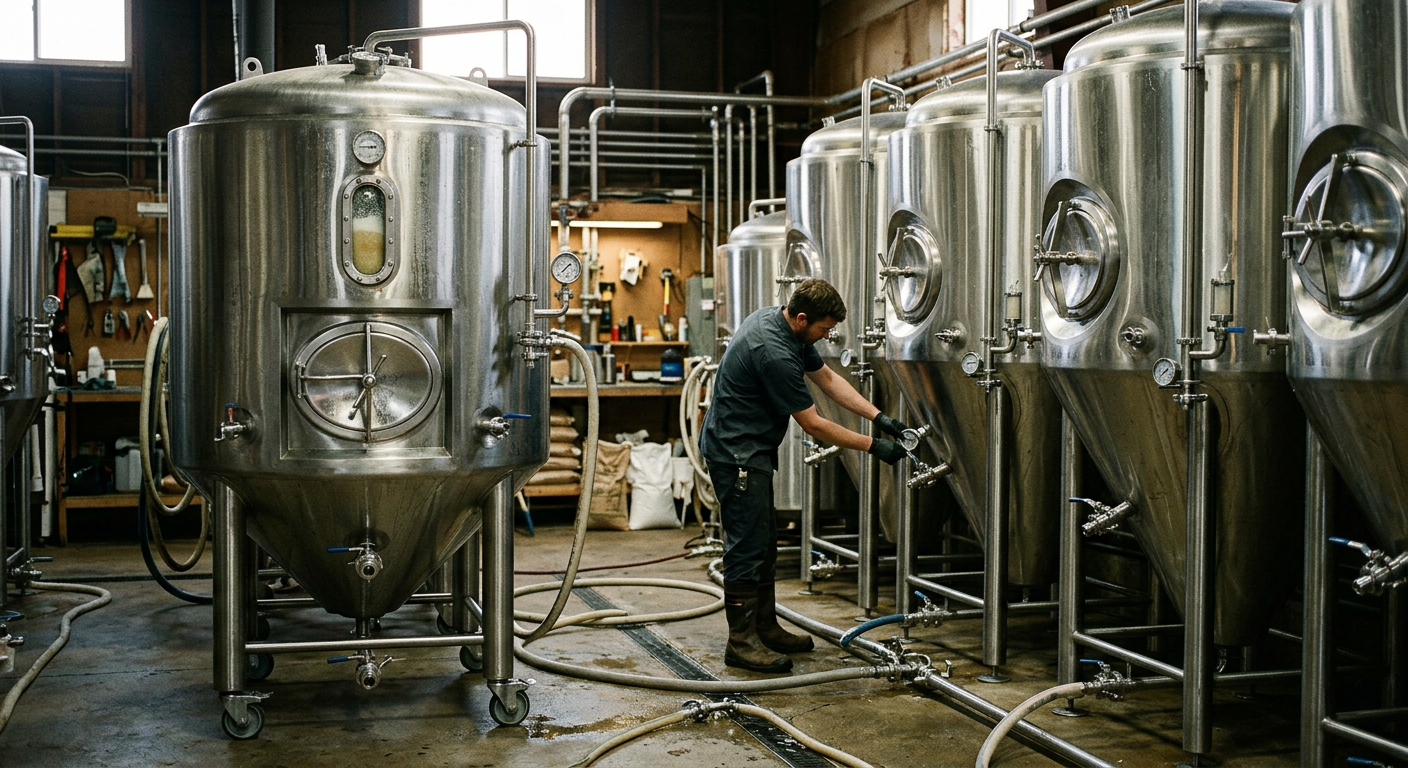
A conical fermenter is fundamentally designed for fermentation, yeast management, and trub separation. The conical bottom supports solids collection and discharge, while the cylindrical body provides the main fermentation volume. Depending on configuration, it may include cooling zones, sample valves, pressure capability, CIP devices, insulation, and instrumentation. In many American breweries, the conical fermenter remains the backbone of the cellar.
A unitank takes that basic foundation and expands the vessel’s role. It is typically pressure-rated for fermentation and conditioning under pressure, often with the ability to carbonate in-vessel and hold finished beverage before packaging. This can shorten process steps and reduce transfers, especially for beer, cider, hard seltzer, and some fermented functional beverages.
The difference is therefore not only mechanical; it is strategic. Unitanks collapse multiple cellar functions into one asset. Conical fermenters preserve separation between process stages. If your beverage style, packaging schedule, or quality system benefits from isolation at each step, conicals can be stronger. If your priority is minimizing movement and simplifying workflow, unitanks usually lead.
| Factor | Unitank | Conical Fermenter | Practical Impact in U.S. Plants |
|---|---|---|---|
| Primary role | Ferment, condition, carbonate, hold | Ferment and separate solids | Unitanks reduce transfers; conicals fit classic cellar layouts |
| Pressure capability | Usually higher and more central to operation | Varies by design; often less central | Important for carbonation and pressure fermentation |
| Need for bright tanks | Can reduce dependency | Typically still needed for full finishing flexibility | Affects total capex and packaging scheduling |
| Floor-space efficiency | High | Moderate | Critical in urban production facilities |
| Process segmentation | Lower | Higher | Conicals support separate maturation strategies |
| Transfer frequency | Lower | Higher in multi-vessel workflows | Impacts labor, oxygen exposure, and sanitation burden |
| Typical best fit | Space-limited, efficiency-focused producers | Plants with dedicated bright tank strategy | Selection should follow production logic, not trend-following |
This table matters because the purchase decision is rarely about a single performance claim. Buyers need to connect vessel type to packaging cadence, yeast handling practice, and downstream tank availability. For example, a fast-moving taproom brewery may prioritize unitank turnover, while a regional production brewery may still find that conical fermentation plus multiple bright tanks creates more packaging flexibility across a larger portfolio.
Buying Advice for U.S. Owners and Engineers
Start with scheduling math rather than tank terminology. Determine annual production target, average batch size, fermentation days, conditioning days, packaging frequency, and desired spare capacity. Then test both scenarios: one with unitanks handling fermentation through carbonation, and another with conicals feeding bright tanks. The right answer often appears once actual occupancy days are modeled.
Second, evaluate utilities. Unitanks may demand more rigorous pressure, temperature, and carbonation control inside a single vessel, so instrumentation quality, glycol zoning, and pressure relief strategy matter. Conical systems can spread the load across more dedicated assets, but they may introduce more pumps, transfer lines, and cleaning cycles.
Third, analyze labor. If your team is lean, a unitank can simplify workflow and reduce movement. If you have a strong cellar crew and a process culture built around dedicated fermentation and finishing stages, conicals may provide more control without becoming a labor bottleneck.
Fourth, think ahead to product diversification. A brewery producing lager, hazy IPA, fruited sour, and hard seltzer on the same floor may benefit from mixed tank architecture. A kombucha brand with strict flavor integrity and contamination control requirements may prefer very intentional segmentation. A contract manufacturer with varied customer specs may benefit from both pressure-capable unitanks and standard conical vessels.
Industries Using These Tanks
Although the discussion often centers on brewing, the equipment is relevant across multiple sectors. Beer remains the most visible category, but unitanks and conical fermenters also appear in cider, wine adjunct processing, mead, kombucha, probiotic beverages, RTD fermentation bases, yeast propagation systems, and some specialty ingredient applications.
In the food and beverage capital projects environment, the same engineering logic applies across categories: sanitary design, cleanability, thermal stability, automation integration, and utility efficiency. Buyers in dairy-adjacent cultured beverages, non-alcoholic fermentation, and functional beverages increasingly compare these tank styles through the same lens used by breweries: throughput, contamination risk, flexibility, and installed lifecycle cost.
The bar chart shows why generalized advice is insufficient. Craft beer still drives the most visible demand, but adjacent categories are strong enough that tank selection should not assume a brewery-only workflow. A supplier that understands beer, kombucha, spirits-based beverages, and broader sanitary process design is often more useful than a vendor focused only on one niche.
Applications and Process Scenarios
Use a unitank when your application requires closed transfer protection, pressure-capable fermentation, in-vessel carbonation, and compressed process flow. This is especially common in taproom breweries, fast-growing regional craft operations, cider facilities, and RTD plants trying to maximize throughput without overbuilding the cellar.
Use a conical fermenter when your application emphasizes yeast harvesting, long or specialized maturation paths, separation of fermentation from finishing, or broad compatibility with an existing bright tank network. This is still highly relevant for larger beer portfolios, pilot systems, and facilities where different process steps are intentionally isolated for quality or scheduling reasons.
| Application | Recommended Tank Style | Why It Fits | Important Design Note |
|---|---|---|---|
| Small urban craft brewery | Unitank | Saves space and reduces transfers | Prioritize pressure rating and CIP access |
| Regional brewery with brite cellar | Conical fermenter | Works well with separated finishing stages | Match sizing to packaging windows |
| Cidery | Unitank | Flexible fermentation-to-carbonation workflow | Check flavor retention and cooling control |
| Kombucha plant | Mixed strategy | Depends on contamination control and secondary processes | Validate sanitary valve and gasket selection |
| Pilot beverage R&D center | Conical fermenter | Great for process testing and separated observations | Instrumentation accuracy is more important than volume |
| Co-packing facility | Mixed strategy | SKU changes favor flexible vessel architecture | Automated CIP and utility integration are critical |
| Hard seltzer base production | Unitank | Efficient closed process and streamlined finishing | Plan for pressure, carbonation, and cleaning validation |
For many U.S. facilities, the strongest answer is neither pure unitank nor pure conical deployment. A hybrid layout can create the best economics: unitanks for high-velocity SKUs and conicals for brands or products requiring more separated maturation and handling.
Case-Based Selection Logic
Consider a 3,000 to 10,000 barrel brewery in a dense metro market. If lease costs are high and packaging windows are tight, unitanks often provide better return because they can compress fermentation and finishing steps inside a smaller footprint. Now consider a larger regional brewery with a stable packaging schedule and existing bright tanks. In that case, adding conical fermenters may be more efficient than paying for full unitank functionality on every vessel.
A kombucha company scaling from local retail to multi-state distribution faces a different question. Product integrity, cleaning validation, and flavor changeovers may be more important than simply reducing vessel count. Here, a carefully engineered conical or mixed system with dedicated CIP and automation may outperform a one-size-fits-all unitank strategy.
Similarly, a contract beverage manufacturer serving multiple brand owners may prefer mixed architecture because one customer’s process spec might require a pressure-rated ferment-and-hold vessel while another needs a more traditional fermentation-only setup feeding separate finishing tanks.
Local Suppliers and Integrators in the United States
Choosing the right supplier is often as important as choosing the right tank type. Fabrication quality matters, but so do documentation, FAT/SAT support, controls integration, utility coordination, field installation, and responsiveness after startup. The U.S. market includes both fabricators and engineering-driven integrators, and buyers should understand which type they are engaging.
| Company | Service Region | Core Strengths | Key Offerings |
|---|---|---|---|
| Disruptive Process Solutions | All 50 U.S. states and Canada | Process engineering, capital planning, integration, field execution | Unitanks, conical fermenters, utilities, controls, turnkey installation |
| DME Process Systems | United States and Canada | Brewery process systems and stainless vessel solutions | Fermentation vessels, brewhouses, cellars, process skids |
| JV Northwest | United States | Stainless process equipment for brewing and beverage | Fermenters, brite tanks, custom vessels, process integration |
| Criveller Group | North America | Wide beverage equipment portfolio | Fermenters, tanks, winery systems, cellar equipment |
| Premier Stainless Systems | United States | Custom stainless fabrication and sanitary systems | Fermentation tanks, process vessels, skids, turnkey support |
| Deutsche Beverage + Process | United States | Engineered beverage and brewery systems | Cellar tanks, brewhouses, controls, installation support |
| Paul Mueller Company | United States | Strong stainless manufacturing heritage | Sanitary vessels, processing tanks, thermal process support |
The companies above are relevant for different reasons. Some are primarily vessel fabricators; others bring stronger design-build capability. That distinction matters when a project includes glycol distribution, compressed air, steam, CIP, structural support, automation, and commissioning. A buyer comparing quotes should ask whether the vendor is supplying a tank, a process package, or a full production solution.
Detailed Supplier Comparison
Below is a more practical comparison focused on buyer concerns. The purpose is not to declare one universal winner, but to show which supplier profiles align with different project types in the United States.
| Company | Best For | Engineering Depth | Installation Support | Suitable Tank Strategy |
|---|---|---|---|---|
| Disruptive Process Solutions | Owners wanting engineering plus execution accountability | High | High | Unitank, conical, or hybrid systems |
| DME Process Systems | Breweries seeking recognized process equipment support | High | Moderate to high | Both, especially brewery-focused layouts |
| JV Northwest | Custom stainless vessel projects | Moderate to high | Moderate | Both, with strong fabrication orientation |
| Criveller Group | Diverse beverage operations including wine and cider | Moderate | Moderate | Both, depending on package scope |
| Premier Stainless Systems | Custom sanitary equipment buyers | Moderate to high | Moderate | Both, especially custom process vessels |
| Deutsche Beverage + Process | Beverage plants seeking engineered process solutions | High | High | Both, especially integrated systems |
| Paul Mueller Company | Large sanitary manufacturing and processing environments | High | Moderate | Conical-heavy or custom sanitary applications |
This table is useful because the right partner depends on how much project risk you want the supplier to absorb. If you only need a tank and already have internal process, utilities, and controls expertise, a fabrication-led supplier may be enough. If your project involves greenfield construction, utility buildout, SCADA, sanitary process routing, or aggressive startup timelines, a design-build integrator is usually the better fit.
Trend Shift in Tank Preferences
Across the United States, buyers are gradually shifting from simple vessel-by-vessel purchasing toward system-level optimization. This does not mean conical fermenters are disappearing. It means owners are increasingly willing to pay for whichever architecture reduces operating friction over a three- to seven-year horizon.
The area chart captures a realistic market transition. Traditional layouts remain important, but integrated unitank workflows are gaining ground because labor efficiency, oxygen control, and space economics are becoming more decisive. Even so, the future is likely mixed architecture rather than complete replacement of one tank style by the other.
Supplier and Product Strategy Comparison
One more comparison helps buyers convert theory into action. The chart below compares practical project priorities rather than marketing claims.
The comparison shows the core tradeoff clearly. Unitanks dominate when buyers prioritize compactness and fewer transfers. Conical fermenters dominate when buyers need dedicated control over finishing stages or want to expand the cellar in modular pieces over time.
Our Company Perspective
For U.S. buyers evaluating unitank vs conical fermenter options, Disruptive Process Solutions brings an unusually practical combination of equipment knowledge, engineering depth, and execution accountability. The company supports beverage and food manufacturers across all 50 states and Canada, with headquarters in Cary, North Carolina, and a West Coast presence in Lake Forest, California, giving it real operating reach rather than a remote-export model. From a product standpoint, DPS designs and supplies fermentation systems alongside full utility and controls integration, and its broader process portfolio includes tanks up to 12,000 gallons, CIP systems, automation, SCADA, and turnkey commissioning under strict sanitary expectations common to FDA, USDA, SQF, and BRC-governed environments. From a cooperation standpoint, DPS works flexibly with end users, co-packers, brand owners, distributors, and project stakeholders through engineered supply, custom equipment manufacturing, integration, installation, owner’s representative support, and broader design-build-manage delivery rather than a one-format sales model. From a service standpoint, its local project execution model, vetted partner network, field installation capability, and online-plus-on-site support structure give U.S. buyers meaningful pre-sale and after-sale protection. That combination matters because a fermentation tank is only as valuable as the utility design, controls logic, installation quality, startup support, and long-term process performance behind it. Buyers can learn more about the company’s operational approach on the about us page, review broader tank and process capabilities through its equipment solutions, and explore execution examples in these project stories: case study one, case study two, and case study three.
What U.S. Buyers Should Ask Before Signing
Before buying either tank style, request detailed answers on shell and jacket thickness, pressure rating, insulation, weld finish, interior surface finish, nozzle orientation, CIP coverage, manway design, sample valve configuration, cooling-zone control, sensor package, documentation, FAT scope, and spare parts availability. Do not limit your review to vessel drawings alone.
You should also ask whether the supplier will support line sizing, glycol loads, floor loading, utility tie-ins, controls programming, and startup sequencing. These points often determine whether a tank performs as promised. An attractively priced vessel can become expensive if it arrives without the integration detail required for a smooth installation in Phoenix, Raleigh, Sacramento, Milwaukee, or any other production environment where downtime is costly.
| Question Area | Why It Matters | Risk If Ignored | Best Practice |
|---|---|---|---|
| Pressure rating | Determines carbonation and safe pressure operation | Limited process capability | Match rating to real production use, not assumptions |
| CIP design | Critical for sanitation and turnaround time | Contamination or longer downtime | Validate spray coverage and drainability |
| Cooling zones | Controls fermentation temperature stability | Inconsistent product quality | Specify independent zone control where needed |
| Controls integration | Supports automation and alarms | Manual errors and startup delays | Coordinate PLC and SCADA early |
| Documentation | Needed for validation, maintenance, and compliance | Poor traceability | Require full turnover package |
| Field service | Reduces startup and repair risk | Longer outages | Confirm local or regional support coverage |
| Expansion compatibility | Protects future capex efficiency | Fragmented cellar design later | Standardize nozzles, controls, and utilities |
This checklist is especially important for owners who are buying their first serious cellar equipment. The vessel itself is visible; hidden engineering gaps are not. A disciplined pre-purchase review saves far more money than late-stage field fixes.
Future Trends for 2026 and Beyond
Looking ahead, the U.S. market is moving toward smarter, more connected fermentation systems. Sensors, recipe management, remote monitoring, and tighter PLC/SCADA integration will increasingly favor suppliers that can engineer the full process environment rather than only sell stainless. This is particularly relevant for multi-site beverage groups and co-packers seeking repeatability across facilities.
Sustainability will also shape tank design and selection. Producers are under pressure to reduce water use, cleaning time, energy consumption, and product loss. Unitanks may gain further traction where reduced transfers lower cleaning demand and oxygen exposure, but conical fermenters may also remain competitive when paired with well-designed bright tank systems and optimized CIP recovery loops.
Policy and compliance trends matter too. More buyers are paying attention to documentation, sanitary design validation, and traceable component quality, especially when facilities serve retailers, contract customers, or export channels with stricter audit expectations. Equipment partners that understand not just brewing, but broader food and beverage compliance, will have a growing advantage.
Finally, hybrid production facilities will continue to rise. More American plants are producing beer, flavored malt beverages, hard tea, non-alcoholic fermented drinks, or functional beverages under one roof. That diversification strengthens the case for flexible tank strategies rather than rigid loyalty to one format.
FAQ
Is a unitank always more expensive than a conical fermenter?
Usually on a per-vessel basis, yes, because the unitank often includes more pressure-capable functionality and may reduce the need for separate finishing assets. But total project cost can favor the unitank if it removes downstream equipment, shortens process steps, or saves floor space.
Can a conical fermenter be used in a modern craft brewery without feeling outdated?
Absolutely. Conical fermenters remain highly relevant in the United States, especially when paired with bright tanks and a well-planned packaging schedule. They are not outdated; they simply reflect a different process philosophy.
Which is better for small breweries?
Many small breweries benefit from unitanks because they simplify operations and reduce footprint. However, if the brewery already has bright tanks or wants more control over finishing, conical fermenters can still be the better investment.
Which is better for kombucha or specialty fermented beverages?
It depends on contamination control, flavor changeover, carbonation needs, and process validation. Many specialty beverage plants use a mixed architecture because it provides flexibility across product styles.
Should I buy from a domestic supplier only?
Not necessarily. Domestic suppliers can offer strong service and easier coordination, but qualified international manufacturers with proper U.S. certifications, material traceability, and reliable local support can offer strong value. The key is validating service infrastructure and integration support, not just country of origin.
What is the biggest mistake buyers make?
The most common mistake is comparing vessel quotes without comparing the full installed process. Tank type, utilities, controls, CIP, layout, and staffing all interact. A lower vessel price does not guarantee a better project outcome.
[/trp_language]
Complete Company Portfolio
About the Author: Disruptive Process Solutions (DPS)
The DPS team combines process engineering expertise with real-world food and beverage manufacturing experience. Our content focuses on process optimization, production efficiency, facility improvements, and practical solutions that help manufacturers operate more effectively in a rapidly evolving industry.
Share