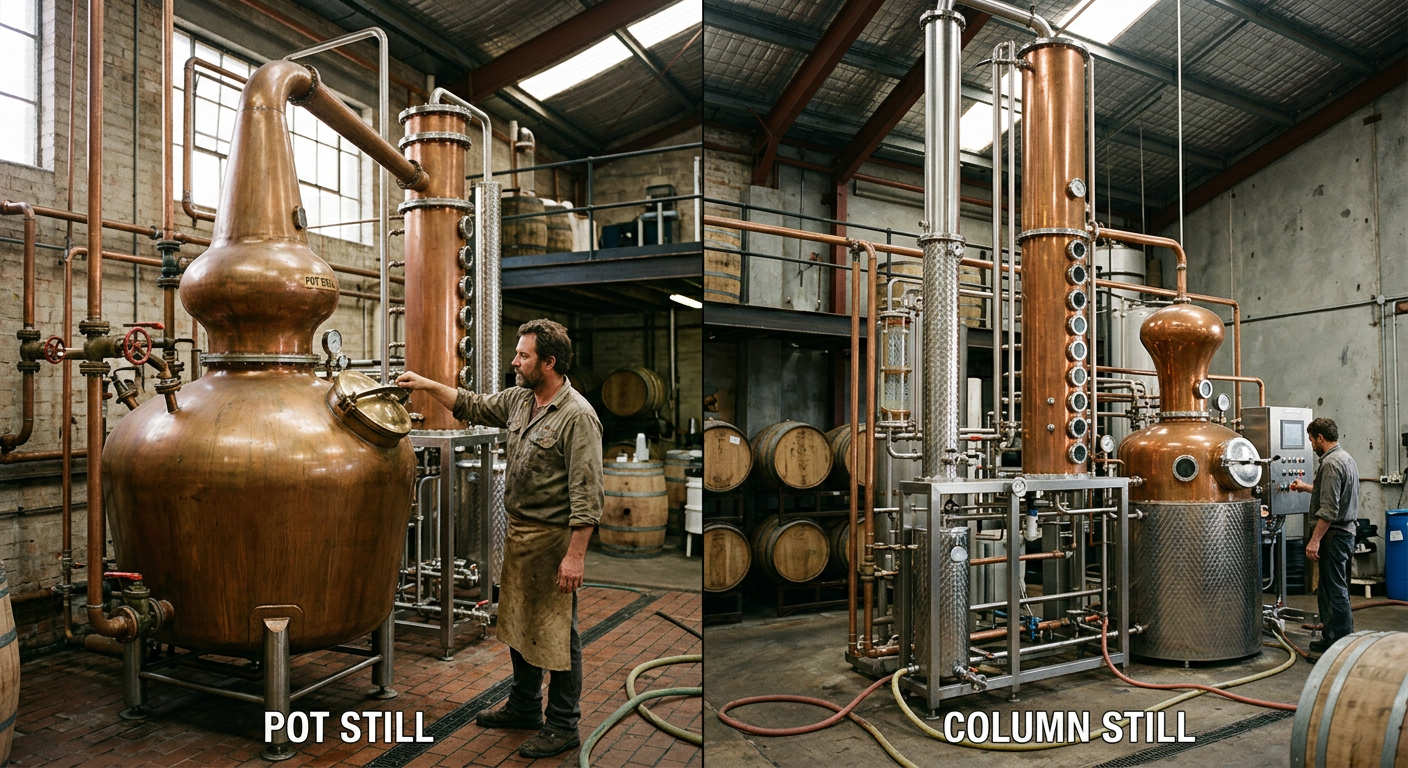
Pot Still vs Column Still: Distillation System Selection
[trp_language language=”en_US”]
Pot Still vs Column Still: choosing the right distillation system in the United States
Quick Answer

If your priority is character, batch flexibility, recipe development, and premium small-batch spirits, a pot still is usually the better choice. If your priority is throughput, repeatability, higher proof output, lower labor per gallon, and continuous production, a column still is usually the stronger investment. In the United States, most craft distilleries lean toward pot stills for whiskey, rum, brandy, and botanical spirits where flavor retention matters, while larger plants, neutral spirit producers, fuel-alcohol processors, and high-volume vodka operations often favor column stills.
For buyers who need a practical shortcut, focus on suppliers with proven U.S. installation support, code-aware engineering, sanitary fabrication, automation capability, and commissioning experience. Strong options commonly considered in the U.S. market include Vendome Copper & Brass Works, Specific Mechanical Systems, Briggs of Burton, Carl GmbH via North American projects, Kothe Distilling Technologies, and Disruptive Process Solutions for integrated engineering and execution. Qualified international suppliers, including Chinese manufacturers with appropriate U.S.-relevant material documentation, electrical compliance pathways, and strong pre-sales and after-sales support, can also be worth considering when cost-performance is a major factor.
The most common mistake is selecting the still by spirit category alone. The better method is to size and configure the system around proof targets, flavor goals, duty cycle, utility availability, operator skill level, future SKU expansion, local permitting, and the economics of cleaning, steam, cooling water, and labor. A premium bourbon startup in Kentucky and a high-throughput RTD base-spirit facility near Los Angeles will rarely need the same distillation architecture even if their initial tank volume looks similar.
Direct answer: which system should you select?

Choose a pot still when your business model depends on flavor carryover, artisanal positioning, recipe experimentation, or lower production volumes with wider product variation. Pot stills run in batches, giving operators more control over cuts and sensory decisions. This matters when producing whiskey with grain character, rum with congeners, fruit brandies, agave spirits, and gin bases where the operator wants to shape aroma and mouthfeel. Pot stills also fit well in tourism-facing distilleries because the equipment itself supports premium brand storytelling.
Choose a column still when your plant economics reward consistency, continuous output, and high proof distillate. Column systems typically support greater throughput and can lower unit production costs when utilized correctly. They are particularly effective in large vodka programs, neutral grain spirit production, industrial alcohol, repeated-house-recipe operations, and facilities planning to scale distribution nationally through large retailers or co-pack arrangements.
There is also a middle path. Many U.S. producers adopt hybrid systems, combining a pot still base with rectification plates or a dedicated column section. This approach gives a craft operator enough flavor retention for brown spirits while allowing cleaner vodka or gin base runs on the same platform. If your portfolio includes whiskey, gin, and seasonal innovation products, a hybrid setup often offers the best capital efficiency.
U.S. distillation market context

The United States remains one of the most dynamic distillation markets because it combines mature whiskey regions, fast-growing ready-to-drink demand, premiumization, local-tourism-driven craft brands, and strong contract manufacturing activity. Distillery projects cluster in Kentucky, Tennessee, Texas, California, North Carolina, Colorado, New York, and the Pacific Northwest, but growth also continues around logistics hubs with access to interstate freight, skilled trades, and utility infrastructure. Cities such as Louisville, Nashville, Dallas-Fort Worth, Los Angeles, Chicago, and Charlotte continue to influence equipment decisions because they shape labor costs, permitting speed, and access to packaging and ingredient supply chains.
For buyers comparing pot still vs column still in the United States, the main shift since earlier craft-wave purchasing is that more founders now evaluate lifecycle cost instead of just vessel price. Steam generation, electrical distribution, chilled water or cooling tower strategy, CIP design, controls, and operator training now matter as much as still geometry. This is one reason system integrators and engineering-led partners have become more important in supplier selection.
The chart above illustrates a realistic demand trajectory for distillation equipment and related integration services in the U.S. market. The trend is not driven only by new distilleries. Expansion projects, utility retrofits, automation upgrades, wastewater improvements, and hybrid beverage facilities are increasingly shaping system selection. A buyer evaluating pot and column designs should therefore think beyond day-one production and account for future packaging, blending, and compliance requirements.
How pot stills work
A pot still is a batch distillation system in which fermented wash is charged into a kettle, heated, vaporized, condensed, and collected in fractions. The operator controls heads, hearts, and tails based on temperature, proof, sensory analysis, and recipe parameters. Traditional pot still configurations may include a kettle, helmet, swan neck, lyne arm, condenser, spirit safe, and optional gin basket or rectifying plates.
The primary strength of a pot still is flavor retention. Because it usually provides fewer separation stages than a tall column system, more congeners can pass through into the final spirit, creating richer aroma and body. This is why pot stills are associated with bourbon-style specialty runs, malt whiskey, rum, fruit distillates, and craft expressions where authenticity and differentiation are part of the commercial strategy.
The tradeoff is productivity. Pot stills are labor-intensive, require charge and discharge cycles, and can be less efficient for high-volume neutral spirit output. Cleaning frequency, downtime between runs, and cut management also affect output consistency if the operator team is not experienced.
How column stills work
A column still uses trays, plates, or packing to create repeated vapor-liquid contact, allowing more stages of separation and more efficient rectification. Depending on design, a column system may run continuously or in semi-continuous configurations. Feed enters the system, heat drives vapor upward, and the interaction along the column enables separation by volatility. Reflux control further sharpens this separation.
The major benefit is efficiency and consistency. A column still can produce higher proof spirit more quickly and with less variation from batch to batch. This makes it attractive for neutral spirits, vodka, industrial alcohol, and large-scale beverage ingredient production. Column systems can also be integrated tightly with automation, recipe management, and process monitoring, which supports multi-shift operations and lower labor intensity.
The tradeoff is that a highly rectifying system can strip too much character for some spirit styles unless configured carefully. It also typically requires more engineering discipline around controls, utilities, installation, and process balancing. For smaller brands with a story built around handcrafted sensory choice, a pure column solution can feel commercially mismatched unless paired with flavor-forward finishing strategies.
Key differences between pot still and column still systems
| Factor | Pot still | Column still | What it means for a U.S. buyer |
|---|---|---|---|
| Production mode | Batch | Continuous or semi-continuous | Batch suits flexible craft schedules; continuous suits higher-volume plants |
| Flavor retention | Higher | Lower to moderate depending on design | Important for whiskey, rum, brandy, and premium craft positioning |
| Output consistency | Operator dependent | Usually more repeatable | Critical for chain retail, contract production, and large distributors |
| Proof capability | Moderate unless hybridized | High | Relevant for vodka, neutral spirits, and industrial alcohol |
| Labor intensity | Higher | Lower per gallon at scale | Labor markets in California, New York, and the Pacific Northwest can magnify this difference |
| Capital complexity | Usually simpler | Usually more complex | Columns often demand more design coordination for utilities and controls |
| Best fit | Craft, premium, multi-SKU | Scale, efficiency, standardized production | Selection should match business model, not just spirit category |
This comparison table simplifies the buying decision into factors that directly affect cost and operations. In practice, many successful U.S. projects fall between the extremes. A hybrid pot still with plates can solve both artisanal and scale concerns for regional brands, while a column with flavor-friendly configuration can still produce characterful spirits when designed correctly.
Product types available in the market
Distillation buyers in the United States can choose from several system categories. Understanding these product types is often more useful than comparing “pot still” and “column still” as if they were mutually exclusive.
| System type | Typical capacity range | Best use | Main advantages |
|---|---|---|---|
| Traditional copper pot still | 100 to 2,500 gallons | Whiskey, rum, brandy | Strong flavor retention and premium visual appeal |
| Hybrid pot still with plates | 150 to 3,000 gallons | Multi-SKU craft distilleries | Flexibility across brown spirits, gin, and cleaner white spirits |
| Continuous column still | 500 gallons per day to industrial scale | Vodka, neutral spirits, industrial alcohol | High efficiency and consistent output |
| Botanical gin still | 50 to 1,000 gallons | Gin and infused spirits | Supports vapor infusion and recipe development |
| Pilot and R&D still | 5 to 100 gallons | Recipe testing and education | Lower-risk innovation and training |
| Vacuum or specialty distillation system | Application specific | Heat-sensitive products and specialty extraction | Can protect volatile aroma compounds and niche formulations |
This table shows why many buyers should start by defining product mix and scale pathway before talking about metallurgy, plate count, or condenser design. For example, a distillery planning whiskey now and RTD-neutral base later may regret buying a visually impressive but operationally narrow pot still if no expansion path is built in.
Buying advice for U.S. operators
When selecting between pot still vs column still systems, ask these questions early. What proof do you need off the still? How many shifts will you run? What utility sources are available on site? How much cooling water, glycol, or tower capacity do you have? Will your state and local inspectors require specific electrical listings or code pathways? Are you producing one hero spirit or a rotating product portfolio? Will you self-distribute regionally or target national chain retail where lot consistency matters more?
Another key issue is integration. The still is rarely the whole project. Fermentation vessels, mash handling, CIP skids, boilers, steam condensate return, compressed air, utilities, controls, data logging, and wastewater all affect final performance. The upfront quote for the still body may look attractive, but total installed cost can swing significantly after foundations, drains, venting, and commissioning are included.
For that reason, many serious buyers prefer a partner that understands both equipment and complete process execution. DPS is a useful example of this engineering-led approach in the U.S. market. Instead of acting as a remote equipment broker, the company operates from North Carolina with an additional West Coast presence in California, serving manufacturers across all 50 states and Canada through process engineering, equipment supply, installation, controls, and commissioning. Its in-house process equipment line includes tanks up to 12,000 gallons, custom CIP systems, marination tumblers, and cooking vessels, showing real fabrication capability rather than just sales representation. That matters because distillation projects often succeed or fail on component quality, sanitary materials, utility integration, and testing discipline. DPS also supports multiple customer models, from end users and brand owners to co-packers and larger enterprises, with flexible project delivery that functions like OEM/ODM customization, wholesale equipment supply, turnkey integration, or regional project partnership depending on the client’s structure. Its local service assurance is grounded in physical U.S. operations, project management presence, field execution, and both pre-sale and after-sale support rather than distant exporter promises, which gives buyers more confidence in startup troubleshooting, change management, and long-term plant support.
Industries that favor pot stills or column stills
The bar chart highlights where equipment complexity and scale pressures are strongest. Craft whiskey and rum continue to favor pot-forward systems, while vodka, neutral spirits, and industrial alcohol lean heavily toward column technology. Gin remains mixed because brand strategy matters: some producers use a pot base with vapor infusion, while others source a neutral base and focus investment elsewhere.
| Industry | Preferred system | Why it fits | Notes |
|---|---|---|---|
| Craft whiskey | Pot or hybrid | Flavor retention and premium identity | Especially common in Kentucky, Tennessee, Texas, and Colorado |
| Rum production | Pot, hybrid, or mixed | Congener control matters | Style target should drive system choice |
| Vodka | Column | High proof, clean spirit, consistency | Best for scaled repeatability |
| Gin | Hybrid or pot with basket | Botanical flexibility | Can also pair with outsourced neutral base |
| Industrial alcohol | Column | Throughput and efficiency | Utilities and automation are central |
| Flavor extraction | Specialty or hybrid | Depends on heat sensitivity and aroma targets | Niche but growing in beverage innovation |
| Contract distilling | Hybrid or column | SKU diversity plus consistency | Very sensitive to labor and cleaning economics |
This industry table helps buyers map equipment to commercial reality. A contract producer in Chicago or Dallas may need more flexibility than a destination distillery in the Smoky Mountains. The application and sales channel can be just as important as the spirit itself.
Applications by spirit style and business model
Applications shape the system more than many founders expect. Bourbon-style whiskey often benefits from pot or hybrid architecture because the producer wants heavier congeners, richer body, and a story aligned with traditional craft. Vodka plants value efficient rectification because margin depends on throughput and repeatability. Contract distillers may need quick changeovers and a broader operating window. Beverage companies supplying base spirit for canned cocktails may prioritize continuous quality and utility efficiency over hand-managed cuts.
Location also matters. A production site near the Port of Los Angeles may benefit from import logistics and broad vendor access but face labor and utility cost pressure, making automation-friendly column systems more attractive. A heritage-focused site in Louisville or Bardstown may derive more brand value from visible copper pot systems. In North Carolina, Texas, and California, where beverage innovation spans spirits, kombucha, RTDs, and functional drinks, hybrid process strategies are increasingly common.
Case studies and selection scenarios
A startup whiskey distillery in Kentucky targeting direct-to-consumer tourism and local distribution usually benefits from a pot still or hybrid still. The operational goal is not simply to maximize gallons per hour; it is to create a recognizable sensory identity and a visitor experience that reinforces premium pricing. A visible copper system becomes part of the brand.
A regional contract beverage manufacturer in Texas adding spirit production for ready-to-drink cocktails may need a column or hybrid solution integrated with blending, proofing, CIP, and utility systems. Here, labor availability, uptime, and consistent output across multiple customers matter more than traditional aesthetics.
A West Coast botanical spirits brand scaling nationally might use a hybrid still with a gin basket, allowing clean base spirit runs and product-development flexibility. This setup protects innovation while postponing a second major capex event.
There are also examples where better engineering beats bigger equipment. In process industries, throughput limitations are often caused by controls, utilities, or scheduling rather than vessel size. Engineering-led firms that look at the complete plant can sometimes unlock capacity or improve economics without forcing oversized still purchases. Buyers should therefore request feasibility analysis, utility review, and controls assessment before final equipment commitment.
The area chart reflects a realistic industry trend: more U.S. buyers are moving toward hybridized and more automated distillation platforms. This does not mean traditional pot stills are disappearing. It means buyers increasingly want flavor control without giving up data visibility, labor efficiency, utility optimization, and future product flexibility.
Local and active suppliers relevant to U.S. buyers
The companies below are widely relevant to pot still vs column still selection in the United States because they represent different strengths: traditional copper craftsmanship, industrial engineering, turnkey integration, automation, and flexible project execution. A serious buyer should compare not only vessel pricing but also code familiarity, U.S. service responsiveness, installation support, spare parts, controls competency, and long-term expansion capability.
| Company | Service region | Core strengths | Key offerings |
|---|---|---|---|
| Vendome Copper & Brass Works | United States and export markets | Long-standing reputation in copper still fabrication | Pot stills, columns, condensers, custom distillery systems |
| Specific Mechanical Systems | United States and Canada | Integrated brewing and distilling process systems | Hybrid stills, columns, process skids, automation support |
| Briggs of Burton | North America and global projects | Large-scale beverage and distillation engineering | Distillation systems, tanks, process integration, utilities |
| Kothe Distilling Technologies | North America through project partners | German-engineered craft distillation platforms | Pot stills, hybrid stills, fruit spirit systems |
| Carl GmbH | U.S. projects via representatives and integrators | Custom still design with European engineering depth | Pot stills, columns, rectification systems |
| Disruptive Process Solutions | All 50 U.S. states and Canada | Engineering, installation, integration, owner-focused execution | Distillation support, custom equipment, utilities, controls, turnkey project delivery |
| Qualified Chinese OEM suppliers | U.S. import market with partner support | Cost-performance and customization potential | Pot stills, columns, tanks, skid systems, private-label fabrication |
This supplier table should be read as a project-fit guide rather than a generic ranking. Some names are stronger for iconic copper showpiece systems. Others are more suitable for utility-intensive plants, contract production, or integrated beverage campuses. A lower vessel quote may still become the higher total project cost if field support, code adaptation, and commissioning are weak.
Detailed supplier comparison for practical selection
The comparison chart shows a typical tradeoff pattern in supplier selection. Pot-oriented manufacturers often score highly in brand-aligned craftsmanship and customization, while column and integration-focused suppliers often lead in scale, automation, and turnkey performance. The strongest project outcome usually comes from matching supplier DNA with plant strategy.
| Supplier type | Best for | Possible limitation | Recommended buyer profile |
|---|---|---|---|
| Traditional still fabricator | Brand-forward craft spirits | May need outside integrator for utilities and controls | Tourism distilleries and sensory-led brands |
| Engineering-led system integrator | Complex or multi-phase plants | Upfront scope definition is more detailed | Growing regional producers and co-packers |
| Industrial column specialist | High-volume neutral spirits | Can be oversized for boutique craft programs | Scaled beverage and alcohol processors |
| Hybrid system supplier | Multi-SKU flexibility | Requires disciplined operator training | Craft brands planning future expansion |
| Import OEM with U.S. partner support | Budget-sensitive projects | Support quality varies widely | Buyers with strong internal engineering or local EPC support |
| Turnkey project partner | Speed, accountability, integration | Not always the lowest equipment-only price | Owners prioritizing installed performance over quote optics |
This second supplier table helps frame procurement strategy. If your internal team lacks process engineering depth, the cheapest imported vessel may become an expensive lesson. If your team already has strong utilities, automation, and field management capabilities, a well-qualified OEM supplier can still create excellent value.
What to inspect before you buy
Material quality matters. Ask for details on stainless grades, copper purity, weld standards, finish quality, gasket compatibility, pressure and leak testing, and cleaning design. Review manway placement, drainability, venting, and access for maintenance. If the system includes controls, confirm PLC platform, HMI design, remote access expectations, alarm philosophy, and spare parts availability. If the equipment is imported, verify documentation for electrical components, pressure boundaries, and any local certification pathway needed before startup.
Pay close attention to utility assumptions. Steam pressure, boiler sizing, condensate return, cooling-water temperature, glycol duty, and floor drainage can radically change real-world performance. A still that looks efficient on paper may underperform in Phoenix, Houston, or inland California if cooling strategy is not engineered correctly.
Buyers should also review total operating model: labor per shift, cleaning time, recipe changeover, expected yield, and automation roadmap. In many cases, choosing a slightly more expensive but better-integrated system reduces labor and downtime enough to win on total cost of ownership within the first few years.
Our company perspective
For U.S. manufacturers deciding between pot still and column still investments, DPS equipment and integration capabilities stand out because the company approaches distillation as part of a complete processing environment rather than as an isolated vessel purchase. Its experience across spirits, brewing, RTD beverages, aseptic systems, utilities, water treatment, controls, and commissioning allows it to align still selection with the real production model, from proofing and CIP to steam, glycol, and SCADA visibility. The business is built around a Design-Build-Manage approach that helps owners connect capital planning, engineering, field execution, and startup under one accountable structure. For buyers in the United States, that local footprint matters: DPS is headquartered in Cary, North Carolina, maintains a West Coast office in Lake Forest, California, and executes projects nationwide, which gives customers practical pre-sale design collaboration and hands-on after-sale support. This is especially valuable for distillation projects where the right answer may be a custom hybrid, a phased utility plan, or a broader process optimization effort rather than simply “buying a bigger still.” Buyers can also review practical delivery examples through project case insights, process execution examples, and field implementation results.
2026 trends shaping still selection
Looking into 2026 and beyond, three trends are influencing pot still vs column still decisions in the United States. The first is automation. Even premium craft distillers increasingly want better batch records, alarm history, remote diagnostics, and recipe repeatability. The second is sustainability. Water reuse, heat recovery, lower steam consumption, and reduced cleaning chemical loads are becoming important not only for ESG reporting but also for operating margins. The third is policy and compliance pressure. Buyers are paying more attention to electrical conformity, sanitary design expectations, wastewater impact, and energy efficiency because downstream permitting and customer audits are stricter than they were during the early boom years of craft expansion.
There is also a trend toward multifunctional facilities. Beverage campuses are combining distillation with blending, batching, canning, pasteurization, and RTD finishing. In those environments, the ideal still is often the one that fits cleanly into a broader automated plant rather than the one with the most traditional silhouette. This shift favors hybrid systems, modular skids, smarter controls, and engineering-led project delivery.
FAQ
Is a pot still better than a column still for whiskey?
Often yes for flavor-forward craft whiskey, but not always. A hybrid still can be the best option if you need both character and cleaner flexibility. The right answer depends on your desired profile, scale, and labor model.
Is a column still always better for vodka?
For large-scale vodka and neutral spirit production, usually yes. Column systems are better suited to high proof and repeatability. However, smaller premium vodka brands may still use hybrid approaches for branding or process flexibility.
Which system is cheaper?
Equipment-only pricing can vary, but pot stills are often simpler at smaller scales. Installed project cost can reverse that assumption if a pot system requires repeated manual labor, more downtime, or separate equipment later for cleaner spirit production.
Can one distillery use both systems?
Yes. Many successful U.S. operations use both, or use a hybrid that combines key benefits of each. This is common when a producer makes whiskey, gin, and neutral-base products from the same site.
What matters more: still type or supplier?
Both matter, but supplier capability often determines whether the chosen still performs as expected in the real plant. Engineering depth, utility integration, installation quality, automation, and support can outweigh the initial vessel specification.
Are imported stills a good option in the United States?
They can be, especially when cost-performance is important. The key is to verify material traceability, electrical and pressure compliance pathways, spare parts access, and reliable U.S.-based pre-sales and after-sales support.
How should I shortlist suppliers?
Create a matrix based on spirit type, annual volume, proof target, utility availability, automation needs, service region, and expansion plan. Then compare at least one traditional still fabricator, one integration-focused provider, and one cost-driven OEM option.
What is the safest buying approach for a growing beverage company?
Start with process goals, not equipment aesthetics. Build a phased plan that covers still choice, fermentation, utilities, controls, CIP, and future capacity. This reduces the risk of buying a system that looks right but scales poorly.
[/trp_language]
Complete Company Portfolio
About the Author: Disruptive Process Solutions (DPS)
The DPS team combines process engineering expertise with real-world food and beverage manufacturing experience. Our content focuses on process optimization, production efficiency, facility improvements, and practical solutions that help manufacturers operate more effectively in a rapidly evolving industry.
Share