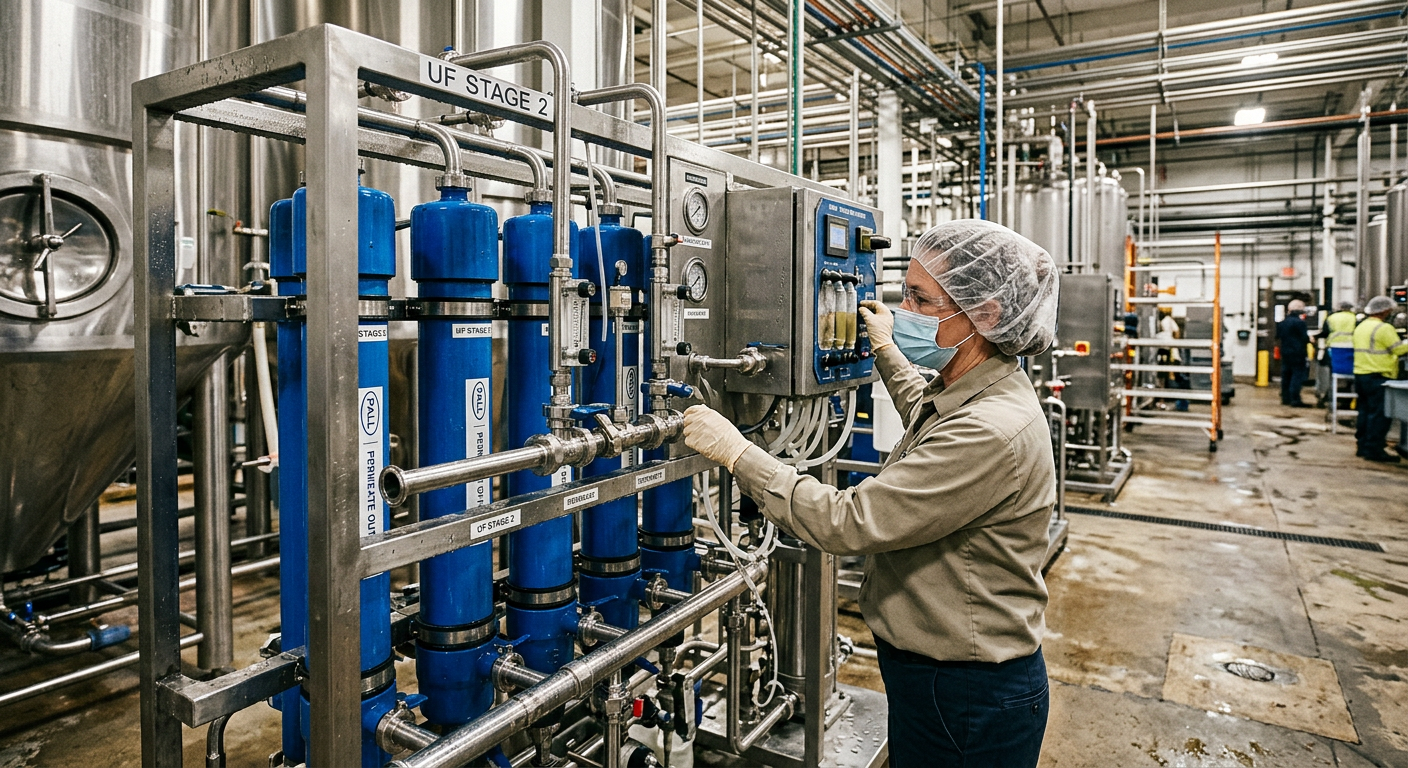
Membrane Filtration Systems for Food and Beverage
[trp_language language=”en_US”]
Membrane Filtration in U.S. Food and Beverage Manufacturing
Quick Answer

For food and beverage manufacturers in the United States, membrane filtration systems are most valuable when you need reliable concentration, clarification, separation, microbial reduction, water recovery, or ingredient standardization without the thermal damage associated with more aggressive processing. The most practical suppliers and integrators to evaluate first are GEA, Tetra Pak, SPX FLOW, Pall Corporation, SUEZ Water Technologies, and Disruptive Process Solutions for engineered integration and plant-level execution. These companies are especially relevant for projects in major manufacturing corridors such as the Midwest dairy belt, California beverage production hubs, Texas protein facilities, and Southeastern co-packing operations.
If you need a fast shortlist, start with GEA for dairy and beverage membrane skids, Tetra Pak for integrated food and dairy lines, SPX FLOW for hygienic processing systems, Pall for high-performance filtration in beverage and specialty applications, and SUEZ for water reuse and process water optimization. For companies that need plant-wide engineering, utility coordination, equipment integration, controls, and execution support rather than stand-alone equipment only, Disruptive Process Solutions is a strong fit in the United States and Canada. Qualified international suppliers, including Chinese manufacturers with relevant U.S.-recognized material, electrical, and sanitary compliance support plus strong pre-sales and after-sales response, can also be worth considering when cost-performance is a major driver.
Market Overview in the United States

The U.S. market for membrane filtration food and beverage systems continues to expand because processors want higher yields, tighter microbial control, lower water use, and more flexible production. Membrane separation is now widely used across dairy, protein, juice, brewing, wine, functional beverages, and ingredient manufacturing. The strongest demand is concentrated in regions where processing density and utility costs make efficiency gains economically visible: California, Wisconsin, Illinois, Texas, North Carolina, Georgia, Pennsylvania, and the Pacific Northwest.
In practical terms, membrane filtration is no longer viewed as a niche technology. It has become a strategic process tool for improving shelf life, standardizing product composition, reducing transportation costs through concentration, and recovering valuable solids from waste streams. This matters for processors dealing with margin pressure, labor constraints, and sustainability targets. Plants near logistics hubs such as Los Angeles/Long Beach, Houston, Savannah, Chicago, and Newark also benefit because concentrated or stabilized products can lower freight and storage costs.
Another reason the market is growing is that membrane technology fits modern line design. It can be integrated with CIP systems, automation, SCADA, inline quality monitoring, thermal processing, and water treatment platforms. That makes it attractive for both new greenfield plants and brownfield upgrades where capacity must increase without a full building expansion.
The line chart above illustrates a realistic project-growth pattern for membrane filtration adoption in U.S. food and beverage plants. The steepest gains are expected in dairy ingredient concentration, water reuse, non-thermal beverage stabilization, and wastewater load reduction projects as processors prepare for tighter utility economics and stronger sustainability reporting expectations through 2026 and beyond.
Core Product Types

Membrane filtration systems are not one product category. They include several separation ranges, each designed for different particle sizes, target outputs, and sanitation requirements. Buyers should define the process goal first: clarification, concentration, fractionation, demineralization, or water purification.
| Membrane Type | Typical Separation Range | Common Food and Beverage Uses | Main Benefit | Main Limitation | Typical U.S. Buyer Profile |
|---|---|---|---|---|---|
| Microfiltration | Largest pore size among sanitary membranes | Beer clarification, wine polishing, bacteria reduction in dairy, broth clarification | Good for suspended solids and microbial management | Less effective for dissolved solids concentration | Breweries, dairies, beverage plants |
| Ultrafiltration | Protein and colloid retention range | Milk protein concentration, whey processing, gelatin, egg, plant proteins | Strong for protein concentration and standardization | Flux can drop with high-fouling streams | Dairy, ingredient, protein processors |
| Nanofiltration | Intermediate range between UF and RO | Partial demineralization, sugar and organic concentration, specialty ingredients | Useful selective separation profile | More application-specific design needed | Ingredient and specialty product manufacturers |
| Reverse Osmosis | Smallest pore scale for dissolved solids rejection | Water purification, juice concentration, dairy concentration, process water reuse | High water removal efficiency | Higher pressure and energy requirements | Water-intensive and large-volume processors |
| Ceramic Membranes | Durable inorganic membrane platform | High-fouling liquids, aggressive cleaning conditions, fermentation broths | Long life and chemical tolerance | Higher upfront cost | Plants with difficult streams and long operating cycles |
| Spiral-Wound Polymer Systems | Common sanitary module format | Dairy, beverage, ingredient concentration and filtration | Widely available and cost-effective | Less tolerant of severe solids abuse than ceramic formats | Mainstream food and beverage processors |
This table shows why system selection should not begin with price alone. The best value comes from matching membrane chemistry, module configuration, cleaning regime, and automation logic to the actual product stream. A lower-cost skid can become expensive if fouling, cleaning downtime, or product losses are underestimated.
How Membrane Filtration Is Used Across Industries
Different industries use membranes for very different reasons. Dairy processors often focus on protein concentration and standardization. Beverage manufacturers may prioritize clarity, flavor protection, and shelf-life support. Protein and ingredient plants frequently use membranes for recovery, concentration, and wastewater load reduction. Distilleries and breweries may use them to reduce filter aid consumption, stabilize finished product, or recover process water.
The bar chart highlights where U.S. demand is strongest today. Dairy remains the most established segment because membrane systems are deeply embedded in milk, whey, and ingredient processing economics. Water reuse is rising quickly because processors in states with tighter water constraints or higher discharge costs increasingly treat water recovery as an operational necessity rather than a sustainability bonus.
| Industry | Typical Feed Stream | Primary Objective | Preferred Membrane Approach | Operational Priority | Expected Business Result |
|---|---|---|---|---|---|
| Dairy | Milk, whey, permeate | Protein concentration and standardization | UF, MF, RO | Yield and product consistency | Higher ingredient value and tighter formulation control |
| Juice | Fruit and vegetable juice | Clarification and concentration | MF, UF, RO | Flavor retention and lower thermal stress | Better quality concentrate and stable appearance |
| Brewing | Beer and process water | Clarification and microbial reduction | MF and specialty final filtration | Shelf stability and bright product | Reduced solids and improved packaging performance |
| Wine | Wine, lees, rinse streams | Polishing and recovery | MF, ceramic options | Preserve sensory profile | Lower losses and more stable bottled product |
| Protein Processing | Broths, protein liquors, wash waters | Recovery and wastewater reduction | UF, NF, ceramic | Fouling management | Higher solids recovery and reduced disposal cost |
| Functional Beverage | Botanical, fermented, or fortified liquids | Clarity and microbial control | MF, UF | Protect actives and flavor | More stable finished beverage with less heat damage |
This table makes clear that the same membrane technology can serve very different economic goals depending on the process stream. The strongest projects usually combine product quality gains with utility or yield improvements, allowing a shorter payback period.
Buying Advice for U.S. Manufacturers
When buying a membrane filtration food and beverage system in the United States, focus on six decision points: product objective, sanitation standard, recoverable value, utility integration, automation depth, and service access. If a supplier cannot explain expected flux, fouling behavior, cleaning strategy, membrane life assumptions, and target recovery under real plant conditions, the proposal is incomplete.
Buyers should also verify sanitary design details. In U.S. facilities, membrane skids must align with the plant’s broader hygienic and compliance environment. That means attention to material selection, weld quality, cleanability, instrumentation, valve layout, CIP validation approach, and integration with the site’s electrical and control standards. For processors under FDA, USDA, SQF, or BRC-driven programs, documentation and startup discipline matter as much as the skid itself.
Lead time risk is another major issue. A technically strong skid with poor field execution can delay a launch or seasonal production window. For that reason, many processors prefer a partner who can manage process engineering, utility tie-ins, automation, installation, commissioning, and ramp-up together rather than relying on separate vendors with fragmented accountability.
| Buying Criterion | What to Ask | Why It Matters | Red Flag | Best Practice | Commercial Impact |
|---|---|---|---|---|---|
| Feed Characterization | Has the supplier tested or modeled the actual stream? | Performance depends on real solids, viscosity, and fouling profile | Proposal based only on generic assumptions | Pilot test or strong process history | Reduces underperformance risk |
| Sanitary Design | What are the materials, finishes, and cleanability standards? | Food safety and cleaning time are major cost drivers | Minimal hygienic documentation | Clear sanitary package and CIP logic | Lowers contamination and downtime exposure |
| Automation | How are flux, pressure, temperature, and cleaning cycles controlled? | Automation stabilizes product and membrane life | Manual intervention required for routine optimization | PLC/SCADA visibility with trending | Improves labor efficiency and consistency |
| Service Footprint | Who handles startup and troubleshooting in the U.S.? | Downtime cost can exceed equipment savings | Remote-only support model | Regional field support and spare parts plan | Faster recovery from issues |
| Utility Integration | What are the water, steam, compressed air, and power needs? | Unexpected utility upgrades can break project budgets | Utility scope excluded or vague | Integrated site utility review | Prevents hidden capital costs |
| Total Cost of Ownership | What are membrane replacement, chemical, labor, and yield assumptions? | Lifecycle cost often exceeds purchase price | Only capex is discussed | Model full operating economics | Supports better payback analysis |
The table above is useful during supplier interviews because it shifts the discussion from brochure features to execution reality. In membrane projects, the best commercial result usually comes from the supplier or integrator that understands process variation, startup risk, and plant operations rather than from the one offering the lowest initial quote.
Applications in Food and Beverage Plants
Membrane systems can be placed at many points in production. In beverage operations, they are often used before packaging for clarification or microbial stabilization, or earlier in the process to concentrate a product without heavy evaporation. In dairy, they are central to protein and solids management. In food and protein plants, they often sit at the intersection of ingredient recovery and wastewater reduction.
- Milk standardization and whey protein concentration
- Juice clarification and aroma-friendly concentration
- Beer polishing and microbial stabilization support
- Wine polishing and lees recovery
- Fermentation broth cleanup
- Protein liquor concentration and by-product recovery
- Process water purification and reuse
- CIP recovery and wastewater load reduction
- Sugar and ingredient fractionation in specialty production
- Plant-based beverage solids management
The best application candidates are usually streams with one of three characteristics: valuable retained solids, costly water disposal, or quality sensitivity to heat. That is why membrane filtration remains especially attractive for processors trying to grow capacity without sacrificing flavor, texture, or nutrient profile.
Detailed Supplier Landscape in the United States
The supplier market includes global OEMs, water specialists, niche filtration experts, and engineering integrators. Some companies mainly sell skids or membrane modules, while others support full plant integration. Buyers should choose based on project complexity, not just brand recognition.
| Company | Service Region | Core Strengths | Key Offerings | Best Fit | Buyer Note |
|---|---|---|---|---|---|
| GEA | United States nationwide | Dairy and beverage process expertise, large installed base | Membrane skids, separators, evaporators, integrated lines | Large dairy and ingredient projects | Strong choice when membranes are part of a broader process platform |
| Tetra Pak | United States nationwide | Integrated food and dairy processing systems | Membrane filtration, mixing, heat treatment, filling integration | Dairy, beverage, prepared foods | Useful for standardized high-sanitation line concepts |
| SPX FLOW | United States and Canada | Hygienic processing and plant systems | Filtration-related process systems, pumps, valves, thermal integration | Plants needing broader hygienic process support | Good when filtration must connect cleanly with existing unit operations |
| Pall Corporation | United States nationwide | Advanced filtration and specialty separation | Beverage filtration, sterile filtration, membrane technologies | Beverage and specialty applications | Strong for demanding product quality and final filtration performance |
| SUEZ Water Technologies | Major U.S. industrial regions | Water and process treatment expertise | RO, NF, UF, process water reuse, wastewater optimization | Water-intensive manufacturers | Best when product filtration and water strategy overlap |
| Disruptive Process Solutions | All 50 U.S. states and Canada | Engineering, integration, utilities, controls, execution management | Process design, membrane-related system integration, water treatment, installation, commissioning | Mid-market and enterprise manufacturers needing full project ownership | Well suited for greenfield and brownfield projects with complex site coordination |
This table is practical because it separates equipment-first suppliers from execution-first partners. If a project involves only a packaged skid, a global OEM may be enough. If it also includes utilities, automation, site modifications, sanitary piping, commissioning, and schedule risk, an integration-focused firm becomes much more important.
Trend Shift in Technology and Sustainability
Through 2026, the most important trend is the movement from stand-alone membrane systems to digitally managed resource-optimization platforms. Plants increasingly want filtration systems that communicate with upstream batching, downstream filling, CIP, utility dashboards, and quality systems. Sustainability goals are also changing buying behavior. Water recovery, lower chemical use, reduced thermal load, and smaller wastewater volumes are becoming board-level metrics.
The area chart shows a realistic increase in projects where sustainability and digital visibility are central rather than secondary. For U.S. processors, that usually means membrane systems designed not just for separation efficiency, but also for measurable reductions in water intensity, discharge load, cleaning resource use, and quality variance.
Another visible trend is broader interest in ceramic membranes, especially in difficult process streams where membrane longevity and aggressive cleaning tolerance matter more than lower upfront cost. At the same time, modular skid design is improving, making it easier to install new filtration capacity in brownfield plants with limited space.
Case Study Patterns That Deliver Strong Returns
Many successful membrane projects follow a similar pattern: the processor initially searches for a machine, but the real value comes from redesigning the surrounding process. For example, a dairy plant may seek protein concentration but discover that CIP recovery and standardization control produce equal savings. A beverage co-packer may want polishing filtration yet realize that upstream blending consistency and downstream packaging timing determine whether the membrane system performs as intended.
Projects in the United States often perform best when they are framed around business outcomes such as yield improvement, launch timing, ingredient revenue, trucking reduction, water reuse, or wastewater savings. This is particularly relevant in states where utility pricing, labor constraints, and wastewater surcharges make process inefficiency highly visible on the P&L.
Manufacturers reviewing solution approaches can benefit from operational examples such as the project experience and execution style reflected in food and beverage project case studies, where engineering and capital deployment are treated as profitability decisions rather than isolated equipment purchases. Similar lessons apply when evaluating phased upgrades, facility relocations, or utility-constrained line expansions.
Local Supplier and Integration Comparison
The U.S. buying environment often favors suppliers with field execution capability near the plant. That matters in manufacturing centers such as Wisconsin, California’s Central Valley, Dallas-Fort Worth, Charlotte, Chicago, and the Northeast corridor, where downtime and contractor coordination costs can escalate quickly.
This comparison chart reflects the capability profile buyers should evaluate when choosing a partner for a complex membrane filtration project. It emphasizes that success depends on much more than membrane selection. Utility tie-ins, controls, startup, and brownfield constructability often decide whether the project reaches its ROI target.
| Supplier Type | Typical Advantage | Typical Gap | Best Project Type | Commercial Risk | Recommendation |
|---|---|---|---|---|---|
| Global OEM | Proven equipment platforms | May rely on third parties for plant execution | Standardized skid projects | Scope fragmentation | Use when site integration is simple |
| Water Specialist | Strong RO and reuse expertise | Less food process depth in some cases | Water-intensive plants | Product-process misalignment | Best when water strategy is the main driver |
| Filtration Specialist | Strong membrane science and product quality focus | Limited full-plant scope | High-spec beverage or specialty filtration | Utility and controls gaps | Good for focused filtration applications |
| Engineering Integrator | Connects process, utilities, controls, and construction | May source rather than manufacture every membrane element | Complex brownfield and greenfield projects | Depends on partner network quality | Often best for mid-to-large capital programs |
| Local Fabricator | Fast custom response | Variable sanitary and documentation depth | Simple support skids and modifications | Validation and long-term support | Use selectively with clear standards |
| Qualified International Supplier | Cost-performance potential | Service and compliance vary widely | Price-sensitive projects with clear specifications | After-sales response risk | Consider only with strong U.S. support and documentation |
This table helps buyers avoid mismatched procurement decisions. A low-cost equipment deal can become expensive if no one owns startup accountability, sanitary integration, or utility scope. Conversely, a more integrated contract may reduce schedule risk enough to justify a higher initial price.
Our Company Perspective
For U.S. food and beverage manufacturers evaluating membrane filtration projects, Disruptive Process Solutions brings value as an engineering and execution partner rather than a remote equipment broker. The company works across all 50 states and Canada from its Cary, North Carolina headquarters and West Coast presence in Lake Forest, California, giving it a physical operating footprint that supports real project delivery in major manufacturing corridors. Its technical depth spans process, mechanical, electrical, plumbing, structural, controls, PLC programming, SCADA, utilities, and commissioning, which is important because membrane systems only perform well when piping, CIP, automation, water treatment, and downstream operations are engineered together. DPS also manufactures selected process equipment, integrates complete utility and process systems, and delivers projects under a design-build-manage model that fits end users, co-packers, brand owners, distributors, regional partners, and customers seeking tailored OEM or private-label style execution pathways through flexible project and supply arrangements. The firm’s experience with aseptic systems, water treatment, reverse osmosis, filtration, compliance-driven environments, and capital planning provides concrete evidence of product and process rigor, while its practical field support model, project oversight, and on-the-ground U.S. presence offer buyers stronger pre-sale evaluation, installation control, startup support, and long-term accountability than a distant exporter model. Companies exploring a broader processing partner can review the team background on the company overview page and see how engineered systems and fabricated equipment align on the process equipment solutions page.
How to Decide Between Standard Skids and Custom Integrated Systems
A standard skid is often enough when the feed is well understood, the utility infrastructure already exists, and the membrane system can operate independently. Custom integrated systems are better when the project touches multiple plant functions: utilities, blending, CIP, concentration, storage, controls, wastewater, or expansion planning. Many U.S. facilities underestimate this distinction and buy a skid for a process problem that is actually a plant-system problem.
For example, if a protein or dairy facility in Wisconsin or Texas wants to recover more solids, membrane performance may depend on feed conditioning, tank residence time, cleaning chemistry, pump control, and receiving logistics. In a beverage co-packing facility in North Carolina or California, clarity and microbial management may be linked to syrup room design, chilled water stability, carbonation timing, or filler scheduling. An integration-led view usually produces a better payback because it addresses the real bottleneck instead of only the visible symptom.
Manufacturers planning a phased investment can also benefit from looking at examples of execution strategy such as integrated capital project delivery and facility transformation work, where profitability, schedule, and long-term scalability are evaluated together.
2026 and Beyond: Future Trends
Looking ahead, membrane filtration in food and beverage will be shaped by four major trends. The first is deeper automation, including predictive maintenance, membrane performance analytics, and recipe-linked control logic. The second is sustainability pressure, especially around water reuse, wastewater reduction, and lower thermal load. The third is growth in premium and functional beverages that need gentle clarification and microbial control. The fourth is plant flexibility: processors want modular systems that can support changing SKUs, short runs, and contract manufacturing models.
Policy and compliance trends also matter. Buyers should expect stronger attention to sanitary design documentation, material traceability, operator training records, and utility accountability as food safety systems and customer audits become more demanding. Sustainability reporting will push more projects toward measurable water and energy savings. That creates a stronger business case for integrated filtration, RO, and reuse packages rather than isolated process units.
In the United States, this means the winning membrane projects through 2026 will likely be the ones that combine product quality, water strategy, digital visibility, and practical field execution. Companies that treat membrane systems as a strategic production asset instead of a stand-alone purchase will be better positioned to improve both resilience and margin.
FAQ
What is the best membrane type for beverage clarification?
Microfiltration is often the starting point for beverage clarification because it handles suspended solids and supports microbial reduction with limited flavor impact. However, the best option depends on the product, target shelf life, and packaging method.
Is reverse osmosis suitable for food and beverage plants?
Yes. Reverse osmosis is widely used for process water purification, ingredient concentration, and water reuse applications. It is especially useful when dissolved solids removal and high water recovery are priorities.
How do I estimate ROI for a membrane filtration system?
Start with yield improvement, product recovery, reduced thermal load, labor savings, lower wastewater cost, and water reuse value. Then compare those gains against membrane replacement, chemicals, energy, maintenance, and downtime assumptions.
Are membrane systems good for small and mid-sized manufacturers?
Yes, especially when the product has high value, the plant has disposal costs, or quality is sensitive to heat. Modular systems can make membrane filtration practical even for mid-sized processors and co-packers.
What should U.S. buyers verify before purchase?
Verify sanitary design, material compatibility, membrane life assumptions, flux expectations, CIP method, spare parts availability, controls strategy, and who owns commissioning responsibility on site.
Can international suppliers compete in the U.S. market?
Yes, if they can provide compliant materials, electrical compatibility, documentation, responsive service, and dependable U.S.-based support. Cost-performance can be attractive, but service and accountability must be proven in advance.
[/trp_language]
Complete Company Portfolio

About the Author: Disruptive Process Solutions (DPS)
The DPS team combines process engineering expertise with real-world food and beverage manufacturing experience. Our content focuses on process optimization, production efficiency, facility improvements, and practical solutions that help manufacturers operate more effectively in a rapidly evolving industry.
Share

