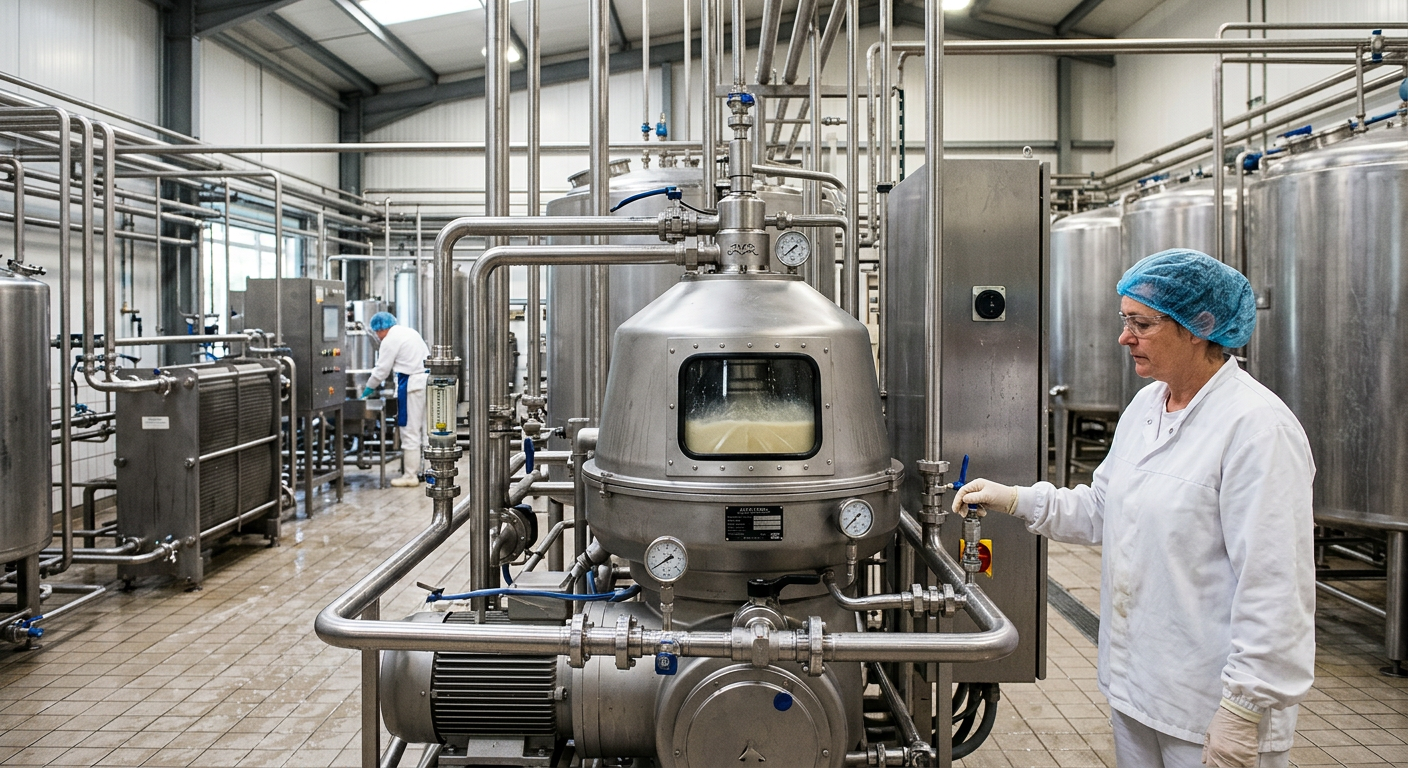
Centrifugal Separation in Beverage and Dairy Processing
[trp_language language=”en_US”]
Centrifugal Separation for U.S. Dairy and Beverage Plants
Quick Answer

Centrifugal separation is one of the most effective process technologies for beverage and dairy manufacturers in the United States when the goal is to remove solids, clarify liquids, recover valuable product, standardize fat content, and improve shelf stability without slowing production. In practical terms, dairies use centrifugal separators to split cream from skim milk, reduce bactofugation loads, polish whey streams, and improve consistency before pasteurization or downstream blending. Beverage plants use the same core principle for juice clarification, yeast recovery in brewing, kombucha and fermented drink cleanup, RTD base polishing, and removal of fine suspended solids that can interfere with filtration, filling, or flavor stability.
For U.S. buyers looking for actionable options, the most recognized suppliers commonly considered are Alfa Laval, GEA, SPX FLOW, Flottweg, Pieralisi, and HAUS. These companies are widely evaluated for sanitary centrifuges, disc-stack separators, decanters, and process support in North America. For engineering, layout integration, utilities, CIP strategy, and full plant execution, manufacturers often also need an experienced project partner that can connect separation equipment with tanks, piping, controls, pasteurization, automation, and commissioning. Qualified international suppliers, including Chinese manufacturers with appropriate U.S.-relevant sanitary documentation, material traceability, and strong pre-sales and after-sales support, can also be worth considering, especially when cost-performance is a priority and lead times are competitive.
How Centrifugal Separation Works in Beverage and Dairy Processing

Centrifugal separation uses high rotational force to separate materials of different densities much faster than gravity settling. In dairy applications, that usually means separating milk into cream and skim fractions, clarifying raw milk, reducing microbial load in selected streams, and recovering fat or solids that would otherwise be lost. In beverage processing, it often means removing pulp, sediment, yeast, protein haze, or fermentation solids while maintaining continuous throughput. Compared with simple settling tanks, centrifugal systems occupy less floor space, respond better to high-volume production, and provide tighter control over product consistency.
In U.S. plants from California to Wisconsin to North Carolina, sanitary centrifugal systems are usually selected not as stand-alone machines but as part of a broader process chain. Their performance depends on upstream tank design, flow balancing, feed temperature, viscosity, solids load, CIP chemistry, automation logic, and downstream packaging requirements. A brewery recovering yeast from conical fermentation, for example, will evaluate different design priorities than a yogurt processor standardizing cream or a juice manufacturer clarifying citrus blends before pasteurization. That is why specification must begin with the process objective, not just centrifuge capacity.
For beverage and dairy operators, the business case typically centers on four measurable outcomes: product yield, quality consistency, labor efficiency, and wastewater reduction. A well-specified disc-stack separator can raise recoverable product volumes, reduce filter loading, shorten cleaning events, and stabilize downstream filling. In dairy, standardized fat control improves label compliance and repeatable mouthfeel. In beverages, cleaner base liquid often improves brightness, flavor stability, and line performance.
United States Market Outlook

The U.S. market for centrifugal separation in food and beverage processing remains strong because processors are being pushed from multiple directions at once: higher labor costs, tighter quality targets, expanding RTD categories, demand for protein-rich dairy ingredients, and pressure to recover more saleable product from every batch. Plants near major dairy corridors such as Wisconsin, Idaho, California, and New York continue investing in cream separation, whey optimization, and hygienic automation. Beverage hubs in California, Texas, Illinois, North Carolina, and the Northeast are increasing demand for clarification systems that support juice, functional drinks, fermented beverages, and contract packaging.
Another market driver is plant modernization. Older facilities often rely on legacy separators that still run but consume more utilities, need more manual intervention, and integrate poorly with modern PLC and SCADA environments. As processors upgrade to continuous operations and higher sanitation standards, the separator becomes part of a digital process architecture rather than an isolated asset. That makes retrofit engineering, instrumentation, skid packaging, and remote support increasingly important in purchase decisions.
Sustainability is also reshaping buying priorities. U.S. processors want better product recovery, lower water consumption during cleaning, reduced chemical use, and lower energy per gallon processed. In dairy, this aligns with stronger attention to protein recovery and wastewater loading. In beverages, it supports better line utilization and reduced product giveaway. The result is a market that increasingly rewards suppliers and integrators who can quantify total cost of ownership rather than only quoting equipment price.
The line chart above illustrates a realistic growth pattern for centrifugal separation project activity in the U.S. food and beverage sector. The steady rise reflects expansion in dairy ingredients, co-packing, fermented beverages, and plant modernization programs. It also shows why buyers should plan capacity and utility integration early rather than waiting until clarification becomes a bottleneck.
Common Product Types
Not all centrifugal equipment serves the same purpose. Choosing the wrong type can create quality issues, unnecessary maintenance, or disappointing ROI. In beverage and dairy processing, buyers usually compare the following product categories.
| Equipment Type | Typical U.S. Use | Best For | Advantages | Limitations | Typical Buyers |
|---|---|---|---|---|---|
| Disc-stack separator | Milk skimming, juice clarification, yeast removal | Fine solids and liquid-liquid separation | High efficiency, compact footprint, sanitary designs | More sensitive to solids overload | Dairies, breweries, RTD plants |
| Decanter centrifuge | High-solids beverage waste, sludge, byproduct streams | Continuous solids handling | Handles heavier solids load well | Less precise for fine polishing | Large processors, wastewater-heavy plants |
| Cream separator | Milk fat standardization | Dairy fat separation | Purpose-built for dairy consistency | Narrower application range | Fluid milk, cheese, yogurt plants |
| Clarifier centrifuge | Raw milk cleanup, beverage polishing | Solid particle removal | Improves downstream filtration and filling | Not for strong liquid-liquid fractionation | Juice, tea, dairy, fermentation plants |
| Bactofuge-style system | Dairy microbial reduction support | Selective bacterial/spore reduction | Useful in premium dairy process control | Higher complexity and validation needs | Advanced dairy processors |
| Hybrid separator skid | Integrated clarification with automation and CIP | Turnkey projects | Faster site integration, clearer validation path | Higher upfront engineering scope | Co-packers, expanding plants |
This table shows why equipment selection should be tied to feed characteristics and business goals. A high-throughput juice processor with unstable solids loading may need a different solution than a dairy plant focused on fat standardization accuracy. Many U.S. processors benefit most from a packaged skid that includes valves, instrumentation, controls, and validated cleaning sequences rather than a bare machine delivered without system context.
Key Industries Using Centrifugal Separation
The strongest demand comes from sectors where product uniformity, sanitation, and continuous throughput matter. Dairy remains the anchor market, but beverage applications are broadening quickly as brands launch more functional, protein-enriched, fermented, and shelf-stable products.
The bar chart indicates where centrifugal separation creates the highest operational value today. Fluid dairy and cheese or whey processing remain especially strong because yield and composition control directly affect margins. RTD and functional beverages are also rising quickly because fine solids, protein haze, and shelf-life challenges require more advanced clarification than many legacy beverage lines were built to handle.
| Industry | Typical Separation Goal | Primary Product Benefit | Operational Benefit | Common U.S. Plant Locations | Special Notes |
|---|---|---|---|---|---|
| Fluid milk | Cream separation and standardization | Consistent fat content | Lower giveaway, tighter specs | Wisconsin, California, New York | Critical for label accuracy |
| Cheese and whey | Fat recovery and whey clarification | Higher solids recovery | Improved downstream efficiency | Idaho, Wisconsin, Minnesota | Strong ROI from recovery projects |
| Juice processing | Pulp and sediment removal | Brighter appearance | Reduced filter loading | California, Florida, Texas | Feed variation affects sizing |
| Brewing | Yeast recovery and beer clarification | Stable finished product | Faster tank turnover | Colorado, North Carolina, Oregon | Useful in high-throughput breweries |
| Kombucha and fermented drinks | Culture management and solids polishing | Cleaner finished beverage | Less packaging disruption | California, Washington, Texas | Requires careful process validation |
| RTD and functional beverages | Protein or botanical solids control | Better shelf stability | Higher filling reliability | Illinois, Georgia, North Carolina | Often paired with aseptic systems |
This table highlights the practical role of centrifugal systems across multiple categories. The key point is that the separator does not create value in isolation. It creates value when matched to product chemistry, sanitation rules, and packaging objectives in each sector.
Applications Across Beverage and Dairy Plants
Within a typical U.S. facility, centrifugal separation may appear at several process points. Raw milk plants may use it early for clarification and cream standardization. Cheese and cultured dairy operations often use it to recover fat from whey or support ingredient concentration steps. Beverage processors may install centrifugal systems after extraction, fermentation, blending, or before final polishing and packaging. In co-packing environments, flexibility is especially important because one line may run dairy-based beverages in one production window and shelf-stable functional drinks in another.
Common plant-level applications include:
- Milk skimming and fat standardization before pasteurization
- Whey polishing and valuable product recovery
- Juice and tea clarification before heat treatment or filling
- Brewer’s yeast recovery for throughput improvement
- Kombucha solids management for cleaner packaged product
- Protein beverage stabilization before aseptic filling
- Reduction of suspended solids to protect membranes and filters
- Byproduct handling and wastewater load reduction
When engineering these applications, processors should look beyond nominal flow rate. Residence time, feed temperature, shear sensitivity, viscosity swings, product loss during discharge, and cleaning intervals all affect performance. A separator that looks correct on a spec sheet can still underperform if it is not matched to the product window the plant actually runs.
Buying Advice for U.S. Processors
The best centrifugal separator purchase is rarely the cheapest machine. It is the system that delivers the lowest practical cost per gallon or per pound of finished product over years of operation. U.S. buyers should ask detailed questions in six areas: process fit, sanitary design, automation, maintainability, service reach, and integration risk.
Process fit means validating the expected feed stream, solids profile, viscosity, temperature range, and required separation outcome. Sanitary design means confirming wetted materials, surface finish, seal design, CIP compatibility, hygienic valve arrangements, and documentation that supports food safety programs. Automation includes local control panels, recipe management, alarms, interlocks, and how the separator exchanges data with plant PLC and SCADA systems. Maintainability includes bowl service intervals, spare parts availability, seal replacement complexity, training needs, and whether your maintenance team can support the asset in-house. Service reach matters because downtime in a beverage or dairy plant is expensive; local field support, remote diagnostics, and emergency parts access can outweigh a lower initial price. Integration risk includes skid layout, utilities, structural loading, tie-in shutdown planning, and operator training.
| Buying Factor | What to Check | Why It Matters | Risk If Ignored | Best Practice | Who Should Review |
|---|---|---|---|---|---|
| Feed characterization | Solids %, fat %, viscosity, temperature | Determines actual separator performance | Low yield or unstable clarity | Run pilot or sample validation | Process engineer, supplier |
| Sanitary compliance | Wetted materials, finish, hygienic design | Supports food safety and cleaning | Contamination or audit issues | Review documentation before PO | QA, engineering |
| Utility demand | Power, water, air, CIP chemicals | Impacts operating cost and retrofit scope | Unexpected installation cost | Map utility loads in advance | Plant engineering |
| Automation interface | PLC tags, SCADA, alarms, recipes | Enables repeatable operation | Manual workarounds, downtime | Define controls scope early | Controls team, integrator |
| Service support | Parts inventory, field tech access | Reduces downtime risk | Long outage during failure | Verify U.S. service footprint | Maintenance, procurement |
| System integration | Piping, tanks, valves, floor space | Ensures plant fit and startup success | Costly change orders | Use 3D layout and FAT/SAT planning | Integrator, owner’s rep |
This buying table is useful because it shifts the discussion from simple machine comparison to project success. In many U.S. plants, the hidden costs of integration and downtime exceed the quoted difference between two separator brands.
Leading Suppliers Serving the United States
The supplier landscape in the United States includes global equipment manufacturers, North American sanitary process specialists, and integration firms that package multiple technologies into a complete solution. The names below are commonly discussed by processors evaluating dairy and beverage centrifugal separation.
| Company | Service Region | Core Strengths | Key Offerings | Best Fit | Considerations |
|---|---|---|---|---|---|
| Alfa Laval | United States and global | Strong sanitary separation portfolio, established service network | Disc-stack separators, dairy skimming, beverage clarification, heat transfer support | Large dairy and beverage plants | Premium pricing is common |
| GEA | United States and global | Deep dairy process knowledge, integrated line capabilities | Separators, clarifiers, dairy systems, automation integration | Dairy ingredients, milk, cheese facilities | Complex projects may require longer planning cycles |
| SPX FLOW | North America | Broad sanitary processing expertise | Separation-related process solutions, pumps, valves, homogenization support | Plants wanting broader sanitary ecosystem compatibility | Scope varies by application and package |
| Flottweg | United States and global | Solid decanter expertise, robust solids handling | Decanters, separators, tricanters for difficult streams | High-solids recovery and byproduct streams | May be more than needed for simple polishing tasks |
| Pieralisi | North America through partners | Long centrifuge history, oil and industrial crossover knowledge | Separators and decanters for selected food uses | Processors comparing multiple centrifuge architectures | Application fit should be validated carefully |
| HAUS | U.S. projects via representatives | Value-oriented centrifuge options | Decanters and separation equipment for food applications | Cost-conscious projects with technical review | Support model should be confirmed before purchase |
This supplier table is designed for practical screening. It helps buyers narrow the field based on service coverage, process complexity, and support model. The strongest choice depends on whether the project is a stand-alone equipment replacement, a yield-improvement initiative, or a full plant integration program involving tanks, utilities, automation, and sanitary piping.
Supplier Comparison by Project Priority
Processors rarely compare suppliers on one dimension alone. The right decision often depends on whether your priority is yield, sanitation, service speed, capital efficiency, or ease of integration into an existing plant. The comparison below presents a realistic directional view that procurement and engineering teams can use for early discussions.
The area chart shows a major trend shift in the U.S. market: buyers are placing more value on automation, skid integration, and lifecycle support rather than simply buying the centrifuge itself. This is especially visible in new co-packing facilities, high-throughput dairy plants, and beverage facilities that run multiple SKUs.
The comparison chart is not a procurement scorecard, but it reflects how many U.S. buyers frame the market. Premium global brands usually lead in documentation depth, sanitary specialization, and process breadth, while qualified value-focused international suppliers can be attractive where budgets are tight, specifications are clear, and dependable support arrangements are in place.
Case Study Patterns Seen in U.S. Projects
Across beverage and dairy projects, the most successful centrifugal separation implementations follow the same pattern: a clearly defined process objective, early sample analysis, utility mapping, layout coordination, and realistic startup planning. In dairy, one common case is a processor trying to improve cream standardization accuracy while reducing product giveaway. Here the separator is paired with flow control, fat measurement discipline, and validated CIP sequences. In beverage, a common case is a co-packer dealing with product haze or sediment that creates filler interruptions. The separator then becomes part of a broader quality stabilization package that may include blending, filtration, pasteurization, and automation changes.
Another frequent pattern is recovery-driven investment. Cheese and whey plants often discover that small gains in fat recovery have an outsized effect on annual margin. Similarly, breweries and fermentation plants may justify centrifugal equipment because faster clarification supports more tank turns and better utilization of existing assets. These are not just engineering wins; they are throughput and profitability wins.
Manufacturers evaluating project partners should also look for documented experience in plant execution, not just equipment supply. A separation skid that arrives late, lacks the right controls philosophy, or conflicts with the plant’s CIP design can delay startup and erase expected savings. That is why many operators prefer integrators that understand both process technology and capital project delivery.
For examples of project execution approaches, buyers often review plant modernization and integration work such as the process examples shown in food and beverage project casework, additional implementation details in system integration examples, and broader delivery snapshots in processing facility case studies. Looking at project outcomes rather than brochures helps clarify whether a partner understands real plant constraints.
Local Supplier and Service Considerations
For U.S. processors, local support is often decisive. A separator installed in a dairy plant in Wisconsin or a beverage facility near Charlotte, Los Angeles, or Dallas must be supported by technicians, parts access, startup planning, and documented cleaning procedures. Buyers should verify where service technicians are based, whether spare parts are stocked domestically, how quickly emergency response can be dispatched, and whether remote troubleshooting is available for controls and process alarms.
It is also smart to consider the broader plant ecosystem. A separator may interact with pasteurizers, homogenizers, heat exchangers, utility skids, fermentation vessels, blending systems, and filler supply loops. If your supplier or integrator cannot own the interface points, internal engineering teams may end up bridging the gaps. For expanding U.S. co-packers and mid-market processors, that can become the biggest source of delay.
Our Company
Disruptive Process Solutions brings a different advantage to centrifugal separation projects in the United States because it operates as a full-scope food and beverage engineering partner rather than a remote equipment reseller. From its headquarters in Cary, North Carolina and West Coast presence in Lake Forest, California, DPS supports manufacturers across all 50 states and Canada with design, installation, integration, and project management for complete process systems. That local operating footprint matters for U.S. buyers who need real project accountability, not just a machine quote. On the product and technical side, DPS works across sanitary food and beverage applications including dairy processing, dairy-based beverages, juice, kombucha, brewing, spirits, aseptic systems, filtration, clarification, pasteurization, homogenization, cream separation, controls, and full utility infrastructure, which means centrifugal separation can be specified in the context of the entire process line, including tanks, CIP, automation, PLC programming, SCADA, boilers, cooling, and piping. The company also manufactures selected branded process equipment and applies rigorous engineering oversight to meet FDA, USDA, SQF, and BRC project requirements, giving buyers confidence that material selection, fabrication standards, testing expectations, and documentation align with recognized North American processing benchmarks. In terms of cooperation models, DPS can support end users, co-packers, brand owners, distributors, regional partners, and multi-site manufacturers through flexible engagement structures ranging from feasibility studies and owner’s representative roles to turnkey design-build-manage delivery, equipment supply, integration, and general-contractor-led execution where licensed. Its approach is equally suited to major enterprise expansions and fast-turn problem solving for mid-sized regional plants. For local service assurance, DPS is physically present in the U.S., executes projects on site with vetted trade networks, provides online and field-based pre-sale and after-sale support, and has demonstrated that it protects client economics with honest technical guidance rather than pushing unnecessary capital spend. Buyers can learn more about the company’s operating model on the about DPS page and review its broader process equipment capabilities while assessing fit for separation, utility, and full-line integration work.
Future Trends Through 2026 and Beyond
Several trends are shaping centrifugal separation decisions in the U.S. market through 2026 and beyond. The first is smarter automation. Plants increasingly want separators tied into recipe management, automated cleaning validation, predictive maintenance alerts, and line-wide OEE dashboards. The second is sustainability-driven recovery. More processors are investing in separation not just to improve clarity but to recover proteins, fats, and saleable liquids that would otherwise become waste. The third is flexible production. Co-packers and beverage innovators want skids that can handle multiple formulations with faster changeovers and better data capture.
Policy and compliance trends also matter. Food safety documentation expectations continue to rise, and processors increasingly prefer equipment packages that simplify validation, traceability, and audit readiness. In parallel, water and energy intensity are becoming board-level concerns, especially in regions facing utility cost pressure or wastewater constraints. Separation technologies that reduce downstream filtration load, improve cleaning efficiency, or cut product loss will become more attractive as plants measure sustainability in financial terms.
Another notable trend is the rise of hybrid sourcing strategies. U.S. manufacturers are still drawn to established premium brands, but many are now open to evaluating qualified international suppliers if those suppliers can demonstrate sanitary design credibility, documentation, responsive support, and integration compatibility. That creates opportunities for cost-performance procurement, particularly in secondary lines, expansion projects, and applications where the process window is well understood.
Frequently Asked Questions
What is the main advantage of centrifugal separation in dairy plants?
The main advantage is rapid, precise separation of components with different densities, especially for cream separation, fat standardization, and product recovery. It improves consistency, yield, and process control while supporting high-throughput sanitary operation.
How is beverage clarification different from dairy separation?
Beverage clarification often focuses on removing suspended solids, yeast, pulp, or haze-forming particles, while dairy separation more often involves fat fractionation, microbial load reduction support, and recovery of valuable dairy solids. The machine type may be similar, but process targets differ.
Should a U.S. processor buy only from a major global brand?
Not necessarily. Major brands often offer stronger documentation and broader support, but qualified international suppliers can make sense when the specification is clear, total cost matters, and service arrangements are dependable. What matters most is verified process fit and support responsiveness.
When is a turnkey integration partner more valuable than a machine supplier?
A turnkey integration partner is especially valuable when the project involves piping, CIP, tanks, utilities, controls, layout redesign, structural changes, or startup sequencing across multiple process systems. That is common in dairy expansions and beverage co-packing facilities.
Can centrifugal separation reduce wastewater costs?
Yes. By recovering usable product and reducing solids loading to drains or downstream treatment, a properly designed system can reduce wastewater burden and improve overall plant sustainability economics.
What should be tested before final equipment selection?
Processors should validate feed composition, solids loading, temperature range, viscosity, target clarity or recovery, expected CIP cycles, and how the separator responds to the full operating range rather than only best-case product conditions.
[/trp_language]
Complete Company Portfolio
About the Author: Disruptive Process Solutions (DPS)
The DPS team combines process engineering expertise with real-world food and beverage manufacturing experience. Our content focuses on process optimization, production efficiency, facility improvements, and practical solutions that help manufacturers operate more effectively in a rapidly evolving industry.
Share