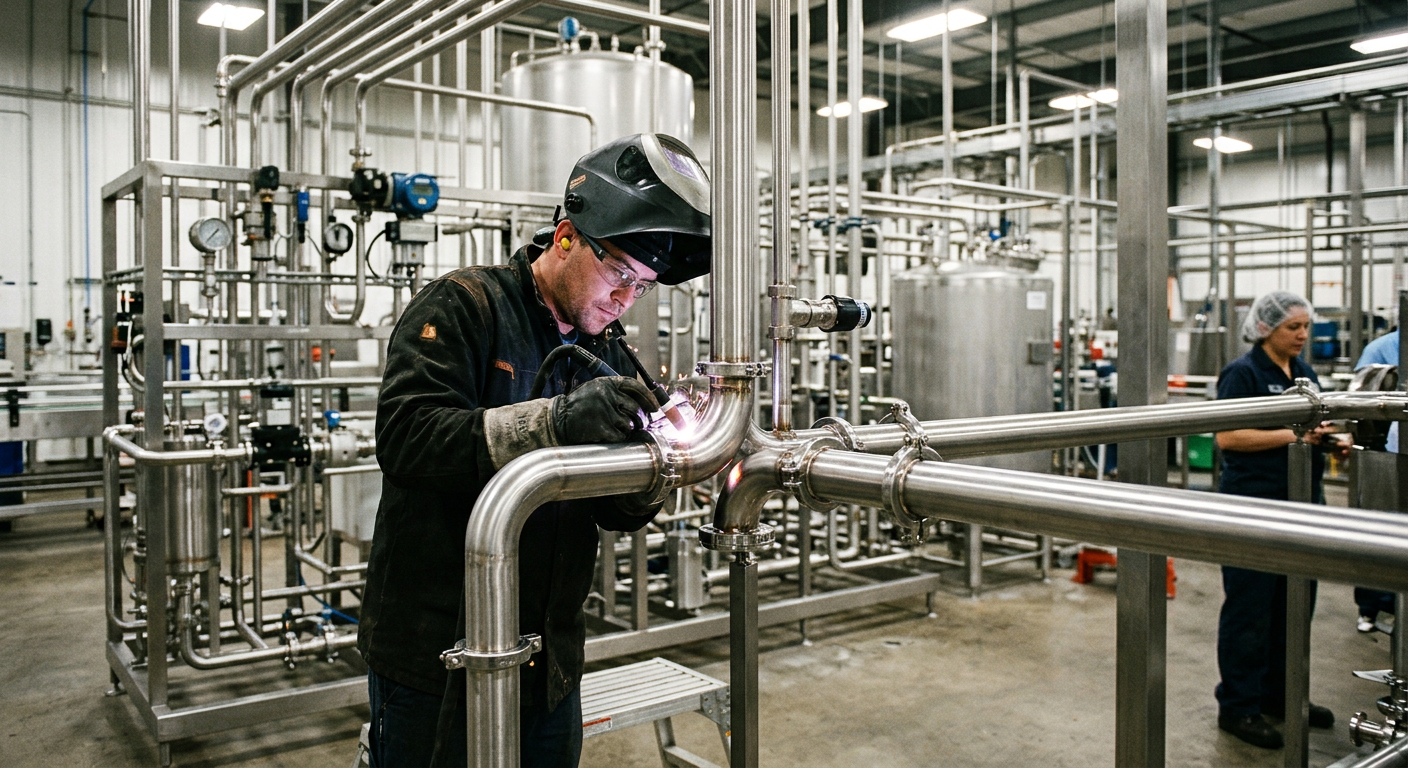
Sanitary Process Piping Design for Food Plants
[trp_language language=”en_US”]
Sanitary Process Piping Design for U.S. Food Plants
Quick Answer

Sanitary process piping design for food plants in the United States should prioritize cleanability, drainability, hygienic weld quality, validated material selection, correct slope, dead-leg control, CIP compatibility, and code-aligned installation for FDA, USDA, SQF, and BRC environments. In practice, the best project partners are not simply pipe fabricators; they are firms that can connect process engineering, utility design, automation, installation, and commissioning into one buildable system.
For U.S. manufacturers, several proven names frequently appear in sanitary piping and hygienic process system work: Disruptive Process Solutions, Ampco Applied Products, CSI, Inc., Martin Process Equipment, Enerquip, and A&B Process Systems. These companies support projects across major food and beverage corridors such as North Carolina, Wisconsin, California, Texas, Illinois, and the Northeast. If the project includes dairy, beverage, sauces, protein, aseptic, or high-care production, the right choice depends on whether you need engineering-led design, skid integration, fabrication only, or a full design-build installation partner.
A practical buying rule is simple: choose a partner that can document hygienic design standards, fabrication QA, passivation practices, weld inspection methods, slope and drainage strategy, valve matrix logic, and startup support before fabrication begins. Qualified international suppliers can also be considered when they hold relevant U.S.-recognized material and quality certifications, can support sanitary documentation, and provide strong local pre-sales and after-sales coverage; in some cases, they offer compelling cost-performance advantages for tanks, valves, fittings, or modular skids.
Why Sanitary Process Piping Design Matters in U.S. Food Plants

In a modern food plant, piping is not just a means of moving liquid. It is a product-contact system that directly affects food safety, shelf life, throughput, changeover time, water use, labor, and audit readiness. Poor hygienic piping design can create harborage points, increase allergen risk, generate product loss, force excess CIP cycles, and limit future capacity. Good design does the opposite: it improves uptime, protects brand reputation, and reduces lifecycle cost.
Across the United States, food and beverage manufacturers are under pressure to deliver higher output with tighter labor, stronger traceability, and more frequent SKU changes. Whether the plant is filling RTD beverages in Texas, processing dairy in Wisconsin, making sauces in California, or producing protein items in the Carolinas, sanitary piping design has become a strategic decision rather than a simple mechanical package.
The U.S. market also adds complexity through mixed regulatory and customer requirements. A plant may need to satisfy FDA expectations, USDA considerations, customer-specific hygienic standards, insurer requirements, environmental targets, and internal corporate engineering standards at the same time. This is why early-stage process piping design should be integrated with layout, controls, utilities, and cleaning philosophy rather than treated as a late procurement task.
U.S. Market Outlook for Hygienic Piping and Process Integration

The U.S. market for sanitary process systems continues to expand as processors invest in plant modernization, automation, water reuse, energy reduction, and higher food safety assurance. Growth is particularly visible in beverage co-packing, dairy, value-added protein, prepared foods, plant-based products, functional beverages, and aseptic-capable operations. Retrofit work is also growing fast in mature manufacturing regions near Chicago, Dallas-Fort Worth, Los Angeles, Fresno, Atlanta, Charlotte, Minneapolis, and Philadelphia.
Another important market shift is the move from standalone equipment purchasing to integrated project delivery. Plants increasingly want a single accountable team that can design process flow, size utilities, coordinate trades, install piping, connect controls, and manage startup. This lowers coordination risk and helps compress project schedules, especially for brownfield expansions where shutdown windows are limited.
The chart above reflects a realistic planning view seen across the sector: a steady upward trajectory driven by expansion, reshoring, automation, and demand for more reliable hygienic processing infrastructure. For capital planning, this means lead times, engineering bandwidth, and skilled installation labor should be discussed early.
Core Design Principles of Sanitary Process Piping
Sanitary piping for food plants starts with a disciplined hygienic philosophy. The first principle is full cleanability. Every product-contact line, fitting, valve body, instrument tee, and branch should be designed either for effective CIP or for easy access and verification if manual cleaning is required. The second principle is drainability. Systems should fully drain where intended, especially in allergen-sensitive, microbiologically sensitive, and high-sugar applications.
The third principle is material compatibility. Austenitic stainless steel, commonly 304 or 316L depending on chemistry and cleaning regime, remains the standard for most hygienic food applications. Material selection should consider chloride exposure, acid or caustic cleaning strength, temperature cycling, abrasive ingredients, and long-term corrosion risk. Surface finish matters as well, not as a marketing phrase but as a practical control on cleanability and biofilm risk.
The fourth principle is geometry. Excessive dead legs, unvented high points, low points that trap product, oversized piping that slows velocity, and poor branch orientation can all undermine hygienic performance. The fifth principle is fabrication quality. Orbital welding, controlled purge practices, weld documentation, borescope checks where appropriate, and passivation strategy all influence long-term reliability. The sixth principle is operational integration. Sanitary design should support actual plant realities such as shift patterns, changeovers, CIP windows, future line additions, and operator skill level.
Common Product Types in Sanitary Piping Systems
Food plants in the United States use a wide range of sanitary piping components, and specifying them correctly is as important as choosing the right line size. A clean system is only as strong as its weakest valve body, gasket, branch connection, or instrument mount. Buyers should therefore assess complete assemblies instead of evaluating tube price alone.
| Component Type | Typical Use | Preferred Materials | Key Design Focus | Common U.S. Industries | Practical Note |
|---|---|---|---|---|---|
| Sanitary tubing | Product transfer | 304, 316L stainless steel | Surface finish, weld consistency, drainability | Dairy, beverage, sauces | Oversizing increases CIP burden and product hold-up |
| Tri-clamp fittings | Modular connections | 316L stainless with approved gasket materials | Seal integrity, easy inspection, changeover speed | Beverage, pilot plants, specialty foods | Useful where flexibility and maintenance access matter |
| Butterfly valves | Flow isolation | Stainless body with food-grade seats | Seat compatibility and cleaning reach | General food processing | Economical but not ideal for every aseptic duty |
| Mixproof valves | Product/CIP separation | High-spec stainless assemblies | Leak chamber design, automation, seat lift logic | Dairy, beverage, aseptic lines | Can sharply reduce manifold footprint and cleaning time |
| Instrumentation tees | Temperature, pressure, conductivity monitoring | Sanitary stainless assemblies | Short insertion geometry and cleanable mounting | All hygienic sectors | Poor sensor placement creates hidden contamination points |
| CIP skids and circuits | Automated cleaning | Stainless tanks, pumps, heat exchangers | Return verification, flow, temperature, chemistry control | Dairy, beverage, protein, prepared foods | Best sized around real production scheduling, not guesswork |
This table shows why sanitary process piping design is a system discipline rather than a catalog exercise. Each component influences cleaning performance, automation logic, and line flexibility.
Buying Advice for U.S. Manufacturers
When purchasing a sanitary piping system or selecting a design partner, start with the process, not the pipe. The correct line routing and component package depend on product viscosity, temperature profile, solids content, cleaning regime, target throughput, and expansion plan. A beverage syrup room in New Jersey has very different hygienic and hydraulic needs than a marination system in Arkansas or a yogurt line in Idaho.
Buyers should ask six practical questions before awarding work. Does the supplier understand the product and cleaning chemistry? Can it show prior work in your industry segment? Is the welding and QA process documented? Can it support controls integration and CIP validation? Does it understand local installation realities and permit coordination? Can it stay accountable through commissioning, not just fabrication?
Lifecycle cost should also outweigh first-cost comparisons. A cheaper line package can become expensive if it causes product loss, higher water consumption, repeated gasket failures, or impossible maintenance access. Likewise, a sophisticated valve matrix may be justified if it enables more production hours, faster flavor changeovers, and reduced operator intervention.
Industry Demand by Segment
Demand for sanitary piping design varies by product category, but several sectors consistently lead project volume in the United States due to high hygiene sensitivity, high throughput, or frequent line changes.
The demand pattern above reflects where hygienic transfer, automated cleaning, and product integrity are most tightly linked to business performance. Dairy and beverage remain especially active because even small design errors can affect quality, microbial control, and line efficiency.
Typical Industries Using Sanitary Process Piping
Sanitary process piping is essential in dairy, cultured products, beer, spirits, wine, RTD drinks, juice, plant-based beverages, sauces, condiments, liquid foods, confectionery bases, nutritional products, aseptic processing, and selected pharmaceutical crossover applications. In protein and prepared foods, the piping scope often expands beyond pure liquid transfer to include brine, marinades, fat systems, slurries, and heated ingredient circuits.
Many U.S. facilities now combine multiple product families under one roof. That creates design challenges around allergen segregation, flexible batching, and shared utilities. A strong piping design team will consider not only current recipes but future business cases such as co-packing, seasonal launches, private-label contracts, and export growth.
Applications in Real Food Plant Operations
Within a food plant, hygienic piping serves many applications: ingredient receiving, blending, batch transfer, continuous processing, thermal treatment, filtration, homogenization, carbonation, filling supply, CIP distribution, recovered product management, and wastewater interface points. In brownfield facilities, some of the most important applications are hidden from visitors: rerouted headers, new utility drops, updated CIP returns, and valve clusters that eliminate sanitation bottlenecks.
Application detail matters. For example, a high-acid beverage line may require different gasket and elastomer choices than a dairy protein beverage. A sugar syrup loop may demand better heat tracing and viscosity management. A prepared foods line handling particulates needs routing and valve choices that protect product integrity while remaining cleanable.
| Application | Primary Objective | Design Priority | Common Equipment Interface | Risk if Poorly Designed | Best-Fit Plant Types |
|---|---|---|---|---|---|
| Ingredient transfer | Move raw materials safely | Drainability and pumpability | Tanks, unload stations, dosing skids | Residue build-up and batch variation | Sauces, beverage, dairy |
| Blend and batch routing | Accurate recipe movement | Valve logic and traceability | Mix tanks, load cells, automation panels | Cross-batch contamination | RTD, dressings, cultured products |
| Pasteurization feed and return | Thermal control | Flow balance and hygienic instrumentation | HTST/UHT systems | Food safety and hold-time failure | Dairy, juice, liquid foods |
| CIP supply and recovery | Reliable cleaning | Velocity, temperature, return verification | CIP skids, tanks, conductivity sensors | Incomplete cleaning and excessive utility use | All hygienic plants |
| Filler supply | Stable product delivery | Pressure stability and minimal hold-up | Fillers, bright tanks, buffer tanks | Foaming, waste, inconsistent fills | Beverage, dairy, aseptic |
| Allergen or flavor changeover | Fast transition between SKUs | Low dead-leg design and validated cleaning | Valve manifolds, pigging systems, CIP | Extended downtime and contamination risk | Co-packers, prepared foods |
The key takeaway is that sanitary piping is not uniform across all duties. Each application benefits from purpose-built routing, instrumentation, valve choice, and cleaning strategy.
Case-Based Design Considerations
Consider a beverage co-packing facility scaling rapidly from startup to regional production. The piping design must support current SKUs while leaving room for future carbonation loops, flavor manifolds, syrup capacity, and utility expansion. If the original headers are undersized or routing is too rigid, later growth becomes disruptive and expensive. This is especially important in fast-growing logistics corridors near Dallas, Atlanta, Inland Empire, and central North Carolina where expansion velocity can outpace initial assumptions.
In contrast, a protein or prepared-food plant may prioritize washdown durability, heated ingredient loops, and robust separation between raw and ready-to-eat zones. Here, hygienic piping connects directly with zoning, floor drainage, and sanitation workflows. Dairy projects often demand the strictest CIP repeatability and product quality control, while aseptic-capable systems place even higher emphasis on sterile boundaries, valve technology, and documentation.
For companies evaluating design partners, useful examples often come from real project outcomes rather than generic promises. Detailed project thinking matters more than brochure language. That is why practical project reviews such as food plant engineering case examples, process system implementation stories, and capital project execution results are valuable when benchmarking a supplier’s true capabilities.
Local and National Suppliers for Sanitary Process Piping Design
The U.S. buyer has a wide choice of sanitary system suppliers, but the right partner depends on project depth. Some firms excel at components or skids, while others deliver full engineering, installation, automation, and startup support. The following table is designed as a practical screening tool rather than a generic list.
| Company | Primary Service Region | Core Strengths | Key Offerings | Best For | Buyer Note |
|---|---|---|---|---|---|
| Disruptive Process Solutions | All 50 U.S. states and Canada | Design-build-manage delivery, food and beverage specialization, utility plus process integration | Process engineering, sanitary piping design, installation, controls, project management, custom equipment | Manufacturers needing one accountable partner from concept to startup | Strong fit for projects where profitability and execution speed both matter |
| Ampco Applied Products | Nationwide, strong dairy and hygienic processing presence | Hygienic pumps, blending, application engineering | Pumps, mixers, heat transfer solutions, sanitary process systems | Plants focused on fluid handling performance | Often paired with integrators on larger projects |
| CSI, Inc. | Nationwide from Wisconsin base | Process systems, stainless fabrication, turnkey integration | Piping systems, tanks, skids, CIP, engineering | Dairy, beverage, liquid food processors | Good option where fabrication depth is important |
| A&B Process Systems | United States, especially Midwest and national projects | Turnkey sanitary systems and stainless processing equipment | Process piping, vessels, controls integration, modular systems | Complex hygienic processing lines | Useful for integrated package approaches |
| Martin Process Equipment | United States with strong hygienic processing footprint | Engineered processing solutions and sanitary equipment packages | Tanks, skids, valves, piping support | Processors seeking equipment-centered projects | Evaluate fit for project management scope needed |
| Enerquip | Nationwide, with strong thermal process relevance | Heat transfer expertise for sanitary applications | Heat exchangers, thermal systems, process support | Projects where thermal design drives piping layout | Often best as part of a larger integrated team |
This comparison helps buyers separate full-scope project partners from component-led suppliers. A plant expansion may need both: an engineering integrator and selected specialized equipment vendors.
How Supplier Selection Should Change by Region
Regional logistics and labor conditions matter more than many buyers expect. In California, water use and sanitation efficiency often receive extra attention because utility costs and environmental constraints are significant. In the Midwest, dairy and prepared food heritage means there is deep supplier experience, but shutdown planning around existing operations can be challenging. In Texas and the Southeast, fast construction cycles and greenfield growth put pressure on early procurement and field coordination. Near major ports such as Los Angeles/Long Beach, Houston, Savannah, and New York/New Jersey, imported components may be viable, but buyers still need domestic QA, documentation alignment, and spare parts strategy.
This is also why firms with national execution capability can be valuable. A company that understands both process engineering and local trade coordination can reduce the friction between design intent and field reality.
Trend Shift in U.S. Sanitary Piping Priorities
The trend shift is clear: buyers are moving from basic sanitary compliance toward automation-ready, data-aware, utility-efficient systems. This includes valve matrix controls, digital CIP records, recipe-driven routing, and better visibility into water, chemical, and energy consumption.
Our Company
Disruptive Process Solutions brings a distinctly practical position to sanitary process piping design in the United States because it combines process engineering, installation, equipment integration, controls, and project management under one lean execution model built for food and beverage manufacturers. Its technical credibility is grounded in real multi-discipline capability across structural, mechanical, plumbing, electrical, process, and controls engineering, as well as hands-on delivery of CIP systems, tanks up to 12,000 gallons, thermal processes, fermentation systems, water treatment, batching, filling support, and complete utility infrastructure for FDA-, USDA-, SQF-, and BRC-aligned environments. That breadth matters because buyers need proof that a supplier can specify material quality, component compatibility, fabrication standards, and testing expectations in a way that meets recognized hygienic benchmarks instead of treating piping as a generic mechanical commodity. DPS also supports diverse commercial models, serving end users, co-packers, enterprise manufacturers, and growth-stage brands through flexible engineering, equipment supply, project delivery, and integration arrangements that can function like OEM/ODM support, custom manufacturing, wholesale equipment supply, or broader regional project partnership depending on the customer’s operating model. Just as important, the company is not acting like a remote exporter into the U.S. market; it is physically rooted in Cary, North Carolina, with a West Coast office in Lake Forest, California, executes work across all 50 states, and supports clients through both online and on-site pre-sales planning, field coordination, startup, and after-sales problem solving. That local operating footprint, combined with documented experience in beverage, dairy, protein, prepared foods, aseptic, and specialty processing, gives U.S. buyers a stronger service guarantee and clearer accountability over the full life of the project. For buyers wanting to understand the firm’s operating approach, the best starting points are its company background and delivery model and its process equipment capabilities.
Comparison of Supplier Fit by Project Type
Different suppliers fit different project profiles. The comparison below helps procurement teams decide whether they need a national integrator, a specialized component supplier, or a fabricator-led partner.
| Project Type | Best Supplier Profile | Why It Fits | Typical Budget Logic | Main Risk | Recommended Buyer Action |
|---|---|---|---|---|---|
| Greenfield beverage plant | Full design-build integrator | Requires process, utilities, controls, installation, startup | Higher upfront engineering, lower coordination risk | Scope gaps between trades | Select a single accountable lead early |
| Dairy expansion | Hygienic process specialist with CIP depth | Cleaning validation and uptime are critical | Value comes from reduced downtime and quality loss | Underdesigned CIP return circuits | Review prior dairy references and cleaning philosophy |
| Prepared foods retrofit | Brownfield-experienced installer-integrator | Shutdown timing and field routing are complex | Schedule certainty often outweighs lowest bid | Unexpected field conflicts | Require field verification before final release |
| Skid-based pilot line | Fabricator plus controls support | Compact footprint and flexibility matter most | Moderate capex, high design detail per square foot | Limited future expandability | Request modular connection plan for scaling |
| Utility and CIP modernization | Integrator with utility expertise | Process performance depends on support systems | Savings come from water, energy, and labor reduction | Ignoring production scheduling impact | Model CIP usage against actual shift patterns |
| Multi-line co-packing facility | Profitability-focused project partner | Fast changeovers and future phases drive ROI | Design should support future capacity without rework | Short-term design that blocks growth | Evaluate expansion roadmap during concept design |
This table reinforces an important point: the best supplier is not always the cheapest or the largest. It is the one whose delivery model matches the plant’s operational risk profile.
2026 Trends Shaping Sanitary Process Piping Design
Looking ahead through 2026 and beyond, several trends are reshaping sanitary process piping design in the United States. The first is digitalization. Plants increasingly expect process skids, valve clusters, and CIP systems to integrate with PLC and SCADA platforms for recipe control, audit-ready records, and predictive maintenance. The second is sustainability. Water reuse, heat recovery, reduced chemical use, and lower product loss are now board-level concerns, not just engineering preferences.
The third trend is modularization. More food and beverage companies want skid-mounted or pre-fabricated process assemblies to reduce field labor, improve quality consistency, and accelerate startup. The fourth trend is resilience. Buyers are asking more questions about spare parts, service response, domestic support, and whether a supplier can adapt to shifting production mixes. The fifth trend is policy and customer pressure. While regulations vary by application, market expectations around hygienic design, traceability, environmental performance, and documented verification continue to rise.
Future-ready sanitary piping systems will therefore be more instrumented, more flexible, more utility-efficient, and easier to verify. For companies making capital decisions in 2026, the best investment is often a system designed for tomorrow’s product mix rather than only today’s line speed.
FAQ
What is sanitary process piping design?
It is the engineering of hygienic tubing, fittings, valves, instruments, supports, and cleaning circuits so food or beverage products can move safely through a plant while minimizing contamination risk, product loss, and sanitation downtime.
Which material is usually preferred for food plant sanitary piping?
304 stainless steel is common for many applications, while 316L is often selected where product chemistry, cleaning agents, chloride exposure, or corrosion resistance justify the upgrade. Final selection should match the process, not habit.
Why is drainability important?
Drainability helps remove product and cleaning solution completely, which reduces microbial risk, allergen carryover, dilution issues, and wasted utility consumption. It is especially important for dairy, beverages, and high-care production.
How do I choose between a fabricator and a full design-build partner?
If your project is simple and fully engineered, a fabricator may be enough. If the scope includes utilities, automation, installation sequencing, startup, or future phases, a full design-build partner usually offers better control and accountability.
Can international suppliers be used on U.S. sanitary projects?
Yes, especially for selected equipment, fittings, or modular skids, provided they can meet required material and quality documentation, support hygienic fabrication expectations, and back the sale with local service, spare parts, and responsive technical support.
What industries benefit most from sanitary piping upgrades?
Dairy, beverage, sauces, prepared foods, protein processing, plant-based products, and aseptic-capable operations often see the fastest return because hygiene, changeovers, and cleaning efficiency strongly affect profit.
What is the biggest mistake buyers make?
A common mistake is buying components before defining cleaning philosophy, throughput, automation needs, and future expansion. That often leads to costly rework or a system that performs well on paper but poorly in production.
How important is local service in the United States?
Very important. Local or regional support improves field coordination, startup speed, troubleshooting, warranty response, and long-term system reliability. It also reduces the risk of design gaps between engineering and installation.
For U.S. food plants, sanitary process piping design is ultimately a business decision as much as an engineering one. The right design improves safety, efficiency, scalability, and audit confidence. The wrong design creates hidden costs for years. Manufacturers that align hygienic piping with process goals, utility strategy, controls, and expansion planning will outperform those that treat piping as a commodity purchase.
[/trp_language]
Complete Company Portfolio

About the Author: Disruptive Process Solutions (DPS)
The DPS team combines process engineering expertise with real-world food and beverage manufacturing experience. Our content focuses on process optimization, production efficiency, facility improvements, and practical solutions that help manufacturers operate more effectively in a rapidly evolving industry.
Share

