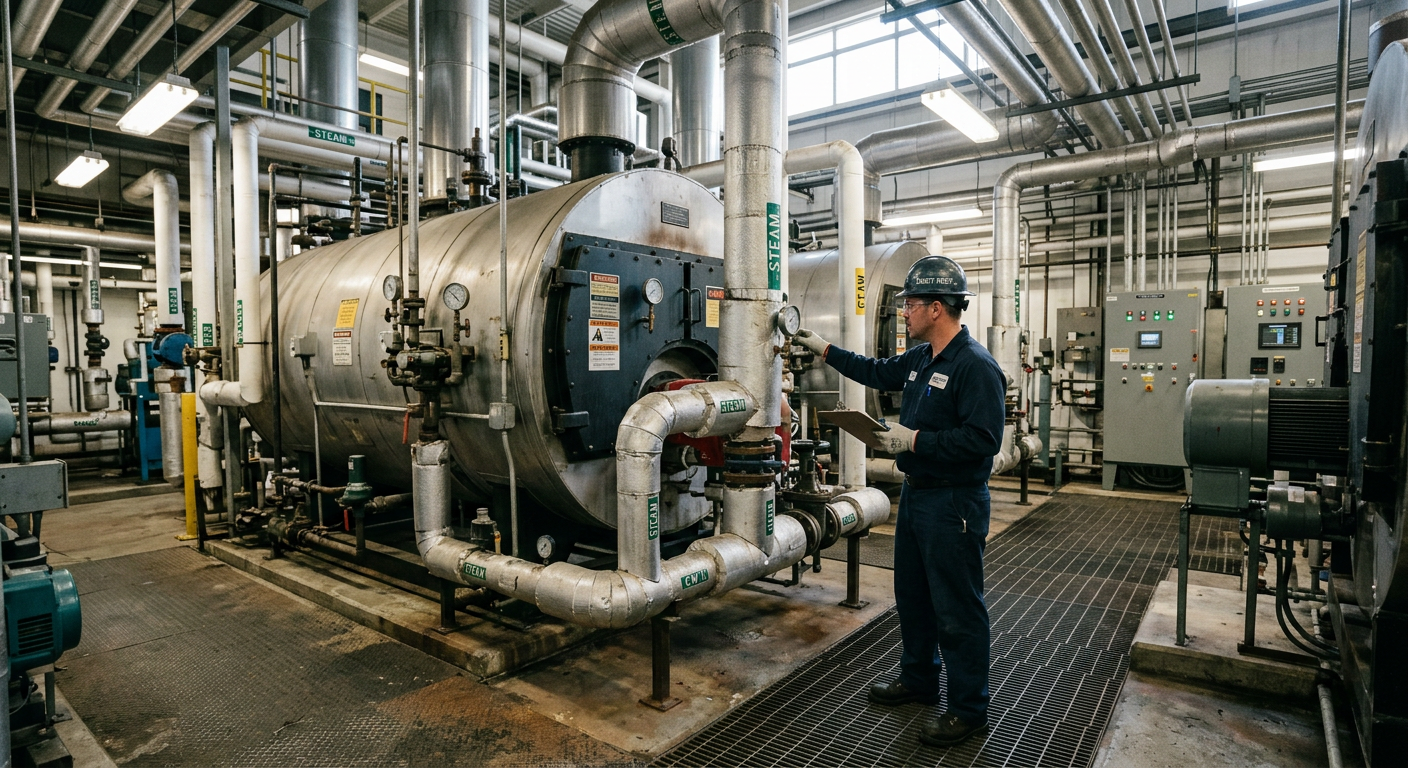
Boiler and Steam System Design for Food and Beverage Plants
[trp_language language=”en_US”]
Boiler Steam System Design for Food and Beverage Plants in the United States
Quick Answer

A boiler steam system food plant in the United States should be designed around product safety, stable pressure, condensate recovery, sanitary distribution, energy efficiency, and code compliance. For most food and beverage plants, the right solution is not simply choosing a boiler; it is building a complete steam architecture that matches process loads such as cooking, blanching, pasteurization, CIP, tank heating, humidification, and building heat while protecting uptime and product quality.
For practical sourcing and project execution in the U.S., proven companies frequently considered include Miura America, Fulton, Cleaver-Brooks, Clayton Industries, Parker Boiler, and Indeck, depending on whether the plant needs modular low-NOx units, rapid-start steam generation, packaged firetube systems, or custom utility integration. In major food manufacturing corridors such as the Midwest, Texas, California, the Carolinas, and the Northeast, buyers often prefer suppliers and integrators that can support permitting, controls, water treatment, and commissioning rather than only equipment sales.
For owners planning new plants or capacity expansions, the most effective approach is to size the steam plant from real process demand, reserve capacity, maintenance strategy, and future SKUs instead of using a generic pounds-per-hour estimate. Qualified international suppliers can also be considered when they hold relevant U.S.-recognized certifications and provide strong local pre-sales and after-sales support, especially where cost-performance is a deciding factor for utility packages, tanks, skids, and balance-of-system components.
Market Overview in the United States

The United States remains one of the largest and most diverse markets for food plant steam systems because steam is still central to thermal processing across dairy, beverage, protein, prepared foods, sauces, aseptic operations, and sanitation-intensive facilities. Even as electric heating, heat pumps, and hybrid thermal systems gain interest, steam remains the dominant utility where plants need high turndown, fast heat transfer, validated lethality, washdown readiness, and broad compatibility with kettles, heat exchangers, retorts, ovens, blanchers, and CIP sets.
Demand is especially strong in regional manufacturing hubs such as Chicago, Milwaukee, Minneapolis, Kansas City, Dallas-Fort Worth, Houston, Fresno, Modesto, Los Angeles, the Research Triangle, Atlanta, and the I-95 corridor where food and beverage capacity continues to shift closer to labor pools, co-packing clusters, cold-chain infrastructure, and major logistics routes. Port-linked production near Long Beach, Savannah, Houston, New York-New Jersey, and Norfolk also increases demand for reliable steam utilities in export-oriented and ingredient processing operations.
In the current market, buyers are under pressure to reduce fuel consumption, manage water use, lower emissions, and improve labor efficiency. That has pushed more projects toward high-efficiency burners, O2 trim, economizers, deaeration upgrades, condensate recovery, digital controls, remote monitoring, and modular boiler room layouts that reduce downtime during maintenance or expansion. At the same time, insurers, AHJs, and plant quality teams are requiring better documentation for pressure vessel compliance, safety valves, feedwater treatment, and operating procedures.
For food and beverage manufacturers, the market is no longer just about buying a boiler at the lowest price. The winning projects are usually engineered around total lifecycle performance: steam quality at the point of use, operator simplicity, spare parts access, emissions permitting, redundancy strategy, and integration with production plans. That is why experienced engineering partners increasingly influence purchasing decisions alongside plant managers and procurement teams.
The line chart above illustrates a realistic growth pattern for steam-system-related capital projects in U.S. food and beverage manufacturing. The increase reflects plant modernization, fuel-efficiency upgrades, greenfield beverage and co-packing builds, and tighter compliance expectations.
What a Food Plant Steam System Must Achieve

A good boiler steam system food plant design must do more than generate steam. It must deliver the correct steam quality and pressure to each use point, maintain stable operation during production swings, protect sanitary processes, support maintenance access, and minimize waste in blowdown, flash steam, and condensate losses. In practical terms, the system should be engineered as a network with several linked layers:
- Boiler generation sized for peak, average, startup, and future load
- Feedwater handling with treatment, storage, and deaeration
- Steam distribution headers with proper pressure zoning
- Point-of-use control packages for kettles, exchangers, ovens, and CIP
- Condensate return infrastructure and energy recovery
- Instrumentation, controls, alarms, and safety interlocks
- Documentation for ASME, local code, and food plant operating standards
Food plants often make the mistake of focusing only on boiler horsepower. In reality, the biggest operating problems usually come from wet steam, undersized headers, poor trap management, bad condensate routing, inconsistent feedwater quality, or lack of redundancy during sanitation and production overlap.
Common Product Types and System Architectures
Different food and beverage operations need different steam plant configurations. The table below compares common product types used in the U.S. market and explains where each one fits best.
| System Type | Typical Capacity Range | Best Fit Applications | Main Advantages | Key Limits | Typical U.S. Buyer Profile |
|---|---|---|---|---|---|
| Firetube packaged boiler | Low to high plant loads | Dairy, sauces, bakeries, prepared foods | Strong steam reserve, familiar maintenance, packaged design | Slower startup than once-through systems | Established plants wanting dependable central utility |
| Watertube boiler | Medium to very high loads | Large protein, ingredient, and multi-line plants | High pressure capability, fast response, scalable | Higher complexity and footprint considerations | Large industrial food campuses |
| Once-through steam generator | Small to medium modular loads | Beverage, pilot plants, flexible production sites | Rapid startup, compact footprint, modular redundancy | Application fit must be verified for load swings | Plants prioritizing efficiency and flexible shifts |
| Electric steam boiler | Small to medium niche loads | Urban plants, specialty food, low-emission projects | Low on-site emissions, quiet operation, easy control | Utility power cost and infrastructure may be limiting | Plants with sustainability or air permit constraints |
| Hybrid steam plant | Variable | Plants with mixed thermal loads and decarbonization goals | Operational flexibility, staged transition strategy | More integration engineering required | Forward-looking corporate manufacturers |
| Containerized or skid-mounted boiler room | Small to medium | Expansion projects, temporary capacity, fast deployment | Reduced site work, quicker installation, modular service | Site logistics and weatherproofing must be reviewed | Co-packers and fast-growth processors |
For most food plants, the right architecture combines multiple elements: a primary boiler or modular boiler bank, feedwater treatment, condensate return, blowdown management, steam pressure reduction stations, and local control skids near thermal process equipment.
Where Steam Is Used in Food and Beverage Plants
Steam remains one of the most versatile utilities in processing because it can be used directly or indirectly. In direct systems, culinary-grade or filtered steam may contact the product or product-contact surfaces under strict design rules. In indirect systems, steam transfers heat through jackets, coils, or heat exchangers. Each use case changes design choices for pressure, controls, and condensate handling.
| Industry Segment | Typical Steam Uses | Pressure Sensitivity | Sanitary Considerations | Peak Load Pattern | Design Priority |
|---|---|---|---|---|---|
| Dairy | Pasteurization, hot water generation, tank heating, CIP | High | Very high | Batch and washdown overlap | Stable control and sanitary utility separation |
| Brewing and beverages | Mash heating, brew kettle, syrup room, CIP, sterilization | Medium to high | High | Shift-based with cleaning spikes | Rapid response and modularity |
| Protein processing | Cooking, blanching, sanitation, rendering support | Medium | High | Heavy continuous loads | Rugged reliability and redundancy |
| Prepared foods | Kettles, ovens, jacketed mixers, retort support, CIP | High | High | Recipe-driven variation | Turndown and load matching |
| Sauces and dressings | Blend tank heating, cook systems, hot fill support | High | High | Batch operation | Precise temperature control |
| Aseptic and retort foods | Sterilization, retorts, hot water support, SIP functions | Very high | Very high | Mission-critical cycles | Validation, control integrity, documentation |
This table highlights why one standard boiler package does not fit every food facility. The steam utility must mirror the actual process profile of the line, not just the square footage of the building.
The bar chart compares relative steam demand intensity by segment. Retort, aseptic, and protein plants generally place the highest demands on central steam reliability, while beverage plants often emphasize rapid response and CIP timing.
Buying Advice for Plant Owners and Project Teams
When buying a steam system for a U.S. food or beverage facility, start with the production model, not the equipment catalog. That means mapping every thermal load, its pressure requirement, its cycle time, its concurrent demand, and its criticality to food safety and throughput. A plant that runs one shift with heavy cleanup has a very different profile from a 24/7 co-packer with retorts, syrup preparation, and future expansion plans.
Key buying questions should include:
- What is the true peak steam load during production plus sanitation overlap?
- What reserve margin is needed for growth, maintenance, or one-boiler-out conditions?
- Which loads require clean steam, filtered steam, or indirect heating only?
- How much condensate can realistically be recovered and reused?
- What water chemistry program is required for the local water source?
- Will local air permitting favor low-NOx burners, electric steam, or hybrid options?
- How will operators monitor pressure, fuel use, blowdown, and trap performance?
- What spare parts and service support are available within the region?
Buyers should also evaluate total installed cost, not only purchase price. In the U.S. market, expensive rework often comes from underdesigned stacks, poor venting, missing condensate infrastructure, weak controls integration, inaccessible maintenance layouts, and boilers selected without a realistic startup and turndown strategy. The most cost-effective systems over time are usually those with stronger engineering upfront.
Leading Local Suppliers and Integrators in the United States
The following suppliers are commonly considered by U.S. food and beverage plants. Some are equipment manufacturers, some are boiler room specialists, and some are stronger on integrated plant design. The best choice depends on whether you need a boiler, a full steam plant, a retrofit, or a complete process utility package.
| Company | Primary Service Region | Core Strengths | Key Offerings | Best Fit | Notes for Food Plants |
|---|---|---|---|---|---|
| Miura America | Nationwide U.S. | Modular once-through steam, fast startup, water treatment integration | Low-NOx boilers, monitoring, modular steam plants | Beverage, flexible manufacturing, multi-shift plants | Often selected for efficiency and quick response |
| Cleaver-Brooks | Nationwide U.S. | Broad packaged boiler portfolio, controls, burners, heat recovery | Firetube, watertube, burners, economizers, skid systems | Medium to large food plants | Strong choice for full boiler room scope |
| Fulton | Nationwide U.S. | Steam and thermal systems for industrial process users | Vertical and horizontal boilers, thermal fluid heaters | Food processors needing compact solutions | Useful where footprint matters |
| Clayton Industries | Nationwide U.S. and export | Steam generators, compact design, rapid response | Steam generators, heat recovery, hot water systems | Plants wanting compact utility layouts | Strong for high-performance modular concepts |
| Parker Boiler | Strong in Western U.S. | Compact industrial boilers and hot water systems | Steam boilers, hot water boilers, feedwater equipment | Small to mid-size plants | Frequently evaluated in California and nearby markets |
| Indeck | Nationwide U.S. | Large industrial boiler systems, custom projects, rentals | Packaged boilers, custom systems, temporary steam | Large upgrades and emergency capacity | Useful for major capital projects and contingency planning |
This supplier comparison is practical for first-pass screening. Final selection should still depend on local representative strength, service response time, emissions requirements, and how well the vendor supports control integration and commissioning.
Detailed Analysis of Supplier Selection Factors
Choosing among boiler and steam system providers requires looking beyond brand recognition. The real decision should balance process needs, utility philosophy, and operational risk. The comparison below helps buyers match supplier profiles to plant realities.
| Selection Factor | Why It Matters | Questions to Ask | Risk if Ignored | Best Evaluation Method | Typical Owner Priority |
|---|---|---|---|---|---|
| Steam load matching | Prevents oversizing and unstable cycling | Can the design follow batch and CIP swings? | Fuel waste and poor control | Load profile model | Very high |
| Service network | Reduces downtime when parts or technicians are needed | Who supports the plant in my region? | Extended outages | Check local reps and response commitments | Very high |
| Emissions compliance | Required for permitting in many jurisdictions | What burner and NOx package is included? | Permit delays or retrofit costs | Permit review with local specialists | High |
| Controls integration | Links boiler room data to plant operations | Can alarms and data be shared with SCADA? | Blind spots and manual workarounds | Controls scope review | High |
| Water treatment strategy | Protects boiler life and steam quality | What chemistry, pretreatment, and monitoring are required? | Scaling, corrosion, carryover | Water analysis and treatment plan | Very high |
| Expansion flexibility | Supports future SKUs and capacity growth | Can capacity be added without replacing the plant? | Early obsolescence | Phased master planning | High |
This framework is especially useful for manufacturers comparing standard packaged boiler quotes against broader design-build solutions. The lowest initial quote often excludes important risk items that later become owner costs.
The area chart shows the ongoing shift toward digitally monitored, higher-efficiency steam infrastructure. In food manufacturing, this trend is being driven by labor shortages, sustainability targets, insurance expectations, and the need for better uptime visibility.
Applications by Process Area
Within a single food plant, steam demand can vary sharply by process area. Understanding these differences helps engineers zone pressure correctly and avoid overcomplicating the entire system around one critical application.
In raw processing zones, steam often supports blanchers, cookers, smokehouses, or render support equipment. In formulation and batching zones, it commonly serves jacketed kettles, scraped-surface heat exchangers, blend tanks, and hot water loops. In packaging zones, it may support tunnel applications, sterilization support, or ancillary thermal functions. Utility and sanitation areas use steam for CIP generation, hot water systems, space heat, and humidification where needed.
For beverage plants, steam loads often concentrate in syrup rooms, brew houses, flash pasteurization support, bottle or can line sanitation, and centralized CIP. For dairy and aseptic facilities, steam integrity and control are even more critical because utility instability can directly affect validated processing windows.
Case-Based Design Lessons
Across the U.S. market, successful projects tend to follow several repeatable patterns. New co-packing plants usually benefit from modular boiler rooms that can expand in phases as contract volumes ramp up. Legacy dairy and prepared food plants often gain the most from condensate recovery upgrades, trap audits, and better pressure zoning before they replace the main boiler. Protein processors frequently prioritize rugged redundancy, operator simplicity, and washdown-friendly routing because downtime is expensive and plant environments are demanding.
A common lesson from failed projects is that utility rooms are designed too late. When boilers, feedwater systems, stacks, blowdown separators, and chemical feed packages are treated as afterthoughts, owners often face ceiling conflicts, poor service access, and longer startup schedules. In contrast, plants that integrate utility planning early can align steam loads with process expansion, sanitation timing, and future product mix.
Manufacturers looking for real-world project thinking can review examples such as food and beverage project case studies, where system-level planning matters more than standalone equipment selection. Similar insight can also be gained from expansion and relocation scenarios like integrated execution projects and complex plant delivery examples, especially when steam utilities are tied to broader production goals.
Our Company Perspective
Disruptive Process Solutions brings a practical U.S. market advantage to boiler and steam system food plant projects because it works as an engineering-led project partner rather than a catalog reseller. Founded in 2020 and operating from Cary, North Carolina, with a West Coast office in Lake Forest, California, DPS supports clients across all 50 states and Canada with integrated process, mechanical, plumbing, electrical, controls, and project execution capabilities. That footprint matters for local service assurance: buyers are not dealing with a remote exporter but with a team already active in U.S. food and beverage capital projects, including beverage utility infrastructure such as boilers, compressors, cooling towers, and complete process support systems. On product strength, DPS combines system design expertise with its own branded process equipment line, including tanks up to 12,000 gallons, custom CIP systems, marination tumblers, and cooking vessels, built to fit regulated food environments and integrated with strict project oversight, commissioning discipline, and compliance familiarity across FDA, USDA, SQF, and BRC expectations. On cooperation models, the company is structured to serve end users, co-packers, multi-site manufacturers, regional partners, and brand-led operators through flexible design-build-manage delivery, GC-led installation where licensed, GC-equivalent execution elsewhere, proprietary equipment supply, turnkey integration, and owner’s representative support. Buyers seeking long-term operating confidence can learn more about the DPS team and operating model and explore DPS equipment capabilities as part of a broader evaluation of plant utility and process integration partners.
How to Build a Better Steam Utility Strategy
For a new plant, start with a utility master plan that includes year-one capacity, year-three expansion, product mix changes, sanitation overlaps, and energy targets. For an existing plant, begin with a steam balance study. That study should map boiler output, pressure drops, condensate recovery rate, trap failures, blowdown losses, and major process consumers. Many owners discover that improving distribution and recovery yields a faster payback than replacing the boiler first.
The best steam strategies in 2026 also account for policy and sustainability pressure. More U.S. manufacturers are being asked by customers and investors to reduce Scope-related energy intensity, document water use, and show resilience planning. That does not mean every plant should eliminate boilers. It means the steam plant should be measurable, efficient, and compatible with phased decarbonization pathways such as higher-efficiency burners, heat recovery, electrified auxiliaries, and selective hybridization.
2026 Trends Shaping Boiler and Steam System Design
Several trends are clearly shaping the next generation of food plant steam systems in the United States. First, digital visibility is becoming standard. Plants increasingly want boiler room alarms, fuel tracking, make-up water trends, and maintenance data integrated into central dashboards. Second, modularity is gaining ground because phased production ramp-ups are common in co-packing and private-label markets. Third, emissions sensitivity is increasing, especially in regions with tighter air quality controls. Fourth, water management is getting more attention as utilities become more expensive and ESG reporting matures.
There is also a broader design trend toward utility resilience. More facilities now want N+1 thinking, remote diagnostics, standardized spare parts, and layouts that support quick service without shutting down adjacent operations. In addition, thermal systems are being evaluated against overall plant profitability, not just engineering convention. That favors teams that understand both utility design and manufacturing economics.
The comparison chart reflects how many U.S. buyers prioritize supplier selection factors today. Integration support and food-industry fit are increasingly weighted as heavily as basic equipment performance.
FAQ
What is the best boiler type for a food plant?
There is no single best type. Firetube boilers are common for dependable central utility systems, while once-through and modular systems are attractive for plants that want fast startup, phased growth, and compact layouts. The best choice depends on load profile, emissions requirements, space, and maintenance philosophy.
How much reserve capacity should a steam plant have?
That depends on whether the facility is batch or continuous, the cost of downtime, sanitation overlap, and future expansion plans. Many food plants plan around operational redundancy rather than only installed nameplate capacity.
Should food plants recover condensate?
In most cases, yes. Condensate recovery reduces fuel, water, and chemical use while improving overall boiler room efficiency. The economic case is usually strongest where condensate is relatively clean and return distances are practical.
Do beverage plants need a different steam strategy than food plants?
Often yes. Beverage plants may favor modularity, rapid response, and tight integration with brew, syrup, and CIP schedules, while many food plants emphasize heavy continuous loads, retort support, or rugged sanitary washdown environments.
Can an international supplier be used in the U.S. market?
Yes, if the supplier can meet applicable certification, code, documentation, and service requirements. In many projects, international suppliers are considered for cost-performance reasons, especially when they support local commissioning, spare parts, and responsive after-sales service.
When should a plant hire an engineering-led integrator instead of buying directly from a boiler vendor?
Whenever the project involves multiple process loads, facility expansion, utility coordination, controls integration, permitting complexity, or broader production optimization. In those cases, system design quality usually has a larger financial impact than equipment unit price alone.
[/trp_language]
Complete Company Portfolio

About the Author: Disruptive Process Solutions (DPS)
The DPS team combines process engineering expertise with real-world food and beverage manufacturing experience. Our content focuses on process optimization, production efficiency, facility improvements, and practical solutions that help manufacturers operate more effectively in a rapidly evolving industry.
Share

