Compressed Air Systems for Food Grade Manufacturing
[trp_language language=”en_US”]
Food-Grade Compressed Air Solutions in the United States
Quick Answer

For food and beverage manufacturers in the United States, the best food-grade compressed air solution is usually an oil-free or properly treated low-risk compressed air system designed around the product-contact risk, required air purity, utility load profile, and plant validation plan. For most processors, the strongest suppliers to evaluate first include Atlas Copco, Ingersoll Rand, Kaeser, Quincy Compressor, FS-Curtis, and Gardner Denver because they offer broad U.S. support, industrial reliability, and food-industry-ready packages. If your facility handles direct product contact, packaging purge air, ingredient conveying, aseptic filling, fermentation support, dairy processing, meat processing, or clean utility distribution, focus on Class 0 oil-free compression or robust multi-stage treatment with validated filtration, drying, condensate management, and monitoring.
Shortlist these companies for immediate review: Atlas Copco USA for oil-free systems and national coverage; Ingersoll Rand for integrated compressor and dryer packages; Kaeser Compressors for energy-efficient rotary screw systems and strong service support; Quincy Compressor for dependable industrial air packages across U.S. manufacturing markets; FS-Curtis for practical packaged systems and regional responsiveness; and Gardner Denver for broad compressed air portfolios suitable for larger plants. Qualified international suppliers can also be considered when they hold relevant U.S.-recognized certifications, use proven global component brands, and provide strong pre-sales engineering plus dependable after-sales support in North America. In some projects, these suppliers can offer compelling cost-performance advantages, especially for skidded utility packages and standardized process support systems.
The U.S. Market for Food-Grade Compressed Air

Food-grade compressed air is no longer treated as a secondary utility in U.S. processing plants. It is now viewed as a controlled process medium that can directly affect product safety, shelf life, line uptime, packaging quality, sanitation performance, and audit readiness. In states with dense food and beverage production such as California, Texas, North Carolina, Illinois, Wisconsin, Pennsylvania, and Georgia, processors are upgrading air systems as part of broader modernization programs. Facilities near major logistics and trade hubs such as Los Angeles, Long Beach, Houston, Savannah, Chicago, and the Research Triangle are especially focused on scalable utilities because compressed air demand rises fast when production lines, packaging formats, and sanitation requirements expand.
Across the United States, buyer priorities have shifted from simple compressor horsepower to total risk control. Plant teams now ask whether compressed air touches product, whether the system can be validated for audits, how often filters are changed, whether pressure dew point is stable, how condensate is removed, whether the plant can monitor particles and oil carryover, and how redundancy is designed. Food plants are also trying to reduce energy intensity because compressed air is one of the most expensive utilities to generate. This is why variable-speed drives, heat recovery, leak reduction, storage optimization, and smarter controls are increasingly part of capital planning.
Another major market driver is consolidation. Large brand owners, co-packers, protein processors, beverage producers, dairy operators, and ingredient manufacturers are standardizing utility specifications across multiple sites. That pushes demand toward engineering-led suppliers that can support design, installation, integration, commissioning, and lifecycle optimization instead of only selling a compressor. This is particularly relevant for processors building new greenfield sites or relocating production assets across the United States.
The chart above illustrates a realistic demand trajectory for food-grade compressed air systems in the U.S. market. Growth is driven by food safety upgrades, packaging automation, expansion of beverage co-packing, higher sanitation standards, and capital investment in utility efficiency. While exact volumes vary by region and segment, the overall direction remains positive through 2028.
Product Types Used in Food and Beverage Plants

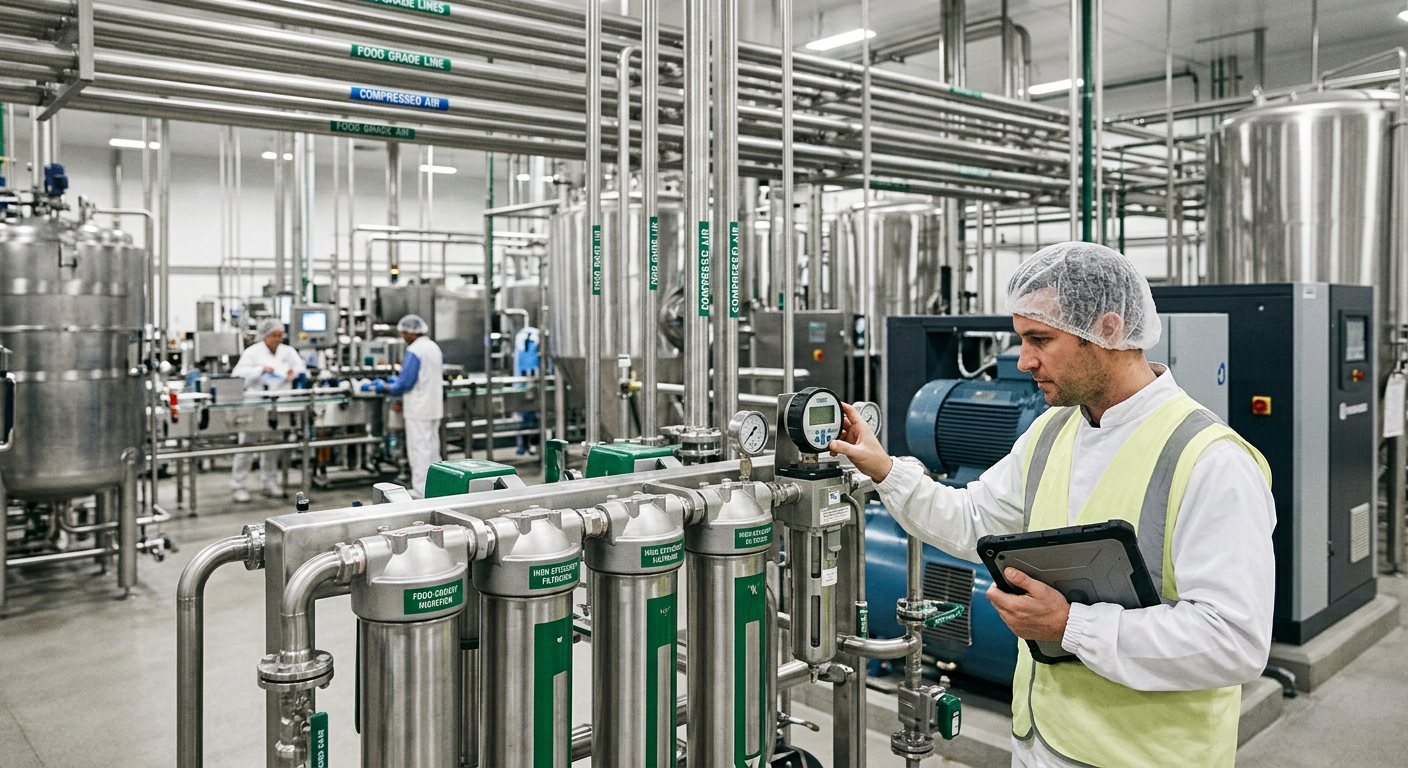
The term compressed air food grade usually refers to a full system rather than a standalone machine. A compliant solution may include the compressor, intake filtration, aftercooler, moisture separator, refrigerated or desiccant dryer, coalescing filters, activated carbon stage when required, sterile point-of-use filtration, storage receiver, condensate drain, monitoring instruments, stainless or aluminum distribution piping, and pressure controls. Selection depends on the contamination risk and application criticality.
Oil-free rotary screw compressors are widely preferred in high-risk and direct-contact environments because they reduce the chance of lubricant contamination at the source. Oil-injected rotary screw systems are still used in some food plants, but only when downstream treatment is carefully engineered and the application risk assessment supports that design. Scroll compressors can work well for lower-demand clean applications, while piston compressors are typically reserved for smaller or intermittent loads. For very sensitive processes such as aseptic filling, dairy packaging air, fermentation-related controls, pharmaceutical crossover work, and critical purge air, plants often specify more rigorous treatment and monitoring packages.
| System type | Best fit | Typical air quality strategy | Main advantages | Main limitations | Typical U.S. users |
|---|---|---|---|---|---|
| Oil-free rotary screw | High-volume clean processing | Oil-free compression plus drying and final filtration | Lower contamination risk, strong uptime | Higher capital cost | Dairy, beverage, aseptic, snack foods |
| Oil-injected rotary screw with treatment | Indirect-contact utilities | Coalescing, carbon, drying, point-of-use filters | Good efficiency, broad availability | Needs strict maintenance validation | Prepared foods, secondary packaging |
| Scroll compressor package | Smaller clean loads | Low-oil-risk compression with filtration and drying | Quiet, compact, clean operation | Limited capacity range | Labs, pilot plants, specialty packaging |
| Reciprocating compressor package | Intermittent demand | Enhanced downstream treatment required | Lower initial cost | Higher noise and pulsation | Small processors, maintenance air |
| Centralized compressor room | Large multi-line plants | Central treatment with monitored distribution | Efficient control and redundancy | More design complexity | Protein, beverage, dairy campuses |
| Skid-mounted utility package | Fast-track projects | Integrated compression, drying, and filtration | Faster deployment, cleaner installation | May need site-specific customization | Co-packers, expansion projects, relocations |
This table shows that there is no single best compressor type for every facility. A poultry processor in Arkansas, a yogurt producer in Wisconsin, a kombucha plant in California, and a beverage co-packer in Texas may all require different system architectures. The correct approach is to match compressor technology and treatment stages to contamination risk, load stability, and plant growth plans.
Buying Advice for U.S. Processors
When buying a food-grade compressed air system in the United States, start with the application map rather than the compressor catalog. Separate direct product contact, indirect contact, packaging air, actuator air, clean-in-place support, instrument air, and maintenance air. Many plants overspend by designing everything to the highest purity level, while others create audit risk by assuming all air uses are equal. A practical engineering review typically identifies where the highest purity is truly needed and where zoned treatment can lower total cost.
Ask suppliers how they size the system for peak demand, turndown, future expansion, and redundancy. Review pressure drop through filters and dryers because a poorly designed treatment train can silently waste energy for years. Request clear maintenance schedules, filter replacement intervals, dew point targets, oil monitoring options, and commissioning documentation. In coastal regions such as Southern California, the Gulf Coast, and parts of the Southeast, ambient conditions can change dryer selection and condensate handling design.
It is also wise to review installation and piping. A premium compressor feeding poor piping will still produce poor results at point of use. Food plants increasingly prefer clean, corrosion-resistant piping systems with properly sloped runs, drain legs, and isolated branches for wet and dry loads. For processors planning line additions, reserve space and controls capacity for future receivers, treatment skids, and remote monitoring.
| Buying factor | Why it matters | What to ask suppliers | Common mistake | Best practice | Impact on cost |
|---|---|---|---|---|---|
| Application risk mapping | Determines purity level needed | Which points are direct contact? | One-spec-for-all design | Zone the system by risk | Can reduce overdesign |
| Compressor technology | Affects contamination and energy | Oil-free or oil-injected? | Choosing by horsepower alone | Match technology to process use | High long-term impact |
| Dryer selection | Controls moisture and microbial risk | What dew point is guaranteed? | Undersized dryer | Size for ambient and peak load | Moderate to high |
| Filtration train | Removes oil, particles, and odors | What stages are included? | Missing point-of-use filtration | Design by contamination pathway | Moderate |
| Monitoring and validation | Supports audits and QA confidence | Can the system log critical metrics? | No baseline testing | Include testing ports and alarms | Moderate |
| Service footprint | Reduces downtime risk | Who supports our city and state? | Buying from remote-only sellers | Choose strong local support | Protects lifecycle cost |
The table above can be used as a practical procurement checklist. It helps teams compare proposals on safety, uptime, compliance, and total cost instead of only on initial price. This is especially useful for multi-site food companies trying to create a common utility standard.
Industries Driving Demand
Demand for food-grade compressed air is strongest where cleanliness, uptime, and packaging integrity intersect. Beverage plants use compressed air for blow molding support, packaging, filling auxiliaries, valve actuation, nitrogen systems support, and instrumentation. Protein processors use it for controls, conveyors, slicing lines, portioning systems, packaging, and sanitation support. Dairy producers need clean compressed air for valves, packaging, ingredient handling, and sanitary automation. Bakery, snack, sauce, condiment, and ingredient plants also rely on clean air for conveying, filling, sealing, and process support.
This bar chart shows a realistic relative-demand view across major U.S. processing sectors. Beverage, dairy, and protein continue to lead because they combine tight hygiene expectations with heavy automation and high line utilization. Aseptic and pharmaceutical-adjacent food applications remain smaller in volume but are highly specification-driven and often require more advanced air quality controls.
Typical Applications Inside a Plant
Compressed air can be used almost everywhere in a food or beverage facility, but not every use has the same contamination risk. The most critical applications are those where air may contact ingredients, finished product, primary packaging interior surfaces, or sensitive sanitary zones. Less critical uses might include maintenance air or remote utility support. A proper plant review maps all air uses and determines where dedicated treatment branches are necessary.
| Application | Contact risk | Typical purity expectation | Recommended system approach | Common U.S. sectors | Notes |
|---|---|---|---|---|---|
| Direct product contact air | High | Very strict | Oil-free plus validated final filtration | Dairy, powders, beverages | Requires documented risk control |
| Packaging purge and blow-off | Medium to high | Strict | Dry air with point-of-use filtration | RTD, snacks, sauces | Check packaging interior exposure |
| Pneumatic valves and actuators | Low to medium | Moderate | Central treatment and dry air distribution | All food sectors | Moisture can damage valves |
| Ingredient conveying | High | Strict | Oil-free or high-integrity treated air | Powders, bakery, dairy | Review direct contact carefully |
| CIP and sanitation support | Low to medium | Dry and reliable | Stable pressure, dryer sized for peaks | Protein, dairy, beverage | Peak load often underestimated |
| Instrument air | Low | Dry and consistent | Dedicated branch with pressure stability | Automation-heavy plants | Important for control accuracy |
This table helps show why system segmentation matters. Plants often discover that only a limited set of applications truly requires the highest air quality, while the rest can be served by a more economical branch. That balance improves both safety and capital efficiency.
Case Study Patterns Seen Across U.S. Projects
In beverage facilities, a common issue is underestimating compressed air demand during startup and changeover. A co-packer may size the system for steady-state filling but forget the extra loads from packaging, blow-off, automation, and sanitation overlap. In protein plants, the biggest challenge is often moisture management in harsher operating environments, especially where washdown frequency is high. Dairy sites frequently need more robust monitoring and validation because any contamination event can quickly become a quality or audit concern.
Another common pattern is that plants invest in process equipment yet leave utilities underspecified. The result is pressure instability, nuisance downtime, poor actuator performance, water in air lines, or inconsistent air quality at point of use. The best outcomes come from integrated project planning where utility design is developed alongside the process and packaging lines rather than after major equipment has already been purchased.
Facilities expanding near Dallas-Fort Worth, Chicago, Charlotte, Fresno, Milwaukee, and the Inland Empire often benefit from skid-mounted compressor and treatment packages because they reduce field labor, speed installation, and allow tighter quality control before shipment. For relocated operations or brownfield retrofits, modular utility skids can simplify tie-ins and reduce disruption to active production schedules.
Local Suppliers and Service-Oriented Brands in the United States
For most U.S. food and beverage buyers, supplier selection should balance product performance, national parts access, local field service, and application engineering depth. The companies below are real and relevant options for compressed air food grade projects, especially when plants need documented performance and responsive support.
| Company | Service region | Core strengths | Key offerings | Best fit users | Practical note |
|---|---|---|---|---|---|
| Atlas Copco USA | Nationwide | Oil-free technology, monitoring, broad portfolio | Oil-free compressors, dryers, filters, controls | Large beverage, dairy, aseptic plants | Strong fit for critical-contact applications |
| Ingersoll Rand | Nationwide | Integrated packages, broad industrial support | Compressors, dryers, storage, service plans | Multi-line food and packaging plants | Good for standardized utility platforms |
| Kaeser Compressors | Nationwide | Energy efficiency, system engineering | Rotary screw units, treatment systems, controls | Plants focused on lifecycle cost | Often strong in central system optimization |
| Quincy Compressor | Nationwide through distributors | Industrial durability, broad U.S. reach | Compressors, dryers, filters, air system packages | General food manufacturing | Good availability in many regions |
| FS-Curtis | Broad U.S. coverage | Packaged systems, practical support | Rotary screw, reciprocating, dryers, filtration | Mid-sized processors and regional plants | Useful for value-focused projects |
| Gardner Denver | Nationwide | Large portfolio, industrial scale | Compressed air systems and accessories | Large manufacturing campuses | Best evaluated with local integrator input |
This supplier table is most useful during early screening. It identifies brands with enough scale and U.S. footprint to support food-grade projects, but final selection should still depend on local branch quality, application knowledge, and how well the proposal fits your process risks.
The area chart above reflects a clear purchasing trend in the U.S. market: more processors are moving toward oil-free or higher-integrity treated air systems, especially in direct-contact, packaging, and audit-sensitive applications. This shift is tied to food safety expectations, energy optimization, and lifecycle risk reduction.
Comparison of Supplier Profiles
Not every supplier competes on the same basis. Some lead with advanced oil-free technology, others with service availability, and others with value-oriented packaged systems. Buyers should compare these profiles against plant priorities rather than assuming the most recognized brand is automatically the best fit.
This comparison chart is a realistic directional view rather than an absolute ranking. It suggests how buyers might weigh food-grade suitability, system breadth, engineering support, and U.S. service coverage when evaluating vendors for typical processing projects.
Our Company
Disruptive Process Solutions brings a different advantage to compressed air food grade projects in the United States because the company approaches utilities as part of a full manufacturing system rather than as an isolated equipment purchase. Headquartered in Cary, North Carolina, with a West Coast office in Lake Forest, California, DPS already operates with physical presence across major U.S. food and beverage corridors and supports projects throughout all 50 states and Canada. That local reach matters for buyers who want an engineering partner with real field execution experience, not a remote exporter. DPS integrates compressed air within broader utility and process packages that can include boilers, cooling towers, process water, CIP, controls, and full line infrastructure, making it especially effective for greenfield plants, brownfield expansions, co-packer facilities, and high-speed beverage or protein operations. Its engineering depth spans process, mechanical, plumbing, electrical, structural, controls, PLC programming, SCADA, installation, commissioning, and project management, which means air systems are designed around actual production needs, sanitation realities, and future scale targets. Through its proprietary Design-Build-Manage model, DPS serves end users, brand owners, co-manufacturers, distributors, and regional partners with flexible delivery structures ranging from turnkey system integration and equipment supply to owner’s representative support, custom fabrication, private-label style collaboration, and broader capital project partnerships. The company also manufactures selected process equipment in-house, applying strict project-based quality oversight and practical testing discipline to ensure that utility systems align with food, beverage, aseptic, FDA, USDA, SQF, and BRC expectations. For local buyers, the strongest assurance is DPS’s hands-on U.S. operating model: online engineering support, on-site coordination, trade management, startup assistance, and long-term project accountability backed by teams already executing complex facilities in this market. That combination of regional presence, cross-discipline expertise, and documented food and beverage execution gives customers a trustworthy partner for compressed air projects that must perform in real production conditions.
If you want to understand the company background in more detail, you can review the team and company story. Buyers comparing integrated utility scopes may also find value in the company’s process equipment capabilities. For practical examples of execution style, the available project snapshots including project case work, additional field implementation, and system delivery examples provide useful context for how DPS supports complex manufacturing environments.
How to Choose the Right Partner
If your project is a straightforward replacement in a single facility, a major compressor brand with strong local branch support may be enough. If your project involves line additions, sanitation redesign, process risk review, utility integration, automation changes, or a new facility launch, an engineering-led partner can deliver more value by coordinating the air system with the entire plant. This is particularly true for beverage campuses, dairy operations, co-packing sites, aseptic systems, and protein plants where utility issues can affect throughput, product quality, and startup timing.
U.S. buyers should also evaluate the supplier’s willingness to challenge assumptions. The best project outcomes often come from partners who ask hard questions about airflow, storage, treatment zones, pressure drop, redundancy, and controls instead of simply matching existing nameplate capacity. In many plants, the true bottleneck is not compressor horsepower but poor controls logic, leaking distribution, unstable demand, or underdesigned treatment stages.
Future Trends Through 2026 and Beyond
Several trends are shaping the next generation of food-grade compressed air systems in the United States. First, more processors will adopt continuous monitoring for dew point, pressure stability, filter condition, and contamination indicators to support audit readiness and predictive maintenance. Second, energy management will become central to utility investment decisions, with variable-speed systems, heat recovery, storage optimization, and digital leak analytics gaining wider adoption. Third, sustainability pressure will encourage plants to reduce compressed air waste, improve condensate handling, and align utility modernization with broader carbon and water goals.
Policy and customer expectations are also moving the market. Large retailers, brand owners, and co-manufacturing partners increasingly expect better documented food safety controls, cleaner utility design, and stronger traceability. This will push more plants to formalize risk assessments around compressed air rather than treating it as a background utility. On the technology side, packaged modular utility skids, remote diagnostics, smarter controls, and cross-system integration with SCADA and plantwide data platforms will become more common. By 2026 and beyond, the most competitive facilities will be the ones that treat compressed air as a strategic manufacturing asset rather than a maintenance expense.
FAQ
What does compressed air food grade mean?
It generally refers to compressed air systems designed and maintained to minimize contamination risk in food and beverage environments. In practice, this includes proper compressor selection, drying, filtration, piping, monitoring, and validation based on application risk.
Do all food plants need oil-free compressors?
No. Some applications can use oil-injected systems with robust downstream treatment, but direct-contact and higher-risk uses often justify oil-free compression or higher-integrity designs. The correct answer depends on the hazard assessment.
Is food-grade compressed air only for product contact?
No. It is also important for packaging, conveying, controls, sanitation support, and instrument air. However, purity requirements vary by use point, which is why system zoning is so valuable.
What matters more: the compressor brand or the system design?
System design usually matters more. Even a strong brand can underperform if the dryer is undersized, the filters are wrong, the piping creates pressure loss, or the plant lacks monitoring and maintenance discipline.
How often should filters and dryers be reviewed?
They should be reviewed on a documented schedule tied to run hours, ambient conditions, load, and risk level. Critical food applications often justify more frequent inspection, pressure drop checks, and replacement planning.
Can international suppliers be a good option for U.S. projects?
Yes, if they have suitable certifications, proven component quality, clear documentation, and real North American support for startup, spares, troubleshooting, and warranty response. Cost-performance can be attractive, but service reliability must be verified.
When should a plant use an engineering integrator instead of only a compressor vendor?
Use an integrator when the project affects multiple utilities, process lines, automation systems, compliance requirements, or expansion phases. This is common in greenfield builds, major retrofits, co-packing sites, and high-capacity beverage or protein projects.
[/trp_language]
Complete Company Portfolio

About the Author: Disruptive Process Solutions (DPS)
The DPS team combines process engineering expertise with real-world food and beverage manufacturing experience. Our content focuses on process optimization, production efficiency, facility improvements, and practical solutions that help manufacturers operate more effectively in a rapidly evolving industry.
Share

