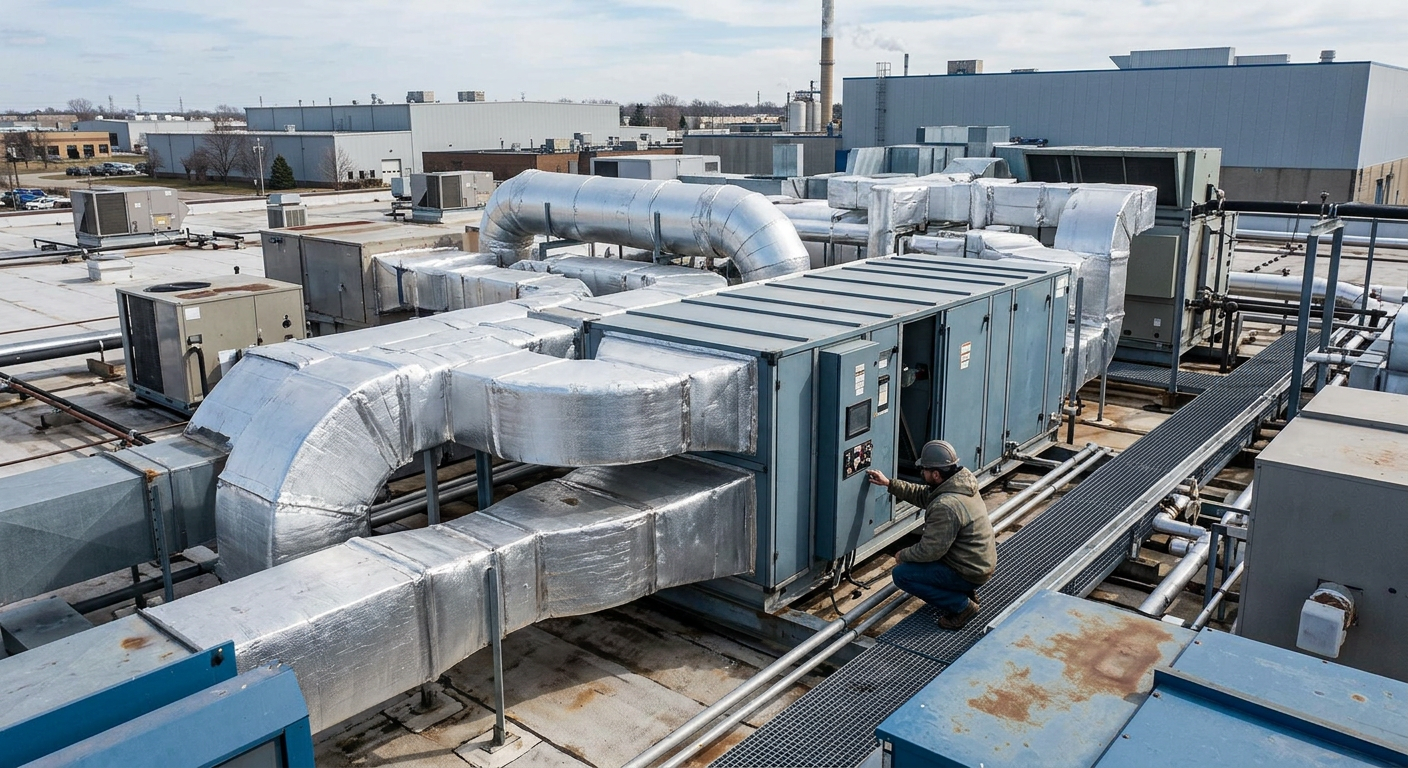
HVAC Design for Food and Beverage Manufacturing Facilities
[trp_language language=”en_US”]
HVAC for U.S. Food and Beverage Manufacturing Facilities
Quick Answer

HVAC design for food and beverage manufacturing facilities in the United States should be driven by food safety, moisture control, pressurization strategy, corrosion resistance, cleanability, utility integration, and lifecycle cost rather than comfort cooling alone. In practice, the most suitable partners are firms that understand processing environments, washdown zones, USDA and FDA expectations, airborne contamination control, and the interaction between HVAC, refrigeration, steam, CIP, compressed air, and building envelopes.
For manufacturers that need practical project support, strong options in the U.S. market include Johnson Controls, EMCOR, Southland Industries, Stellar, and Disruptive Process Solutions. Johnson Controls brings broad building automation and national service coverage. EMCOR is a major mechanical contractor with deep industrial execution capacity. Southland Industries is well known for design-build MEP delivery. Stellar has strong food plant design and construction experience. Disruptive Process Solutions is especially relevant for food and beverage processors that want integrated process, utility, controls, and facility execution under one coordinated model.
If your operation is in dairy, protein, beverage, aseptic, prepared foods, or co-packing, prioritize HVAC partners that can separate hygienic zones, manage dew point in cold-process areas, maintain room pressure relationships, and design systems that stand up to sanitation chemicals and aggressive washdown. Qualified international suppliers can also be considered when they hold relevant U.S.-accepted certifications and provide reliable pre-sales engineering, spare parts planning, and local after-sales support; in some projects, they offer meaningful cost-performance advantages.
Why HVAC Is Mission-Critical in Food and Beverage Plants

In food and beverage manufacturing, HVAC is not simply a background building system. It directly influences product quality, shelf life, worker safety, line uptime, sanitation performance, audit readiness, and energy spend. A poorly designed system can cause condensation above open product zones, unstable fermentation temperatures, mold growth in packaging rooms, dust migration in dry ingredient handling, odor transfer between areas, and excessive humidity that compromises labels, cartons, and electrical controls.
Across the United States, processors in regions such as North Carolina, California, Texas, Wisconsin, Illinois, Georgia, and Pennsylvania face different climate loads, utility costs, and production constraints. A beverage plant near Charlotte or Cary may focus on syrup room heat rejection, can line ventilation, and positive pressure in filling spaces. A protein plant in Texas or the Midwest may need aggressive humidity control, corrosion-resistant air distribution, and pressure-managed raw-to-ready zoning. A dairy facility in California’s Central Valley may require highly stable temperature and moisture control with careful energy recovery and utility coordination.
The core objective is straightforward: create air conditions that protect the process. That means matching HVAC design to production realities such as open product exposure, hot fill, cold fill, fermentation, retort, packaging speed, sanitation schedule, dock activity, people density, and utility loading. In many facilities, the best-performing HVAC systems are those developed alongside process engineering rather than after process layouts are already fixed.
U.S. Market Outlook for Food Plant HVAC

The U.S. market for food and beverage facility upgrades remains active because processors are expanding capacity, modernizing legacy plants, reducing energy use, and hardening facilities against labor, compliance, and climate risks. Growth is especially visible in beverage co-packing, dairy alternatives, protein processing, prepared foods, and shelf-stable product manufacturing. HVAC scope is rising at the same time because air quality, pressurization, and moisture control are increasingly tied to audit performance and production efficiency.
Several market forces are shaping project decisions. First, labor shortages encourage automation, which raises internal heat loads and increases sensitivity to stable environmental control. Second, sustainability goals are pushing heat recovery, variable-speed systems, demand-based ventilation, and better building analytics. Third, stricter customer requirements from major retailers and brand owners are increasing attention to hygiene zoning and documented environmental control. Finally, geographic shifts in manufacturing near logistics hubs such as Dallas-Fort Worth, Atlanta, Chicago, the Inland Empire, and the I-95 corridor are creating opportunities for new greenfield and brownfield projects.
For many manufacturers, the decision is no longer whether to upgrade HVAC, but whether to do it as a standalone mechanical job or as part of a broader plant optimization effort. In complex facilities, integrated execution usually performs better because HVAC must coordinate with structural openings, process piping, drain strategy, room classification, controls architecture, and commissioning.
The chart above illustrates a realistic growth pattern for HVAC modernization activity tied to food and beverage plant upgrades, showing how demand has moved from efficiency retrofits toward deeper, compliance-driven environmental control investments.
Core HVAC Requirements in Food and Beverage Manufacturing
Design criteria in this sector go beyond office standards. Processors need systems that support sanitation, product protection, and reliable operation under demanding schedules. The most important requirements usually include temperature control, relative humidity control, airborne particle management, directional airflow, room pressure cascades, and materials suitable for corrosive or wet environments.
Washdown zones often require sealed equipment, stainless or coated components, drain-aware layouts, and air distribution that avoids trapping moisture on ceilings or overhead utilities. Dry processing rooms need tight moisture control to prevent caking, dust accumulation, or microbial risk. Packaging halls may prioritize thermal comfort, balanced ventilation, and energy-efficient make-up air systems. High-care areas demand disciplined pressurization and filtration strategy. Cold rooms and refrigerated production areas need dew-point-focused design to prevent condensation and slippery floors.
Successful HVAC scope also depends on maintainability. Filters must be accessible, coils cleanable, drains protected, and control sequences understandable to plant teams. The best systems are not merely code-compliant on startup; they remain serviceable after years of sanitation, production changeovers, and utility fluctuations.
Common System Types Used in U.S. Food and Beverage Plants
Different production environments call for different HVAC configurations. There is no universal system that fits every facility. Instead, engineers typically combine multiple approaches depending on product risk, process heat, occupancy, and building age.
| System Type | Best Fit | Main Advantage | Main Limitation | Typical U.S. Use Case |
|---|---|---|---|---|
| Packaged rooftop units | Dry packaging, warehousing, secondary processing | Lower initial cost and simpler replacement | Less precise humidity control | Snack, dry ingredient, and end-of-line spaces |
| Dedicated outdoor air systems | High ventilation or pressure-controlled rooms | Strong latent load handling and air quality control | Higher design complexity | Filling rooms, ready-to-eat zones, high-care spaces |
| Make-up air units with heat | Washdown and exhaust-heavy areas | Balances air removed by process exhaust | Can be energy intensive if poorly controlled | Cooking, smokehouses, kettle rooms |
| Chilled water air handlers | Large campuses and precise control areas | Centralized efficiency and scalability | Needs plant utility infrastructure | Dairy, beverage, multi-room processing plants |
| DX split systems | Small isolated support spaces | Fast deployment | Not ideal for critical hygienic production rooms | Electrical rooms, labs, offices |
| Desiccant dehumidification systems | Cold-process and low-dew-point environments | Excellent condensation prevention | Higher capital and control requirements | Protein processing, cold packaging, freezer transitions |
| Fabric duct air distribution | Open production spaces | Even airflow and washdown-friendly options | Must be selected carefully for sanitation regime | Dairy, beverage, bakery, prepared foods |
This table shows why system selection must be tied to the actual production environment. A beverage filler room, for example, often benefits from a dedicated outdoor air strategy with filtration and positive pressure, while a dry warehouse may only justify packaged rooftop equipment.
Industry Demand by Processing Segment
Not all food sectors place the same demands on HVAC. Beverage, dairy, protein, and ready-to-eat operations generally require tighter environmental control than ambient-stable dry storage or secondary packaging areas. Understanding where HVAC matters most helps buyers allocate budget intelligently.
The bar chart highlights which sectors usually demand the highest level of HVAC precision. Aseptic, protein, and dairy environments tend to require the strongest coordination between sanitation, pressure control, and moisture management.
Buying Advice for U.S. Manufacturers
When evaluating HVAC options for a food or beverage plant, the first question should not be, “What tonnage do we need?” It should be, “What environmental conditions must each room reliably hold during the worst production and sanitation scenario?” That shift changes the project from a commodity mechanical purchase into a process-aligned engineering decision.
Start by mapping room-by-room risk. Identify open product exposure, washdown intensity, target temperature range, humidity tolerance, required air changes, pressure relationships, and whether the room operates wet, dry, hot, cold, or mixed-mode. Next, confirm utility context: steam, chilled water, glycol, hot water, compressed air, automation, and available electrical capacity. Then review building envelope weakness, dock infiltration, and roof loading. These factors often drive more HVAC problems than equipment capacity alone.
Buyers should also evaluate controls sophistication. Advanced mechanical equipment without robust sequencing often performs poorly. Good controls should reset ventilation where appropriate, manage dew point, trend critical conditions, alarm on pressure deviations, and integrate with plant operations. In retrofit projects, phased installation and startup planning are equally important because many plants cannot accept extended downtime.
Another practical point is contractor fit. A general commercial HVAC contractor may be capable in comfort systems but inexperienced in high-care rooms or washdown environments. Food plant HVAC demands familiarity with cleanability, hygienic zoning, and the operational consequences of every air movement decision.
Key Applications Across Food and Beverage Operations
HVAC applications differ significantly by process area. In raw receiving and warehouse spaces, the goal is often reasonable ventilation, temperature moderation, and infiltration control. In ingredient handling and mixing rooms, dust control and balanced air movement are critical. In thermal processing areas, exhaust replacement and worker comfort become central. In filling rooms, pressure control and stable temperature often matter more than simple cooling load calculations.
Beverage plants commonly need precise HVAC around syrup rooms, blending areas, filtration zones, bright tank rooms, packaging lines, and utility corridors. Fermentation spaces may require close control to support product stability and operator access. Carbonated beverage packaging areas often benefit from balanced ventilation that protects equipment while avoiding condensation on cold surfaces.
Food plants have equally specific needs. Protein processing rooms often struggle with wet floors, corrosive washdown, and low-temperature condensation. Dairy facilities need smooth integration between HVAC, refrigeration, and sanitation. Ready-meal and sauce plants may have varying heat gains from kettles, retorts, ovens, and cooling tunnels. Aseptic spaces need the most disciplined coordination of filtration, pressurization, and contamination control.
How Environmental Priorities Are Shifting
The trend in food plant HVAC is moving away from broad building-wide conditioning and toward targeted room-by-room environmental management. Manufacturers increasingly invest where environmental control directly supports yield, quality, and compliance.
The area chart reflects a realistic shift toward more granular, hygienic, data-driven HVAC strategies. This mirrors the broader industry move toward risk-based environmental design instead of one-size-fits-all mechanical planning.
Detailed Supplier Comparison in the United States
The supplier landscape includes global building systems firms, major mechanical contractors, food-focused design-build specialists, and integrated process engineering companies. For food and beverage manufacturers, the right choice depends on whether the project is mostly mechanical, mostly process-driven, or a hybrid capital improvement initiative.
| Company | Primary Service Region | Core Strengths | Key Offerings | Best For |
|---|---|---|---|---|
| Johnson Controls | Nationwide U.S. | Controls, building systems, service network | BMS integration, HVAC equipment, maintenance programs | Multi-site operators needing national support |
| EMCOR | Nationwide U.S. | Large-scale mechanical contracting | Industrial HVAC installation, retrofit execution, service | Large construction-heavy projects |
| Southland Industries | Major U.S. metros | Design-build MEP and engineering depth | Mechanical design, fabrication, energy solutions | Complex greenfield and brownfield facilities |
| Stellar | Nationwide with food sector reach | Food plant design and construction | Facility design, refrigeration, MEP coordination | Processors wanting food-sector project alignment |
| Shambaugh & Son | National project coverage | Industrial refrigeration and mechanical systems | HVAC, refrigeration, plumbing, process utility support | Cold-chain and refrigeration-intensive plants |
| Hixson | Nationwide design projects | Food and beverage facility engineering | Architecture, engineering, packaging and utility planning | Front-end planning and plant redesign |
| Disruptive Process Solutions | All 50 states and Canada | Integrated process, utility, controls, and project execution | Engineering, capital planning, GC-led delivery, installation, system integration | Manufacturers needing HVAC linked to process profitability |
This comparison matters because HVAC results are often determined by organizational structure as much as equipment selection. A provider that can coordinate process utilities, automation, and construction logistics often reduces rework and startup risk, especially in beverage, dairy, protein, and aseptic projects.
Product and Solution Comparison by Facility Need
Buyers should compare solutions based on application rather than brand preference alone. The table below helps connect common plant conditions to HVAC approaches that usually perform well.
| Facility Need | Recommended HVAC Approach | Why It Works | Typical Add-Ons | Main Buyer Watchout |
|---|---|---|---|---|
| High-care packaging room | Dedicated outdoor air with pressure control | Supports filtration and positive pressure stability | HEPA or high-MERV filtration, vestibules | Door traffic can defeat pressure cascade |
| Cold protein room | Desiccant dehumidification plus low-temp air handling | Reduces condensation and slip hazards | Dew point monitoring, insulated ducts | Undersized dehumidification causes sweating |
| Beverage blending hall | Chilled water air handling or DOAS hybrid | Handles variable loads and process heat | BMS trend logs, make-up air balancing | Utility coordination is essential |
| Cook room or kettle area | Make-up air plus exhaust coordination | Controls heat plume and worker conditions | Energy recovery where feasible | Exhaust imbalance pulls in unfiltered air |
| Dry ingredient room | Conditioned ventilation with dust-aware airflow | Controls moisture and particle spread | Dust collection integration | Too much humidity creates caking risk |
| Aseptic suite | High-filtration pressure-managed air handling | Protects controlled production environment | Room monitoring and alarm systems | Poor commissioning can undermine compliance |
| Warehouse and shipping | Packaged rooftop or destratification strategy | Cost-effective comfort and infiltration moderation | Dock seals, high-speed doors | Overdesign wastes energy |
Instead of buying on capacity alone, use the table to shortlist the environmental strategy most likely to support your specific line, sanitation routine, and product risk profile.
Case Study Patterns from Real Food and Beverage Projects
In many U.S. facilities, HVAC problems are discovered only after a production ramp-up. A plant may pass startup, yet fail once summer humidity rises, sanitation frequency increases, or a line reaches full throughput. Several recurring project patterns stand out.
One common scenario is the beverage co-packer scaling faster than expected. Filling rooms start seeing label issues, warmer ambient conditions, or line interruptions because air balancing and latent load control were designed for early-stage output only. Another is the protein processor that installs additional equipment without revisiting room pressurization and moisture management, resulting in chronic condensation and sanitation frustration. A third is the dairy or prepared foods plant that adds automation and more enclosed equipment, increasing internal heat gain while leaving the original mechanical strategy unchanged.
These issues are why front-end engineering matters. Facilities that define environmental targets before finalizing layouts usually avoid expensive retrofits later. When the project team models process heat, sanitation moisture, occupancy, dock infiltration, and shift patterns early, HVAC becomes an enabler of capacity rather than a late-stage correction item.
Manufacturers evaluating project partners can review operational examples through pages such as food and beverage project experience, capital execution examples, and facility integration case studies to understand how integrated engineering teams approach real plant conditions.
Local and Regional Considerations Across the United States
HVAC strategy changes materially by region. In the Southeast, including North Carolina, Georgia, and Florida, outside air humidity can dominate design decisions, especially in beverage filling, dairy, and cold-process environments. In Texas, plants often face high sensible load, strong seasonal peaks, and large dock-related infiltration. In California, energy efficiency standards, water concerns, and utility cost management play a larger role. In the Midwest, wide seasonal swings create challenges in both winter pressurization and summer moisture control.
Facilities near logistics hubs and ports also have unique realities. Plants near Los Angeles/Long Beach, Savannah, Houston, Newark, and Chicago often experience rapid scale-up due to distribution advantages, which makes flexible HVAC capacity more valuable. Co-packers and contract manufacturers especially benefit from systems that can adapt to changing SKUs, shift patterns, and sanitation schedules without complete redesign.
Our Company
Disruptive Process Solutions serves food and beverage manufacturers across all 50 U.S. states and Canada with a model that links process engineering, utilities, controls, installation, and project execution under one accountable team. For buyers evaluating HVAC within a broader plant investment, DPS stands out because its mechanical work is developed in the context of complete manufacturing performance: the firm designs and integrates processing systems for beverage, protein, dairy, aseptic, prepared foods, and co-packing operations, while also covering structural, mechanical, plumbing, electrical, process, and automation scope. Its technical credibility is reinforced by work performed under FDA, USDA, SQF, and BRC compliance expectations, plus practical familiarity with demanding utility environments such as CIP, boilers, refrigeration, compressed air, cooling towers, and SCADA-enabled control systems. The company also supports flexible cooperation models that fit end users, regional partners, brand owners, and project stakeholders through engineering-led delivery, equipment supply, proprietary system manufacturing, turnkey installation, and GC or GC-equivalent execution depending on jurisdiction, making it suitable for clients who need anything from equipment integration to full capital project leadership. From a local-service standpoint, DPS is not a remote exporter into the U.S. market: it is headquartered in Cary, North Carolina, maintains a West Coast office in Lake Forest, California, executes projects nationwide, and backs field work with both strategic planning and rapid-response support. That footprint, together with its documented experience scaling beverage and food facilities, gives U.S. buyers a practical combination of regional presence, online and on-site coordination, and long-term accountability. Companies wanting to review the team can visit the company overview, while those assessing integrated hardware capabilities can explore process equipment offerings.
How to Evaluate a Supplier or Engineering Partner
When comparing providers, ask detailed questions that reveal whether they truly understand food and beverage conditions. Good questions include: How do you establish room-by-room pressure relationships? How do you size dehumidification for washdown and door cycling? What materials do you specify in corrosive zones? How do you validate airflow after line changes? Can your controls strategy trend dew point, pressure, and alarm history? How do you coordinate HVAC with refrigeration, steam, process piping, and sanitation?
Also examine project delivery model. Some providers are strongest in design but rely heavily on others for field coordination. Others install well but provide limited front-end process understanding. For brownfield projects, phased implementation planning is a major differentiator. Plants that cannot stop production need contractors who can sequence shutdowns, prefabricate where possible, and commission without disrupting food safety controls.
Supplier Selection Checklist
| Evaluation Topic | What to Confirm | Why It Matters | Strong Supplier Signal | Warning Sign |
|---|---|---|---|---|
| Food-sector experience | Relevant projects in your processing category | Reduces design assumptions | Can discuss dairy, beverage, protein, or aseptic specifics | Only commercial office references |
| Humidity expertise | Dew point and condensation control method | Critical in cold and washdown rooms | Uses room-specific moisture analysis | Sizes only by dry-bulb load |
| Pressurization strategy | Documented airflow relationships | Protects hygienic zoning | Provides room pressure narrative and monitoring plan | No pressure validation plan |
| Controls integration | BMS or SCADA communication approach | Improves visibility and response | Trend logs, alarms, setpoint management | Standalone mechanical controls only |
| Material suitability | Corrosion resistance and cleanability | Important in sanitation-heavy areas | Explains coatings, stainless options, sealing details | Generic commercial specs |
| Service footprint | Local or regional response capability | Supports uptime after startup | Named field support path and spare parts planning | Unclear after-sales ownership |
| Delivery model | Design, build, manage responsibilities | Affects schedule and accountability | Single-point coordination across scopes | Frequent handoff gaps |
This checklist helps buyers move beyond brochure claims and identify suppliers with the operational depth required for real production environments.
2026 Trends and What They Mean for Buyers
Looking through 2026 and beyond, several trends are changing HVAC decisions in U.S. food and beverage manufacturing. The first is deeper environmental data visibility. Plants increasingly want dashboards for room pressure, humidity, temperature stability, alarm history, and energy intensity. This supports audits and helps operations teams catch issues before they affect product or sanitation.
The second trend is decarbonization pressure. Even when regulation varies by state, large manufacturers and brand owners are pushing lower energy intensity and more efficient utilities. Expect more heat recovery, variable refrigerant support in non-critical zones, improved economizer logic where climate allows, and stronger integration between HVAC and plant energy management systems.
The third is hygienic segregation by risk rather than by department. Instead of conditioning whole buildings uniformly, manufacturers are isolating high-care areas, adding vestibules, and designing cleaner pressure cascades. This often reduces contamination risk while improving energy focus.
The fourth is resilience. Buyers increasingly ask how systems will perform during utility disruptions, extreme weather, and rapid production shifts. Redundancy, maintainability, and parts availability are moving higher on procurement criteria.
Finally, policy and customer pressure around sustainability, refrigerant management, and documented food safety controls will keep HVAC visible in capital planning. For many plants, the next upgrade cycle will combine compliance, automation, and energy strategy into one integrated investment decision.
FAQ
What is the biggest HVAC mistake in food and beverage manufacturing?
The most common mistake is treating the project like a standard comfort-cooling job instead of a process-critical environmental control system. This usually leads to poor humidity control, weak pressurization, and sanitation-related failures.
Do all food plants need humidity control?
Not to the same degree, but many do. Cold rooms, washdown areas, protein processing, dairy, beverage filling, and any area with condensation risk often need more than simple temperature control.
Is stainless steel HVAC equipment always necessary?
No, but corrosion-resistant materials and finishes are often necessary in sanitation-heavy or wet environments. The correct material depends on washdown chemistry, room temperature, and exposure conditions.
How early should HVAC be addressed in a plant expansion?
Ideally at concept stage. HVAC performance is closely tied to layout, envelope, utilities, drains, door strategy, and production assumptions. Delaying it usually increases cost and change orders.
Can one contractor handle process utilities and HVAC together?
Yes, and in many food and beverage projects that approach reduces coordination risk. Integrated partners are especially useful when HVAC must align with refrigeration, steam, compressed air, CIP, and controls.
Are international suppliers worth considering?
They can be, particularly when they offer strong value, recognized certifications, documented material standards, and dependable local support in the United States. Cost savings only matter if installation, commissioning, and spare parts response are credible.
Why does pressurization matter so much?
Pressure relationships help control the direction of air movement. That is essential for protecting higher-risk or cleaner rooms from contaminants migrating in from adjacent areas.
What kind of company is best for a complex food plant project?
A partner with real food and beverage experience, utility coordination capability, controls understanding, and strong field execution is usually the best fit. For many manufacturers, that means looking beyond a generic HVAC contractor toward an engineering-led project delivery team.
[/trp_language]
Complete Company Portfolio
About the Author: Disruptive Process Solutions (DPS)
The DPS team combines process engineering expertise with real-world food and beverage manufacturing experience. Our content focuses on process optimization, production efficiency, facility improvements, and practical solutions that help manufacturers operate more effectively in a rapidly evolving industry.
Share