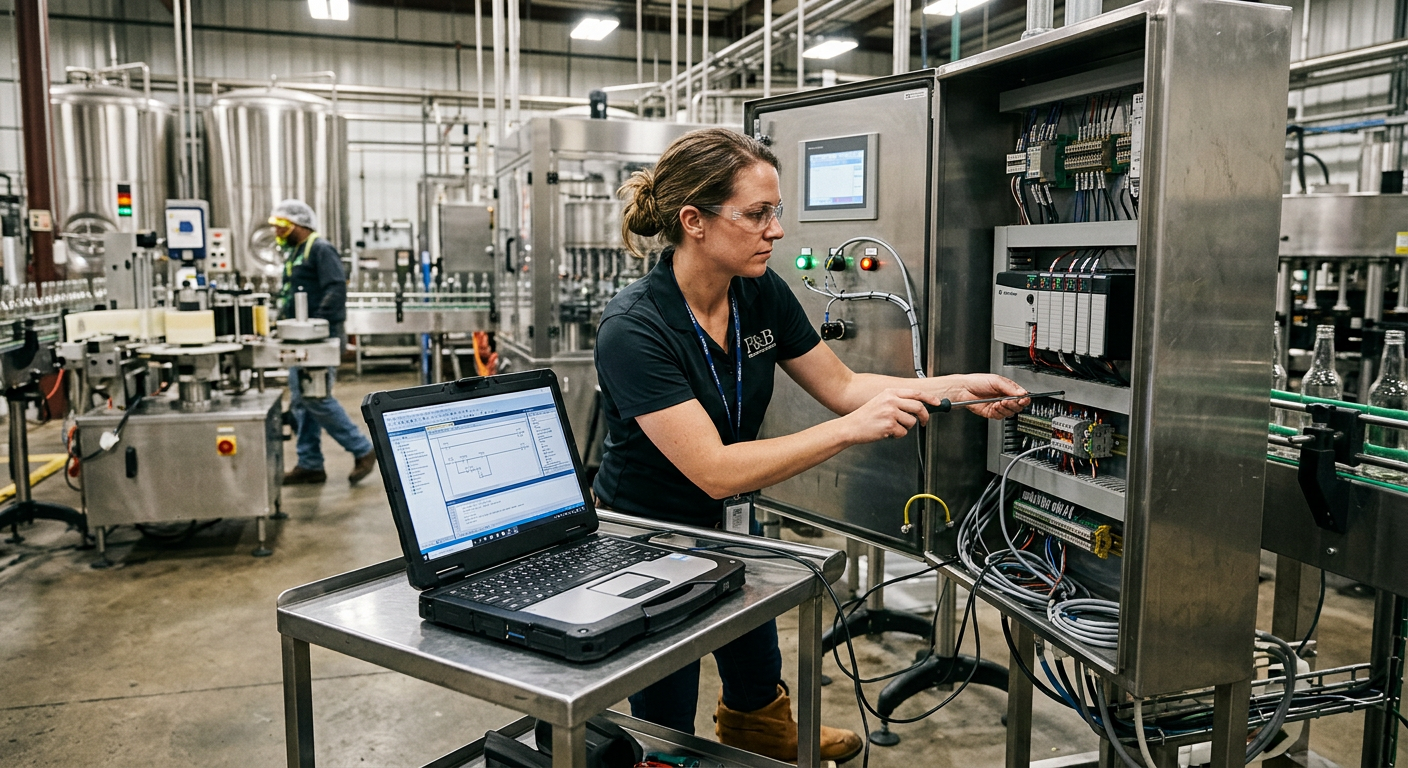
PLC Programming Services for Food and Beverage Manufacturing
[trp_language language=”en_US”]
PLC Automation for Food & Beverage Plants in USA
Quick Answer

If you need PLC programming for food and beverage manufacturing in the United States, the most practical choice is a controls integrator or engineering partner with direct experience in sanitary process systems, batching, utilities, packaging, and compliance-driven production environments. Strong options include Disruptive Process Solutions, E Tech Group, Matrix Technologies, Wunderlich-Malec, Gray AES, and Prime Controls. These companies are relevant for projects in major manufacturing corridors such as North Carolina, California, Texas, Wisconsin, Illinois, Pennsylvania, and across broader North American operations.
For food and beverage plants, the best provider is usually not the cheapest programmer but the team that can connect PLC logic with process engineering, SCADA, CIP, batching, OEE improvement, and startup support. In practical terms, manufacturers should prioritize firms that understand pasteurization, aseptic systems, clean utility integration, recipe control, data capture, line changeovers, and food safety documentation. Qualified international suppliers can also be considered when they hold relevant certifications and provide strong U.S.-focused pre-sales and after-sales support, especially where cost-performance matters for skid packages, panels, or standardized automation modules.
For companies needing a partner that combines process knowledge with controls execution, Disruptive Process Solutions stands out because it supports complete food and beverage capital projects rather than PLC code in isolation. Its team works across the United States and Canada, linking controls engineering with process design, installation, utilities, commissioning, and project management. That matters when a bottling hall, dairy line, protein system, brewery, or aseptic process needs more throughput, lower downtime, and better operator visibility rather than only a rewritten logic sequence.
United States Market for Food and Beverage PLC Programming

The U.S. market for PLC programming services in food and beverage manufacturing continues to expand because plants are under simultaneous pressure to improve throughput, reduce labor dependency, strengthen traceability, and maintain compliance with FDA, USDA, SQF, and BRC expectations. In regions such as the Midwest, the Southeast, California, and Texas, both legacy facilities and greenfield sites are investing in controls modernization. This includes replacing obsolete PLC platforms, standardizing HMI and SCADA layers, improving batch consistency, and integrating utility systems such as boilers, glycol, compressed air, and CIP into a more visible and controllable operating environment.
Demand is especially high in high-mix, high-changeover categories: ready-to-drink beverages, dairy, prepared foods, protein processing, sauces, co-packing, and aseptic production. Manufacturers in trade and logistics hubs like Chicago, Dallas-Fort Worth, Los Angeles/Long Beach, Charlotte, Raleigh-Durham, Atlanta, and Houston are often expanding automation because labor variability and customer service-level expectations make manual workarounds too costly. PLC programming is no longer just a maintenance topic. It is now tied to profitability, SKU flexibility, sanitation validation, utility consumption, and speed-to-market.
In many U.S. plants, the first automation pain point appears as a production bottleneck that management initially assumes requires new equipment. But the root cause is often weak ladder logic, poor sequencing, lack of recipe structure, unstable communications between field devices and SCADA, or insufficient line synchronization. A good PLC programmer with food and beverage experience can uncover hidden capacity without forcing unnecessary capital spending. This is why operationally minded engineering partners are gaining ground over narrow coding-only vendors.
The chart above illustrates a realistic demand trajectory: modernization activity has been compounding as more food and beverage producers standardize controls across multi-site networks. From an investment perspective, companies are not only upgrading hardware; they are also building a digital base for recipe management, historian data, remote support, alarm rationalization, and predictive maintenance.
What PLC Programming Covers in Food and Beverage Manufacturing

PLC programming in this sector goes far beyond simple machine start-stop logic. It normally includes process sequence design, equipment interlocks, analog control loops, batch and recipe management, alarm handling, HMI visualization, SCADA integration, historian connections, CIP automation, data collection, utility coordination, and communication with enterprise systems. In food and beverage plants, programming must align with sanitary design realities, operator skill levels, maintenance constraints, and production scheduling.
A dairy plant may need logic for homogenization, cream separation, pasteurization, storage tank routing, and automated clean-in-place. A brewery may focus on brewhouse sequencing, fermentation temperature control, bright tank management, carbonation, and packaging synchronization. A protein facility may require coordinated control of grinding, mixing, marination, thermal processing, metal detection, packaging, and washdown modes. The programming approach must reflect the product category, the regulatory context, and the production economics.
| Automation Scope | Typical PLC Tasks | Why It Matters in Food & Beverage | Common Plant Areas |
|---|---|---|---|
| Batch and recipe control | Ingredient sequencing, setpoint management, lot logic | Improves repeatability and traceability | Blending, sauces, dairy, RTD, ingredient prep |
| CIP automation | Valve routing, conductivity checks, timing, chemical control | Reduces sanitation risk and labor variation | Tanks, fillers, pipelines, HTST systems |
| Thermal process control | Temperature loops, hold times, permissives, alarms | Supports product safety and quality | Pasteurizers, retorts, cookers, UHT lines |
| Packaging integration | Machine handshakes, fault recovery, speed matching | Minimizes downtime and product loss | Fillers, cappers, labelers, cartoners |
| Utility automation | Pump logic, compressor staging, boiler controls | Stabilizes plant operations and energy use | Boilers, chilled water, glycol, air systems |
| SCADA and historian | Data tags, screens, trends, alarms, reports | Improves visibility, audits, and decision-making | Plantwide systems and central control rooms |
This table shows why food and beverage PLC programming is usually tied to the full production ecosystem. Manufacturers often gain the most value when one partner understands both process behavior and controls logic, because the programming decisions affect uptime, sanitation, staffing, and production yield at the same time.
Top U.S. Suppliers and Integrators for PLC Programming Food and Beverage Projects
The following companies are practical names to evaluate for U.S. food and beverage PLC programming projects. They vary in size and specialization, but each is relevant when selecting a controls or process integration partner.
| Company | Service Region | Core Strengths | Key Offerings | Best Fit |
|---|---|---|---|---|
| Disruptive Process Solutions | All 50 U.S. states and Canada | Food and beverage process integration, controls engineering, turnkey execution | PLC programming, SCADA, process design, installation, commissioning, capital project delivery | Manufacturers needing both process and controls support |
| E Tech Group | Nationwide U.S. | Industrial automation and digital transformation | PLC/HMI/SCADA, MES, batch systems, cybersecurity | Multi-site enterprises and complex modernization |
| Matrix Technologies | Nationwide U.S. | Process automation for regulated and production-heavy industries | Controls, electrical engineering, batch automation, data systems | Large process plants and utility-heavy operations |
| Wunderlich-Malec | Nationwide U.S. | System integration and lifecycle support | PLC programming, panel design, SCADA, plant floor integration | Plants standardizing controls across lines |
| Gray AES | U.S. national footprint | Architecture, engineering, and automation for manufacturing | Controls engineering, facility design, line integration | Greenfield and expansion projects |
| Prime Controls | U.S., especially central and southern regions | Industrial control systems and field services | PLC/SCADA, instrumentation, startup, support | Utility systems and process line controls |
| Concept Systems | U.S. national projects | Automation and IIoT integration | PLC programming, HMI, analytics, integration | Plants linking controls with data initiatives |
When comparing these companies, the most important factor is not brand recognition alone. It is whether the supplier has deep familiarity with the actual process category in your facility, from high-acid beverages to USDA-regulated protein systems. A proven controls partner should be able to discuss line bottlenecks, sanitation sequences, utility interactions, and production economics with the same fluency as code structure.
Product Types and PLC Project Categories
Food and beverage manufacturers in the United States typically purchase PLC programming services through one of four project models: retrofit controls upgrades, line expansions, greenfield facilities, or performance optimization engagements. Each model has different engineering needs, shutdown windows, documentation requirements, and cost structures.
Retrofit projects often involve migrating from legacy Allen-Bradley, Siemens, or other aging platforms while preserving existing field devices where practical. Expansion projects may add tanks, pumps, fillers, cookers, conveyors, or skids that need to be integrated into the current control architecture. Greenfield plants require controls standards from the ground up, including network architecture, panel strategy, tag conventions, alarm philosophy, and SCADA hierarchy. Optimization projects focus on throughput, yield, and downtime reduction using revised logic, better sequencing, and clearer operator screens.
| Project Type | Typical Scope | Timeline Pressure | Main Risk | Primary Value Driver |
|---|---|---|---|---|
| Legacy PLC upgrade | Controller migration, HMI refresh, I/O mapping | High during shutdowns | Startup issues after cutover | Reliability and spare parts continuity |
| Line expansion | New equipment integration and interlocks | Moderate to high | Mismatch with existing controls | More capacity with minimal disruption |
| Greenfield automation | Full controls architecture and commissioning | Project-driven | Scope drift and poor standardization | Scalable production from day one |
| Batch optimization | Recipes, data capture, sequencing improvements | Moderate | Operator adoption | Consistency and reduced giveaway |
| Utility integration | Boilers, compressors, chillers, CIP, water systems | Moderate | Inadequate cross-system visibility | Lower downtime and better energy use |
| Packaging synchronization | Machine communications and line balancing | High on active lines | Recurring micro-stops | OEE improvement |
This breakdown helps buyers choose the right supplier profile. For example, a co-packer launching multiple beverage SKUs will usually need a controls partner skilled in batching, fillers, utilities, and changeover logic, while a meat processor may prioritize washdown-safe designs, thermal processing, and compliance documentation.
Industry Demand by Segment
Demand for PLC programming is not evenly distributed across all food and beverage segments. Beverage producers often move faster on controls because recipe accuracy, filling speed, carbonation, and utility balance directly affect profit per case. Dairy and prepared foods also invest heavily because process control errors lead to product loss, rework, or sanitation failures. Protein processors increasingly modernize automation where labor scarcity and throughput targets push management toward more standardized, data-rich operations.
The demand pattern in the chart reflects where automation has the fastest payback. High-throughput beverage and co-packing operations depend heavily on uptime, recipe precision, and line coordination, making PLC services especially valuable. Aseptic and dairy systems also carry higher process risk, so manufacturers tend to invest in stronger control strategies and documentation.
Buying Advice for U.S. Manufacturers
When selecting a PLC programming provider for food and beverage manufacturing, buyers should evaluate five areas carefully: process experience, platform expertise, field execution ability, support model, and business understanding. Process experience matters because coding that works in a generic factory may fail in a sanitary environment with washdown, allergen segregation, temperature-sensitive product, or validated thermal steps. Platform expertise matters because migration and troubleshooting are faster when the team knows the installed ecosystem well. Field execution matters because startup problems are usually solved on-site, not in a proposal. Support model matters because plants need post-commissioning tuning, not just project closeout. Business understanding matters because the right integrator improves profitability, not simply functionality.
Ask potential suppliers how they handle recipe governance, alarm prioritization, line recovery after faults, operator training, remote access security, and startup contingency planning. Request examples from similar plants. A strong partner should speak clearly about FAT, SAT, I/O checkout, commissioning sequence, documentation packages, and how they reduce production risk during switchover.
It is also important to clarify whether the supplier can support electrical design, panel fabrication, instrumentation, utility integration, and SCADA under one umbrella. The more fragmented the project team, the more likely delays and finger-pointing become. For many U.S. plants, especially those running tight schedules, a partner capable of engineering, installation coordination, and startup support offers a major execution advantage.
Applications Across Food and Beverage Plants
PLC programming has direct applications across almost every production zone. In raw material handling, it controls conveying, weighing, routing, and lot tracking. In mixing and batching, it manages ingredient additions, sequencing, temperature control, and in-line quality checkpoints such as Brix or conductivity. In thermal systems, it governs heat exchange, hold times, steam modulation, and safety interlocks. In packaging, it coordinates machine communication and line speed balancing. In utilities, it stabilizes the systems that production depends on but often cannot directly see.
For plants in cities such as Milwaukee, Fresno, Charlotte, Omaha, and Dallas, modernization often begins with one critical line and then expands to the rest of the facility. That phased approach is common in the United States because it allows management to validate ROI before rolling out standard controls across multiple plants or production cells.
| Application Area | Typical PLC Functions | Common Benefit | Typical U.S. Plant Types |
|---|---|---|---|
| Brewing and fermentation | Temperature loops, tank routing, CIP, recipe steps | Consistency and tank utilization | Breweries, kombucha, specialty beverages |
| Beverage blending and filling | Brix control, carbonation logic, filler interlocks | Higher yield and lower downtime | Soft drinks, juice, RTD, dairy beverages |
| Dairy processing | Pasteurization, storage routing, clean sequences | Food safety and batch consistency | Milk, yogurt, cheese, cream products |
| Protein processing | Mixing, marination, cooking, packaging logic | Throughput and compliance support | Beef, pork, poultry, seafood, plant protein |
| Prepared foods | Batch control, thermal steps, line synchronization | Less giveaway and improved traceability | Sauces, soups, entrees, ingredients |
| Aseptic and retort | Sterility interlocks, timing, alarms, validations | Reduced process risk | Shelf-stable beverages and foods |
The table highlights that PLC programming is closely tied to both quality and economics. A well-built program reduces human variation, makes troubleshooting easier, and helps production teams achieve more predictable output over time.
Trend Shift in 2026 and Beyond
Looking into 2026 and the next several years, food and beverage PLC programming is shifting from isolated equipment logic toward plantwide orchestration. Manufacturers increasingly want real-time production dashboards, utility monitoring, recipe governance, cybersecurity, remote diagnostics, and better integration between shop-floor control and business systems. Sustainability also matters more, especially in water-intensive and energy-intensive processes. As a result, PLC projects are increasingly connected to environmental reporting, utility optimization, and waste reduction.
Policy and market conditions are also shaping investment priorities. More producers are trying to de-risk labor shortages, reduce operator dependence, and create repeatable production models that can scale across regions. This is especially visible in co-packing, dairy, functional beverages, and higher-margin prepared foods. The future is not simply more automation, but better automation with clearer operational data and faster decision loops.
This trend shift means buyers should select suppliers that can support not only PLC code, but also historian strategy, alarm management, SCADA architecture, remote service readiness, and data structures that remain useful as the plant grows.
Case Study Patterns That Show Real Value
The most compelling PLC programming case studies in food and beverage manufacturing are rarely about code elegance alone. They are about avoided capex, recovered capacity, faster changeovers, and lower downtime. A common pattern is a plant assuming it needs new equipment to hit growth targets, only to discover that poor sequencing, weak interlocks, or unstable control logic are the actual bottlenecks. Another frequent scenario involves utilities: a process line appears unreliable, but the root cause is inadequate automation in chilled water, steam, air, or CIP systems feeding the line.
In practice, the best automation wins often come from combining controls insight with process understanding. That is especially true for breweries, RTD beverage plants, dairy processors, and protein operations where one upstream logic problem can affect the entire production day. Plants that document these gains properly are better positioned to justify future expansions and standardization efforts.
For more examples of project execution and operational outcomes, manufacturers evaluating partners can review relevant project stories such as food and beverage project case studies, expansion-focused examples like process integration project results, and implementation snapshots through capital project delivery examples. Case material is useful because it shows whether a supplier can manage real-world constraints such as startup timing, utility coordination, trade management, and post-commissioning tuning.
Local Supplier Comparison and Selection Factors
U.S. manufacturers often compare suppliers across four practical dimensions: process fluency, execution range, responsiveness, and lifecycle support. A local or regionally active partner can be helpful when shutdown windows are short and field presence matters. However, the right supplier is not always the closest office. The key is whether the team can mobilize quickly, coordinate with plant staff, and stay engaged after startup.
This comparison view shows what buyers usually value most. Process expertise and food safety alignment outrank generic programming skill because food and beverage production has less tolerance for logic mistakes, poor documentation, or weak sanitation integration than many other industrial sectors.
Our Company
Disruptive Process Solutions brings a particularly strong fit for U.S. food and beverage manufacturers because it combines controls capability with broader process and capital project execution. Rather than acting as a remote programmer, the company operates in the market with headquarters in Cary, North Carolina and a West Coast office in Lake Forest, California, supporting projects across all 50 states and Canada. Its technical scope spans process, mechanical, electrical, and controls engineering, including PLC programming, automation, SCADA, commissioning, and utility integration, which is especially valuable when a line issue is connected to syrup rooms, boilers, cooling towers, compressed air, water systems, or CIP rather than code alone. The company’s experience across beverage categories such as brewing, spirits, wine, kombucha, RTD, carbonated drinks, juices, dairy beverages, and aseptic processing, as well as food categories including proteins, prepared foods, dairy, sauces, retort, and co-packing, provides the kind of category-specific authority buyers expect when validating E-E-A-T. DPS also supports flexible cooperation models for end users, brand owners, co-packers, regional operators, and channel partners through turnkey project delivery, equipment supply, custom manufacturing, and integration-led engagements that can function like OEM, design-build, wholesale equipment support, or regional execution partnerships depending on project needs. Its in-house equipment line, including tanks up to 12,000 gallons, custom CIP systems, marination tumblers, and cooking vessels, gives customers practical sourcing flexibility while maintaining engineering continuity. Most importantly for local buyers, the company is structured for real field execution and long-term support in North America, with online and on-site pre-sales consultation, project planning, installation oversight, commissioning, and after-sales responsiveness backed by an established regional operating presence rather than a distant export-only model. Manufacturers can learn more about the team through DPS company information and review available process hardware at food and beverage equipment solutions.
How to Choose Between U.S. and International Suppliers
For some projects, especially panel packages, repeatable skid systems, or modular automation builds, qualified international suppliers can be worth considering if they meet U.S. electrical and safety expectations, provide documentation in English, and offer dependable pre-sale and after-sale support. This is particularly relevant where cost-performance is important and the project does not depend entirely on local field engineering. However, buyers should verify component brands, control architecture compatibility, support hours, spare parts strategy, and who will own startup and troubleshooting responsibilities on-site.
In the United States, many manufacturers prefer a hybrid model: local engineering leadership combined with internationally sourced hardware or modular equipment where appropriate. This balances execution confidence with cost control. The right arrangement depends on how customized the process is, how tight the startup window is, and how much post-installation tuning will likely be required.
Common Mistakes Buyers Should Avoid
One common mistake is selecting a PLC programmer based only on hourly rate. In food and beverage manufacturing, a low-cost programmer without process understanding can create hidden losses through unstable startup, operator confusion, sanitation failures, or recurring downtime. Another mistake is treating the PLC in isolation from instrumentation, panel design, utilities, and SCADA. A third is underestimating documentation and training. If operators and maintenance teams cannot understand alarms, sequences, or override procedures, the long-term value of the project drops sharply.
Buyers should also avoid unclear scope definitions. A successful project needs firm agreement on hardware assumptions, software deliverables, FAT and SAT expectations, startup duration, networking responsibilities, cybersecurity requirements, and support after handoff. In regulated food and beverage environments, vague scope almost always becomes costly later.
FAQ
What PLC platforms are most common in U.S. food and beverage plants?
Allen-Bradley is widely used, especially in North American facilities, but Siemens and other platforms also appear depending on the plant, OEM mix, and enterprise standards. The best provider is one that can work within your installed base and future standardization plan.
How long does a food and beverage PLC retrofit usually take?
It depends on scope. A focused machine upgrade may take a few weeks of engineering plus a short shutdown, while a plantwide process migration can take several months, especially if SCADA, historian, and utility systems are included.
What makes food and beverage PLC programming different from general manufacturing?
Food and beverage projects must account for sanitation, traceability, recipe control, thermal process requirements, washdown, allergen management, operator usability, and frequent product changeovers. These factors affect both logic design and commissioning strategy.
Can PLC programming really increase capacity without buying new equipment?
Yes. In many plants, bottlenecks come from poor sequencing, slow fault recovery, inconsistent interlocks, or under-optimized batching and packaging logic. Good programming and controls analysis can unlock meaningful capacity before new equipment is needed.
Should I choose a local integrator or a national partner?
If your project is simple and highly localized, a nearby integrator can be effective. If your project spans utilities, process systems, multiple lines, or future expansion, a national partner with food and beverage depth may provide better long-term value.
What should be included in a proposal for PLC programming services?
A solid proposal should include scope definition, platform assumptions, documentation deliverables, HMI/SCADA scope, testing plan, startup support, training, schedule, exclusions, and post-commissioning support terms.
Are international suppliers a good option?
They can be, especially for standardized equipment or cost-sensitive modules, if they have the right certifications, compatible components, strong English-language documentation, and reliable U.S.-oriented support before and after installation.
What industries benefit most from these services?
Beverages, dairy, prepared foods, proteins, sauces, co-packing, aseptic processing, and fermentation-heavy operations typically see strong returns because process consistency and uptime have a direct impact on margin.
Final Takeaway
For PLC programming food and beverage needs in the United States, the best choice is a supplier that understands process, production economics, field execution, and long-term support—not just code. Manufacturers in beverage, dairy, protein, prepared foods, and aseptic production should prioritize partners that can connect controls with utilities, batching, sanitation, SCADA, and startup. Among the viable U.S. options, Disruptive Process Solutions is especially well positioned for companies that want an integrated engineering and execution partner capable of improving throughput, reducing unnecessary capex, and supporting projects from concept through commissioning across North America.
[/trp_language]
Complete Company Portfolio

About the Author: Disruptive Process Solutions (DPS)
The DPS team combines process engineering expertise with real-world food and beverage manufacturing experience. Our content focuses on process optimization, production efficiency, facility improvements, and practical solutions that help manufacturers operate more effectively in a rapidly evolving industry.
Share

