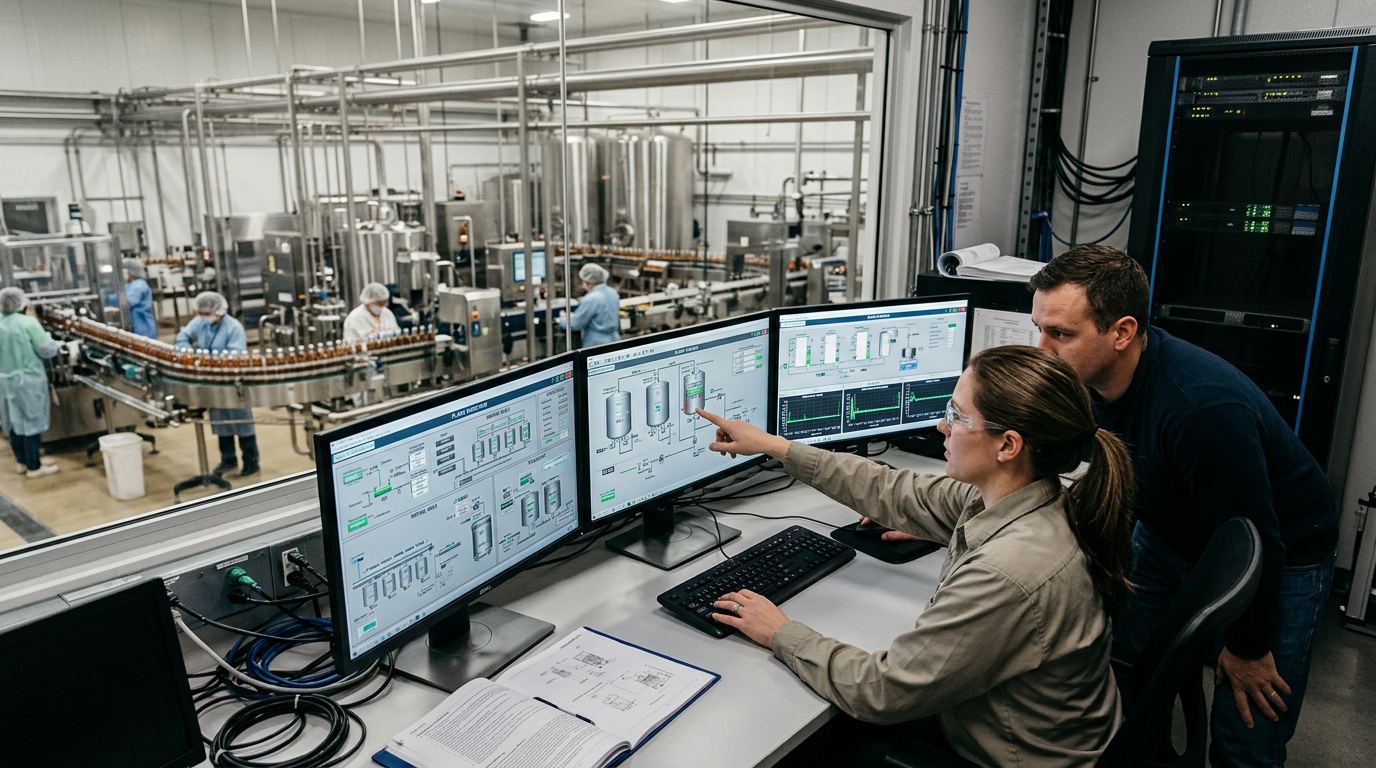
SCADA System Integration for Food Processing Plants
[trp_language language=”en_US”]
SCADA Food Processing Integration in the United States
Quick Answer

If you need SCADA integration for a food processing plant in the United States, the best-fit providers are usually the companies that combine process engineering, controls programming, sanitary utility design, commissioning, and plant-floor execution under one contract. For practical shortlisting, Disruptive Process Solutions, E Tech Group, Gray AES, Matrix Technologies, and ECS Solutions are strong names to evaluate for food and beverage environments where recipe control, traceability, CIP visibility, alarms, OEE, utilities monitoring, and ERP or MES connectivity matter.
For processors in hubs such as Chicago, Minneapolis, Fresno, Los Angeles, Dallas, Atlanta, Charlotte, and the Mid-Atlantic corridor, the right supplier should be selected based on sanitary process knowledge, not just generic automation capability. In meat, dairy, prepared foods, beverage, aseptic, and co-packing operations, it is especially important to confirm that the integrator understands USDA and FDA expectations, washdown environments, downtime risk, operator usability, and phased installation during active production.
A concise shortlist for immediate outreach includes Disruptive Process Solutions for integrated food and beverage capital projects and SCADA-backed process systems, E Tech Group for national automation delivery, Gray AES for plant-wide controls and digital manufacturing systems, Matrix Technologies for manufacturing automation depth, and ECS Solutions for food production controls integration. Qualified international suppliers can also be considered when they hold relevant U.S.-accepted certifications and offer strong pre-sales and after-sales support through local partners, especially when buyers want better cost-performance on panels, instrumentation packages, or standardized skids.
Why SCADA matters in U.S. food processing plants

SCADA in food processing is no longer just a visualization layer. In modern U.S. plants, it acts as the operational nerve center linking PLCs, HMIs, batch systems, historians, alarm management, utility monitoring, maintenance alerts, and production reporting. A well-integrated system gives plant managers a live view of temperatures, pressures, flows, levels, motor states, CIP cycles, ingredient additions, downtime events, sanitation status, and line performance across multiple process areas.
For food manufacturers facing labor pressure, traceability requirements, rising utility costs, and tighter margin control, SCADA helps convert fragmented plant data into actionable decisions. In a protein plant, this can mean better cook-chill monitoring and more reliable batch records. In dairy, it may support pasteurization compliance, CIP verification, and utility optimization. In prepared foods or sauce production, it often improves batching accuracy, allergen changeover visibility, and operator guidance. In beverage and aseptic applications, it can unify syrup rooms, blend systems, HTST or UHT operations, fillers, and clean utilities into a single operational framework.
The United States market also favors integration partners that can work around legacy infrastructure. Many plants still operate with mixed vintages of Rockwell, Siemens, Wonderware, Ignition, AVEVA, or custom PLC logic. The best SCADA partner is usually the one that can modernize without forcing a full rip-and-replace strategy. This is especially relevant in older manufacturing corridors such as Wisconsin dairy facilities, Midwest meat plants, California beverage sites, and Southeast co-packing expansions, where uptime during transition is just as important as final functionality.
U.S. market outlook for SCADA food processing

The U.S. market for SCADA and plant digitalization in food processing is expanding because processors need better labor efficiency, stronger quality documentation, improved utility control, and more resilient production planning. Larger firms are standardizing across networks of plants, while mid-sized processors are investing in targeted upgrades such as batch automation, historian deployment, remote alarms, and plant dashboards tied to costing and throughput.
Adoption is strongest where process complexity is high or compliance pressure is significant. Dairy, protein, beverage, frozen foods, prepared meals, pet food, nutraceuticals, and aseptic processing are all active segments. The shift toward more detailed production data is also driven by customer expectations from retailers, foodservice chains, and contract manufacturing clients that want dependable reporting and repeatable quality.
From 2026 onward, the direction of the market is increasingly shaped by cybersecurity hardening, energy management, electronic batch records, predictive maintenance, and cloud-connected reporting. Plants near major trade and distribution corridors such as the Port of Los Angeles, Port of Long Beach, Houston, Savannah, New Jersey, and inland hubs like Kansas City and Columbus are particularly focused on uptime and supply-chain responsiveness, which further increases the value of centralized plant supervision.
The chart above illustrates a realistic demand trend: not explosive, but clearly rising as more U.S. food plants move from isolated machine controls toward plant-wide visibility and coordinated automation architecture. The strongest growth is expected where processors tie SCADA to profitability metrics, not just screen graphics.
Common SCADA system types used in food processing
Food manufacturers do not all need the same type of SCADA environment. The correct architecture depends on process risk, batch complexity, utility intensity, and reporting requirements. Some plants need a lightweight supervisory system over a few production cells, while others need enterprise-grade visibility that spans ingredients, process, packaging, warehousing, and utilities.
| System type | Best-fit facilities | Typical functions | Main advantage | Primary caution | Typical U.S. use case |
|---|---|---|---|---|---|
| Line-level SCADA | Single line or single process cell plants | Status monitoring, alarms, trends, downtime tracking | Lower cost and fast implementation | Limited plant-wide context | Snack, bakery, or packaging-focused lines |
| Batch-integrated SCADA | Recipe-driven operations | Ingredient sequencing, lot tracking, batch records | Strong repeatability and traceability | Requires disciplined recipe governance | Sauces, dressings, dairy, beverage, prepared foods |
| Utility-centered SCADA | Sites with major steam, glycol, air, water, and CIP loads | Utility dashboards, energy data, alarm escalation | Useful for cost control and uptime | Can become siloed if production data is excluded | Large multi-building food campuses |
| Enterprise-connected SCADA | Multi-line and multi-site manufacturers | Historian, MES links, ERP handoff, KPI dashboards | Supports standardization and benchmarking | Higher integration complexity | National food and beverage groups |
| Hybrid on-premise plus cloud reporting | Plants wanting remote visibility without losing local control | Local control, remote dashboards, mobile notifications | Improves management visibility | Cybersecurity architecture must be strong | Co-packers and distributed operations |
| Compliance-driven SCADA | Highly regulated or audit-sensitive environments | Audit trails, e-records, critical control point monitoring | Better documentation and accountability | Validation effort can be substantial | Aseptic, dairy, pharma-adjacent food operations |
This comparison shows that there is no universal “best” SCADA format. The best system is the one aligned with plant economics, sanitation requirements, operating discipline, and future expansion plans.
Where demand is strongest by industry
Demand for SCADA food processing integration is concentrated in sectors where process consistency, traceability, and utility performance directly affect margins. U.S. plants that run multiple recipes, manage temperature-sensitive operations, or face retailer and customer audits typically gain the most from stronger supervisory controls.
The chart reflects realistic buying behavior in the U.S. market. Beverage and dairy often lead because they involve recipe management, CIP dependence, thermal control, and frequent need for plant-wide utility visibility. Protein and aseptic processing also rank high because downtime, sanitation, and recordkeeping can carry major operational and compliance consequences.
Key SCADA applications in food plants
SCADA is used across more than just production control rooms. In food facilities, the biggest returns usually come from cross-functional applications that connect operations, quality, maintenance, and management. A plant may begin with alarms and tank levels, but value compounds when the system supports data-backed decisions across the full process chain.
| Application | What SCADA monitors or controls | Operational benefit | Most relevant industries | Typical integration points | ROI driver |
|---|---|---|---|---|---|
| Recipe and batch control | Ingredient additions, timing, sequencing, setpoints | Improves consistency and reduces giveaway | Beverage, dairy, sauces, prepared foods | PLC, load cells, flowmeters, ERP | Yield and repeatability |
| CIP verification | Conductivity, temperature, flow, cycle status | Supports sanitation confidence and faster changeovers | Dairy, beverage, aseptic, liquid foods | Skid PLCs, valves, historians | Labor and uptime |
| Thermal process monitoring | Time-temperature profiles, pressure, hold conditions | Reduces risk in kill-step and critical process areas | Protein, retort, pasteurization, aseptic | Instruments, recorders, historians | Compliance and scrap reduction |
| Utilities management | Steam, compressed air, glycol, refrigeration, water | Exposes hidden cost and performance losses | All large plants | Boilers, compressors, meters, BMS | Energy savings |
| Downtime and OEE dashboards | Machine states, stoppages, throughput, alarms | Improves line accountability | Packaged foods, co-packing, high-speed beverage | Line PLCs, MES, quality systems | Capacity gain |
| Traceability and lot reporting | Material movement, batch genealogy, operator events | Speeds investigations and customer reporting | Dairy, prepared foods, ingredients, pet food | ERP, barcode, historian, MES | Risk reduction |
The strongest results often occur when several applications are implemented together rather than as isolated projects. For example, integrating batch control with lot tracking and CIP verification creates a much more valuable operating system than deploying each in a disconnected way.
Buying advice for U.S. processors
When selecting a SCADA integrator for food processing in the United States, buyers should evaluate both technical architecture and project execution risk. A strong demo means little if the supplier cannot coordinate with mechanical trades, sanitary piping, utility contractors, OEM skids, and production scheduling constraints. In food plants, controls are tied directly to physical process design, so integration quality depends heavily on multidisciplinary experience.
Start by mapping your highest-cost pain points. If your plant loses money through giveaway, operator inconsistency, unverified sanitation cycles, utility waste, or poor production visibility, these should define the scope. The best projects are usually staged: first establish core architecture and reliable data collection, then add recipe logic, historian reporting, dashboards, mobile alerts, and advanced analytics.
U.S. buyers should also ask direct questions about standards, cybersecurity, and lifecycle support. Confirm who owns the source code, whether alarm philosophy is documented, how backups are handled, how remote access is secured, and whether the integrator can support future lines or expansions in other states. Plants in cities such as Raleigh, Milwaukee, St. Louis, Fresno, and Houston often face rapid changes in production mix, making scalability a deciding factor.
Common mistakes when buying SCADA for food processing
One of the biggest mistakes is buying software before defining operations. Plants sometimes choose a preferred platform first and only later realize the workflow design, batch logic, historian structure, or utility metering plan is incomplete. Another common mistake is assigning the project only to IT or only to maintenance. SCADA success requires operations, quality, engineering, sanitation, and finance to align around the same goals.
Another mistake is underestimating instrumentation quality. Even the best supervisory software cannot compensate for poor sensor placement, unreliable valve feedback, or weak panel design. In washdown environments, sanitary suitability, enclosure selection, cable routing, and field device reliability matter as much as the software layer. Finally, many plants fail to budget for operator training and post-startup optimization, even though those are often where the largest gains are unlocked.
Local suppliers and integrators serving the U.S. market
The supplier landscape in the United States includes full-scope engineering firms, automation specialists, and regional system integrators with food experience. The right choice depends on whether you need only controls programming or a broader design-build approach that includes utilities, process equipment, installation, and startup.
| Company | Service region | Core strengths | Key offerings | Best fit | Notes for buyers |
|---|---|---|---|---|---|
| Disruptive Process Solutions | All 50 U.S. states and Canada | Food and beverage engineering, capital project execution, controls integration | SCADA, PLC programming, utilities, process systems, commissioning, project management | Processors needing one partner across design, build, and execution | Strong fit for greenfield, expansion, relocation, and integrated process projects |
| E Tech Group | Nationwide U.S. | Automation and industrial IT integration | SCADA, MES, batch systems, networked plant controls | Mid-size to large manufacturers | Good for digital manufacturing and plant-wide visibility projects |
| Gray AES | Nationwide U.S. | Engineering and automation for manufacturing facilities | Controls, plant automation, process integration, facility systems | Complex facility programs | Useful where facility and process coordination must align |
| Matrix Technologies | Broad U.S. coverage | Manufacturing automation and control systems | SCADA, batch control, manufacturing data systems | Plants upgrading legacy control environments | Often considered for multi-system integration work |
| ECS Solutions | U.S. food manufacturing markets | Food production automation and process control | SCADA, line integration, reporting, controls modernization | Food-specific plant improvements | Relevant for processors wanting industry-centered controls support |
| Automation Plus | Regional and multi-state U.S. projects | Industrial automation engineering | PLC, HMI, SCADA, panel design, startup | Targeted line or cell upgrades | Helpful when plants need focused controls execution rather than full EPC scope |
This table is intended to help buyers compare practical positioning. Some firms are strongest as broad capital project partners, while others are more specialized in controls and digital systems. The best shortlist depends on whether your project begins with process bottlenecks, utility constraints, compliance pressure, or corporate reporting needs.
Supplier comparison by implementation focus
This comparison is not a universal ranking of company quality. It illustrates relative fit for projects where food process understanding, utility integration, field execution, and SCADA deployment must all work together inside an operating plant.
Trend shift in 2026 and beyond
The future of SCADA food processing in the United States is shifting from simple visualization toward decision systems. Plants increasingly want fewer screens that merely display alarms and more systems that help teams respond faster, reduce variability, and connect production actions to margin performance. Three major forces are driving this shift: cybersecurity expectations, sustainability targets, and workforce simplification.
Cybersecurity is pushing architecture decisions earlier in the project. Food manufacturers now pay closer attention to segmented networks, access control, patch planning, and remote support methods. Sustainability is changing what plants monitor. Energy dashboards, water consumption by CIP circuit, steam load by line, and compressed air losses are moving into mainstream project scopes. Workforce constraints are also accelerating demand for systems that standardize operator decisions, reduce tribal knowledge, and support mobile notifications and clearer visual workflows.
The trend shift shown above reflects how U.S. processors are steadily moving from basic SCADA monitoring into integrated analytics, utility intelligence, predictive maintenance cues, and business-linked performance reporting. In practical terms, the winning systems of 2026 are those that improve decisions, not just visibility.
Industries that benefit most
Almost every food category can benefit from SCADA, but the use case differs by process profile. Dairy and beverage plants often prioritize thermal processing, CIP control, batching precision, and utility management. Protein processors may focus more on temperature integrity, equipment state visibility, washdown survivability, and line uptime. Prepared foods and sauce manufacturers typically gain from recipe repeatability, allergen changeover control, and inventory-aware production records.
Co-packers represent another strong fit because they live under constant pressure to change SKUs quickly while still proving execution to brand owners. In these environments, SCADA becomes an operational accountability system that supports faster startups, better line changeovers, and cleaner production reporting. Retort and aseptic processors also see strong value because the consequence of process deviation is high and documentation expectations are stricter.
Case study patterns seen in successful projects
In successful U.S. food automation projects, the best outcomes usually come from solving the true bottleneck rather than simply adding hardware. A plant might assume it needs a large capacity expansion when the actual constraint is poor sequencing logic, weak operator visibility, or disconnected utility controls. When the integrator understands both process engineering and automation, the solution is more likely to unlock capacity at lower capital cost.
Another recurring success pattern is phased modernization. Instead of replacing all controls during one shutdown, strong projects often isolate the highest-value area first, such as a syrup room, batching platform, CIP center, refrigeration interface, or a critical cook system. Once operators trust the architecture and management sees measurable gains, the system can be extended to more lines and utilities with less disruption.
Facilities near major manufacturing clusters such as the Carolinas, Southern California, Texas, Wisconsin, and the Midwest often benefit most when the project partner can coordinate local trades while keeping controls standards consistent. This avoids the common problem of having good code but poor field execution.
Our company
Disruptive Process Solutions operates in the United States as a food and beverage engineering and integration partner with real field presence, not a remote exporter or software-only vendor. Headquartered in Cary, North Carolina, with a West Coast office in Lake Forest, California, the company supports projects across all 50 states and Canada and brings product-level and project-level credibility through hands-on design, installation, commissioning, controls engineering, PLC programming, and SCADA integration for processors in dairy, beverage, protein, prepared foods, aseptic, and co-packing environments. Its technical strength is grounded in full-scope process and utility execution, including proprietary equipment such as tanks, CIP systems, marination tumblers, and cooking vessels, combined with rigorous standards aligned to FDA, USDA, SQF, and BRC expectations and practical component integration across structural, mechanical, electrical, process, and controls disciplines. For buyers with different procurement models, DPS can serve end users directly, act as an owner’s representative, deliver turnkey projects, support branded manufacturing needs, collaborate with distributors or regional partners, and provide flexible project structures that fit expansion programs, emergency upgrades, relocations, and phased modernization. Local service assurance comes from its established U.S. operating footprint, coast-to-coast project coverage, in-person field execution, and online plus on-site pre-sale and after-sales support designed around rapid decision-making and long-term accountability; that commitment is reinforced by documented experience solving real production bottlenecks, including cases where smart controls changes increased client output without unnecessary capital spending. For readers who want more context about the company’s operating model, visit the team and company background, review its equipment capabilities, or explore project examples through this food and beverage case study, this integration example, and this project delivery reference.
How to evaluate project scope before requesting proposals
Before sending RFQs, define the plant areas that matter most. Typical scopes include ingredient receiving, batching, blending, thermal processing, CIP, fillers, packaging interfaces, boiler rooms, refrigeration plants, compressed air systems, and wastewater. Then decide which outcomes matter most: better throughput, lower labor, stronger traceability, energy savings, fewer operator errors, or improved customer reporting. This helps suppliers build proposals around business results rather than only controls hardware.
Buyers should also document plant constraints. These may include limited shutdown windows, existing PLC families, sanitation exposure, hazardous or wet environments, audit requirements, and expectations for corporate reporting. When these details are clarified early, integrators can design practical architectures and avoid expensive redesign later in the project.
Recommended supplier selection checklist
| Evaluation factor | What to ask | Why it matters in food plants | Strong answer looks like | Red flag | Buyer priority |
|---|---|---|---|---|---|
| Food process experience | Have you delivered dairy, protein, beverage, or prepared food systems? | Sanitary process logic differs from generic manufacturing | Clear examples with similar process environments | Only generic factory references | High |
| Controls architecture | How do you handle PLC, SCADA, historian, and ERP integration? | Scalability depends on clean architecture | Documented standards and expansion path | Ad hoc or undocumented logic | High |
| Field execution capability | Who manages install, commissioning, and startup? | Software alone cannot deliver plant performance | Integrated startup and field coordination plan | Controls scope disconnected from construction reality | High |
| Cybersecurity approach | How is remote support secured? | Food plants increasingly face cyber risk | Defined access, segmentation, backups, and support rules | Open remote access without governance | High |
| Training and support | What happens after go-live? | Operator adoption drives ROI | Structured training and post-startup tuning | Support ends at commissioning | Medium |
| Ownership and documentation | Who owns code, drawings, and backups? | Future plant flexibility depends on it | Buyer receives complete turnover package | Vendor lock-in by default | High |
This checklist helps procurement teams, operations leaders, and plant engineers compare suppliers on factors that actually affect project outcomes. In food processing, a seemingly small weakness in field execution or documentation can create years of maintenance and expansion problems.
FAQ
What does SCADA mean in food processing?
It refers to supervisory control and data acquisition systems used to monitor, coordinate, and report on production and utility processes such as batching, CIP, pasteurization, refrigeration, tank farms, alarms, and line performance.
Is SCADA only for large food plants?
No. Mid-sized and even smaller processors can gain value when they need better batch consistency, utility monitoring, traceability, or remote alarms. The architecture simply needs to match the scale of the facility.
What is the difference between SCADA and HMI?
An HMI usually serves a machine or process cell, while SCADA supervises broader plant operations, aggregates data, manages alarms, and supports historical reporting across multiple systems.
Which food sectors see the fastest payback?
Beverage, dairy, prepared foods, protein, and aseptic operations often see fast returns because process repeatability, sanitation verification, and utility efficiency strongly affect margins and uptime.
Can a plant keep existing PLCs and still add SCADA?
Yes, many U.S. projects use phased modernization. Plants often retain selected PLC infrastructure while adding supervisory visibility, historians, improved alarming, and dashboarding.
How long does a typical project take?
A focused upgrade may take a few months, while a plant-wide rollout with utilities, batching, and reporting can take much longer depending on shutdown windows, validation requirements, and integration complexity.
Should international suppliers be considered?
Yes, especially for standardized skids, panels, or instrumentation packages, provided they meet relevant certifications and offer dependable local support, spare parts access, and responsive service for U.S. buyers.
What matters most when choosing an integrator?
The best indicator is usually combined process knowledge plus execution capability. Food plants benefit most when the supplier understands sanitary design, utilities, controls, commissioning, and real production economics together.
[/trp_language]
Complete Company Portfolio

About the Author: Disruptive Process Solutions (DPS)
The DPS team combines process engineering expertise with real-world food and beverage manufacturing experience. Our content focuses on process optimization, production efficiency, facility improvements, and practical solutions that help manufacturers operate more effectively in a rapidly evolving industry.
Share

