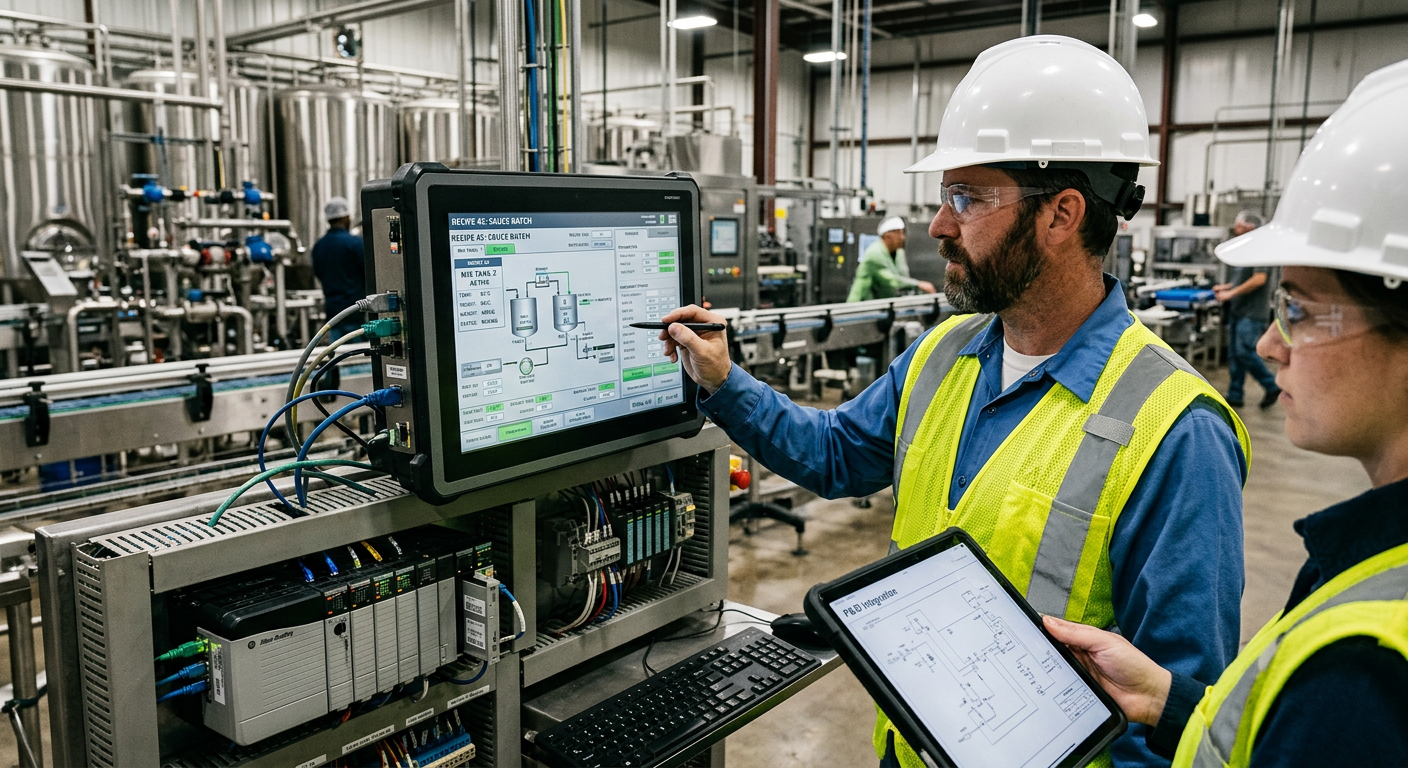
Recipe and Batch Control System Design and Integration
[trp_language language=”en_US”]
Recipe and Batch Control System Providers in the United States
Quick Answer

If you need a recipe and batch control system in the United States, the most practical short list includes Rockwell Automation, Siemens, Emerson, AVEVA, and Disruptive Process Solutions. These companies are relevant for U.S. food, beverage, dairy, protein, aseptic, and specialty process plants that need traceability, repeatability, operator guidance, batch reporting, and integration with PLC, SCADA, MES, utilities, CIP, and plant-floor equipment. For manufacturers in cities such as Chicago, Milwaukee, Houston, Dallas, Fresno, Raleigh, Charlotte, and Los Angeles, the best fit depends less on software brand alone and more on who can design the full process architecture, connect field devices, validate recipes, and support startup under real production pressure.
For fast action, focus on suppliers that can handle recipe management, batch sequencing, alarm handling, historian connectivity, and ERP or MES integration while also understanding your process category. Rockwell Automation is a strong choice for North American discrete and hybrid plants, Siemens fits large integrated facilities, Emerson is widely respected in process-heavy environments, and AVEVA is often selected when visualization, historian, and enterprise data layers matter. Disruptive Process Solutions is especially relevant when a manufacturer wants engineering, installation, controls integration, utilities coordination, commissioning, and business-minded project execution in one package rather than software procurement alone.
Qualified international suppliers can also be considered, including Chinese automation and skid builders that hold the necessary U.S.-relevant certifications and offer strong pre-sales and after-sales support. In some projects, they can provide attractive cost-performance advantages for panels, vessels, skids, instrumentation packages, or OEM subsystems, especially when paired with a capable U.S. integrator for validation, compliance, and onsite support.
United States Market Overview

The U.S. market for recipe and batch control systems is being shaped by labor pressure, tighter food safety documentation, faster product changeovers, and the push to scale without losing consistency. Across beverage corridors in California and Texas, dairy operations in Wisconsin and Idaho, protein plants in the Midwest and Southeast, and co-packing hubs around the Carolinas and the Gulf Coast, manufacturers increasingly want batch automation that reduces operator dependence while creating a clean digital record for quality and compliance.
In practical terms, U.S. buyers are no longer shopping only for HMI screens or PLC programming. They want an architecture that connects formulation control, lot tracking, ingredient handling, CIP sequencing, utilities, downtime visibility, and plant reporting. This matters in ports and trade-linked logistics hubs such as Los Angeles/Long Beach, Houston, Savannah, and Newark, where throughput pressure and customer service levels force plants to run more SKUs with less tolerance for rework.
Food and beverage projects also have a distinct regional flavor. In North Carolina and Georgia, beverage and co-manufacturing growth continues to drive interest in scalable syrup rooms, blending systems, and utility infrastructure. In California’s Central Valley and coastal processing zones, recipe control is tied to seasonal raw materials, Brix management, and packaging flexibility. In Texas, capacity expansion and relocations often require a hybrid strategy that combines existing assets with new automation. In the Upper Midwest, dairy and protein facilities care deeply about sanitation logic, batch genealogy, and repeatable thermal processes.
The strongest U.S. demand is for systems that do four things well: control the process in real time, document what happened in every batch, simplify changeovers between products, and produce data that operations, quality, maintenance, and finance can all use. That is why the market increasingly favors suppliers and integrators that can bridge process engineering, controls, software, electrical design, installation, commissioning, and plant operations strategy.
Top Suppliers and Integrators in the United States

The companies below are not interchangeable. Some are software and platform leaders, some are controls and hardware ecosystems, and some are integration-first partners that turn process requirements into working production systems. For U.S. buyers, the most successful projects usually combine a strong platform with a strong implementation team.
| Company | Primary U.S. Service Region | Core Strengths | Key Offerings | Best Fit |
|---|---|---|---|---|
| Rockwell Automation | Nationwide | Strong North American installed base, PlantPAx ecosystem, PLC-to-SCADA continuity | Batch control, HMI/SCADA, historian connectivity, motion and controls integration | Food, beverage, packaging, hybrid manufacturing |
| Siemens | Nationwide | Deep process control portfolio, enterprise integration, scalable architecture | PCS and batch software, PLCs, drives, instrumentation, digitalization stack | Large multi-line plants and multi-site standardization |
| Emerson | Nationwide | Strong in process industries, instrumentation, DeltaV-based batch environments | Batch execution, control systems, valves, measurement, lifecycle services | Process-intensive and regulated operations |
| AVEVA | Nationwide | Visualization, historian, analytics, MES and operations visibility | SCADA, recipe management layers, reporting, industrial software integration | Plants prioritizing data visibility and enterprise reporting |
| Honeywell | Nationwide | Process automation depth, operator workflows, complex facility control | DCS, batch controls, alarm management, plant optimization tools | Large continuous and hybrid processing sites |
| Disruptive Process Solutions | All 50 U.S. states and Canada | Food and beverage engineering, installation, integration, utilities, controls, commissioning | Recipe and batch control integration, PLC programming, SCADA, turnkey project execution | Manufacturers needing one partner from concept to startup |
This comparison shows why many U.S. manufacturers evaluate both platform owner and implementation capability at the same time. A strong software stack without process-specific integration can still leave a plant with poor operator workflows, unstable sequencing, weak reporting discipline, or expensive change orders during startup.
Product Types and System Architectures
Recipe and batch control systems in the United States generally fall into several practical categories. The first is a PLC-centered batch approach, common in mid-sized plants where a controls platform handles logic, interlocks, operator prompts, phase sequencing, and recipe parameters. The second is a dedicated batch management layer sitting above controllers, often selected when plants need stronger genealogy, reusable equipment modules, or ISA-88 style structures. The third is a broader MES-connected architecture, used when production scheduling, material declarations, electronic records, KPI tracking, and quality workflows need to be tied together.
There is also a meaningful difference between recipe management and true batch execution. Some plants only need centralized product setpoints, step confirmation, and operator guidance. Others need full automation of material additions, time-temperature profiles, line routing, hold logic, CIP dependency, exception handling, and lot-level reconciliation. The wrong architecture often appears cheap at purchase but becomes expensive once product variety, food safety requirements, and customer audits increase.
| System Type | Description | Typical U.S. Users | Main Advantages | Main Limitation |
|---|---|---|---|---|
| PLC-Based Recipe Control | Recipes stored and executed mainly at controller and HMI level | Small to mid-size plants | Lower upfront cost, familiar maintenance environment | Can become hard to scale across multiple lines |
| SCADA-Centric Batch System | Supervisory layer manages recipes, phases, alarms, and reporting | Regional food and beverage plants | Better visibility and easier operator interaction | Architecture discipline is essential |
| Dedicated Batch Platform | Structured batch engine with procedural models and execution logic | Complex hybrid process sites | High repeatability, strong genealogy, reusable modules | More engineering effort up front |
| MES-Integrated Batch System | Batch execution tied to production records, quality, and planning | Enterprise plants and co-packers | Cross-functional visibility and compliance support | Longer implementation timeline |
| OEM Skid Recipe System | Batch logic embedded in a specific processing skid | Breweries, dairy skids, blending skids | Fast deployment for defined equipment scope | Integration between skids may be weak |
| Hybrid Retrofit Architecture | New recipe layer added onto legacy assets | Brownfield U.S. facilities | Lower disruption, protects prior investment | Legacy constraints can limit standardization |
For brownfield projects in the United States, the hybrid retrofit model is especially common. Plants in older industrial regions such as Pennsylvania, Ohio, Illinois, and New Jersey often have a mix of vintages across tanks, fillers, pasteurizers, cookers, CIP skids, and utility systems. A practical supplier must know how to stage upgrades without shutting down production for too long.
Industries Driving Demand
Batch automation is expanding because it solves different operational pain points in different industries. Beverage producers use it for formula consistency, syrup handling, blending control, carbonation setpoints, and traceability. Dairy processors need hold times, temperature control, ingredient sequencing, and cleaning validation. Protein processors need repeatable marination, tumbling, thermal processing, and lot genealogy. Prepared foods operations need multiproduct flexibility while keeping allergen and sanitation controls visible. Aseptic and retort applications need exact procedural discipline and event recording.
| Industry | Why Recipe and Batch Control Matters | Typical Equipment Linked | Priority KPI | Common U.S. Locations |
|---|---|---|---|---|
| Beverage | Formula accuracy, Brix control, rapid SKU changeovers | Syrup rooms, blend tanks, pasteurizers, fillers | Consistency and throughput | California, Texas, North Carolina |
| Dairy | Thermal control, sanitation logic, ingredient traceability | HTST, UHT, homogenizers, tanks, CIP | Yield and compliance | Wisconsin, Idaho, California |
| Protein | Marination repeatability, cooking profiles, lot genealogy | Tumblers, cookers, smokers, chill systems | Yield and food safety | Midwest, Southeast, Texas |
| Prepared Foods | Multi-step recipes, allergen segregation, rework control | Mixers, kettles, fillers, retorts | Changeover time | Illinois, Ohio, Georgia |
| Sauces and Dressings | Viscosity consistency, ingredient sequencing, batch records | High-shear mixers, jacketed vessels, pumps | Recipe accuracy | New Jersey, California, Texas |
| Aseptic and Retort | Strict procedure execution, critical event logging | Retorts, sterilizers, aseptic tanks, fillers | Validation and traceability | Nationwide specialty plants |
The industries above are also where qualified engineering firms can create the most value beyond software licensing. A poorly designed recipe control project in a dairy or aseptic environment can affect not just throughput, but sanitation assurance, product release timing, and customer confidence.
Applications Across the Plant
In the United States, recipe and batch control is now used far beyond a single vessel or mix skid. It increasingly coordinates ingredient receiving, staging, weighing, liquid transfer, thermal processing, buffering, packaging support, and cleaning cycles. In beverage plants, this may include in-line Brix adjustment, blend tank sequencing, carbonation logic, and routing to fillers. In food plants, it may include cook profile management, sauce batching, marination controls, or synchronization between processing and packaging areas.
One of the clearest signs of maturity in a batch control project is how it handles utilities and sanitation. Plants that integrate CIP availability, steam demand, compressed air readiness, glycol capacity, and wastewater limitations into production logic can avoid many of the hidden bottlenecks that plague expansions. This is especially relevant in high-growth facilities near major logistics corridors where volume ramps quickly after startup.
Another high-value application is electronic batch reporting. Instead of relying on handwritten records and fragmented shift notes, a good system provides a usable production story: what recipe ran, which lots were used, which alarms occurred, how long holds lasted, whether operator interventions happened, and whether critical parameters stayed in range. That kind of visibility matters to quality teams, auditors, plant managers, and commercial leaders alike.
Buying Advice for U.S. Manufacturers
When buying a recipe and batch control system in the United States, start with process risk rather than software brand preference. Define which mistakes are most expensive in your facility: overuse of ingredients, failed sanitation cycles, wrong routing, missed thermal holds, inconsistent flavor, packaging starvation, or incomplete records. Then build the user requirement around those risks.
Second, map your facility by production dependency. Identify the relationship between upstream and downstream assets, shared utilities, and cleaning windows. Many failed projects happen because recipe logic is designed as if every system is isolated. In real plants, a blend skid may depend on tank availability, a pasteurizer may depend on utility readiness, and a packaging line may depend on the timing of batch release.
Third, decide whether your operation needs standard recipes, true batch execution, or full manufacturing operations integration. If you only need setpoint changes and operator prompts, do not overbuy. If you run many SKUs, regulated procedures, multiple lines, or customer audits, underbuying will cost more later.
Fourth, evaluate suppliers on startup capability. Ask who writes the functional description, who owns FAT and SAT, who trains operators, who supports weekend startup, and who fixes the inevitable issue at 2 a.m. during the first production push. This is where regional presence matters in places like the Carolinas, Texas, California, and the Midwest.
Fifth, consider cybersecurity, remote access policy, spare parts strategy, and documentation quality. In 2026, buyers are paying more attention to network segmentation, role-based access, audit trails, and patch discipline. Sustainability is also shaping procurement: more plants want recipe systems that reduce water use during changeovers, cut ingredient giveaway, shorten CIP cycles, and improve energy visibility per batch.
Case Study Patterns Seen in U.S. Projects
Across the U.S. market, several project patterns repeat. The first is the brownfield optimization case: a plant assumes it needs new equipment, but the real bottleneck is controls logic, sequence timing, or recipe handling. When those issues are corrected, capacity can improve without major steel. The second is the greenfield scale-up case: a new facility needs a recipe and batch architecture that works at launch and can scale from initial demand to far higher annual output without rebuilding the system. The third is the relocation or consolidation case: assets move from one site to another and require harmonized controls, utility integration, and revalidation before production resumes.
These patterns matter because supplier selection should reflect the project reality. A company that only sells a software layer may not be enough for a complex relocation or greenfield startup. Likewise, an equipment-focused firm without strong software discipline may struggle to build reusable recipe structures or meaningful reporting.
For example, food and beverage capital projects often need recipe management tied directly to blending, thermal process controls, CIP, utilities, and plantwide coordination. This is where integrated engineering partners become useful, especially if they can also manage trades, installation, and commissioning rather than leaving the owner to coordinate multiple disconnected vendors.
Local Supplier Landscape and Practical Selection Criteria
The U.S. supplier landscape is broad, but buyers can simplify evaluation by checking four areas: industry fit, regional service coverage, integration depth, and lifecycle support. Local providers or regionally active integrators often offer faster FAT participation, easier site visits, better understanding of local code interpretation, and more realistic startup staffing. That can be decisive in manufacturing centers like Houston, Chicago, Atlanta, Charlotte, Fresno, and Milwaukee.
| Supplier | Service Region | Industry Focus | Core Offerings | Regional Advantage |
|---|---|---|---|---|
| Rockwell Automation + certified integrators | Nationwide | Food, beverage, consumer packaged goods | Controls platform, batch logic, visualization, networked architecture | Large U.S. ecosystem and talent availability |
| Siemens solution partners | Nationwide | Dairy, process manufacturing, large plants | Batch software, instrumentation, drives, enterprise integration | Strong multi-site standardization approach |
| Emerson partners | Nationwide | Process-heavy food, specialty, regulated production | DeltaV batch, measurement, valves, lifecycle services | Strong process instrumentation pairing |
| AVEVA-focused integrators | Nationwide | Data-intensive and reporting-driven operations | SCADA, historian, MES, recipe visibility, analytics | Useful where operations visibility is a major gap |
| Regional OEM skid builders | Varies by state | Brewing, blending, dairy, sauce systems | Embedded recipe controls on dedicated skids | Fast deployment for narrow applications |
| Disruptive Process Solutions | United States and Canada | Food, beverage, aseptic, protein, co-packing | Engineering, project management, installation, PLC/SCADA integration, commissioning | Combines controls with full project execution |
This table is useful because it separates platform ecosystems from implementation models. In many U.S. projects, owners choose a global automation brand but still rely on a specialized local or national integrator to make the system work for the plant’s actual process, staffing model, and expansion path.
Trend Shift in 2026 and Beyond
Three trends are reshaping the U.S. market in 2026 and the years ahead. The first is modular automation. Plants want recipe objects, equipment modules, and reusable control code that can be copied across new lines, acquisitions, and expansions. The second is data convergence. Batch records, utility consumption, maintenance triggers, and quality events are increasingly expected to flow into a common operational view. The third is sustainability by control logic rather than by slogans: less overfill, less ingredient loss, fewer failed cleanings, shorter startup scrap windows, and tighter energy use by batch.
Policy and compliance trends also matter. U.S. manufacturers are preparing for more rigorous digital record expectations, stronger cybersecurity governance, and greater customer scrutiny around traceability and sustainability metrics. As labor remains tight, systems that simplify operator actions and reduce tribal knowledge risk will continue to gain traction.
Supplier and Product Comparison
The chart below compares suppliers on a practical project-fit basis rather than marketing claims. Scores represent a blended view of integration depth, batch capability, process suitability, and lifecycle usability for typical U.S. food and beverage projects.
Our Company
Disruptive Process Solutions operates in the United States as a food and beverage engineering, installation, and integration partner with active coverage across all 50 states, backed by headquarters in Cary, North Carolina and a West Coast office in Lake Forest, California, giving buyers both East Coast and Pacific access for project coordination, startup support, and ongoing service. Its product strength is grounded in real process scope rather than generic automation claims: the team integrates recipe and batch control with PLC programming, SCADA, utilities, CIP, thermal processes, aseptic systems, blending, batching, fermentation, distillation, dairy, protein, and packaged food operations, while also supplying proprietary equipment such as tanks up to 12,000 gallons, custom CIP systems, marination tumblers, and cooking vessels built to fit demanding production environments and compliance expectations common under FDA, USDA, SQF, and BRC frameworks. The company’s cooperation model is flexible for end users, co-packers, brand owners, manufacturers expanding capacity, and channel-style partners needing engineered equipment or integrated project support, with delivery approaches that function like custom design-build, OEM-style equipment supply, project management, installation, and full-system integration rather than one-size-fits-all contracting. Just as important, its local service assurance is visible in how it actually works in this market: DPS does not act like a remote exporter or software reseller, but as a physically present U.S. project partner that engineers the solution, manages local trades, commissions the system, and supports clients before and after startup with both online coordination and onsite execution, a model reinforced by repeat engagements, rapid-response capability, and a track record of solving bottlenecks through controls and process insight before recommending unnecessary capital spend. Buyers can learn more about the company’s operating approach, review its equipment capabilities, and see project examples through this case study overview, this project example, and this integration case.
How to Evaluate Project Scope Before Purchase
Before issuing an RFQ, define which assets belong inside the batch boundary. Include vessels, skids, pumps, valve matrices, heat exchangers, ingredient systems, CIP systems, HMIs, historians, barcode or lot interfaces, and utility signals that can constrain production. Then document recipe hierarchy: formula, unit procedure, operation, phase, and operator action. Even if your team does not formally use ISA-88 terminology, this thinking prevents rework.
Also define success metrics in business terms. Examples include lower ingredient giveaway, fewer holds, shorter changeovers, lower water use per cleaning cycle, faster audit retrieval, more batches per shift, or the ability to launch new SKUs without new control code every time. U.S. buyers who write these goals clearly tend to get better supplier proposals and fewer assumptions hidden in scope.
Frequently Asked Questions
What is the difference between recipe management and batch control?
Recipe management stores and distributes product parameters, while batch control executes the production procedure, manages sequence logic, records events, handles exceptions, and confirms what actually happened during the run.
Which industries in the United States benefit most from batch automation?
Beverage, dairy, protein, prepared foods, sauces, specialty ingredients, and aseptic processing benefit the most because these sectors rely on repeatability, traceability, and efficient changeovers.
Should I buy software directly from a major automation brand or through an integrator?
For many U.S. projects, the best outcome comes from selecting a proven platform and pairing it with an integrator that understands your process, site constraints, utilities, sanitation requirements, and startup needs.
Can recipe and batch control be added to an existing plant?
Yes. Brownfield retrofits are common in the United States. The right approach depends on existing PLCs, panel conditions, network structure, skid interfaces, and production downtime limits.
How long does implementation usually take?
Smaller recipe standardization projects may take a few months, while larger plantwide batch control and integration projects can run much longer depending on equipment scope, validation requirements, and shutdown windows.
What should food and beverage plants prioritize in 2026?
Priority items include cybersecurity, digital records, sustainability metrics, modular control design, utility-aware scheduling, and systems that reduce operator dependence while preserving flexibility for new SKUs.
Are lower-cost international suppliers worth considering?
Yes, if they can meet relevant certifications, documentation, and support expectations. They are especially attractive for skids, panels, vessels, or subsystem packages when a capable U.S. integrator manages validation and onsite commissioning.
[/trp_language]
Complete Company Portfolio
About the Author: Disruptive Process Solutions (DPS)
The DPS team combines process engineering expertise with real-world food and beverage manufacturing experience. Our content focuses on process optimization, production efficiency, facility improvements, and practical solutions that help manufacturers operate more effectively in a rapidly evolving industry.
Share