Hygienic Process Design for Food and Beverage
[trp_language language=”en_US”]
Hygienic Process Design for Food and Beverage Manufacturers in the United States
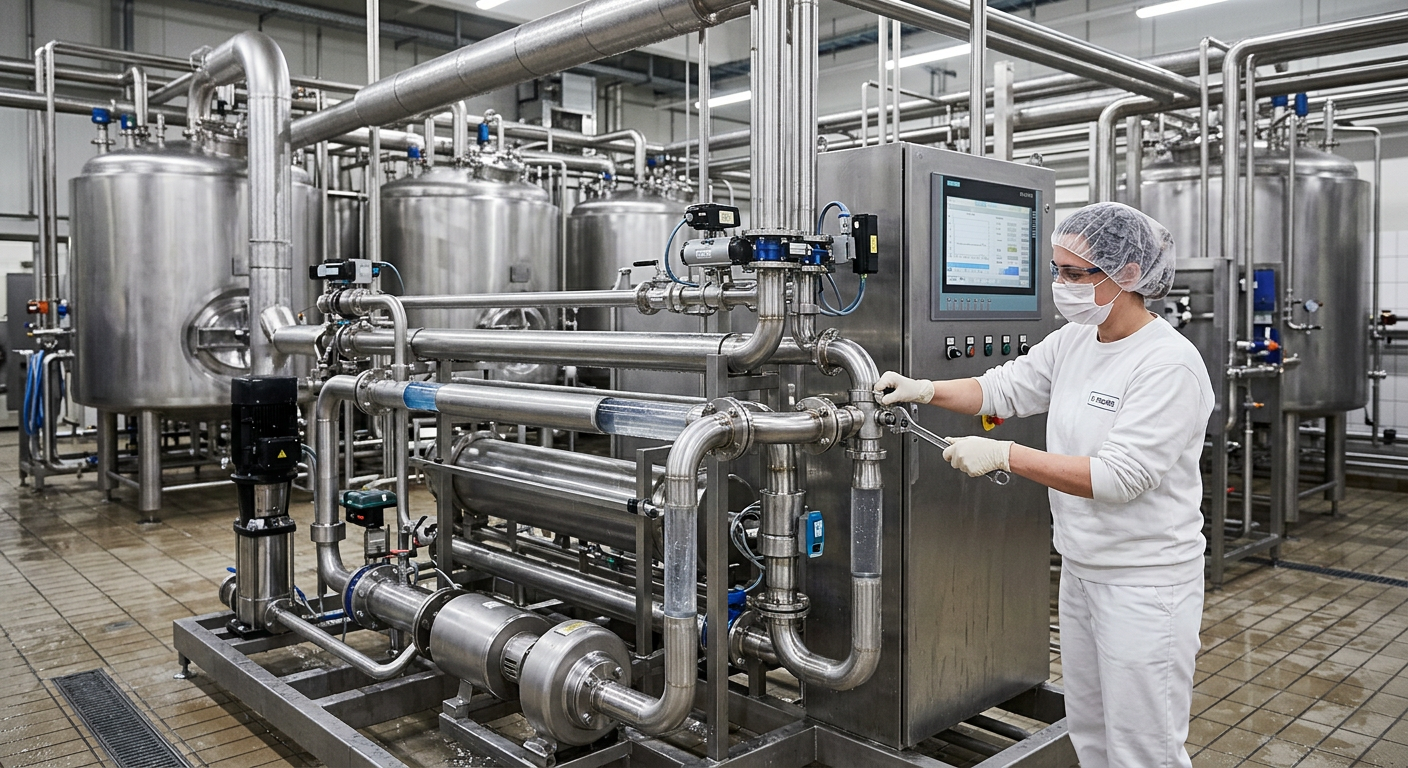
Food and beverage manufacturers in the United States are under constant pressure to improve food safety, reduce downtime, accelerate sanitation, and protect margins. Hygienic process design sits at the center of all four goals. It is not only about choosing stainless steel equipment; it is about shaping entire systems so they can be cleaned effectively, inspected easily, drained fully, and operated consistently under real production conditions. In high-volume markets such as dairy in Wisconsin, protein processing in Texas and Arkansas, beverage production in California, and co-packing near logistics hubs like Chicago, Atlanta, Houston, Savannah, and the Ports of Los Angeles and Long Beach, design errors can quickly become recurring sanitation costs or serious recall risks.
For manufacturers evaluating a retrofit, line expansion, or greenfield build, hygienic design decisions affect piping, tank geometry, utility routing, CIP strategy, zoning, automation, and maintenance access. They also affect capital efficiency. A properly designed process line can shorten wash cycles, reduce chemical use, improve changeover time, and support regulatory readiness for FDA, USDA, SQF, and BRC expectations. Companies seeking an engineering-led partner often prioritize firms that can connect plant design to operations and profitability. That is why many operators reviewing food and beverage engineering services now look beyond basic installation and toward integrated execution models that unite design, build, and project management.
Quick Answer: What Hygienic Process Design Means

Hygienic process design is the practice of engineering food and beverage equipment, piping, utilities, and production spaces so that product contact and nearby non-product-contact surfaces resist contamination, drain completely, can be cleaned and sanitized reliably, and do not create hidden microbial growth points. In the United States, effective hygienic design usually combines sanitary equipment selection, cleanable welds, proper slope, minimized dead legs, appropriate zoning, washdown-ready enclosures, and layout decisions that separate raw, RTE, allergen, and packaging risk.
The fastest way to evaluate whether a process system is hygienically designed is to ask six practical questions. Can every product-contact surface be reached by CIP or COP? Will water drain instead of pool? Are there threads, lap joints, pits, hollow members, or cracked gaskets in exposed areas? Can operators visually inspect the critical surfaces? Does the line prevent cross-traffic between raw and finished goods? Can sanitation verify a repeatable clean every time? If the answer is no to any of these, the system probably needs redesign.
For U.S. buyers, hygienic process design is not a luxury upgrade. It is increasingly a baseline requirement in dairy, beverages, proteins, sauces, aseptic operations, and high-risk ready-to-eat environments. Facilities shipping nationwide from regions like the Carolinas, the Midwest, California’s Central Valley, or the Gulf Coast need designs that hold up under aggressive production schedules and strict retailer expectations.
| Design Element | Why It Matters | Typical U.S. Plant Impact |
|---|---|---|
| Full drainability | Eliminates standing water and product residue | Shorter sanitation cycles and lower microbial risk |
| Minimal dead legs | Prevents trapped product and chemical carryover | Better CIP validation and fewer flavor crossovers |
| Sanitary weld quality | Removes pits, cracks, and roughness | Lower harborages in dairy, beverage, and sauce lines |
| Washdown-rated components | Withstands frequent high-pressure cleaning | Longer equipment life in wet production rooms |
| Risk-based zoning | Reduces cross-contamination pathways | Stronger control in RTE and allergen-sensitive plants |
| Accessible inspection points | Allows routine visual and swab verification | Faster QA release and easier troubleshooting |
The table above shows why hygienic design should be viewed as a plant performance strategy, not just a sanitation preference. Every item links directly to uptime, labor, compliance, and customer protection.
Fundamentals of Hygienic Process Design in Food and Beverage Manufacturing

The fundamentals begin with material selection, geometry, and cleanability. Most U.S. food and beverage manufacturers rely on stainless steel for product-contact surfaces, with 304 common in many applications and 316 or 316L selected where corrosion resistance is more demanding, such as salty brines, aggressive cleaning chemistries, or acidic products. However, material alone does not make a system sanitary. A perfectly good alloy can still fail hygienically if the equipment includes trapped volumes, poor slope, or inaccessible internals.
Geometry matters because microbes exploit complexity. Tanks, valves, pump casings, and transfer lines should favor smooth transitions, radiused corners, self-draining orientation, and limited horizontal ledges. Gaskets and elastomers must be compatible with both product and cleaning chemicals. Instrumentation should be installed with sanitary fittings rather than ad hoc adapters. Structural supports near wet processing lines should avoid hollow bodies or exposed crevices. In older U.S. plants, especially converted warehouses or acquired facilities, legacy add-ons often create these problems over time.
The layout of the process matters as much as the equipment itself. Hygienic process design must connect raw receiving, batching, thermal processing, filling, packaging, and utility systems into a cleanable flow. Plants near busy manufacturing corridors such as Dallas-Fort Worth, Charlotte, Indianapolis, or Southern California often operate under expansion pressure, which increases the temptation to shoehorn new lines into poor footprints. That is where disciplined process engineering prevents long-term sanitation penalties.
Technology plays a growing role. Modern hygienic design increasingly integrates automation, PLC programming, SCADA visibility, recipe control, and CIP sequence management so that sanitation becomes measurable rather than assumed. This is where a technically broad partner can make a difference. Disruptive Process Solutions brings process, mechanical, electrical, controls, and utility engineering together, helping manufacturers align piping design, automation logic, and operating procedures rather than treating them as disconnected tasks. That technical integration is especially valuable when adding HTST, UHT, retort, aseptic, carbonation, blending, or water treatment systems into existing U.S. plants.
| Fundamental | Good Practice | Poor Practice | Operational Result |
|---|---|---|---|
| Surface material | Corrosion-resistant sanitary stainless | Mixed unsuitable metals in wet zones | Less corrosion and easier cleaning |
| Equipment geometry | Radiused, smooth, self-draining | Flat shelves and sharp corners | Fewer harborages and faster washdown |
| Piping design | Short, sloped, cleanable runs | Long stagnant branches | Better CIP coverage |
| Instrumentation | Sanitary fittings and flush mounts | Threaded, recessed connections | Improved hygiene and calibration access |
| Automation | Controlled CIP recipes and tracking | Manual inconsistent cleaning | Repeatable sanitation outcomes |
| Facility flow | Separated raw-to-finished movement | Cross-traffic and shared tools | Reduced contamination transfer |
For buyers, the key advice is to review hygienic design at the concept phase, not after fabrication begins. Late corrections are expensive. Early engineering can right-size slope, valve selection, CIP skids, routing, and clean utilities before stainless is cut.
The market trend above reflects what many U.S. plants are already seeing: continued investment in hygienic upgrades, driven by labor efficiency, automation, retailer requirements, and risk reduction. Looking toward 2026 and beyond, the fastest growth is likely in automated CIP verification, digital maintenance records, hygienic robotics in packaging, and water- and energy-efficient washdown design.
Microbial Harborage Prevention: Crevices, Dead Legs, and Non-Draining Surfaces

Microbial harborage points are the hidden spaces where moisture, product residue, and biofilms survive cleaning. In food and beverage manufacturing, three of the most common design failures are crevices, dead legs, and non-draining surfaces. These may appear small on drawings but become major sanitation liabilities once exposed to sugars, proteins, fats, starches, or frequent thermal cycling.
Crevices often form at bolted overlaps, gasket misfits, poorly sealed supports, cracked weld repairs, and hollow framework ends. Dead legs typically occur when piping branches are too long relative to flow-through diameter, creating stagnant pockets during CIP or production. Non-draining surfaces appear on flat-top supports, level pipe runs, vessel jackets with poor outlet orientation, and enclosures that catch spray. In meat, dairy, RTD beverage, and sauce plants, these zones can sustain persistent environmental positives and repeated sanitation interventions.
In the United States, harborage prevention is especially important in older facilities where repeated line changes have created “temporary” modifications that became permanent. Plants in legacy industrial areas such as the Midwest or Northeast often inherit these problems through acquisitions. A hygienic audit should map all likely trap points and classify them by product exposure, cleaning frequency, and contamination consequence.
| Harborage Risk | Where It Appears | Typical Cause | Preferred Fix |
|---|---|---|---|
| Crevices at joints | Frames, guards, and covers | Overlapping metal or poor sealing | Continuous seal or hygienic redesign |
| Dead legs in piping | Instrument branches and sample ports | Excess branch length | Short sanitary branch or re-route |
| Standing water | Supports, conveyor frames, floors | Flat or reverse slope | Add slope and improve drainage path |
| Residue traps in valves | Seat cavities and actuator interfaces | Wrong valve style for product | Select sanitary valve by application |
| Open hollow members | Machine legs and supports | Tube ends left exposed | Seal ends or use solid hygienic design |
| Threaded product contact | Adapters and legacy fittings | Improper retrofit practices | Replace with sanitary fittings |
The table highlights how small geometric details become repeat sanitation failures. Corrective action should be prioritized based on risk to finished product, not just visual appearance.
Product type also affects harborage severity. Protein slurries, dairy solids, nut-based drinks, fruit purees, marinades, and viscous syrups cling more aggressively than thin water-like products. Buyers should therefore ask equipment suppliers for cleanability evidence under their actual product conditions, not idealized water tests.
Biofilm Prevention Through Optimized Geometry and Surface Finish
Biofilms form when microorganisms attach to a surface, produce protective extracellular material, and become harder to remove through normal cleaning. Once established, they can seed recurring contamination events and increase chemical demand, water use, and sanitation labor. Geometry and surface finish are two of the strongest design controls against biofilm formation.
Optimized geometry means reducing niches where residue stays behind after production. Smooth internal transitions, flush-mounted instruments, drainable pump orientation, and properly pitched piping reduce the retention time of soils. Surface finish matters because rougher surfaces give microbes and residues more footholds. While exact finish requirements vary by application, the practical goal is a smooth, defect-free, cleanable surface without pitting, undercut, inclusions, or mechanical damage from poor fabrication.
For beverage plants producing kombucha, spirits, juice, dairy beverages, or carbonated soft drinks, biofilm prevention is especially important at fillers, blend manifolds, transfer panels, carbonation skids, and bright tank connections. For food plants, the same principle applies to scrape-surface systems, jacketed kettles, dairy lines, sauce manifolds, and aseptic transfer points. Facilities operating around humid climates such as the Southeast or Gulf Coast should also pay attention to external moisture management, since environmental wetness can support non-product-contact biofilms around drains and equipment bases.
DPS supports this area not only through engineering but also through manufacturing insight. Its equipment capabilities include custom tanks, CIP systems, marination tumblers, and cooking vessels built to integrate cleanability into the mechanical design. That matters because true hygienic performance comes from how nozzles, internals, access points, and outlet geometry work together in real operation, not from surface finish alone.
| Surface or Geometry Factor | Low-Risk Condition | Higher-Risk Condition | Expected Outcome |
|---|---|---|---|
| Internal corners | Radiused transitions | Sharp angles | Better product release |
| Surface finish | Smooth, uniform, defect-free | Scratched or pitted areas | Lower biofilm adhesion |
| Instrumentation | Flush-mounted sanitary design | Recessed probes | Fewer hidden residues |
| Pump orientation | Drainable installation | Liquid retained in casing | Improved cleanout |
| Tank outlet design | Complete drain path | Heel left in vessel | Reduced soil carryover |
| Access ports | Inspection-friendly placement | Difficult to verify interiors | Stronger sanitation validation |
As 2026 approaches, expect greater use of computational flow modeling, spray coverage verification, and digital sanitation monitoring to support biofilm prevention. U.S. processors with complex SKUs and shorter runs will increasingly need these tools because more frequent changeovers mean more opportunities for cleaning variance.
IP69K Ratings and High-Pressure Washdown Equipment Design
IP69K is commonly associated with protection against close-range, high-pressure, high-temperature washdown. In wet food and beverage environments, this rating matters for enclosures, sensors, junction boxes, HMIs, motors, and selected controls hardware exposed to aggressive sanitation. However, plant buyers should understand that an IP69K rating alone does not guarantee hygienic design. A component may resist water ingress yet still create external ledges, poorly cleanable housings, or cable routing issues that trap soil and moisture.
High-pressure washdown design should be evaluated as a system. Cable glands, mounting brackets, seals, venting, and orientation all influence real performance. If a washdown-rated component is mounted beneath a flat plate where debris accumulates, the line still has a hygienic problem. Likewise, electrical survival after washdown is not the same as easy sanitation around the equipment.
In U.S. protein plants, fresh-cut operations, dairy facilities, and high-moisture co-packing rooms, IP69K-rated hardware is often beneficial where intensive foam-and-rinse programs are used. In dry or low-moisture zones, over-specifying washdown hardware may add unnecessary cost. Buying advice should therefore tie enclosure and equipment ratings to the actual hygiene regime of each room.
Manufacturers should also think about utility impact. Heavy washdown increases water use, drainage load, and humidity, affecting floors, HVAC, compressed air reliability, and maintenance workload. Plants near water-sensitive regions such as California are increasingly pairing hygienic design with water efficiency goals. By 2026, sustainability pressure will push more processors to optimize spray devices, recover rinse stages where possible, and use data to reduce excess wash time without compromising food safety.
Hygienic Zoning: Separating High-Risk and Low-Risk Process Areas
Hygienic zoning is the disciplined separation of plant spaces based on contamination risk. The principle is simple: do not allow people, tools, air, water, materials, or equipment to move in ways that carry contamination from dirtier zones to cleaner ones. In practice, zoning affects walls, doors, drains, pressure regimes, traffic paths, gowning, forklifts, utensil color coding, sanitation sequencing, and maintenance access.
In the United States, zoning is critical for ready-to-eat products, dairy, aseptic beverage filling, protein slicing and packaging, and allergen-sensitive operations. A raw receiving area and an RTE packaging room should never function as if they are part of the same hygiene environment. Even when space is limited, risk can be reduced through room segregation, directional process flow, air handling strategy, and controlled personnel transitions.
Facilities near major logistics nodes like Memphis, Chicago, Newark, Houston, or Atlanta often prioritize throughput, but speed cannot come at the expense of zone discipline. High-volume traffic is exactly why physical and procedural separation must be engineered in from the start.
| Zone Type | Typical Products | Control Measures | Main Risk Reduced |
|---|---|---|---|
| Raw receiving | Meat, produce, bulk ingredients | Separate docks, drain control, traffic limits | Incoming contamination spread |
| Raw processing | Grinding, marinating, blending | Dedicated tools and sanitation timing | Cross-transfer to cooked or RTE areas |
| Thermal processing | Pasteurization, cooking, retort | Controlled transitions and utility separation | Post-process contamination |
| High-care filling | Aseptic, dairy, RTD beverages | Restricted access, gowning, air management | Environmental contamination |
| RTE packaging | Sliced proteins, finished cups, bottles | Positive practices, tool segregation | Finished goods exposure |
| Warehouse and support | Packaging, maintenance, storage | Managed movement and cleaning controls | Indirect transfer through people and materials |
The table shows that zoning is not only a floorplan issue; it is an operating system. Good zoning reduces environmental positives, allergen incidents, and sanitation confusion while improving audit readiness.
When redesigning a facility, it helps to partner with teams that understand both process and construction realities. A design-only plan can fail during installation if utilities, structural interferences, or contractor sequencing are ignored. DPS approaches projects through an integrated design-build-manage method that aligns engineering intent with field execution, which is especially useful in active plants where phased construction must preserve production continuity.
EHEDG Guidelines vs. 3-A Sanitary Standards: Key Differences
U.S. manufacturers often encounter both EHEDG and 3-A when evaluating hygienic equipment, especially global brands, export-oriented processors, and multinational project teams. While both frameworks support hygienic design, they differ in origin, scope emphasis, and how users commonly apply them.
3-A Sanitary Standards are highly familiar in the United States, particularly in dairy and related sanitary processing applications. They are often used to assess equipment materials, fabrication, and cleanability expectations for specific equipment categories. EHEDG, which is influential in Europe and internationally, is widely recognized for broader hygienic design guidance and equipment evaluation methods focused on cleanability and contamination control principles.
For U.S. buyers, the practical question is not which system is “better” in the abstract. The right question is whether the equipment and line design satisfy the plant’s product risk, regulatory environment, and sanitation regime. Many projects combine design lessons from both, especially in beverage, aseptic, and export-facing operations.
| Comparison Area | EHEDG | 3-A Sanitary Standards | Practical U.S. Takeaway |
|---|---|---|---|
| Regional familiarity | More common in Europe/global projects | Deeply recognized in the U.S. | 3-A is often the default reference stateside |
| Use emphasis | Broader hygienic design guidance | Equipment-specific sanitary criteria | Many projects benefit from both viewpoints |
| Typical sectors | Beverage, aseptic, multinational systems | Dairy and sanitary processing equipment | Sector determines relevance |
| Cleanability focus | Strong emphasis on hygienic design principles | Strong emphasis through equipment criteria | Review actual cleanability evidence |
| Buyer evaluation style | Often principle- and testing-oriented | Often standards- and conformance-oriented | Use both design review and field validation |
| Best procurement approach | Assess fit to risk and process | Assess fit to U.S. compliance expectations | Do not rely on labels alone |
The explanation is straightforward: standards are useful, but plant performance depends on real design execution. A “compliant” component installed in a poor layout can still create contamination risk. During procurement, ask for cleanability details, fabrication methods, gasket materials, slope assumptions, inspection access, and CIP coverage logic.
Best Practices for Hygienic Welding in Food and Beverage Pipe Fabrication
Welding quality is one of the most underestimated drivers of hygienic performance. Even a well-designed line can become difficult to clean if welds contain pits, burn-through, undercut, sugaring, excessive reinforcement, or rough internal transitions. In sanitary piping, welds should support smooth product flow and effective cleaning without creating micro-niches for residue.
Best practice starts with qualified procedures, controlled fit-up, correct purge technique, and material handling that prevents contamination prior to welding. Fabricators should protect tubing and fittings from shop debris, segregate carbon steel tools from stainless work where appropriate, and maintain traceability for critical materials. After welding, visual inspection, borescope review where needed, and appropriate finishing practices help confirm cleanability.
In high-purity beverage, dairy, and aseptic applications, buyers should be especially careful about orbital welding strategy, documentation discipline, and passivation considerations where relevant. In protein and prepared foods, the same principle applies even if process complexity differs: poor welds create recurring sanitation pain regardless of product category.
This is also where manufacturing capability matters. DPS supports clients with proprietary process equipment and integrated fabrication thinking, which helps ensure that tanks, CIP skids, and process assemblies are designed for installation reality rather than just shop appearance. The link between fabrication and field integration is critical in active plants where tie-ins, utility reroutes, and commissioning schedules are tight.
| Welding Practice | Good Hygienic Outcome | Risk if Ignored |
|---|---|---|
| Proper purge control | Clean internal weld profile | Oxidation and roughness inside tubing |
| Consistent fit-up | Uniform weld penetration | Mismatch and product hold-up |
| Qualified procedures | Repeatable sanitary weld quality | Variable defects between welders |
| Tool segregation | Preserves stainless integrity | Surface contamination and corrosion risk |
| Inspection and documentation | Verification before startup | Hidden defects discovered during production |
| Field tie-in planning | Cleaner installs and faster commissioning | Onsite rework and sanitation setbacks |
For buying advice, request examples of sanitary fabrication work, weld quality expectations, inspection methods, and who is responsible for final field acceptance. The lowest initial fabrication quote often becomes the highest lifecycle cost if rework or contamination issues follow.
The Business Case for Hygienic Design: Reduced Cleaning Time and Recall Risk
The strongest business case for hygienic process design is that it improves profitability while reducing operational risk. Better geometry, cleaner welds, effective zoning, and validated CIP design can lower sanitation labor, water use, chemical consumption, changeover time, and lost production hours. At the same time, they reduce the likelihood of environmental positives, product quality failures, and expensive recalls.
In U.S. manufacturing economics, small time savings matter. If a beverage line in North Carolina or California cuts 30 minutes from each CIP cycle, the annual capacity gain can be significant. If a protein line in the Midwest avoids recurring teardown because a harborage point was removed, maintenance and sanitation labor fall while OEE improves. If a dairy processor prevents one contamination incident, the savings in avoided product loss, customer claims, and reputational damage may dwarf the original design investment.
Manufacturers often make the mistake of evaluating hygienic upgrades only by capital cost. A better framework is total cost of ownership. That includes labor, water, energy, chemicals, downtime, quality losses, audit disruption, and recall exposure. Companies with a long-term operating view usually find that hygienic design pays for itself faster than expected.
| Business Driver | Without Good Hygienic Design | With Good Hygienic Design | Value Created |
|---|---|---|---|
| Cleaning labor | Long, manual, inconsistent | Faster, repeatable, less rework | Lower labor cost |
| Water consumption | Excess rinse and wash time | Targeted, efficient cleaning | Utility savings |
| Chemical usage | Higher due to poor cleanability | Optimized CIP and washdown | Reduced spend and safer handling |
| Downtime | Frequent teardown or troubleshooting | More uptime between cleans | Higher throughput |
| Quality risk | Carryover and contamination potential | Better consistency and release confidence | Fewer holds and rejects |
| Recall exposure | Higher consequence of hidden defects | Lower probability through prevention | Brand and margin protection |
The table above explains why finance, operations, QA, and engineering should all be involved in hygienic design decisions. This is not merely a sanitation expense; it is a margin protection strategy.
Supplier selection matters because hygienic outcomes are shaped by how design, equipment, controls, and installation come together. U.S. manufacturers should evaluate whether a partner can support capital planning, engineering, equipment integration, utility design, construction coordination, and startup as one accountable workflow rather than as fragmented scopes.
For those assessing partners, it is useful to review project case studies and verify whether the team has executed across both food and beverage environments. Plants with growth plans should also look for firms that can support expansions in multiple states, not just single-site work.
FAQ
What products benefit most from hygienic process design?
Dairy products, RTD beverages, juices, sauces, dressings, fermented drinks, proteins, prepared foods, aseptic products, and allergen-sensitive items all benefit significantly. The higher the moisture, nutrient load, or contamination sensitivity, the greater the payoff.
Is hygienic design only for new plants?
No. Many U.S. manufacturers gain value from retrofits such as replacing dead-leg branches, upgrading CIP circuits, improving drainage, re-zoning traffic, or swapping non-sanitary instruments and fittings.
How should buyers compare equipment suppliers?
Compare cleanability, fabrication quality, drainability, washdown suitability, documentation, field support, and integration capability. Do not compare only purchase price. Also review the supplier’s process equipment portfolio to see whether they understand application-specific sanitary needs.
Are EHEDG and 3-A enough to guarantee food safety?
No. They are valuable frameworks, but execution, installation, maintenance, and sanitation discipline determine real performance.
What are the most common hygienic design mistakes in the United States?
Poor drainage, rushed retrofits, inaccessible equipment placement, inconsistent welding, zone crossover, and overreliance on washdown pressure instead of good geometry are all common issues.
What should companies do first?
Start with a hygienic risk assessment of process flow, equipment geometry, piping, utilities, and sanitation procedures. Then prioritize fixes by product risk and business impact.
How does DPS fit into these projects?
DPS supports food and beverage manufacturers across North America with process engineering, capital planning, equipment integration, installation, controls, and project management. The company is especially valuable for clients who want technically strong execution tied to measurable business outcomes. You can learn more about the DPS team and how it approaches profitable project delivery.
What trends should plants prepare for in 2026?
Expect tighter sanitation verification, greater automation in CIP and batch control, stronger sustainability pressure around water and energy use, more digital traceability, and broader demand for hygienic designs that support labor efficiency in a constrained workforce market.
In summary, hygienic process design in the United States is no longer a niche engineering topic. It is a strategic requirement across food and beverage manufacturing, from brewing and spirits to dairy, proteins, aseptic lines, sauces, and co-packing. The best results come from combining sanitary principles, fabrication discipline, smart automation, and practical field execution. Manufacturers that invest early in cleanable design usually gain back the value through faster sanitation, stronger compliance, better uptime, and lower recall risk.
[/trp_language]
Complete Company Portfolio
About the Author: Disruptive Process Solutions (DPS)
The DPS team combines process engineering expertise with real-world food and beverage manufacturing experience. Our content focuses on process optimization, production efficiency, facility improvements, and practical solutions that help manufacturers operate more effectively in a rapidly evolving industry.
Share