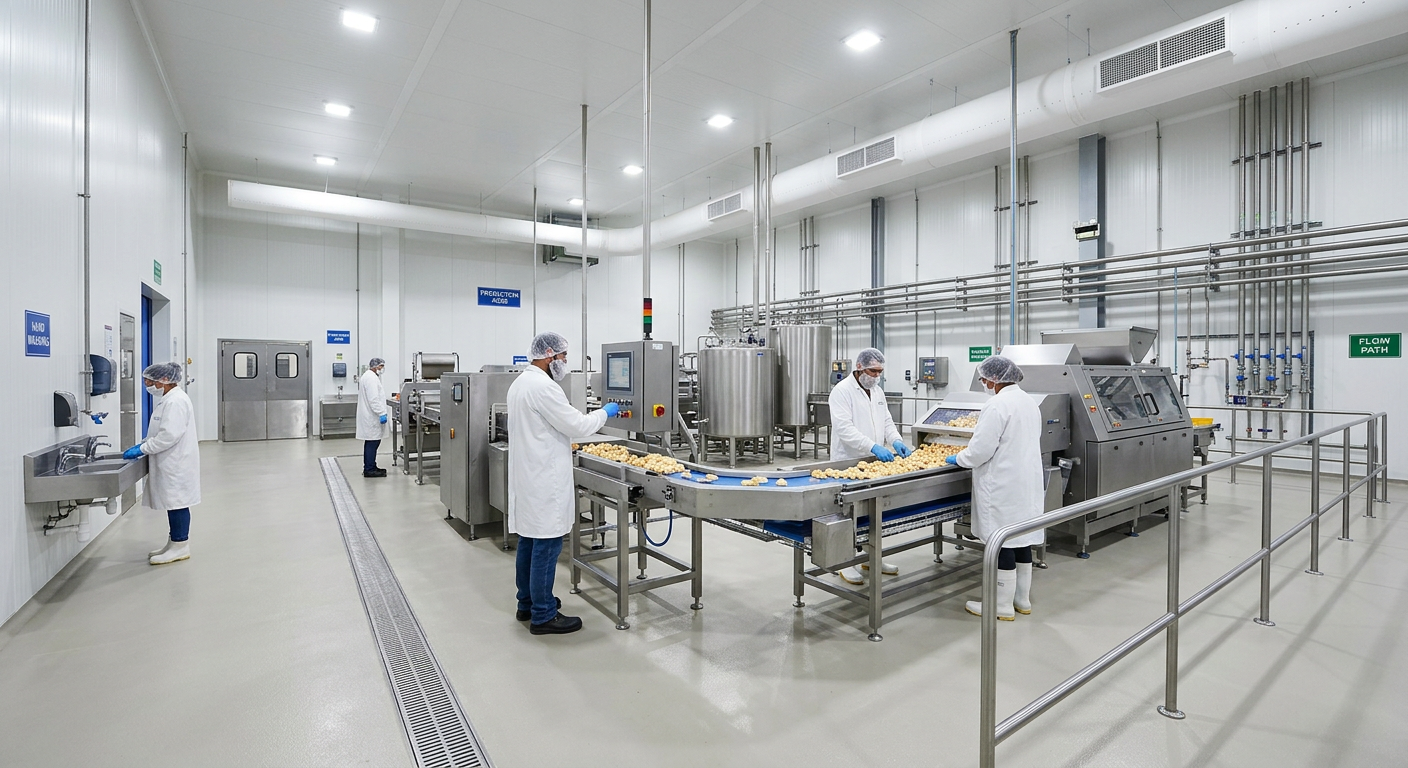
Beverage Plant Design Build Services
[trp_language language=”en_US”]
Beverage Plant Design-Build Services in the United States
The United States beverage market is expanding across ready-to-drink beverages, carbonated soft drinks, spirits, beer, kombucha, dairy beverages, juices, and aseptic products. In this environment, beverage plant design-build is no longer just a construction choice. It is a commercial strategy that connects process engineering, utilities, food safety, compliance, installation, controls, and startup into one delivery model. For beverage manufacturers in hubs such as North Carolina, Texas, California, Illinois, Georgia, Florida, New Jersey, and the Midwest logistics corridor, the main goal is clear: launch faster, reduce risk, and protect margins.
Unlike standard industrial construction, beverage facility delivery must address sanitary design, thermal performance, product changeovers, water treatment, packaging interface, clean-in-place systems, and often fast capacity ramp-ups tied to seasonal demand or contract production agreements. That is why many owners now prefer an integrated design-build partner over a fragmented design-bid-build structure.
Quick Answer

Beverage plant design-build is a project delivery method in which one partner handles engineering, design, procurement coordination, construction management, process integration, installation, and commissioning for a beverage facility. It differs from standard industrial construction because beverage plants require specialized sanitary layouts, precise temperature control, utility balancing, CIP validation, automation, and line integration to meet food safety, throughput, and quality targets. In the United States, design-build often saves time because equipment, building systems, and process utilities are coordinated earlier, reducing rework and helping facilities reach production 20% to 30% faster than traditional delivery models.
For owners, the value is practical:
- Shorter schedules from concept to startup
- Single-point accountability for design and execution
- Better coordination between process equipment and building infrastructure
- Reduced change orders and startup surprises
- Improved ROI through faster revenue generation
| Decision Area | Why It Matters in Beverage Projects | Typical Design-Build Advantage |
|---|---|---|
| Schedule | Production launch dates often drive customer contracts and seasonal sales | Overlapping design and field execution reduces total duration |
| Sanitary compliance | Layout errors can create cleanability and inspection risks | Process and facility design are coordinated from the start |
| Utilities | Steam, glycol, compressed air, and water must match process loads | Early load modeling lowers undersizing and oversizing risk |
| Budget control | Late changes are expensive in active plants | Integrated scope visibility reduces gaps between trades |
| Startup readiness | Commissioning delays can postpone first saleable product | Controls, mechanical, and process startup are managed together |
| Expansion planning | Many U.S. beverage plants must scale fast after launch | Future capacity is designed into the backbone utilities |
The table above shows why the delivery model matters. Beverage facilities are not simple shells with equipment dropped in later; they are interconnected production systems where every utility and process node affects yield, uptime, and compliance.
What Is Beverage Plant Design-Build and Why It Differs from Standard Industrial Construction

In a standard industrial project, the building may be designed first, contractors may bid after drawings are complete, and process equipment may be integrated later. That sequence can work for warehouses, light manufacturing, or non-sanitary operations. It is less effective for beverage manufacturing, where product characteristics and processing requirements define the building itself.
For example, a carbonated beverage facility in Dallas or a brewing expansion near Denver needs floor drains, hygienic piping slopes, CO2 distribution, glycol networks, bright tank placement, CIP return routing, and packaging support infrastructure designed in parallel. A dairy beverage or aseptic plant in Wisconsin or California may need even tighter zoning, temperature control, clean utilities, filtration strategy, and validation pathways. In other words, the process does not fit into the building; the building must serve the process.
Beverage plant design-build therefore combines:
- Process engineering and line architecture
- Structural, mechanical, plumbing, electrical, and controls design
- Utility generation and distribution planning
- Equipment layout and access strategy
- Construction management and trade coordination
- Commissioning and production ramp-up support
This approach is particularly valuable when a facility must support co-packing, multiple SKUs, frequent flavor changes, or phased production increases. It also helps owners with brownfield retrofits in older industrial zones near ports such as Long Beach, Houston, Savannah, Newark, or Seattle, where existing constraints can be difficult to untangle if design and construction are separated.
| Project Type | Standard Industrial Construction Focus | Beverage Design-Build Focus |
|---|---|---|
| Warehouse conversion | Envelope, structure, dock flow | Envelope plus hygienic utilities, drains, process zoning |
| Packaging hall | Floor loading, power, access | Line integration, washdown, compressed air, controls |
| Brewing expansion | General mechanical fit-out | Fermentation, glycol, CIP, cellar piping, automation |
| RTD beverage plant | Building systems first | Recipe flow, batching, blending, filler interface, QA points |
| Aseptic facility | Construction sequencing | Sterility barriers, validation, clean utility design |
| Distillery | Basic MEP and safety review | Process heat, still integration, storage, controls, compliance |
This comparison highlights the central difference: beverage design-build is process-led, not merely building-led.
Beverage-Specific Requirements: Temperature Control, CIP Systems, and Process Integration

Three technical pillars separate beverage projects from general industrial work: temperature control, CIP systems, and process integration.
Temperature control affects product quality, microbiological stability, carbonation retention, fermentation performance, fill conditions, and shelf life. Glycol loops, chilled water, cooling towers, refrigeration, and HVAC all influence product outcomes. In breweries, for instance, fermentation profiles depend on stable vessel temperatures. In juice, dairy, and functional beverages, thermal history can shape taste, texture, and safety. In hot-fill or tunnel pasteurization operations, heat recovery and packaging compatibility become critical.
CIP systems are equally important. Clean-in-place design is not just about installing tanks and pumps. It requires circuit definition, chemical compatibility, return verification, valve matrix planning, dead-leg avoidance, cleaning recipe development, flow and velocity requirements, and controls integration. Poor CIP design can increase downtime, water use, chemical costs, and contamination risk.
Process integration means linking raw ingredient receiving, batching, blending, treatment, storage, filling, packaging, utilities, and data systems into one coordinated operation. This includes inline Brix monitoring, flow control, filtration, carbonation, pasteurization, holding times, and batch management. If one area is designed in isolation, the plant may run, but not profitably.
Companies with strong beverage engineering depth can better coordinate these needs. For example, integrated engineering and project delivery services are especially useful when owners need process, utilities, controls, and installation aligned under one execution plan.
| Beverage Requirement | Typical Design Consideration | Operational Impact |
|---|---|---|
| Glycol cooling | Loop sizing, redundancy, insulation, controls | Stable fermentation and cold product handling |
| CIP systems | Tank sizing, circuit routing, chemistry, automation | Lower contamination risk and faster changeovers |
| Carbonation | Pressure control, tank design, CO2 distribution | Consistent taste and package performance |
| Pasteurization | Thermal load, residence time, product sensitivity | Food safety with product quality protection |
| Water treatment | RO, filtration, disinfection, source variability | Better flavor control and process reliability |
| Automation | PLC logic, recipe control, SCADA visibility | Repeatability, reporting, and operator efficiency |
The practical takeaway is simple: the best beverage plant is not the one with the most equipment. It is the one where utilities, controls, and process design work together with minimal friction.
Design-Build vs. Design-Bid-Build for Beverage Facilities: Which Saves More Time
In the United States, time-to-market is one of the strongest reasons owners choose design-build. Design-bid-build tends to separate responsibility among engineers, general contractors, trade contractors, and equipment vendors. That can create pauses between milestones: drawings must be completed before bidding, bids must be evaluated before award, and coordination gaps may surface only after field work begins.
Design-build compresses that timeline. Long-lead equipment, utility backbone decisions, layout validation, and phased construction planning can begin earlier. For a co-packer near Atlanta, a spirits expansion in Kentucky, or a soft drink operation in Southern California, shaving even 8 to 16 weeks from the schedule can materially change annual revenue.
Here is a realistic timeline comparison:
| Project Phase | Design-Bid-Build Typical Duration | Design-Build Typical Duration | Why the Difference Happens |
|---|---|---|---|
| Concept and feasibility | 4 to 8 weeks | 3 to 6 weeks | Integrated team aligns scope faster |
| Detailed design | 12 to 20 weeks | 8 to 16 weeks | Constructability input occurs in real time |
| Bidding and award | 6 to 10 weeks | 1 to 3 weeks | Separate tendering phase is reduced |
| Procurement coordination | 6 to 12 weeks | Starts during design | Long-lead items are addressed earlier |
| Construction and installation | 16 to 32 weeks | 14 to 28 weeks | Fewer field clashes and better sequencing |
| Commissioning | 4 to 8 weeks | 3 to 6 weeks | Controls and process startup are integrated |
This table does not mean every project will follow the exact same schedule, but it reflects a common U.S. pattern. The biggest advantage is not only speed in the field; it is the reduction of waiting time between project stages.
The line chart illustrates the steady growth in integrated beverage project delivery. As more beverage producers prioritize faster launches and cleaner accountability, design-build adoption continues to rise.
The Complete Beverage Plant Design-Build Process from Concept to Commissioning
A successful beverage project usually follows a structured path from strategy to startup. The strongest outcomes come when commercial objectives are defined at the beginning, not after design is underway.
- Business case and feasibility: Confirm demand, product mix, production targets, utility intensity, labor assumptions, and expansion path.
- Process definition: Map ingredient receiving, batching, blending, treatment, filling, packaging, storage, and cleaning logic.
- Conceptual layout: Place core process areas, utility rooms, traffic flow, sanitation barriers, maintenance access, and future space.
- Budget and schedule modeling: Align capital cost with revenue timeline, long-lead items, and shutdown constraints if the site is active.
- Detailed engineering: Develop structural, mechanical, plumbing, electrical, controls, and process packages.
- Procurement and trade coordination: Sequence equipment and field work around lead times and site readiness.
- Installation and integration: Manage piping, utilities, equipment setting, controls, and local trades.
- Commissioning and training: Test systems, validate CIP, start utilities, dry run, wet run, and train operators.
- Ramp-up and optimization: Fine-tune controls, recipes, throughput, and changeovers.
Owners should also look for a partner that can bridge strategy and execution. A project may start with an experienced food and beverage engineering team and later require field installation, controls integration, and hands-on startup coordination. Those transitions are where many projects lose time if the team is fragmented.
A useful feature of advanced delivery teams is their ability to plan for future phases. A facility launching at 20 million cases per year may need a utility and layout structure that can scale to 80 million cases without reworking the entire backbone. In the U.S. market, where co-packing contracts and retail wins can change quickly, that flexibility is often the difference between profitable growth and expensive retrofits.
The area chart reflects the broader trend: owners increasingly prefer integrated models that connect capital planning, design, construction, and process startup.
How to Select a Beverage Plant Design-Build Partner with Industry Expertise
Choosing a partner is not only about price. It is about whether the team understands beverage production deeply enough to protect the business case. The right partner should know how to align product requirements with building systems, utility loads, sanitary routing, automation, and startup risk.
Look for five categories of expertise:
1. Technological capabilities. A qualified partner should understand process engineering, automation, PLC programming, SCADA, utility modeling, thermal systems, water treatment, pasteurization, carbonation, fermentation, blending, and aseptic or hygienic design where needed. Technical depth matters because beverage plants are process-sensitive environments.
2. Manufacturing capabilities. Some partners add value through custom equipment or modular systems that simplify integration. Access to fabricated tanks, custom CIP skids, process vessels, and supporting assemblies can shorten lead times and reduce coordination complexity. If you want to review this side of the market, browse examples of beverage and food process equipment solutions.
3. Service capabilities. Beyond engineering, the partner should manage project controls, local trades, scheduling, procurement interfaces, installation, commissioning, and owner communication. The strongest firms operate as true end-to-end project leaders rather than isolated design consultants.
4. Beverage sector breadth. Experience across brewing, spirits, wine, kombucha, RTD, carbonated soft drinks, juices, dairy beverages, and aseptic systems provides better pattern recognition.
5. Business honesty. A strong partner will challenge poor assumptions, identify bottlenecks, and advise against unnecessary spending when a lower-cost operational fix can solve the problem.
| Selection Criterion | What to Ask | Why It Matters |
|---|---|---|
| Process experience | Have you designed for my beverage category before? | Reduces learning curve and sanitary risk |
| Utility integration | How do you size steam, glycol, air, and water systems? | Protects uptime and future expansion |
| Controls expertise | Do you handle automation, PLC, and SCADA strategy? | Improves consistency and startup speed |
| Construction leadership | Who manages local trades and field coordination? | Determines schedule and accountability |
| Commissioning approach | How do you test, train, and transition to operations? | Impacts first-pass success at startup |
| Commercial mindset | Will you challenge scope if ROI is weak? | Protects capital efficiency |
If possible, request real project examples. A partner’s case experience, such as those shown in completed project case studies, can reveal how the team performs under actual field conditions.
Managing Risk: Single-Point Accountability in Beverage Plant Design-Build
One of the largest advantages of design-build is single-point accountability. In design-bid-build, owners often become the referee between engineer, contractor, vendor, and installer when scope gaps appear. In beverage projects, those gaps can be costly because a small design disconnect may stop the entire line from producing saleable product.
Consider a typical scenario: the filler needs higher compressed air quality than assumed, the CIP return path lacks proper slope, or the glycol header is undersized for a later capacity phase. In a fragmented structure, each party may claim the issue belongs to someone else. In a design-build structure, the delivery partner is accountable for resolving the conflict without leaving the owner trapped in blame management.
This is especially important in active U.S. plants where shutdown windows are short, labor markets are tight, and compliance expectations are high. It matters in brownfield retrofits around Chicago, Philadelphia, Charlotte, or Los Angeles where hidden site conditions can disrupt field work. It also matters in greenfield developments near major freight corridors where startup dates are tied to investor expectations, retail resets, or distribution agreements.
Risk management in beverage design-build usually includes:
- Early utility load validation
- Constructability review during design
- Long-lead procurement planning
- Clear responsibility matrices
- Integrated startup and commissioning plans
- Documented change management
The bar chart shows where specialized project demand is strongest. RTD and aseptic segments are especially sensitive to speed, hygienic design, and integrated utility planning.
ROI Analysis: Design-Build Delivery Reduces Beverage Plant Time-to-Market by 20-30%
For many owners, the strongest financial argument for design-build is not only lower project friction; it is faster revenue capture. If a beverage line starts shipping even two months earlier, the gain can far exceed any modest premium attached to integrated delivery.
Assume a new U.S. RTD facility is projected to generate $1.2 million in gross contribution per month after startup stabilization. If design-build reduces the schedule by 10 weeks, that may accelerate roughly $3.0 million in contribution opportunity, depending on the ramp curve. Add lower change-order exposure and fewer commissioning delays, and the economic case becomes stronger.
ROI also improves because integrated design reduces hidden waste:
- Less overbuilt utility capacity
- Fewer field clashes and demolition corrections
- Lower downtime from poor startup sequencing
- Better labor efficiency through automation and line visibility
- Faster SKU changeovers through thoughtful CIP and routing design
| ROI Driver | Traditional Delivery Impact | Design-Build Impact |
|---|---|---|
| Time-to-market | Delayed revenue recognition | Earlier production and invoicing |
| Change orders | Higher probability of scope gaps | Lower risk through integrated planning |
| Utility efficiency | Potential oversizing or late redesign | Better alignment with process demand |
| Labor productivity | Manual workarounds after startup | Automation planned from day one |
| Product quality | Inconsistent process transitions | Improved repeatability and control |
| Expansion readiness | More disruptive future retrofits | Infrastructure planned for growth |
The table above explains why schedule compression is only part of the value. Better engineering alignment improves the economics of the plant long after construction ends.
The comparison chart summarizes the operational advantage of integrated delivery across the dimensions owners care about most.
Common Mistakes to Avoid in Beverage Plant Design-Build Projects
Even with the right delivery model, some mistakes repeatedly undermine projects.
1. Designing around today’s output only. Plants that cannot scale efficiently often face expensive utility upgrades within a few years.
2. Underestimating CIP complexity. Cleaning logic must be engineered with the same seriousness as production flow.
3. Separating controls strategy from process design. Automation added late usually increases commissioning time.
4. Ignoring building-product interaction. Floor drainage, washdown zones, thermal loads, and access pathways directly affect operation.
5. Choosing solely on lowest bid. Low initial cost can produce high lifecycle cost if startup, quality, or reliability suffer.
6. Failing to validate utility assumptions. Steam, chilled water, compressed air, and electrical loads should be grounded in actual process demand.
7. Weak stakeholder alignment. Operations, QA, maintenance, finance, and leadership all need input early.
| Common Mistake | Typical Consequence | Prevention Strategy |
|---|---|---|
| No future expansion plan | Costly retrofit and downtime later | Design utility backbone for phased growth |
| Late equipment coordination | Field clashes and rework | Integrate vendor data early in design |
| Weak sanitary layout | Cleaning difficulty and compliance risk | Apply hygienic design review during planning |
| Incomplete commissioning plan | Delayed startup and troubleshooting | Define test protocols and training in advance |
| Ignoring operator workflow | Higher labor cost and safety issues | Include operations input in layout reviews |
| Short-term capital thinking | Poor lifecycle ROI | Evaluate total operating impact, not only CAPEX |
For U.S. owners, another mistake is selecting a team with general construction capability but limited beverage process knowledge. Beverage manufacturing is too specialized for generic assumptions.
That is why many manufacturers prefer firms that combine engineering, manufacturing understanding, and field execution under one operating philosophy. A company like Disruptive Process Solutions, for example, is built around full-scope food and beverage engineering, process integration, installation, project management, and capital planning support. Its work spans beverage segments such as brewing, spirits, wine, kombucha, carbonated and non-carbonated drinks, juices, dairy beverages, and aseptic applications, while also supporting North American manufacturers with utility systems, controls, and turnkey integration. In practice, this type of model helps owners connect smart capital spending with practical manufacturing performance.
Service depth matters as much as technical depth. In the U.S. market, clients often need an execution partner that can coordinate local trades, handle end-to-end project leadership, and maintain transparent communication from concept through commissioning. That integrated service capability becomes especially valuable when timelines are tight or operations cannot absorb prolonged uncertainty.
Manufacturing capability is another differentiator. Partners that can supply custom tanks, CIP systems, or process assemblies can reduce interface risk and support more seamless installation. Combined with technological expertise in automation, process engineering, and utility integration, this creates a more controlled project environment.
FAQ
What types of beverage plants benefit most from design-build?
RTD facilities, breweries, distilleries, juice plants, dairy beverage operations, carbonated soft drink facilities, kombucha producers, wine operations, and aseptic beverage plants all benefit. The more utilities, sanitation demands, and line interfaces involved, the stronger the case for design-build.
How much faster is design-build than design-bid-build?
Many U.S. beverage projects see overall schedule improvement of 20% to 30%, especially when long-lead equipment, utility coordination, and startup planning are brought forward.
Is design-build only for large corporations?
No. Mid-sized beverage companies, regional brands, contract manufacturers, and growing co-packers often benefit the most because they cannot afford long delays, repeated change orders, or startup failures.
What should be included in the early feasibility stage?
Demand forecast, product mix, batch size, packaging format, utility loads, labor assumptions, site constraints, sanitation strategy, water treatment needs, automation level, and future capacity phases.
How important is automation in a beverage plant project?
Very important. PLC programming, SCADA, recipe control, alarm handling, and data visibility affect consistency, labor efficiency, CIP repeatability, and troubleshooting speed.
Can design-build work for brownfield retrofits?
Yes. In fact, it is often especially useful for retrofits because process, utility, and structural constraints must be resolved together. This is common in older industrial facilities across the Northeast, Midwest, and West Coast.
What should I ask a potential design-build partner first?
Ask how they approach process integration, utility sizing, sanitary design, controls, startup, and accountability. Also ask for beverage-specific project examples and how they handle phased expansion.
How do 2026 trends affect beverage plant design-build?
By 2026, U.S. projects are expected to place more emphasis on sustainability, energy recovery, water reuse, digital monitoring, labor-saving automation, and stricter compliance readiness. Policy pressure around resource efficiency and ESG reporting is likely to push more owners toward smarter utility design, higher-efficiency thermal systems, advanced CIP optimization, and data-connected operations. Facilities that plan now for electrification pathways, heat recovery, wastewater minimization, and modular expansion will likely be better positioned for both regulation and market demands.
Are local suppliers important?
Yes. Local fabrication, trade availability, code familiarity, and utility coordination can influence schedule and cost. However, the lead partner should still provide centralized engineering and project management so local execution fits the overall process strategy.
Why do owners choose DPS for beverage projects?
Owners looking for a practical, business-minded partner often value teams that combine process engineering, project management, installation coordination, and transparent advice. DPS is known for aligning capital projects with profitability goals, supporting manufacturers across the United States and Canada, and bringing both beverage-specific process knowledge and turnkey execution capability to the table.
For beverage manufacturers in the United States, the choice of project delivery model can directly affect profitability, startup timing, and long-term operating stability. Design-build works best when it is led by a team that understands beverage process realities, not just building construction. In a market defined by speed, quality, compliance, and capital discipline, integrated beverage plant design-build is increasingly the smarter path forward.
[/trp_language]
Complete Company Portfolio

About the Author: Disruptive Process Solutions (DPS)
The DPS team combines process engineering expertise with real-world food and beverage manufacturing experience. Our content focuses on process optimization, production efficiency, facility improvements, and practical solutions that help manufacturers operate more effectively in a rapidly evolving industry.
Share

