Design Build for Food Processing Facilities
[trp_language language=”en_US”]
Design-Build for Food Processing Facilities in the United States
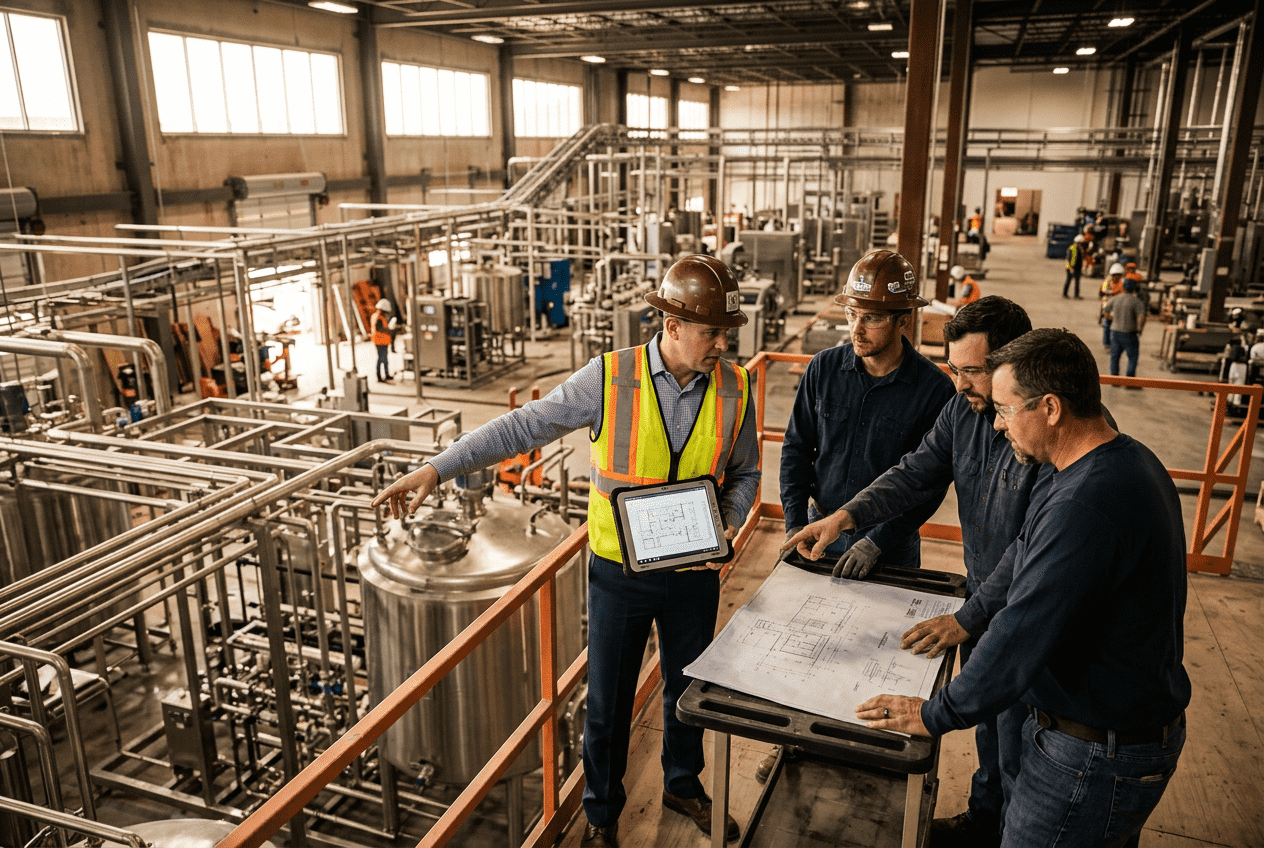
Food manufacturers in the United States are under pressure to expand capacity, improve food safety, automate production, and protect margins at the same time. That combination is exactly why design-build delivery has become a preferred model for food processing facilities. Instead of separating engineering, procurement, construction, utility integration, process installation, controls, and startup across disconnected vendors, design-build aligns them under one coordinated execution framework.
For processors in markets such as Chicago, Dallas-Fort Worth, Fresno, Charlotte, Atlanta, Los Angeles, Houston, Omaha, Philadelphia, and the I-95 logistics corridor, the stakes are high. A delayed protein line, a poorly sequenced dairy expansion, or a missed USDA inspection window can affect product supply, customer commitments, labor efficiency, and EBITDA. In food and beverage environments, facility design is not just about walls and floors. It is about process flow, sanitation zoning, utility resilience, packaging throughput, environmental controls, and future scalability.
That is why many owners now look for a partner that can bridge plant engineering and real-world execution. Disruptive Process Solutions operates in that space by combining engineering, construction management, installation, and process integration for manufacturers across North America. Its approach is especially relevant for owners that want commercially grounded planning rather than siloed design recommendations.
Quick Answer

Design-build delivery for food processing facilities means one integrated team takes responsibility for planning, engineering, budgeting, procurement coordination, construction, process utility installation, equipment integration, and startup support. In the United States, this model helps food and beverage manufacturers reduce schedule gaps, limit change orders, improve constructability, and better align plant design with FDA, USDA, HACCP, SQF, and operational goals.
For most food projects, design-build performs best when the facility has one or more of the following traits:
- Complex hygienic or sanitary process requirements
- Large utility loads for steam, refrigeration, compressed air, or CIP
- Fast growth targets that require phased expansion
- Automation, batching, packaging, or SCADA integration needs
- Operational continuity constraints during renovation or expansion
- Strict startup dates tied to customer launches or seasonal demand
In short, design-build is not simply a contracting format. It is a risk-management strategy for complex manufacturing assets.
| Project Situation | Why Design-Build Fits | Typical Benefit |
|---|---|---|
| New greenfield beverage plant | Coordinates utilities, process rooms, packaging, and future capacity planning | Faster alignment from concept to startup |
| USDA protein facility expansion | Links sanitary zoning and construction phasing | Reduced disruption to live production |
| Dairy line modernization | Combines process engineering with equipment replacement sequencing | Better uptime during renovation |
| Co-packing startup facility | Matches capital spending to launch volumes and margin targets | Improved first-year economics |
| Aseptic or retort installation | Requires close control of utility, automation, and validation planning | Lower commissioning risk |
| Multi-site capital program | Standardizes execution across regions and plants | Portfolio-level visibility |
The table above shows why food owners rarely evaluate delivery method in isolation. The right model depends on process complexity, regulatory exposure, uptime requirements, and the business case behind the capital plan.
What Defines Design-Build Delivery for Food Processing Facilities

In food processing, design-build is defined less by paperwork and more by integration. A true food facility design-build team must understand material receiving, allergen segregation, raw-to-ready separation, hygienic finishes, washdown electrical details, drain strategy, utility redundancy, refrigeration loads, packaging interfaces, and startup constraints. If those elements are not embedded early, the project may still be called design-build, but it will behave like a fragmented job.
A strong design-build program usually includes:
- Front-end feasibility and capital planning
- Conceptual layout and process flow mapping
- Equipment and utility basis of design
- Cost modeling tied to scope maturity
- Permitting and code coordination
- Construction packaging and trade sequencing
- Controls and automation integration
- Commissioning, training, and turnover
In the United States, owners also need to evaluate regional conditions. Projects near the Port of Savannah, the Inland Empire, the Port of Houston, Kansas City rail hubs, and major cold-chain corridors may face different labor availability, permit timing, utility lead times, and freight realities. A national food engineering partner with local execution awareness can help minimize those blind spots.
Design-build also differs from design-bid-build in accountability. Under a fragmented model, engineering may blame field conditions, the installer may blame incomplete drawings, and procurement may blame the owner’s approvals. Under a well-run design-build structure, those interfaces are managed inside one decision-making system.
| Delivery Model | Contract Structure | Coordination Level | Change Order Risk | Best Use Case | Schedule Impact |
|---|---|---|---|---|---|
| Design-Bid-Build | Separate designer and contractor | Low to moderate | Higher | Simple building-led projects | Longer |
| CM at Risk | Designer separate, builder joins earlier | Moderate | Moderate | Larger institutional projects | Moderate |
| EPC-style industrial delivery | Integrated engineering and execution | High | Lower | Utility-heavy industrial projects | Shorter |
| Food-focused design-build | Single integrated responsibility | Very high | Lower | Complex process facilities | Shorter |
| Owner-managed multi-prime | Owner holds many contracts | Variable | High | Experienced internal teams only | Variable |
| Programmatic portfolio delivery | Framework-based repeat execution | Very high | Low to moderate | Multi-site food manufacturers | Fastest over time |
This comparison matters because food plants are not generic buildings. The process often drives the architecture, utilities, and expansion logic.
8 Tips to Design a Food Processing Facility for Maximum Success

Whether you are building a new prepared foods plant in the Midwest, expanding a dairy operation in California, or reworking a beverage co-packing site in the Carolinas, the following eight practices consistently improve outcomes.
- Start with product and throughput, not square footage. Many owners begin with a building shell. The smarter path is to begin with SKUs, shift patterns, line rates, sanitation windows, and growth assumptions.
- Map raw, WIP, finished goods, people, and waste separately. Traffic conflicts create safety, contamination, and labor problems.
- Design sanitation zones early. Hygienic segmentation, drain direction, air pressure logic, and cleanable detail design should not be late-stage decisions.
- Right-size utilities for startup and scale. Oversizing everything wastes capital, but undersizing boilers, glycol, refrigeration, or compressed air creates expensive rework.
- Protect future expansion corridors. Leave room for line duplication, tank farms, packaging additions, and utility tie-ins.
- Integrate maintenance access. If pumps, valves, control panels, or CIP skids are difficult to service, downtime costs rise.
- Align automation with operations. A facility should support operators, supervisors, QA, and maintenance through useful controls, data visibility, and recipe management.
- Plan startup from day one. FATs, SATs, commissioning protocols, training, and validation should shape the project schedule from the start.
These principles are especially important for product categories such as proteins, sauces, dairy, retort foods, aseptic beverages, RTD drinks, and co-manufacturing sites where changeover discipline directly affects profitability.
| Design Tip | Operational Impact | Cost Impact | Food Safety Impact | Expansion Impact | Priority |
|---|---|---|---|---|---|
| Throughput-first layout | Higher line efficiency | Prevents wasted space | Supports flow control | Strong | High |
| Sanitary zoning | Fewer crossovers | Reduces future rework | Critical | Moderate | High |
| Utility master planning | Stable production | Limits emergency upgrades | Indirect but important | Strong | High |
| Maintenance access | Less downtime | Lower service cost | Supports cleaning | Moderate | Medium |
| Automation integration | Improves repeatability | Better labor leverage | Strong traceability | Strong | High |
| Startup planning | Faster ramp-up | Fewer delays | Supports validation | Moderate | High |
The lesson behind this table is simple: successful facility design is a business system, not a drafting exercise.
The growth trend above reflects continued investment in automation, reshoring, cold-chain infrastructure, and processing upgrades across the United States through 2026 and beyond.
Food Processing Facility Construction Costs by Type: 2026 Budget Guide ($250-$850/SF)
Construction cost for food processing facilities in the United States varies widely because process intensity matters more than the shell alone. A dry bakery expansion in Indiana will not cost the same as a USDA-inspected protein plant in Nebraska or an aseptic beverage operation in Southern California. For 2026 budgeting, a useful planning range is roughly $250 to $850 per square foot, depending on process complexity, utility demand, sanitary finish requirements, automation level, and site conditions.
Owners should use these figures for conceptual budgeting, not final GMP. Equipment, owner-furnished items, sitework, freezer construction, ammonia or CO2 refrigeration systems, wastewater pretreatment, and utility upgrades can shift costs significantly.
| Facility Type | 2026 Budget Range per SF | Key Cost Drivers | Typical U.S. Regions | Schedule Complexity | Capital Risk Level |
|---|---|---|---|---|---|
| Dry foods / ingredients | $250-$375 | Dust control, packaging, utilities | Midwest, Southeast | Moderate | Low to moderate |
| Beverage processing | $300-$500 | Tankage, CIP, fillers, boilers, water treatment | Carolinas, Texas, California | Moderate to high | Moderate |
| Dairy processing | $400-$650 | Sanitary piping, refrigeration, clean rooms | Wisconsin, California, Idaho | High | Moderate to high |
| Protein processing | $450-$700 | USDA criteria, cold rooms, drains, washdown | Kansas, Nebraska, Georgia | High | High |
| Prepared foods / sauces | $350-$600 | Cook systems, batching, packaging, utilities | Illinois, Texas, New Jersey | High | Moderate |
| Aseptic / retort / high-care | $550-$850 | Validation, sterile design, advanced controls | California, North Carolina, Pennsylvania | Very high | High |
This table shows why comparing projects by square foot alone can be misleading. Two buildings of equal size may differ by millions of dollars if one includes retort, clean steam, and sterile filling while the other handles dry blending only.
Additional budget line items often overlooked by owners include utility service upgrades, municipal connection fees, wastewater treatment, roof-mounted mechanical support steel, owner contingency, process controls integration, and commissioning labor. In ports and dense logistics zones such as Newark, Long Beach, Savannah, and Miami, site constraints and trade costs can push totals even higher.
The demand chart illustrates where many manufacturers are currently directing capital: protein, beverage, and prepared foods continue to attract strong investment due to private label growth, convenience-driven consumption, and automation opportunities.
The Role of Process Engineering in Food Processing Facility Design-Build
Process engineering is the difference between a food project that merely looks complete and one that performs. In design-build delivery, the process engineer should influence layout, utility capacity, sanitation logic, controls architecture, and startup sequencing from the earliest phase. Without that leadership, the project often becomes building-driven rather than production-driven.
Process engineering typically covers line balancing, thermal treatment strategy, ingredient handling, tank sizing, pumping logic, CIP design, valve matrices, heat transfer, batching methods, packaging interfaces, and operational data requirements. For proteins and prepared foods, it also shapes marination, cooking, chilling, forming, slicing, portioning, and product flow timing. For beverage systems, it informs blending, carbonation, pasteurization, filtration, syrup handling, and filling support.
This is also the right place to highlight technological capability. DPS supports projects with structural, mechanical, plumbing, electrical, process, and controls expertise, including PLC programming, automation, and SCADA integration. That matters because in modern facilities the process cannot be separated from controls. A bottleneck may not be a pump or conveyor at all; it may be recipe logic, sequencing, data gaps, or line synchronization. Owners who want smarter plants should review integrated engineering and project services early instead of waiting until procurement is locked.
| Process Engineering Function | What It Influences | Common Risk If Missed | Operational Outcome | Best Stage to Address | ROI Potential |
|---|---|---|---|---|---|
| Line capacity modeling | Equipment size and staffing | Hidden bottlenecks | Higher throughput | Concept design | High |
| CIP strategy | Sanitation time and chemistry use | Excess downtime | Faster changeovers | Early design | High |
| Thermal process design | Food safety and quality | Validation problems | Stable product results | Basis of design | High |
| Utility load mapping | Boilers, chillers, air, water | Undersized infrastructure | Reliable production | Preliminary engineering | High |
| Automation architecture | Recipes, alarms, data, traceability | Operator inconsistency | Better control and reporting | Early design | High |
| Commissioning planning | Startup and training | Late delays | Quicker ramp-up | Design development | Medium to high |
The main takeaway is that process engineering should not be treated as a support function. It is the core logic of the project.
How Design-Build Reduces Change Orders and Keeps Food Projects on Budget
Change orders in food processing projects usually come from four sources: incomplete scope definition, poor coordination between process and building systems, unrealistic utility assumptions, and field discoveries during live-plant work. Design-build reduces those risks by forcing key decisions earlier and by putting engineering, construction planning, and installation logic in one room.
When the same team reviews process requirements, sanitary construction details, utility routing, and equipment interfaces together, fewer surprises reach the field. Clash detection improves. Procurement sequencing improves. Shutdown planning improves. So does accountability.
This does not mean change orders disappear entirely. Scope still evolves. Municipal requirements change. Owner preferences change. Equipment lead times shift. But the overall rate and severity of cost growth are usually lower when a project is planned through integrated design-build methods.
DPS often positions itself as a business-minded execution partner rather than a traditional contractor. That mindset matters because real savings often come from challenging assumptions before concrete is poured or stainless is ordered. In one example, a client expected to spend millions on extra capacity, but deeper analysis showed the actual bottleneck was controls programming. Solving the root issue increased output at a fraction of the anticipated spend. That is the kind of budget protection food manufacturers should look for.
| Source of Change Orders | Typical Effect | How Design-Build Helps | Residual Risk | Budget Benefit | Owner Action |
|---|---|---|---|---|---|
| Incomplete process scope | Late equipment additions | Early engineering workshops | Moderate | High | Approve basis of design fast |
| Utility underestimation | Rework and delays | Integrated load modeling | Moderate | High | Share production assumptions |
| Field coordination conflicts | Labor overruns | Constructability reviews and BIM | Low to moderate | Medium to high | Freeze major routes earlier |
| Live-plant discoveries | Shutdown extensions | Phased investigation and planning | Moderate | Medium | Provide access for surveys |
| Late owner decisions | Procurement disruption | Decision logs and milestone controls | Moderate | Medium | Assign clear decision makers |
| Permit/code revisions | Schedule reset | Early AHJ coordination | Low to moderate | Medium | Engage local code review early |
For owners, the lesson is straightforward: cost control comes from decision quality and coordination speed, not from squeezing bid packages after the scope is already unstable.
Regulatory Compliance Essentials: FDA, USDA, and HACCP in Facility Design
Every food processing facility in the United States must be designed around compliance, but the exact priorities vary by product, inspection regime, and risk profile. FDA-regulated plants, USDA-inspected protein facilities, and HACCP-driven operations all require disciplined attention to flows, surfaces, cleanability, records, and control points. Compliance is not a final checklist; it is a design input.
Key compliance issues include:
- Separation of raw and ready-to-eat areas
- Drainage design and slope verification
- Cleanable walls, ceilings, penetrations, and utility supports
- Employee and material traffic control
- Allergen handling and rework management
- Temperature control and cold-chain integrity
- Pest exclusion and envelope detailing
- Traceability, batching, and lot control visibility
USDA projects often require especially rigorous planning around sanitary zoning, inspection areas, handwash stations, traffic patterns, and washdown durability. FDA-regulated beverage, dairy, and ingredient plants may place greater emphasis on preventive controls, environmental monitoring support, and CIP validation readiness. A partner experienced with FDA, USDA, SQF, and BRC expectations can shorten the path from concept to compliant operation.
That is one reason food processors often prefer integrated specialists rather than generic industrial builders. Companies with deep compliance familiarity can connect process design to practical construction details instead of leaving QA concerns to be resolved after turnover.
The trend shift above reflects how food safety expectations, labor pressure, and retailer standards are pushing more projects toward automation, data visibility, and higher-care design models.
Phased Construction Strategies for Food Processing Facility Expansions
Many of the most difficult food projects in the United States are not greenfield builds. They are brownfield expansions inside operating plants. In those settings, phased construction is essential. The goal is to increase capacity, improve utilities, or install new lines without breaking customer supply commitments or compromising food safety.
Effective phasing begins with a shutdown map. Owners need to know which systems can be touched during production, which tie-ins require weekend outages, and which changes must wait for seasonal downtime. Phasing also requires temporary utilities, sanitation barriers, traffic rerouting, and detailed trade access plans.
Typical phased expansion approaches include:
- Building utility backbone first, then process rooms
- Creating swing space for production relocation
- Installing duplicate systems before cutover
- Segmenting work by hygienic zone
- Using night or weekend shutdown windows for tie-ins
- Sequencing packaging and warehousing separately from wet processing
This is where service capability becomes especially important. DPS supports capital planning, owner’s representation, project management, general contracting functions where licensed, and full installation and integration support. For live-plant work, those services help owners coordinate local trades, shutdown windows, startup protocols, and stakeholder communication more effectively. Manufacturers considering multi-phase expansions can also review project case examples to understand how integrated execution helps reduce production disruption.
| Expansion Phase | Main Scope | Primary Risk | Best Mitigation | Production Impact | Typical Duration |
|---|---|---|---|---|---|
| Phase 1 | Utility upgrades and enabling work | Service interruption | Temporary systems and off-shift tie-ins | Low to moderate | 4-12 weeks |
| Phase 2 | Building additions or room conversions | Access conflict | Barrier control and traffic routing | Low | 8-20 weeks |
| Phase 3 | Equipment setting and piping | Congestion | Detailed sequencing and prefabrication | Moderate | 6-16 weeks |
| Phase 4 | Controls and utility tie-ins | Startup delay | Pretested panels and staged commissioning | Moderate to high | 2-8 weeks |
| Phase 5 | Validation and ramp-up | Performance instability | Operator training and SAT protocols | Moderate | 2-6 weeks |
| Phase 6 | Legacy system removal or optimization | Residual bottlenecks | Post-startup tuning | Low | 2-10 weeks |
The key message is that phasing is a design discipline, not just a construction schedule activity.
Technology Integration: BIM, VDC, and Automation in Modern Food Facility Design-Build
Technology is reshaping food facility design-build in 2026. BIM and VDC improve coordination across structural steel, hygienic piping, process skids, electrical distribution, refrigeration, and access clearances. Automation platforms improve recipe control, traceability, downtime diagnostics, and labor efficiency. Together, these tools help owners make faster decisions with fewer field conflicts.
BIM and VDC are especially valuable in high-density utility corridors, multi-level process rooms, and retrofit work where old as-builts cannot be trusted. Clash detection before installation can prevent expensive rework. Digital coordination also helps support prefabrication, which can reduce site congestion and improve quality in controlled fabrication environments.
Automation is no longer optional in many food segments. Labor shortages, sustainability targets, and retailer expectations are driving broader use of PLC-based sequencing, SCADA dashboards, batch control, energy monitoring, remote diagnostics, and line performance analytics. For some plants, the greatest ROI comes not from a bigger line but from smarter line control.
This is also where manufacturing capability and equipment integration matter. DPS designs and supplies certain process equipment, including tanks, CIP systems, marination tumblers, and cooking vessels, while integrating broader third-party systems into complete operating lines. Owners exploring food processing equipment and custom systems should evaluate not just the vessel or skid itself, but how it connects to utilities, controls, sanitation, and future expansion.
The comparison above shows why complex facilities often benefit from integrated providers. The value is not only technical depth, but interface control across engineering, procurement, construction, and startup.
| Technology | Primary Use | Best Facility Types | Main Value | 2026 Trend Direction | Implementation Difficulty |
|---|---|---|---|---|---|
| BIM | 3D coordination | All complex builds | Fewer clashes | Rising | Moderate |
| VDC | Construction sequencing | Retrofits and dense plants | Better execution planning | Rising | Moderate |
| PLC automation | Machine and process control | Beverage, dairy, prepared foods | Repeatability | Strongly rising | Moderate |
| SCADA | Supervisory visibility | Multi-line plants | Data-driven operations | Strongly rising | Moderate |
| Batch/recipe management | Traceability and consistency | Sauces, beverages, dairy | Lower variation | Rising | Medium to high |
| Energy monitoring | Utility optimization | Utility-heavy facilities | Sustainability and savings | Rising | Low to moderate |
As policy and buyer expectations tighten around energy intensity, water use, and reporting, these technologies will become even more central to U.S. food capital planning.
FAQ
Is design-build more expensive than traditional bidding?
Not necessarily. The initial proposal format may look different, but many owners save money through fewer clashes, faster schedules, earlier cost visibility, and better utility planning.
What products are best suited for this model?
Protein, dairy, prepared foods, sauces, beverages, RTD products, aseptic systems, retort operations, and co-packing facilities are all strong candidates because of their process complexity.
Can design-build work for small and mid-sized projects?
Yes. It can be highly effective for projects from several hundred thousand dollars up to multi-million-dollar capital programs, especially when utilities, compliance, or startup timing are critical.
How should owners compare suppliers?
Look beyond general contracting experience. Ask about sanitary design knowledge, process engineering depth, automation capability, live-plant expansion experience, compliance familiarity, and commissioning support.
What should be in an RFP?
Include throughput targets, product mix, utility constraints, sanitation standards, growth assumptions, schedule drivers, and whether the plant must remain operational during construction.
Where are strong U.S. markets for food facility projects?
Texas, North Carolina, Georgia, California, Wisconsin, Illinois, Pennsylvania, and parts of the Midwest and Southeast remain active due to labor pools, logistics access, processing clusters, and proximity to ports and distribution hubs.
What 2026 trends matter most?
Automation, workforce efficiency, hygienic design scrutiny, sustainability, water reuse interest, electrification discussions, cold-chain resilience, and domestic manufacturing investment will shape upcoming projects.
How should a buyer choose a partner?
Choose a team that understands both manufacturing economics and execution realities. The best partner will challenge weak assumptions, plan for profitability, and align the project around your operating model rather than just producing drawings.
For food and beverage manufacturers in the United States, the strongest design-build partners are those that combine technological capability, manufacturing understanding, and service discipline. That means knowing how to engineer a process, install and integrate it, manage local trades, support compliance, and keep the project tied to business outcomes. Companies that can do that consistently become more than vendors; they become capital partners.
If your organization is evaluating a new build, expansion, line relocation, utility upgrade, or plant modernization, start with clear answers to five questions: What product are you making, what throughput do you need, what compliance framework governs the plant, what growth path do you expect, and what schedule risk can the business tolerate? Once those are clear, the right delivery strategy becomes much easier to define.
[/trp_language]
Complete Company Portfolio
About the Author: Disruptive Process Solutions (DPS)
The DPS team combines process engineering expertise with real-world food and beverage manufacturing experience. Our content focuses on process optimization, production efficiency, facility improvements, and practical solutions that help manufacturers operate more effectively in a rapidly evolving industry.
Share