Turnkey Food Processing Plant Solutions
[trp_language language=”en_US”]
Turnkey Food Processing Plant Solutions for U.S. Manufacturers
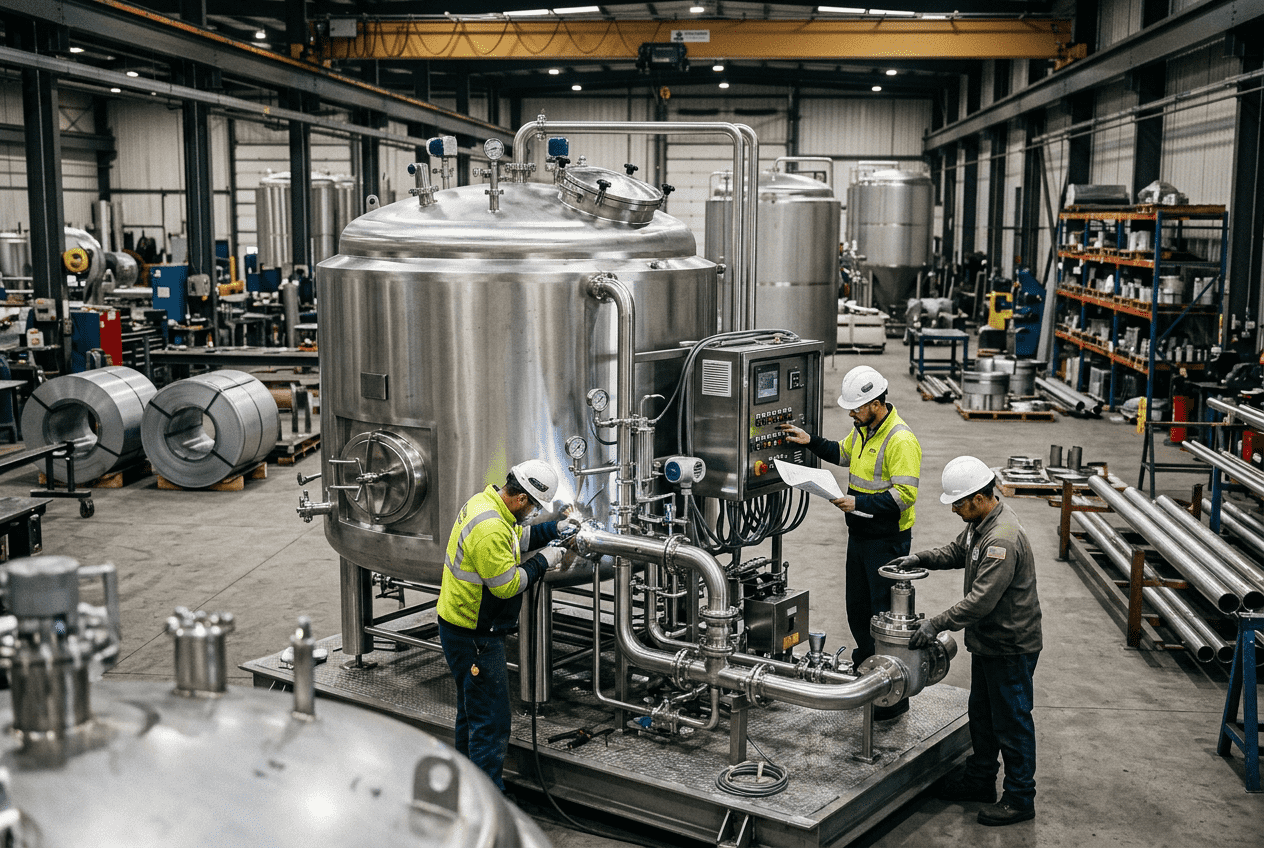
Food and beverage manufacturers in the United States are under pressure to add capacity faster, reduce project risk, and launch production with fewer startup surprises. That is why turnkey food processing plant delivery has become a preferred model for companies building new lines, relocating assets, modernizing utilities, or opening greenfield facilities. Instead of managing separate engineering firms, equipment vendors, installers, controls integrators, and commissioning teams, manufacturers can work with one partner responsible for aligning the whole system from concept through commercial production.
For companies expanding in major manufacturing corridors such as the Midwest, Texas, the Carolinas, California, Georgia, and the Northeast, speed matters. A delayed startup in Chicago, Houston, Charlotte, Fresno, Atlanta, or Newark can affect contracts, labor planning, warehouse commitments, and distribution through ports such as Los Angeles, Long Beach, Savannah, and New York/New Jersey. A well-executed turnkey approach helps reduce those delays by coordinating process design, utilities, controls, installation, compliance, and training under a unified project strategy.
Quick Answer

A turnkey food processing plant is a complete, ready-to-operate production solution delivered by a single project partner or tightly managed delivery team. It typically includes feasibility analysis, process design, equipment selection, utility planning, controls integration, installation, commissioning, operator training, documentation, and startup support. In the United States, turnkey delivery is often the fastest path to market for food and beverage manufacturers because it reduces interface risk between suppliers, shortens coordination time, and improves accountability for performance.
In practical terms, a true turnkey handover means the plant is not merely installed. It is tested, integrated, documented, and prepared for routine production. That matters whether the application is protein processing in the Midwest, aseptic beverage production in California, dairy expansion in Wisconsin, sauces and dressings in New Jersey, or co-packing operations in Texas.
| Turnkey Element | What It Means | Why It Matters |
|---|---|---|
| Single-point accountability | One lead team coordinates design, procurement, installation, and startup | Reduces blame shifting between vendors |
| Integrated process design | Equipment, controls, utilities, and layout are engineered together | Improves throughput and sanitation performance |
| Installation management | Mechanical, electrical, plumbing, and controls work are sequenced as one project | Limits schedule conflict and rework |
| Commissioning and testing | The full line is verified before handover | Finds issues before commercial launch |
| Training and SOPs | Operators and maintenance teams receive structured instruction | Supports safe, stable production |
| Startup support | Post-handover assistance is available during ramp-up | Improves first-pass yields and uptime |
The table above shows why the term turnkey should mean more than equipment delivery. If the provider does not own the integration, training, and startup outcomes, the project is not truly turnkey in the way most U.S. manufacturers expect.
What Is a Turnkey Food Processing Plant and What Does It Include

A turnkey food processing plant is a production environment designed so the owner can “turn the key” and begin operating with minimal additional coordination. In the food sector, that includes not only processing equipment but also the utility backbone and compliance framework required for safe manufacturing.
Depending on the product category, a turnkey plant may include receiving systems, storage tanks, grinding or mixing equipment, thermal processing, filtration, CIP systems, piping skids, refrigeration, compressed air, steam, water treatment, packaging interfaces, automation, SCADA, and quality-control checkpoints. It may also include room layout design, hygienic zoning, traffic flow planning, and integration with existing warehouse or distribution infrastructure.
In the United States, turnkey scope often varies by facility type:
- Protein plants may prioritize grinding, forming, marinating, cooking, chilling, sanitation, and USDA-compliant layouts.
- Beverage plants may require blending, carbonation, pasteurization, clean utilities, syrup rooms, bright tanks, and filler integration.
- Dairy projects may involve homogenization, separation, pasteurization, fermentation, CIP, and cold-chain utility design.
- Shelf-stable food lines may rely on retort, aseptic transfer, thermal validation, and packaging coordination.
- Plant-based processing may require hydration, high-shear mixing, texturization, heat exchange, and flavor management.
When evaluating providers, manufacturers should ask whether the turnkey scope includes only process equipment or also building coordination, local trades, controls, and startup. A narrow scope can still leave the owner managing critical gaps.
| Included Scope | Typical Items | Owner Benefit |
|---|---|---|
| Front-end planning | Feasibility study, budget model, capacity planning, conceptual layout | Better investment decisions before capital is committed |
| Process engineering | PFDs, P&IDs, line sizing, hygienic design, recipe and batch logic | Improves product quality and operational efficiency |
| Equipment package | Tanks, mixers, pumps, heat exchangers, fillers, conveyors, retorts, fermenters | Matches equipment to the product and throughput target |
| Utility systems | Boilers, glycol, refrigeration, compressed air, HVAC, RO, wastewater interfaces | Prevents utility bottlenecks after startup |
| Controls and integration | PLC programming, HMI, SCADA, sensors, alarms, recipe control | Creates one operating logic across the plant |
| Handover package | Training, manuals, as-builts, spare parts lists, validation records | Supports reliable production after turnover |
For manufacturers looking for a partner that can cover this broad scope, food and beverage engineering services should be reviewed not just by trade discipline, but by the provider’s ability to connect process performance, compliance, and business outcomes.
Turnkey vs. Traditional Build: Comparing Total Cost of Ownership and Speed to Market

Many U.S. companies still compare turnkey delivery against a traditional model in which the owner hires separate firms for engineering, equipment purchasing, local contractors, and controls integration. On paper, the traditional model may appear less expensive at the start. In practice, total cost of ownership often rises due to schedule drift, change orders, interface problems, duplicate mobilization, and late-stage redesign.
Turnkey delivery usually creates value in three places: reduced schedule compression risk, fewer equipment compatibility failures, and clearer project governance. These gains are especially important for manufacturers launching new SKUs or entering new regions where a delayed go-live means missed retailer windows or underused co-packing commitments.
| Factor | Turnkey Model | Traditional Build | Likely Impact |
|---|---|---|---|
| Project leadership | Centralized under one delivery lead | Owner coordinates multiple parties | Higher owner workload in traditional build |
| Schedule control | Integrated sequencing from design to startup | Fragmented handoffs between vendors | Turnkey usually shortens startup time |
| Change management | Issues identified earlier across disciplines | Changes often discovered during installation | Traditional can create more rework cost |
| Controls integration | Designed with the process and utilities | Often added after equipment decisions | Turnkey reduces commissioning friction |
| Budget visibility | Broader whole-project forecasting | Piece-by-piece quoting | Traditional may hide downstream costs |
| Startup readiness | Training and documentation planned in advance | Often completed late or inconsistently | Turnkey improves ramp-up confidence |
For many U.S. food manufacturers, speed to market can outweigh modest differences in initial capital pricing. If a new facility in Dallas or a line expansion near Milwaukee launches three to six months sooner, the commercial return can be substantial. That is why experienced owners review not only CapEx but also labor efficiency, first-year scrap, maintenance burden, and lost revenue risk.
The chart illustrates a realistic upward demand trend for integrated project delivery in the U.S. market. Rising labor costs, automation needs, and compliance complexity are pushing more manufacturers toward turnkey models through 2026.
Core Components of Turnkey Food Plant Delivery: Equipment, Installation, and Training
The core of turnkey delivery is the alignment of three workstreams: equipment, installation, and training. If any one of these is weak, the startup suffers. A sophisticated mixer with poor electrical integration or a perfectly installed line with minimal operator instruction can still create downtime, quality loss, and safety concerns.
On the equipment side, manufacturers should confirm product-contact design, throughput assumptions, sanitation access, utility loads, controls compatibility, spare parts strategy, and long-term maintainability. On the installation side, success depends on field coordination between process piping, electrical, structural supports, drains, HVAC, and controls. On the training side, teams need practical instruction on changeovers, CIP, alarm response, preventive maintenance, and production reporting.
DPS brings value in this area through a blend of technological capabilities and field execution. Its teams work across process, mechanical, plumbing, electrical, and controls engineering, including PLC programming and automation logic that help unify the full operating environment. For manufacturers seeking packaged equipment, process equipment solutions can be integrated with broader plant design so utilities, layout, and controls are coordinated instead of addressed in isolation.
| Component | Typical Deliverables | Common Failure if Missing |
|---|---|---|
| Process equipment | Tanks, pumps, mixers, thermal systems, fillers, skids | Capacity mismatch or sanitation issues |
| Utility integration | Steam, chilled water, glycol, air, RO, electrical distribution | Equipment cannot achieve rated output |
| Mechanical installation | Anchoring, piping, supports, alignment, weld quality | Leaks, vibration, poor cleanability |
| Controls integration | PLC logic, HMI screens, recipe control, SCADA tags | Alarm overload and unreliable automation |
| Operator training | Startup, shutdown, changeover, CIP, troubleshooting | High scrap and inconsistent operation |
| Maintenance training | PM routines, critical spares, fault diagnosis | Longer downtime and avoidable breakdowns |
The explanation above shows that turnkey plant delivery is not only about shipping hardware. It is about turning a collection of assets into an operating production system that can meet business targets.
The Turnkey Process: From Feasibility Study to Commercial Production in 8 Steps
A disciplined turnkey project usually follows a structured path from concept to steady-state production. While details vary by industry, the process below reflects what sophisticated U.S. manufacturers expect when making capacity investments.
| Step | Stage | Main Actions |
|---|---|---|
| 1 | Feasibility and business case | Define product mix, throughput, labor model, utility demand, budget range, and ROI |
| 2 | Concept and layout development | Build process flow, room layout, hygienic zoning, expansion allowances, and material flow |
| 3 | Detailed engineering | Develop P&IDs, equipment lists, controls architecture, structural needs, and utility schedules |
| 4 | Procurement and fabrication | Order long-lead items, fabricate skids, validate vendor interfaces, and manage quality checks |
| 5 | Site preparation and installation | Coordinate civil, mechanical, electrical, process piping, drainage, and building modifications |
| 6 | Controls integration and dry testing | Load PLC programs, test I/O, verify alarms, and confirm sequence of operations |
| 7 | Wet commissioning and training | Run water, product, and CIP trials; train operators and maintenance staff |
| 8 | Commercial ramp-up | Stabilize throughput, document SOPs, track KPIs, and resolve startup punch items |
Each step above has a direct effect on capital efficiency. For example, feasibility work can prevent overbuilding. Layout planning can eliminate expensive piping changes later. Controls testing can reduce days or weeks of startup disruption. In highly competitive sectors such as RTD beverages, protein, and aseptic foods, those gains are often the difference between a profitable launch and an expensive recovery effort.
DPS is especially relevant where owners want a design-build-manage mindset rather than a narrow contractor role. That service capability can be valuable for companies that need one team to engineer the solution, coordinate trades, manage execution, and keep the project aligned to financial performance rather than just installation completion.
How Turnkey Solutions Eliminate Equipment Compatibility Issues in Food Processing
Equipment compatibility problems are one of the most common causes of delays and underperformance in food plant projects. These problems do not always appear during procurement. They often emerge during commissioning, when pump curves do not match line requirements, control signals are inconsistent, CIP coverage is incomplete, skid footprints block maintenance access, or utility systems cannot support simultaneous production loads.
Turnkey delivery reduces these failures because the process, controls, and utility engineers review the system as a whole. Instead of optimizing one machine at a time, they optimize the process path from ingredient receiving through finished product transfer and packaging handoff.
Examples of compatibility issues that turnkey teams can prevent include:
- Retort or pasteurization equipment sized without considering upstream accumulation and downstream packaging pace.
- CIP circuits designed without adequate return velocities or chemical concentration monitoring.
- High-shear mixing systems installed without matching power quality or cooling requirements.
- Carbonation, bright tank, or blending systems built without proper integration to filler demand.
- Protein marination or tumbling lines that overload refrigeration or sanitation scheduling.
- Aseptic systems lacking a complete sterile boundary strategy across valves, tanks, and transfer paths.
From a technological capability perspective, this is where integrated process and controls knowledge matters. A provider with experience in automation, SCADA, thermal systems, water treatment, blending, fermentation, protein handling, and hygienic utility design can identify the hidden conflicts earlier. U.S. manufacturers expanding in regions such as the Central Valley, the Carolinas, or the Gulf Coast benefit from this because contractor availability may vary, while process continuity still depends on strong central coordination.
The demand mix above reflects where turnkey integration is often most valuable: categories with strict sanitation requirements, multi-utility dependence, and high startup complexity.
Custom vs. Standard Turnkey Food Processing Plants: Making the Right Choice
Not every project needs a fully custom plant, and not every project should rely on a standard package. The right choice depends on product diversity, throughput goals, sanitary risk, available floor space, labor model, and future expansion plans.
A standard turnkey package may work well for simpler applications with consistent recipes and predictable utility loads. A custom plant is usually better when the business model involves multiple SKUs, sensitive thermal profiles, complex batching, allergen separation, or phased expansion.
| Decision Factor | Standard Turnkey Plant | Custom Turnkey Plant |
|---|---|---|
| Speed of deployment | Usually faster | Longer due to tailored engineering |
| Initial engineering cost | Lower | Higher |
| Flexibility for multiple products | Moderate | High |
| Fit for unusual layouts | Limited | Strong |
| Scalability for phased growth | Moderate | High |
| Optimization for utilities and labor | Basic to moderate | High |
Manufacturing capability also influences this decision. DPS designs and supplies selected branded process equipment, including tanks, CIP systems, tumblers, and cooking vessels, which can support custom plant strategies where off-the-shelf packages do not fully match product or footprint requirements. That type of manufacturing capability becomes especially useful for owners retrofitting existing plants in legacy industrial zones around Philadelphia, Cleveland, St. Louis, or Los Angeles where available space and utility routing can be restrictive.
Buying advice for U.S. manufacturers is simple: choose standard when your process is stable and speed is the top priority; choose custom when long-term productivity, flexibility, or compliance complexity justifies a more tailored system.
Operator Training and Documentation: What Comes with a True Turnkey Handover
Many plant projects are called complete once the line runs a product trial. In reality, the handover is incomplete if operators, supervisors, sanitation crews, and maintenance technicians are not prepared to run the system independently. Training and documentation are therefore central to a true turnkey outcome.
A strong handover package includes classroom instruction, floor-based operating demonstrations, startup and shutdown procedures, CIP sequences, lockout guidance, maintenance intervals, alarm response logic, spare parts recommendations, and as-built documentation. It should also define what support is available during the first weeks of commercial production.
| Handover Item | What Should Be Included | Operational Value |
|---|---|---|
| Operator manuals | Normal operation, changeovers, product setpoints, cleaning steps | Consistency across shifts |
| Maintenance manuals | Lubrication, PM schedules, calibration points, spare parts lists | Better uptime and lower repair costs |
| As-built drawings | P&IDs, electrical schematics, network maps, panel schedules | Faster troubleshooting and future upgrades |
| Training records | Attendance, competency sign-off, refresher needs | Supports audits and workforce readiness |
| Commissioning reports | Test results, punch items, resolved actions | Clear acceptance baseline |
| Startup support plan | Onsite or remote assistance during ramp-up | Smoother move to routine production |
Companies with distributed operations across the United States should also ask whether training materials can be standardized for use at multiple plants. This is important for organizations expanding through M&A or multi-site co-packing networks. A consistent documentation framework helps management compare performance between plants in states such as North Carolina, California, Texas, and Illinois.
Manufacturers wanting to understand the culture and execution style of a project partner can review the company background and approach before engaging. In turnkey work, communication style and transparency are often just as important as technical depth.
Risk Mitigation: How Turnkey Delivery Reduces Project Complexity for Food Manufacturers
Food manufacturing projects fail for predictable reasons: unclear scope, weak utility planning, uncontrolled vendor interfaces, inaccurate schedules, late design changes, poor commissioning discipline, and insufficient startup training. Turnkey delivery reduces these risks by creating one integrated governance structure and one coordinated schedule.
That risk reduction is especially valuable in the United States, where permit timing, labor availability, freight conditions, regional wage rates, and local code enforcement can vary widely from one project location to another. A project near the Port of Savannah may face different equipment delivery and contractor conditions than a brownfield retrofit in New Jersey or a cold-chain expansion in Colorado.
| Risk Category | Traditional Exposure | Turnkey Mitigation Method |
|---|---|---|
| Scope gaps | Multiple parties assume others will handle missing items | Single coordinated scope matrix and ownership plan |
| Schedule delays | Independent timelines conflict | Master integrated schedule with critical path oversight |
| Budget overruns | Late redesign and field changes | Earlier cross-discipline review and package alignment |
| Compliance issues | Sanitation or code details missed until inspection | Design review against FDA, USDA, SQF, or BRC expectations |
| Startup failure | Incomplete testing and operator confusion | Structured commissioning and training protocol |
| Supplier disputes | Root cause is unclear across vendors | Central accountability and coordinated issue resolution |
For owners, this does not mean risk disappears. It means risk becomes visible sooner and is managed in one place. That is a major advantage for food manufacturers trying to keep core operations focused on production, sales, and customer commitments rather than internal project arbitration.
The area trend reflects what many U.S. manufacturers are already seeing: by 2026, turnkey projects are expected to place even more emphasis on automation, traceability, energy efficiency, water reuse, and digital operating visibility.
Future trends to watch include:
- More PLC and SCADA standardization across multi-site manufacturers.
- Greater demand for energy management tied to boilers, refrigeration, and compressed air.
- Water stewardship and wastewater planning becoming part of early project feasibility.
- Stricter documentation expectations linked to food safety modernization and customer audits.
- Growth in modular skid systems that reduce onsite labor time.
- Increased interest in resilient supply chains near ports, intermodal rail hubs, and regional distribution centers.
Manufacturers evaluating partners should also review project examples. Real execution history often says more than marketing claims. The best way to do that is to explore food and beverage project case studies and look for evidence of schedule discipline, integration depth, and startup success.
This comparison chart shows why many owners value a single coordinated delivery structure. Even when individual vendors are strong, fragmented execution often weakens the total project result.
FAQ
What types of facilities can use turnkey food processing plant solutions?
Turnkey solutions are common in beverage plants, protein processing, dairy, prepared foods, sauces, aseptic and retort operations, plant-based foods, and co-packing facilities. They work for greenfield sites, brownfield expansions, line replacements, and major utility upgrades.
Is turnkey delivery only for large enterprise manufacturers?
No. It is often used by mid-market companies as well, especially when internal engineering resources are limited. However, it tends to be most valuable where process complexity, compliance exposure, or time-to-market pressure is high.
How long does a turnkey food plant project usually take in the United States?
Project timelines vary by scope, local permitting, equipment lead times, and utility complexity. Smaller line integrations may move in months, while greenfield or heavily customized plants can take significantly longer. The key advantage of turnkey delivery is not a fixed duration, but a more controlled timeline.
Does turnkey include building construction?
Sometimes. In some projects, the turnkey partner manages full design-build coordination including building and utilities. In others, the scope is limited to process systems within an existing shell. Owners should define this clearly at the start.
What should be included in a turnkey proposal?
A solid proposal should identify design scope, equipment lists, utility assumptions, controls scope, installation responsibilities, training, documentation, commissioning, exclusions, schedule milestones, and acceptance criteria.
How do I choose between multiple turnkey suppliers in the U.S. market?
Compare suppliers on integration depth, field execution capability, controls expertise, compliance knowledge, training quality, transparency, and relevant case history. Ask how they manage trade partners across states and how they handle startup support after handover.
What industries are seeing the strongest turnkey demand in 2026?
RTD beverages, protein, dairy modernization, prepared foods, and shelf-stable products are likely to remain strong. Growth is also expected in automation-heavy projects, sustainability upgrades, and facilities designed for high product mix flexibility.
How important is local market knowledge?
It matters a great deal. Labor availability, code interpretation, logistics, and contractor networks vary between regions such as California, Texas, the Midwest, and the Southeast. A partner that understands these conditions can better control cost and schedule.
What makes a company like DPS relevant for turnkey food processing plant work?
DPS combines service capabilities in engineering, project management, installation, and integration with practical manufacturing knowledge and selected in-house equipment offerings. That combination can help U.S. food and beverage manufacturers reduce project fragmentation and align plant design with profitability goals.
For U.S. manufacturers planning a new facility or expansion, the best turnkey partner is one that understands not only equipment, but also operations, utilities, controls, compliance, labor, and long-term business performance. In today’s market, turnkey success is measured not by delivery alone, but by how quickly and reliably the plant reaches stable commercial production.
[/trp_language]
Complete Company Portfolio
About the Author: Disruptive Process Solutions (DPS)
The DPS team combines process engineering expertise with real-world food and beverage manufacturing experience. Our content focuses on process optimization, production efficiency, facility improvements, and practical solutions that help manufacturers operate more effectively in a rapidly evolving industry.
Share