Beverage Plant General Contractor
[trp_language language=”en_US”]
Beverage Plant General Contracting in the United States
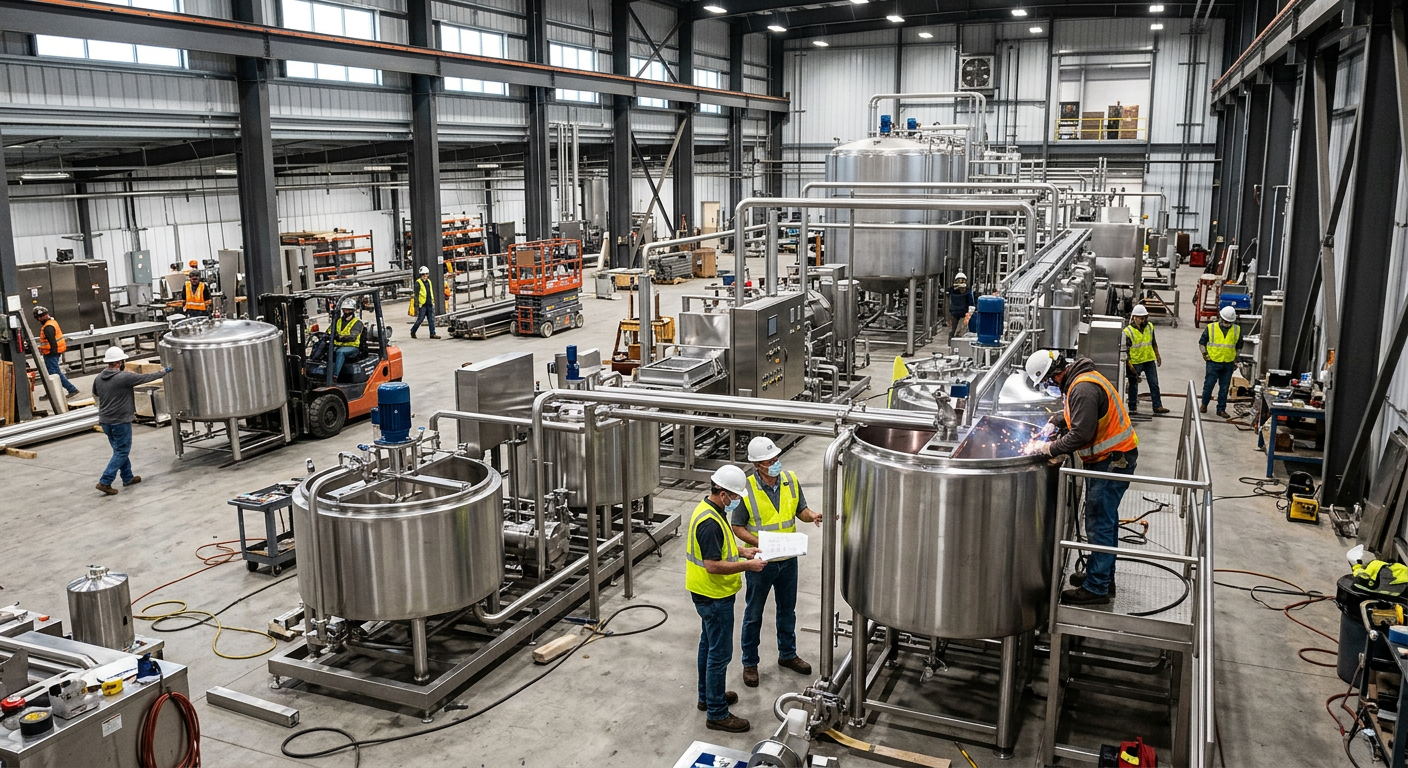
Beverage plants are not ordinary industrial buildings. They combine sanitary process systems, packaging automation, utilities, cold storage, washdown-ready interiors, food safety controls, and often live production constraints under one capital project. In the United States, the best results usually come from a general contractor that understands both construction and beverage manufacturing. That means knowing how a bottling hall differs from a dry warehouse, how to coordinate glycol, compressed air, steam, water treatment, CIP, controls, and line integration, and how to phase work without damaging output. For owners expanding in markets like Dallas-Fort Worth, Chicago, Southern California, the Carolinas, or around logistics hubs near the Port of Los Angeles, Port of Savannah, and Port of Houston, contractor selection directly affects profitability, startup timing, and compliance.
Manufacturers building breweries, RTD facilities, dairy beverage lines, juice plants, carbonated soft drink sites, kombucha operations, co-packing facilities, and aseptic beverage plants should evaluate contractors on more than square-foot price. They should also assess process knowledge, commissioning depth, quality systems, schedule control, utility planning, and the ability to manage local trades across multiple jurisdictions. Companies such as Disruptive Process Solutions approach this work as a business-driven engineering and project execution effort, not simply as a shell-and-core build. That difference matters when a project needs to generate revenue fast.
Quick Answer

A beverage plant needs a general contractor with industry-specific expertise because the project is part building, part manufacturing system, and part regulatory environment. The right contractor coordinates structure, refrigeration, process piping, sanitation design, electrical distribution, controls, packaging utilities, and startup planning as one integrated scope. In the United States, owners should prioritize a GC or GC-equivalent partner with demonstrated beverage experience in bottling, canning, blending, fermentation, distillation, cold storage, wastewater, CIP, and commissioning.
If you are evaluating providers, look for six essentials: beverage process understanding, food-safe construction practices, experience with phased expansions, realistic budgeting, schedule discipline, and a strong network of local trades. A contractor that also understands engineering and system integration can often identify production bottlenecks before unnecessary capital is spent.
| Decision Factor | Why It Matters | Risk If Missing | Best Practice |
|---|---|---|---|
| Beverage process knowledge | Aligns building design with actual production flow | Utility conflicts and poor line layouts | Review prior beverage projects and line integration work |
| Food safety experience | Supports sanitary finishes and controlled construction | Contamination exposure and rework | Use contractors familiar with FDA, SQF, and BRC environments |
| Utility coordination | Steam, glycol, air, water, and CIP drive uptime | Startup delays and reduced throughput | Require utility balance reviews early in design |
| Phased execution ability | Keeps existing operations running | Lost sales during expansion | Create shutdown windows and temporary routing plans |
| Commissioning depth | Moves plant from construction to production faster | Extended debugging after handover | Use FAT, SAT, punch tracking, and dry-run testing |
| National reach with local trades | Improves speed across U.S. markets | Inconsistent field quality | Combine central project leadership with vetted regional partners |
The table above shows why a beverage facility owner should think beyond general industrial construction. A low-bid building contractor may deliver walls and roof, but beverage profitability depends on the total system working together from day one.
Why Beverage Plants Require a Contractor with Industry-Specific Expertise

Beverage production combines strict hygiene, heavy utility demand, fast packaging speeds, and tight margins. A contractor without plant-specific experience can underestimate floor drainage, trenching, slab flatness, process mezzanines, hygienic wall assemblies, traffic separation, or cleanable overhead utility routing. Even small oversights can create major consequences once bottling lines, fillers, pasteurizers, bright tanks, blend systems, or aseptic equipment arrive.
Industry-specific expertise is especially important in U.S. markets where labor conditions, permitting paths, and utility service lead times vary by region. A project in North Carolina may face different wastewater pretreatment constraints than one in California. A Gulf Coast site near Houston may need stronger hurricane resilience planning, while a Midwest cold-fill plant near Chicago may focus more on freeze protection and year-round logistics. Plants near rail spurs, interstate corridors, and export channels must also account for truck courts, trailer circulation, and shipping velocity.
Another reason specialty knowledge matters is that beverage plants often have hidden process bottlenecks. Strong contractors and engineering-led partners evaluate not just the new building, but the business case. They look at syrup room capacity, carbon dioxide systems, boiler redundancy, glycol loads, compressed air demand, controls limitations, warehouse turn rates, and labor flow. That broader viewpoint can prevent overspending on square footage when the true production constraint is a line control sequence, packaging accumulation, or utility undersizing.
On the technology side, owners increasingly prefer partners that can bridge building systems and automation. DPS is a good example of this integrated approach. Through its engineering and controls capabilities, the company supports structural, mechanical, plumbing, electrical, process, and automation coordination, including PLC programming, SCADA, utility integration, and commissioning support. That kind of technical depth helps avoid the classic gap between the construction team and the process startup team.
The market growth trend above reflects the continued expansion of beverage categories in the United States, especially RTD, functional beverages, premium non-alcoholic products, and co-packing. As competition rises, owners need contractors that understand speed to market as well as plant operability.
Beverage Plant Construction Specialties: Bottling Lines, Cold Storage, and Process Integration

Beverage plant construction is usually defined by three specialty zones: process production areas, packaging halls, and warehousing or cold storage. Each has unique requirements and must connect cleanly to the others.
Bottling and canning lines demand flat slabs, robust housekeeping pads, overhead utility racks, air drops, chemical-resistant floor systems, washdown-ready detailing, and enough access for maintenance. Fillers, cappers, depalletizers, conveyors, labelers, packers, and palletizers need more than footprint space; they need proper approach, accumulation, changeover, and sanitation planning.
Cold storage is another specialty. Beverage plants handling dairy drinks, kombucha, juices, concentrates, or temperature-sensitive ingredients often need insulated envelopes, vapor control, refrigeration coordination, door traffic planning, and dock strategies that minimize thermal loss. In climates from Florida to California, cold storage design also affects energy performance and long-term operating expense.
Process integration is where many projects succeed or fail. Tanks, mixers, HTST or UHT systems, filtration, carbonation, water treatment, CIP skids, boiler rooms, glycol systems, compressed air, controls panels, and wastewater connections must all be coordinated around the product path. It is not enough to “fit the equipment.” The contractor must also support cleaning access, valve cluster serviceability, future line tie-ins, and startup sequencing.
DPS has broad beverage and food process integration experience across brewing, spirits, wine, kombucha, soft drinks, juices, dairy beverages, and aseptic systems. It also manufactures selected process equipment such as tanks and CIP systems, which can improve coordination between equipment supply and field installation when schedule certainty matters. You can review more about these integrated capabilities through its equipment solutions.
| Plant Area | Typical Systems | Construction Priority | Common Mistake |
|---|---|---|---|
| Syrup or blend room | Batch tanks, metering, water treatment, CIP | Sanitary routing and access | Insufficient service clearance |
| Filling hall | Fillers, conveyors, packaging equipment | Slab quality and utility drops | Ignoring accumulation and maintenance lanes |
| Pasteurization zone | HTST, tunnel pasteurizers, flash systems | Drainage and heat recovery coordination | Poor condensate handling |
| Cold storage | Panels, refrigeration, insulated doors | Envelope integrity and traffic planning | Undersized dock staging |
| Utility center | Boilers, compressors, glycol, cooling towers | Redundancy and safe maintenance access | No room for future capacity |
| CIP and sanitation area | Chemical storage, return circuits, skids | Operator safety and cleanability | Improper segregation of chemical handling |
This table highlights how each zone requires a different construction logic. Beverage-specialized contractors think in systems, not just rooms.
How to Choose the Right General Contractor for Your Beverage Plant Project
Selecting the right contractor starts with the owner’s business goals. Are you launching a greenfield co-pack facility near Atlanta? Expanding a brewery in Denver? Adding a new aseptic line in Southern California? Converting a warehouse in New Jersey? The contractor must fit the project type, risk profile, and growth plan.
First, ask for project examples that resemble your product and operating model. Experience in commercial offices or generic warehouses is not a substitute for beverage production work. Second, review how the contractor manages preconstruction. Good partners build realistic budgets, utility narratives, schedule assumptions, and phasing plans before field activity begins. Third, examine the handoff between engineering, procurement, construction, and startup. Fragmented teams often create late-stage conflicts.
Fourth, look at communication style. Strong beverage contractors are direct about budget risks, long-lead equipment, and operational tradeoffs. Fifth, verify local code and food safety familiarity. Sixth, ask how they manage subcontractor quality across different states. National coverage only works when local trade relationships are disciplined and repeatable.
DPS positions itself around a design-build-manage model that blends engineering, construction coordination, and project oversight. For owners that need one accountable partner while still protecting long-term ROI, this model can be useful because it ties project decisions back to output, labor efficiency, and startup readiness. More detail on this scope can be found on its service offerings.
| Evaluation Question | What Good Looks Like | Warning Sign | Owner Action |
|---|---|---|---|
| Have you built beverage plants before? | Specific references by category and size | Only general industrial examples | Request site photos and startup outcomes |
| How do you budget early? | Assumption-based estimate with alternates | Single lump sum with little detail | Ask for cost drivers by system |
| How do you manage process utilities? | Integrated engineering reviews | Deferred to late field coordination | Require utility load matrix |
| How do you protect live operations? | Shutdown windows and containment plans | “We will figure it out in the field” | Demand phased execution maps |
| Who leads commissioning? | Defined turnover and startup plan | No clear owner after construction | Include commissioning milestones in contract |
| How do you handle schedule risk? | Procurement tracking and look-ahead planning | Only a high-level schedule | Review critical path every month |
The practical takeaway is simple: interview contractors as if you are hiring an operating partner, not just a builder.
Construction Methods for Beverage Plants: Tilt-Up, Steel Frame, and Hybrid Approaches
In the United States, most beverage plant shells are delivered through three main structural approaches: tilt-up concrete, structural steel, and hybrid systems. The right choice depends on schedule, spans, insulation needs, local labor, seismic conditions, and future expansion plans.
Tilt-up concrete is common for large distribution and production buildings because it can be cost-effective, durable, and secure. It works well for dry warehouses, packaging halls, and broad manufacturing spaces where speed and wall resilience matter. However, process-intensive areas may still require detailed interior buildout to support hygiene and utility routing.
Structural steel offers flexibility for mezzanines, high bays, rooftop loads, pipe bridges, suspended process systems, and future modifications. It is often preferred when equipment support, expansion adaptability, or architectural complexity matters.
Hybrid approaches combine the strengths of both. For example, a plant may use tilt-up perimeter walls for the warehouse and steel framing over process halls where piping, tanks, catwalks, and utility modules need more structural flexibility. Hybrid layouts are frequently effective in beverage projects where packaging, processing, and chilled storage have different performance needs.
| Method | Best Use Case | Primary Advantage | Primary Limitation |
|---|---|---|---|
| Tilt-up concrete | Large dry storage and production shells | Durability and competitive shell cost | Less flexible for some future penetrations |
| Structural steel | Process-heavy plants and mezzanines | Flexibility for utilities and modifications | May cost more depending on market |
| Hybrid shell | Mixed-use beverage facilities | Balanced performance by zone | Requires sharper coordination |
| Insulated metal panel areas | Cold rooms and clean zones | Thermal performance and sanitary finish | Panel detailing must be precise |
| Conventional masonry support zones | Utility rooms and service spaces | Robustness in targeted areas | Slower in some markets |
| Pre-engineered building elements | Budget-sensitive expansions | Fast procurement in select cases | Less customization for complex process halls |
For local supply chains, method selection also depends on the region. In Texas and the Southeast, tilt-up markets are mature. On the West Coast, seismic and permit conditions may favor different detailing. Near major freight hubs like Memphis, Indianapolis, and the Inland Empire, speed to operation can outweigh other preferences.
The demand comparison above shows why flexible construction strategies are so valuable. Categories such as RTD and aseptic beverages are driving complex facility requirements, while traditional segments still require selective modernization.
Phased Construction Strategies That Keep Beverage Operations Running During Expansion
Many U.S. beverage projects take place on active campuses. Owners cannot simply stop filling cans or bottles for six months while the new work is built. That makes phased construction a core competency.
Effective phasing starts with operational mapping. Teams should identify sanitation boundaries, forklift routes, pedestrian paths, production windows, allergen or ingredient segregation, utility interruptions, and quality hold points. Once these are known, the project can be divided into enabling work, shell expansion, utility tie-ins, equipment setting, line integration, and final changeover.
Temporary systems are often critical. These may include temporary chilled water loops, electrical feeds, partition walls, drains, packaging reroutes, or mobile compressors. Night and weekend shutdowns may be needed for tie-ins to steam, compressed air, process water, or controls networks. The best contractors work closely with plant leadership, maintenance, quality, and production planning, not just the owner’s capital team.
DPS is known for project-based execution that combines rapid decision-making with disciplined oversight, which is valuable during active-site expansions. Its project management approach is especially relevant when clients need local trade coordination, schedule compression, and production continuity at the same time.
| Phase | Typical Work | Operational Goal | Key Control |
|---|---|---|---|
| Phase 1 | Site prep and enabling utilities | No disruption to current line output | Separate construction access |
| Phase 2 | Shell expansion or annex buildout | Protect sanitation and traffic flow | Dust and noise containment |
| Phase 3 | Utility rough-in | Maintain service reliability | Planned outage matrix |
| Phase 4 | Equipment set and mechanical install | Keep current production stable | Crane windows and route protection |
| Phase 5 | Controls integration and testing | Minimize startup overlap risk | I/O checks and simulation testing |
| Phase 6 | Cutover and ramp-up | Return to full sales velocity fast | Defined contingency staffing |
This sequence gives owners a practical framework. The key principle is that every construction milestone should be matched to an operational protection plan.
Budget Planning: Realistic Cost Expectations for Beverage Plant General Contracting
Cost expectations vary widely based on product type, sanitation level, utilities, cold storage, automation, and regional labor conditions. A simple dry beverage warehouse expansion in the Midwest will not cost the same as a greenfield aseptic or dairy beverage facility in California. Owners should separate shell cost from process cost, utility infrastructure, and startup support.
In the United States, realistic budgeting usually includes at least these categories: site development, building shell, sanitary finishes, process utility infrastructure, refrigeration or HVAC, electrical distribution, controls, equipment installation, commissioning, and contingency. If your project involves boilers, wastewater pretreatment, RO water, tunnel pasteurization, sterile air, or clean-room-like zones, cost per square foot may be a misleading metric unless tied to process scope.
DPS often works on capital projects ranging from several hundred thousand dollars to multimillion-dollar scopes, particularly where owners need engineering-backed decision making before construction spend accelerates. That matters because early planning can prevent expensive misallocation of capital.
| Project Type | Indicative U.S. Budget Range | Main Cost Drivers | Notes |
|---|---|---|---|
| Warehouse conversion to beverage use | $150-$260 per sq. ft. | Drainage, utilities, hygienic upgrades | Often underestimated in older buildings |
| Dry beverage packaging expansion | $180-$300 per sq. ft. | Electrical, conveyors, dock changes | Excludes major new process systems |
| Brewery or fermentation expansion | $250-$425 per sq. ft. | Glycol, tanks, CIP, floor finishes | Varies with cellar complexity |
| RTD and blended beverage facility | $300-$500 per sq. ft. | Blend rooms, fillers, utilities, controls | High integration content |
| Dairy or cold-chain beverage plant | $350-$575 per sq. ft. | Refrigeration, hygienic detailing, wastewater | Energy design is critical |
| Aseptic beverage buildout | $450-$750+ per sq. ft. | Sterile process, high-end controls, validation | Scope definition drives variance |
These ranges are planning-level only, but they help set expectations. Owners should also plan for long-lead equipment escalation, utility company lead times, and local labor volatility in major metro regions such as Los Angeles, Seattle, Boston, and Phoenix.
The area chart shows a clear shift through 2026: more projects are being justified not only by capacity, but by labor efficiency, water reduction, energy performance, traceability, and operational data visibility.
Quality Control and Food Safety Protocols on Beverage Plant Construction Sites
Construction quality in a beverage plant is not just about finishing work correctly. It is also about protecting the future manufacturing environment while construction is happening. On active sites, that means dust control, debris management, sanitary barriers, traffic separation, cleaning routines, controlled penetrations, and documented turnover procedures.
For food and beverage manufacturers in the United States, quality protocols should align with the plant’s compliance environment, whether that includes FDA expectations, SQF, BRC, customer audits, or corporate GMP standards. The contractor should know how to work around ingredient storage, packaging materials, and production sanitation schedules. Welding quality, pipe slope, floor drainage, insulated envelope continuity, and cleanable detailing all affect long-term operations.
From a technology perspective, contractor quality also includes proper documentation. Utility tagging, as-builts, startup checklists, instrument lists, panel schedules, and controls narratives are all part of a good turnover package. This is where engineering-led contractors stand out, because they can connect field execution to validation and startup requirements.
To see examples of complex project execution and integrated delivery, owners can explore selected project case studies.
| Quality Protocol | Purpose | Applied In | Result |
|---|---|---|---|
| Dust containment barriers | Protect product and packaging areas | Active expansions | Lower contamination risk |
| Controlled access routes | Separate construction and production traffic | Live plants | Improved GMP protection |
| Weld and pipe inspection | Ensure sanitary process performance | Utility and product systems | Reduced leak and cleanability issues |
| Drainage verification | Support washdown and safety | Wet process areas | Better sanitation outcomes |
| Turnover documentation | Support startup and maintenance | All project types | Faster commissioning |
| Pre-startup sanitation review | Confirm readiness before production | Final handover | Lower launch risk |
The lesson is straightforward: quality control in beverage construction must be designed for future food safety, not just immediate building acceptance.
Timeline Optimization: How Leading Contractors Deliver Beverage Plants on Schedule
Beverage project schedules are often pressured by product launches, seasonal demand, distributor commitments, or co-packing contracts. A delayed startup can affect revenue for a full year. That is why top contractors optimize schedule in three ways: early procurement, integrated planning, and disciplined commissioning.
Early procurement is especially important for switchgear, refrigeration equipment, boilers, process tanks, control panels, insulated doors, and specialty packaging equipment. Integrated planning means shell work, utilities, process installation, and controls are sequenced together rather than handed off in isolation. Disciplined commissioning means testing starts before final completion, with loop checks, utility verification, dry runs, and operator training staged in advance.
Leading beverage contractors also use realistic critical path management. They identify long-lead risk, permit dependencies, weather exposure, and tie-in windows. In logistics-intensive regions such as the Inland Empire, Atlanta, and central Pennsylvania, they also plan around freight access and local labor availability. With more owners targeting 2026 sustainability and automation goals, schedule control increasingly includes parallel work on energy systems, digital monitoring, and water reuse infrastructure.
DPS supports these outcomes through a combination of engineering, project management, installation, and GC or GC-equivalent execution. Its service capability is especially relevant for clients that need one partner to align capital planning, owners representation, field coordination, and startup accountability across multiple states.
The comparison above illustrates why specialized contractors consistently outperform generic builders on beverage-specific metrics. Schedule is not just about faster field work; it is about fewer late-stage surprises.
FAQ
What does a beverage plant general contractor do?
A beverage plant GC manages building construction, trade coordination, permitting support, safety, schedule, and cost control while aligning the work with process and packaging needs. In specialized projects, the role often expands into utility planning, equipment setting, and commissioning coordination.
Can a standard warehouse contractor build a beverage plant?
Only for the simplest shell scopes. Once sanitary finishes, process utilities, floor drainage, cold storage, line integration, or food safety controls are involved, industry-specific experience becomes much more important.
How early should we bring in a contractor?
Ideally during feasibility or concept design. Early contractor involvement improves budget realism, phasing strategy, utility planning, and procurement timing.
What product types benefit most from specialized beverage construction expertise?
RTD, aseptic beverages, dairy drinks, carbonated soft drinks, juices, kombucha, brewing, distilling, and co-packing operations all benefit because they combine process complexity with packaging speed and compliance requirements.
How long does a beverage plant expansion usually take?
Small retrofit phases may take a few months, while large greenfield or high-sanitation projects can take 12 to 24 months depending on permits, utility upgrades, long-lead equipment, and startup complexity.
What should owners budget for beyond the building?
Include process utilities, controls, commissioning, startup support, refrigeration, wastewater, sanitation infrastructure, spare parts, training, and contingency. Many owners underestimate these categories.
How do we evaluate local suppliers and subcontractors?
Look for proven performance in food-grade piping, industrial refrigeration, sanitary electrical work, insulated panel systems, drainage, and packaging line support. The best lead contractors use vetted regional partners instead of unfamiliar low bidders.
What are the main 2026 trends in U.S. beverage plant construction?
Expect more automation, stronger SCADA visibility, energy recovery, water reuse, electrification where practical, carbon tracking, resilient cold storage, and more attention to FDA, customer audit, and sustainability-driven design standards.
How can we reduce risk during expansion?
Use phased planning, define utility shutdown windows, separate traffic paths, verify sanitation controls, and involve operations, maintenance, and quality teams in construction planning from the start.
Why do owners choose DPS for beverage-related capital work?
Because the company combines process engineering, installation, project management, and general contracting or GC-equivalent delivery with a practical focus on profitability. Its team works across North America, supports multiple beverage categories, and brings technical depth in process systems, controls, utilities, and integration rather than treating the project as a simple building exercise.
For beverage manufacturers in the United States, the best contractor is the one that understands how the facility makes money. That means linking structural choices, utilities, sanitation, process integration, schedule, and commissioning into a single execution plan. Whether you are expanding near Charlotte, scaling in California, launching in Texas, or modernizing in the Midwest, a specialized beverage plant builder can protect both startup timing and long-term operating performance.
[/trp_language]
Complete Company Portfolio
About the Author: Disruptive Process Solutions (DPS)
The DPS team combines process engineering expertise with real-world food and beverage manufacturing experience. Our content focuses on process optimization, production efficiency, facility improvements, and practical solutions that help manufacturers operate more effectively in a rapidly evolving industry.
Share