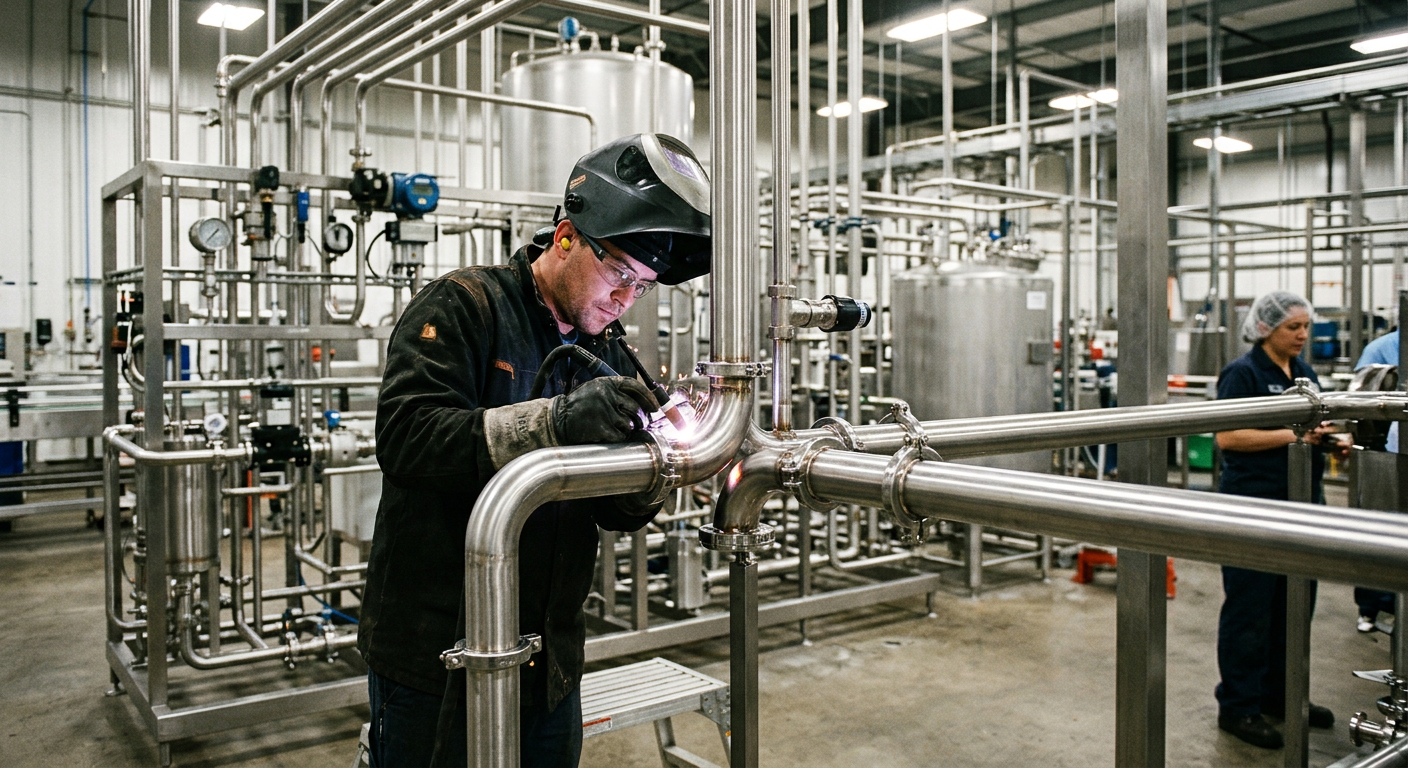
Food Processing Project Management
[trp_language language=”en_US”]
Food Plant Project Leadership in the United States
Managing a food processing capital project is not the same as running a standard building job. In the United States, processors must protect production uptime, food safety, regulatory compliance, and profitability at the same time. A successful food processing project manager aligns process engineering, utilities, controls, sanitation, construction sequencing, commissioning, and operational readiness so the plant can start up safely and meet output goals without expensive delays.
Across major manufacturing corridors such as Chicago, Dallas-Fort Worth, Atlanta, Fresno, Kansas City, Charlotte, Los Angeles, and the New Jersey port region, manufacturers are investing in expansions, retrofits, relocations, and greenfield facilities. These projects often involve protein plants, dairy operations, breweries, beverage bottling lines, aseptic systems, prepared foods, sauces, and co-packing facilities. In each case, project management must go beyond concrete and steel. It must account for hygienic design, utility redundancy, line integration, USDA or FDA expectations, and the commercial reality of hitting first-year production targets.
For companies evaluating outside help, food-focused project leadership is often the difference between a facility that merely gets built and one that actually performs. Firms such as Disruptive Process Solutions position their work around profitable execution, combining engineering, construction oversight, and operational thinking rather than treating the project as a generic construction package.
Quick Answer

Food processing project management is a specialized discipline that blends construction management with process engineering, sanitary design, equipment integration, controls, utilities, validation, and food safety risk control. In the United States, the best project managers for food plants do four things especially well: they plan around production realities, sequence work to protect sanitation and uptime, control scope and budget with discipline, and coordinate startup so the facility reaches designed throughput quickly.
Unlike standard commercial construction, a food manufacturing project may require shut-down windows measured in hours, not weeks. It may involve temporary walls in an active USDA-inspected room, allergen segregation planning, CIP integration, wastewater loading analysis, hygienic piping routes, and commissioning of packaging and automation systems tied directly to quality and traceability. The project manager must therefore understand both the built environment and the process environment.
For U.S. manufacturers, this matters most in three situations: brownfield expansions in active plants, line relocations between states, and capacity additions where utilities and controls are the true bottlenecks. A disciplined manager can prevent overbuilding, avoid contamination events, and make sure capital spending translates into usable capacity rather than stranded equipment.
| Project Type | Main Goal | Primary Risk | PM Priority | Typical U.S. Setting | Success Measure |
|---|---|---|---|---|---|
| Brownfield line expansion | Add capacity | Production disruption | Shutdown sequencing | Existing plant in Midwest or Southeast | Output increase with minimal downtime |
| Greenfield food plant | New facility launch | Startup delays | Integrated master schedule | Texas, Carolinas, California | On-time commissioning |
| Equipment relocation | Reuse assets | Fit and utility mismatch | Field verification | Interstate relocation | Fast restart |
| Utility upgrade | Remove bottlenecks | Underestimated load | Capacity modeling | Beverage and dairy plants | Reliable throughput |
| Automation retrofit | Improve control | Integration failure | I/O and logic coordination | Legacy plants nationwide | Stable line performance |
| Aseptic or sanitary room project | Compliance and shelf life | Contamination risk | Hygienic construction controls | High-value processing sites | Validated sanitation performance |
The table above shows why food plant PM is measured by operating results, not just completion. A building may be “finished,” but if sanitation fails, utilities are undersized, or controls are not tuned, the project has not truly succeeded.
How Food Processing Project Management Differs from Standard Construction PM

Traditional construction project management focuses on cost, schedule, subcontractor coordination, safety, and quality of the built asset. Those remain essential in food processing, but the project layer is much deeper. A food plant includes process flow logic, ingredient handling, hygienic zoning, cleaning chemistry, wastewater implications, thermal systems, and operator interaction. These factors directly influence the construction plan.
For example, installing a new sauce batching system in an active plant near Houston is not just a mechanical task. The project manager must assess traffic separation between contractors and sanitation crews, dust and debris control near exposed product areas, tie-ins to steam and chilled water, CIP return routing, PLC integration, and whether startup will affect allergen scheduling. In a protein facility near Omaha or a dairy plant in Wisconsin, the same principle applies with different hazard profiles.
Another major difference is revenue sensitivity. In many food and beverage plants, a missed startup date does not just create inconvenience; it affects retailer commitments, seasonal production windows, co-packing obligations, and margin. This is especially true near high-volume logistics hubs such as Memphis, the Port of Savannah, the Inland Empire, and New Jersey distribution corridors.
Food-focused PM also requires more cross-disciplinary fluency. The manager must speak the language of operations, maintenance, quality assurance, finance, engineering, and contractors. That is why many manufacturers prefer specialists who understand complete processing systems rather than generalists limited to base building work. Companies offering integrated food and beverage engineering services typically bring that broader perspective to the table.
| Category | Standard Construction PM | Food Processing PM | Why It Matters | Common U.S. Example | Impact if Missed |
|---|---|---|---|---|---|
| Schedule planning | Trade sequencing | Trade plus production sequencing | Plants keep running | Weekend tie-ins in active factories | Unplanned downtime |
| Quality control | Building standards | Building plus sanitary standards | Product contact environments | Washdown room upgrades | Contamination risk |
| Utilities | General MEP coordination | Process-critical utility modeling | Steam, glycol, air, water affect output | Beverage syrup and cooling systems | Capacity shortfall |
| Commissioning | Occupancy readiness | Production readiness | Facility must perform, not just exist | Filler startup and CIP validation | Delayed revenue |
| Regulatory focus | Building code | Building code plus FDA/USDA/SQF/BRC realities | Compliance exposure is higher | Protein and dairy facilities | Audit findings |
| Stakeholders | Owner, architect, GC | Owner, QA, operations, maintenance, process, controls, GC | More decisions affect output | Co-packing expansions | Decision bottlenecks |
The takeaway is simple: food manufacturing projects require project managers who can turn capital plans into operational outcomes, not just completed construction scopes.
This line chart reflects the broader market context: capital activity across the United States continues to rise as processors modernize aging plants, add automation, improve traceability, and build resilience into domestic production networks.
The PM Framework: Planning, Scheduling, Budgeting, and Risk Management for Food Projects

A strong food processing project management framework begins before design is complete. The best teams establish a business case, define throughput targets, map utility constraints, and confirm operating assumptions early. In practice, the PM framework should connect four disciplines: planning, scheduling, budgeting, and risk management.
Planning starts with scope clarity. That includes process goals, target SKUs, packaging formats, sanitation requirements, labor model, utility loads, and expansion allowances. If a beverage client in North Carolina expects to scale from 20 million cases to 80 million cases over time, the PM plan must address not only day-one equipment but also future utility and layout logic. That is where integrated project thinking creates long-term value.
Scheduling for food projects must include procurement lead times, shutdown windows, commissioning activities, factory acceptance tests, site acceptance tests, and operator training. Long-lead stainless tanks, custom controls panels, boilers, refrigeration equipment, and specialty valves can reshape the entire schedule. Ports such as Long Beach, Savannah, and Houston, along with inland freight lanes to Chicago and Dallas, can influence delivery timing and should be built into schedule risk analysis.
Budgeting should go beyond contractor bids. Food projects often carry hidden cost exposure in temporary operations, sanitation support, off-shift labor, expedited freight, utility rework, validation, owner-furnished equipment coordination, and startup waste. Good PM discipline tracks committed cost, forecast at completion, approved changes, contingency burn, and cost-to-capacity economics.
Risk management is the glue. It identifies what could interrupt food safety, schedule, startup, or cash flow and assigns owners to reduce that exposure. Typical risks include undocumented field conditions, utility undersizing, vendor delays, conflicting line elevations, controls incompatibility, and changes requested late by operations.
| Framework Element | Key Questions | Tools Used | Owner | Typical Risk | Best Practice |
|---|---|---|---|---|---|
| Planning | What must the line achieve? | Basis of design, process maps | PM + process engineering | Scope ambiguity | Define measurable capacity targets |
| Scheduling | When can work occur? | Integrated master schedule | PM + contractors + operations | Missed shutdown window | Use detailed outage playbooks |
| Budgeting | What will total installed cost be? | Estimate ladder, cost reports | PM + finance | Soft costs overlooked | Track full life-cycle capital use |
| Risk management | What could stop startup? | Risk register, mitigation plans | PM + stakeholders | Late discovery issues | Review risks weekly |
| Procurement | What is long lead? | Buyout log, expediting matrix | PM + supply chain | Delayed equipment arrival | Release critical packages early |
| Commissioning | How do we prove readiness? | Startup protocols, punch lists | PM + operations + OEMs | Incomplete handoff | Plan commissioning from day one |
The table highlights why a structured framework matters. Every category overlaps. Poor planning weakens schedule logic; weak schedule logic inflates cost; inflated cost often traces back to unmanaged risk. In food manufacturing, that chain reaction is fast and expensive.
Controlling Food Safety Risks During Construction in Active Processing Facilities
One of the hardest parts of food processing project management is executing work inside an operating facility. Active plants cannot tolerate the same jobsite conditions accepted on conventional projects. Construction dust, standing water, contractor traffic, open ceilings, temporary penetrations, and poorly controlled materials can jeopardize sanitation and audit performance.
Effective PM teams create a food safety construction control plan before work starts. This plan typically addresses hygienic zoning, barrier requirements, negative air or dust containment, tool accountability, approved access routes, waste removal timing, contractor gowning where required, sanitation verification, and restart criteria after each work period.
In a U.S. protein facility under USDA inspection, temporary wall placement and cleanup verification may need close coordination with plant QA and inspection staff. In a dairy or aseptic environment, environmental monitoring and stricter airflow controls may be necessary. In snack, bakery, beverage, or ingredient plants, the focus may shift toward dust migration, allergen isolation, and utility contamination prevention.
Water is another major issue. Hot work, trenching, washdown changes, and drain modifications can all create microbiological and operational risks. A good project manager works with sanitation, maintenance, and quality teams to establish hold points before lines return to service.
| Risk Source | Potential Food Safety Issue | Where It Appears | Control Method | Responsible Team | Verification Step |
|---|---|---|---|---|---|
| Dust and debris | Product contamination | Ceiling work, cutting, demolition | Isolation barriers and negative air | PM + contractor | Pre-op inspection |
| Open penetrations | Pest or contamination pathway | Utilities and piping routes | Seal same day where possible | Trade foremen | Daily closeout audit |
| Standing water | Microbial growth | Drain work, washdown areas | Water control and rapid cleanup | Contractor + sanitation | Area release signoff |
| Contractor movement | Cross-contamination | Active production corridors | Dedicated access paths | PM + plant operations | Badge and route checks |
| Improper material storage | Foreign material risk | Staging zones | Approved staging and coverings | Site superintendent | Shift inspections |
| Uncontrolled startup | Sanitation failure | Post-installation restart | Startup release checklist | QA + operations + PM | Documented readiness review |
The point of this table is not only compliance. It is business protection. A contamination event or failed pre-op during construction can erase schedule gains instantly. Experienced food project managers understand that food safety controls must be built into the work plan, not added after the fact.
The bar chart shows where specialized project management demand is strongest. Beverage, co-packing, and protein projects are especially schedule-sensitive because they combine high throughput expectations with complex process and sanitation constraints.
How to Select a Food Processing Project Manager with the Right Expertise
Choosing a food processing project manager should start with operating fit, not just resume length. The right person or firm must understand your product category, facility type, and capital objective. A greenfield spirits facility in Kentucky, a poultry upgrade in Arkansas, and an aseptic beverage expansion in California all require different technical instincts.
Look first for category experience. Ask whether the manager has handled projects involving your process technology: HTST, UHT, retort, batching, fermentation, carbonation, marination, cooking, slicing, blending, homogenization, or CIP. Then evaluate brownfield experience. Many project leaders perform well on clean-sheet work but struggle inside active plants where shutdown windows, sanitation controls, and field improvisation define success.
Next, verify cross-functional capability. Strong candidates can coordinate process engineering, controls, utility planning, and contractor management without losing sight of financial goals. This is especially valuable when the project includes owner-furnished equipment, recipe automation, or future capacity phases.
Finally, look for commercial honesty. Some firms simply expand scope because more installed cost means more revenue. Better partners challenge assumptions when a less expensive fix can unlock capacity. That owner-minded approach is often the real differentiator in food and beverage capital planning.
| Selection Criteria | What to Ask | Strong Signal | Weak Signal | Why It Matters | Decision Weight |
|---|---|---|---|---|---|
| Product category expertise | Have you managed similar lines? | Specific food or beverage examples | Only general construction history | Reduces learning curve | High |
| Brownfield experience | How do you protect active production? | Detailed shutdown and hygiene methods | Vague safety-only answers | Prevents disruption | High |
| Utility knowledge | How do you assess capacity constraints? | Load analysis and process understanding | Defers entirely to trades | Supports throughput goals | High |
| Controls integration | How do you manage automation interfaces? | PLC/SCADA coordination examples | No automation depth | Startup depends on it | Medium |
| Commercial transparency | Will you challenge bad assumptions? | Can share value-engineering stories | Always says yes | Protects capital efficiency | High |
| National execution network | Can you support multi-state projects? | Proven partner network and field reach | Limited geography | Useful for U.S. portfolios | Medium |
Manufacturers comparing providers should also review actual capabilities beyond PM. If a firm can connect project leadership with engineering, equipment, and integration support, handoffs are reduced and decisions become faster. You can review examples of broader processing equipment capabilities and installed solutions to understand how technical depth affects delivery quality.
Integration of Process Engineering and Construction Management in Food Processing PM
The most successful food processing projects are managed as integrated systems, not as separate engineering and construction silos. Process engineering defines flow, hygienic requirements, utility loads, control logic, and operational goals. Construction management turns those requirements into field execution. If the two are disconnected, the project may be built correctly but still function poorly.
That is why integrated delivery models are gaining traction in the United States. Process-led PM helps prevent common disconnects such as inaccessible valve placement, undersized pipe routing, poor cleanability, missing utility redundancy, and controls cabinets located where operators cannot use them efficiently. These are not cosmetic mistakes; they affect uptime, labor, sanitation, and throughput.
From a technological standpoint, high-performing firms now coordinate structural, mechanical, plumbing, electrical, process, and controls engineering in one execution framework. That includes PLC programming, SCADA integration, recipe and batch control, and energy management systems where appropriate. In food and beverage, these technological capabilities shape startup success as much as physical installation does.
On the manufacturing side, some providers also bring custom equipment capability to the table. That may include tanks, CIP skids, marination tumblers, or cooking vessels designed to fit the broader process layout. Manufacturing capability can simplify procurement, improve fit-up, and reduce schedule friction when custom stainless assets are needed.
From a service standpoint, integrated providers support capital planning, feasibility, owner’s representation, project and program management, general contracting where licensed, installation, and full system integration. This service depth allows one team to move from concept through startup with fewer gaps in accountability.
For a practical illustration, consider a plant adding a new blending room and packaging line in the Southeast. Process engineering determines batching logic, ingredient handling, Brix control, filtration, and CIP design. Construction management coordinates slab penetrations, mezzanine steel, utility extensions, trade sequencing, and startup access. If these teams act independently, rework is likely. If they are integrated, decisions can be made around total plant performance.
The area chart shows the trend shift toward integrated delivery. As plants become more automated and sanitary requirements become more demanding, the market increasingly favors teams that can bridge engineering intent and field execution.
Change Management: Handling Scope Adjustments Without Derailing Food Processing Projects
Scope change is normal in food and beverage capital projects. What matters is how it is handled. Changes may arise from field discoveries, utility constraints, evolving production strategy, vendor substitutions, regulatory interpretation, or new commercial priorities. Without a disciplined change process, even small adjustments can damage schedule, cost, and startup quality.
The best change management systems do three things. First, they classify changes by urgency and impact. Second, they tie every change to cost, schedule, operational, and food safety consequences. Third, they force timely decisions. In active plants, slow decision-making is often worse than the change itself.
For example, if a processor in California decides mid-project to add future-ready piping headers for an additional filler, that change may be smart long term. But it should be evaluated against current shutdown windows, structural loading, controls architecture, and startup complexity. Change management is not about blocking improvements; it is about preventing surprises.
A disciplined PM will use formal logs, request workflows, drawing revisions, and owner approvals. Just as important, they will communicate change impacts in business language. Plant leadership needs to know whether the change improves throughput, reduces labor, protects flexibility, or simply adds unnecessary spend.
One reason some owners favor firms with a design-build-manage philosophy is that scope shifts can be assessed across engineering, construction, and operations at the same time. That makes decisions faster and more grounded in actual plant economics.
Performance Metrics: KPIs That Define Successful Food Processing Project Delivery
Food processing project success should be measured through operating KPIs, not just project closeout paperwork. The best metrics connect capital execution to plant performance. That means looking at startup speed, throughput realization, sanitation readiness, budget predictability, schedule reliability, and safety outcomes together.
Key indicators often include percent of planned production reached within 30, 60, and 90 days; number of startup-critical punch list items; contingency usage; downtime during tie-ins; change order ratio; first-pass sanitation release; utility reliability; and operator training completion. In a co-packing or beverage environment, OEE ramp and SKU changeover performance may also be central.
For owners managing multiple U.S. plants, KPI consistency matters even more. A portfolio view allows leadership to compare how projects perform in different regions, whether in the Carolinas, Texas, the Midwest, or the West Coast. That is especially useful when deciding which partners to use for repeat work.
| KPI | Definition | Target Range | Why It Matters | Measured When | Owner Action if Off Target |
|---|---|---|---|---|---|
| Schedule adherence | Milestones achieved on plan | 90% or higher | Protects launch date | Weekly and monthly | Escalate recovery planning |
| Budget predictability | Forecast vs approved budget | Within 5% to 8% | Controls capital efficiency | Monthly | Freeze noncritical changes |
| Startup throughput attainment | Actual vs designed capacity | 80%+ in first 90 days | Measures real performance | Post-startup | Deploy optimization team |
| Food safety release success | Pass rate for pre-op/startup checks | Near 100% | Protects product integrity | Every restart | Review sanitary controls |
| Change order ratio | Change value vs original contract | Project-dependent, ideally controlled | Reveals scope discipline | Monthly | Strengthen approvals |
| Safety performance | Recordable incidents and near misses | Zero serious incidents | Protects people and work continuity | Continuous | Reset field controls immediately |
The table demonstrates that food project KPIs should mirror business outcomes. A project that hits substantial completion but misses throughput, sanitation, or reliability targets has not fully delivered value.
This comparison chart illustrates why many owners prefer integrated delivery for complex food projects. While each model has a place, the combination of engineering, construction, and process oversight often produces the best fit for facilities where uptime and compliance are tightly linked.
Common Mistakes in Food Processing Project Management and How to Avoid Them
The most common mistake is treating a food project like a standard construction job. That mindset leads to poor shutdown planning, weak sanitary controls, and underestimation of startup complexity. The second major mistake is failing to align capital spending with actual bottlenecks. Some plants invest in new equipment when controls, utilities, or flow logic are the true constraints.
Another frequent problem is late stakeholder involvement. If operations, QA, maintenance, sanitation, and automation teams are not involved early, design decisions become harder to reverse. Projects also suffer when vendor coordination is left too late, especially with owner-furnished process equipment.
Insufficient field verification is another expensive error. Legacy plants in cities such as Philadelphia, Milwaukee, St. Louis, or Los Angeles often contain undocumented utilities, altered floor elevations, and hidden structural constraints. Laser scans, utility mapping, and early site walks save money.
Finally, many teams underplan commissioning. They assume startup begins after construction ends. In reality, startup preparation should begin during design, with FAT planning, SAT checklists, spare parts strategy, training, SOP updates, and line trial sequencing already defined.
Owners can avoid these issues by using food-specialized project managers, demanding integrated schedules, requiring formal change control, and selecting partners that combine technical depth with operational honesty. Reviewing relevant project case studies can help validate whether a team has solved comparable problems in the field.
| Common Mistake | Typical Cause | Result | Early Warning Sign | Prevention Method | Business Benefit |
|---|---|---|---|---|---|
| Generic PM approach | No food-sector specialization | Missed sanitary needs | Schedule ignores production constraints | Use food-experienced leadership | Lower compliance risk |
| Wrong bottleneck identified | Weak front-end analysis | Capital wasted | Scope grows without throughput proof | Confirm root cause first | Higher ROI |
| Late stakeholder engagement | Siloed planning | Rework and delays | Frequent late comments | Cross-functional reviews | Faster decisions |
| Poor field verification | Old drawings trusted blindly | Change orders | Many RFIs during install | Scan and verify existing conditions | Better predictability |
| Weak commissioning plan | Construction-first mindset | Slow ramp-up | No startup checklist by mid-project | Plan startup from design stage | Faster revenue capture |
| Slow change approvals | Unclear authority | Schedule slippage | Open decision log grows weekly | Set approval thresholds early | Reduced delay cost |
These mistakes are avoidable. In most cases, the cure is earlier alignment, stronger food-specific controls, and project leadership that understands both manufacturing economics and site execution.
Looking ahead to 2026, several trends will shape food processing project management in the United States. Automation and data integration will continue to expand, especially around SCADA visibility, recipe control, predictive maintenance, and utility monitoring. Sustainability pressures will drive more projects involving water reuse, heat recovery, efficient refrigeration, and energy management. Policy and compliance expectations will remain strong, with traceability, sanitary design rigor, and documentation discipline becoming even more important. Domestic supply chain resilience will also keep supporting regional plant investments near transportation hubs, labor pools, and population centers.
For owners planning future work, this means selecting project management partners who can think beyond immediate installation. The right team should understand technology roadmaps, utility resilience, carbon and water efficiency, labor realities, and the business case for phased capacity expansion.
FAQ
What is food processing project management?
It is the planning and execution of capital projects for food and beverage plants, combining construction management with process engineering, sanitary design, utilities, controls, compliance, and startup readiness.
Why is it different from regular construction management?
Because the facility must not only be built safely and on budget, but also operate hygienically, meet production targets, support cleaning protocols, and comply with food industry requirements.
When should a processor bring in a project manager?
Ideally at concept or feasibility stage. Early involvement improves scope clarity, budgeting accuracy, utility planning, procurement timing, and shutdown strategy.
What industries need this most?
Protein, dairy, beverage, brewing, spirits, prepared foods, sauces, ingredients, aseptic processing, and co-packing operations all benefit from specialized PM.
How important is active plant experience?
Very important. Brownfield work in an operating plant requires food safety controls, tight shutdown windows, and detailed coordination with operations and QA teams.
What should owners ask before hiring a PM firm?
Ask about similar product category experience, utility and controls expertise, active facility procedures, startup performance, change management discipline, and national delivery capability.
Can one partner handle engineering, equipment, and project delivery?
Yes. Many manufacturers prefer integrated partners that can support design, capital planning, custom equipment, installation, and oversight in a unified model.
How do I know whether my project really needs new equipment?
A strong project team will evaluate bottlenecks first. In some cases, automation changes, utility upgrades, or process optimization can deliver more output than major new equipment purchases.
What are the biggest schedule risks in U.S. food projects?
Long-lead equipment, missed shutdown windows, undocumented field conditions, delayed owner decisions, and incomplete commissioning planning are among the most common risks.
What makes a project successful?
Successful delivery means safe execution, controlled budget, reliable schedule, compliant startup, rapid throughput attainment, and clear business value after handoff.
For manufacturers seeking a partner that combines food and beverage engineering depth with practical project execution, integrated providers such as DPS offer a model that aligns process design, build oversight, and management discipline around profitable outcomes rather than simple project volume. That approach is especially valuable for U.S. companies expanding capacity, modernizing utilities, relocating assets, or launching new facilities in competitive markets.
[/trp_language]
Complete Company Portfolio
About the Author: Disruptive Process Solutions (DPS)
The DPS team combines process engineering expertise with real-world food and beverage manufacturing experience. Our content focuses on process optimization, production efficiency, facility improvements, and practical solutions that help manufacturers operate more effectively in a rapidly evolving industry.
Share