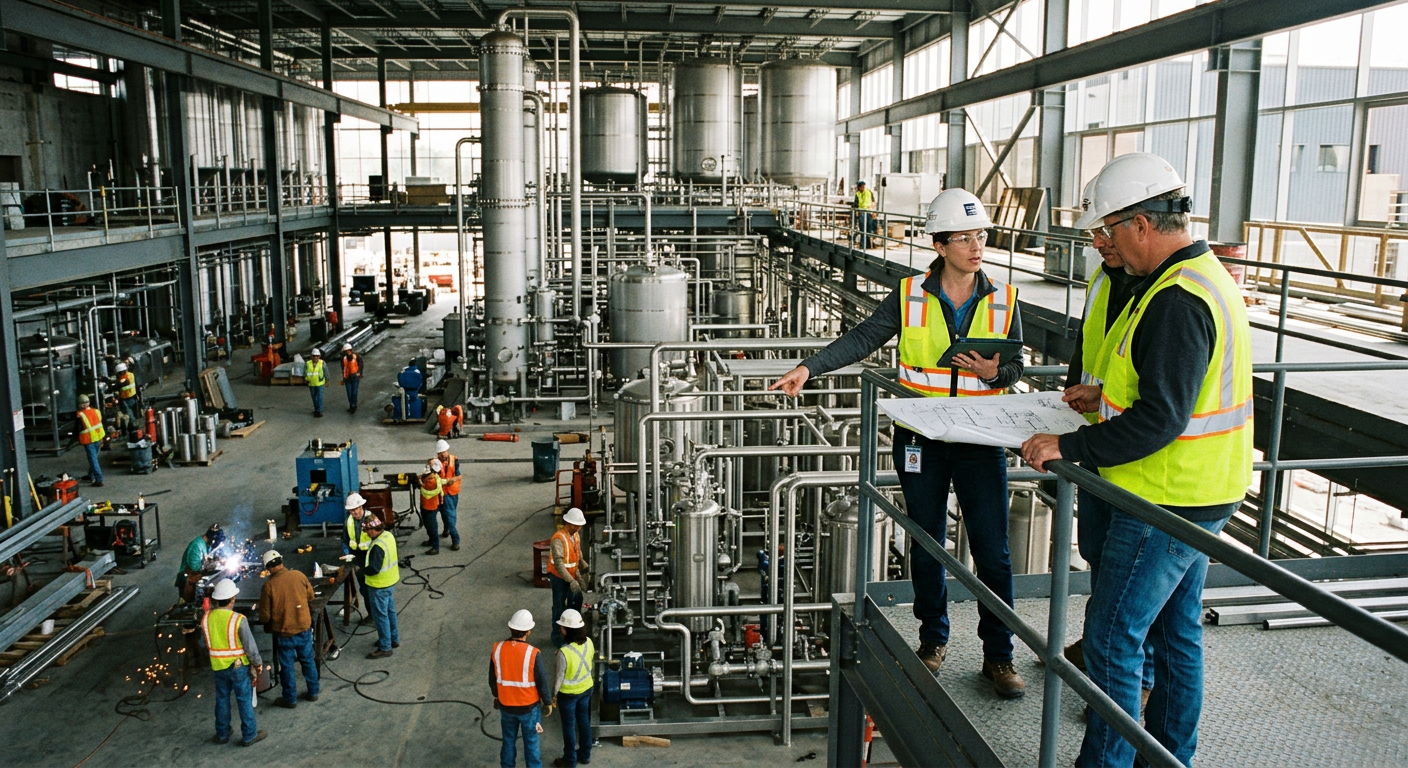
Beverage Plant Owner Representative
[trp_language language=”en_US”]
Building or expanding a beverage plant in the United States is rarely just a construction job. It is a capital strategy decision tied to throughput, sanitary design, utility capacity, workforce readiness, regulatory compliance, and speed to market. An owner representative serves as the plant owner’s advocate throughout planning, design, procurement, construction, commissioning, and startup. Instead of relying solely on designers, equipment vendors, or contractors whose responsibilities may be limited to their own scope, the owner rep keeps the entire project aligned with the owner’s commercial goals, risk tolerance, and launch timeline.
For beverage manufacturers entering new markets like Texas, California, North Carolina, Florida, Illinois, or New Jersey, this role becomes even more valuable. Whether the project involves brewing, distilling, RTD cocktails, juice, dairy beverages, aseptic filling, carbonated soft drinks, or functional wellness beverages, the right representation can reduce change orders, improve sanitary outcomes, verify vendor claims, and help owners avoid expensive downstream fixes. Companies such as Disruptive Process Solutions support owners with an operations-minded perspective designed to connect capital spending with long-term profitability.
Quick Answer

A beverage plant owner representative is an independent project advocate who protects the owner’s interests during facility design, equipment selection, construction, and startup. In the United States, this role helps plant owners manage cost, schedule, compliance, sanitary design, contractor coordination, and commissioning so the finished facility performs as intended from day one.
For beverage projects, an owner rep typically helps with:
- Defining project scope and operational targets
- Reviewing process flow, utility loads, and layout efficiency
- Evaluating equipment suppliers and construction partners
- Verifying capital budgets and change order requests
- Monitoring schedule risks and startup readiness
- Protecting sanitary, food safety, and regulatory standards
- Coordinating communication between stakeholders
If your facility must launch quickly, meet FDA expectations, support future line additions, and reach profitable production without repeated redesign, owner representation is often one of the highest-value services in the full project lifecycle.
| Project Need | Without Owner Representation | With Owner Representation | Impact on Owner |
|---|---|---|---|
| Scope definition | Incomplete assumptions | Detailed requirements documented early | Fewer surprises |
| Vendor selection | Decisions driven by sales claims | Technical and commercial comparison | Better equipment fit |
| Budget control | Limited verification of costs | Independent review of quotes and changes | More predictable capital spending |
| Schedule tracking | Reactive problem solving | Milestone management and escalation | Faster path to launch |
| Compliance oversight | Gaps found late in project | Continuous sanitary and regulatory review | Lower risk of rework |
| Startup readiness | Commissioning may be fragmented | Integrated startup planning | Stronger operational handoff |
The table above shows why many owners treat professional representation as risk insurance rather than an optional add-on. In beverage processing, a small oversight in drainage, cleanability, controls integration, or utility design can create months of lost throughput after startup.
Why Beverage Plant Owners Benefit from Professional Representation

Beverage facilities are among the most interconnected manufacturing environments in the food sector. A syrup room affects filling efficiency. Water treatment quality affects flavor stability. CIP design affects labor, uptime, and microbial risk. Boiler capacity, glycol loads, compressed air quality, and packaging line synchronization all influence final output. Because these systems are tightly linked, owners benefit when one party is focused exclusively on the whole picture.
Professional representation helps owners in three primary ways. First, it creates alignment between financial goals and technical decisions. A plant may be designed to produce 20 million cases annually, but if its process rooms, utility corridors, or automation strategy do not support expansion to 80 million, future growth becomes expensive. Second, it improves procurement discipline. Owners avoid overbuying equipment that exceeds real needs or underbuying systems that become bottlenecks. Third, it prevents the project from becoming fragmented between architect, process engineer, mechanical trades, controls integrator, and equipment suppliers.
This is especially important in U.S. beverage clusters such as Charlotte, Cary, Raleigh, Atlanta, Chicago, Dallas-Fort Worth, Los Angeles, Orange County, Denver, and the New York–New Jersey distribution corridor. In these markets, labor availability, permitting pressure, utility lead times, and logistics constraints can quickly affect project outcomes. Professional representation provides local awareness while maintaining national project standards.
DPS brings value here by approaching projects not as a conventional contractor trying to maximize change orders, but as a practical engineering and execution partner focused on profitable outcomes. Their work across brewing, spirits, wine, kombucha, RTD products, soft drinks, juices, dairy beverages, and aseptic systems positions them to understand both process complexity and commercial reality.
The chart above reflects a realistic view of rising capital activity in the U.S. beverage market. More investment typically means more competition for integrators, OEMs, and skilled trades, which increases the value of disciplined owner-side oversight.
The Owner Rep Role: Protecting Your Interests in Beverage Plant Design and Construction

The owner representative’s core responsibility is simple: make sure the project serves the owner, not the process of the project. In practice, that means creating accountability across every stage of execution. The owner rep reviews assumptions, challenges gaps, documents decisions, and ensures that the facility being built is the facility the business actually needs.
During front-end planning, the owner rep helps define production goals, package formats, sanitation requirements, staffing assumptions, utility redundancy, warehouse flow, and future scalability. During design, they coordinate between civil, structural, MEP, process, controls, and sanitation considerations. During construction, they monitor field progress, track RFIs and submittals, validate contractor sequencing, and help the owner respond to issues quickly. During startup, they verify punch list closure, commissioning logic, and operator readiness.
In beverage work, protecting owner interests often includes questions such as:
- Can the line change over quickly enough for multi-SKU production?
- Are floor slopes and trench drains compatible with high-cleandown operations?
- Will the CIP system support current and future tanks without productivity loss?
- Is the utility backbone sized for expansion?
- Do filler, pasteurizer, depalletizer, and packaging conveyors balance properly?
- Is controls architecture suitable for recipe management, reporting, and troubleshooting?
DPS supports owner-side protection through its Design Build Manage approach, which links engineering, construction execution, and management oversight. That structure can be especially useful when owners want a single group capable of understanding process equipment, local trade coordination, and startup objectives instead of treating them as isolated workstreams.
| Project Phase | Typical Owner Rep Activity | Main Risk Reduced | Expected Benefit |
|---|---|---|---|
| Feasibility | Capacity, footprint, and cost validation | Overbuilding or underbuilding | Smarter capital plan |
| Concept design | Process and utility review | Layout inefficiency | Improved flow |
| Detailed design | Coordination across disciplines | Clashes and missing scope | Fewer redesigns |
| Procurement | Bid leveling and vendor comparison | Weak supplier selection | Higher confidence purchasing |
| Construction | Progress tracking and field issue management | Delay escalation | Better schedule control |
| Commissioning | Startup planning and punch list oversight | Poor operational handoff | Faster ramp-up |
This role becomes even more important when owners are managing multiple stakeholders from different regions. For example, a filler may come from Europe, tanks from the Midwest, control panels from the Southeast, and local mechanical installation from a contractor near the plant site. Someone must own alignment across all of them.
How Owner Representatives Navigate Beverage-Specific Technical and Regulatory Challenges
Beverage manufacturing is not one category. Each product family has distinct technical and regulatory demands. Carbonated soft drinks require attention to CO2 handling, pressure-rated systems, and carbonation stability. Brewing and fermentation operations require vessel controls, CIP discipline, yeast handling, and glycol performance. Spirits projects may involve explosion protection, fire code issues, and bonded storage considerations. Juice and functional beverage plants may need blending accuracy, inline Brix control, allergen risk management, or hot-fill validation. Dairy beverages introduce temperature control, hygienic design, and shelf-life sensitivity. Aseptic systems require an even higher level of integrated control and validation.
An experienced owner rep helps translate these realities into project decisions. They understand that compliance is not a final inspection task. It must be designed into equipment selection, room zoning, drainage strategy, access clearances, material finishes, and documentation from the start.
In the United States, relevant oversight can include FDA expectations, state and local building codes, fire marshal reviews, wastewater discharge limits, occupational safety requirements, environmental permitting, and customer-driven certification expectations such as SQF or BRC. If the project includes meat-adjacent ingredients, dairy inputs, or special processing environments, adjacent standards may influence facility design too.
DPS has broad compliance fluency across FDA, USDA, SQF, and BRC-related projects, which is valuable for manufacturers operating mixed-product campuses, co-packing facilities, or highly audited operations. Their technical capabilities span structural, mechanical, plumbing, electrical, process, and controls engineering, including PLC programming and SCADA. For owner representation, that means issues can be understood not only at a paperwork level, but also at the equipment and operational level.
| Beverage Type | Key Technical Concern | Common Compliance Focus | Owner Rep Contribution |
|---|---|---|---|
| Craft beer and brewing | Fermentation control and CIP | Sanitary design | Reviews vessel layout and utility balance |
| Spirits and distillation | Fire and vapor management | Local fire code and safety | Coordinates process with building requirements |
| Wine production | Tank management and temperature stability | Cleaning and traceability | Improves flow and expansion planning |
| RTD beverages | Frequent SKU changeovers | Labeling and food safety | Optimizes packaging and batching interfaces |
| Juices and functional drinks | Brix accuracy and ingredient handling | Allergen and sanitation controls | Validates hygienic equipment selection |
| Aseptic beverages | Sterility assurance and validation | High-level process control | Verifies integration and startup readiness |
The table above illustrates why general construction experience alone is not enough. Beverage-specific representation requires understanding how product characteristics, sanitation, utility systems, and regulations interact inside a live manufacturing environment.
This demand comparison reflects current U.S. investment patterns, where RTD and functional beverages continue to attract strong capital attention alongside established categories like brewing and spirits.
Vendor and Contractor Evaluation: How Owner Reps Ensure You Get the Right Partners
One of the most important jobs of an owner representative is partner selection. The wrong OEM, installer, controls integrator, or general contractor can derail a project long before startup. Price alone is not a reliable decision tool. Owners need to know whether bidders understand hygienic fabrication, have credible installation labor, can meet documentation standards, and have realistic lead times.
Effective owner reps use structured bid evaluation methods. They compare scope completeness, exclusions, delivery schedules, installation assumptions, FAT and SAT commitments, warranty terms, spare parts strategy, automation compatibility, and service responsiveness. They also evaluate whether proposed equipment is oversized, undersized, or poorly matched to the owner’s production model.
For a beverage facility near Houston or Savannah, logistics and port timing may influence imported equipment strategy. For a project in inland markets like Kansas City or Columbus, freight routing and site access can affect heavy equipment delivery planning. In dense regions like Southern California or northern New Jersey, local labor coordination and permitting complexity may carry more weight. A qualified owner rep understands these practical factors.
DPS maintains a curated network of vetted partners across North America, which can help owners reduce sourcing uncertainty. Their service capabilities include owner’s representative work, project and program management, general contracting where licensed, and GC-equivalent execution elsewhere. That breadth is useful when evaluating not just who can sell equipment, but who can actually deliver successful integration.
| Evaluation Factor | Why It Matters | Weak Supplier Sign | Strong Supplier Sign |
|---|---|---|---|
| Scope clarity | Prevents hidden gaps | Many exclusions | Detailed inclusions and interfaces |
| Sanitary expertise | Protects cleanability | Generic industrial references | Food and beverage project history |
| Schedule realism | Avoids launch delay | Unverified lead times | Documented procurement path |
| Controls compatibility | Supports integration | Closed, inflexible architecture | Open communication protocols |
| Field support | Reduces startup risk | Minimal commissioning presence | Defined startup team and support hours |
| Cost transparency | Improves budget confidence | Lump-sum ambiguity | Clear pricing breakdown |
A good owner rep does more than compare spreadsheets. They ask whether each bidder is a cultural fit for the owner’s speed, quality expectations, and communication style. That insight often separates projects that merely install equipment from projects that launch successfully.
This comparison model shows how owner reps can transform vendor selection from subjective preference into a measurable decision framework tied to project risk.
Budget Oversight and Cost Verification for Beverage Plant Construction Projects
Capital budgets in beverage manufacturing can shift quickly when utility upgrades, sanitation details, automation integration, or building modifications are underestimated. Independent budget oversight is essential because the most expensive project problems are often not obvious at bid time. They appear when one system fails to support another or when site conditions require redesign.
Owner representatives help establish a realistic basis of estimate and then continuously verify how actual spending compares to plan. They review contractor pay applications, change order requests, contingency use, equipment freight assumptions, tax treatment, startup support costs, and commissioning add-ons. Just as important, they assess whether a requested cost increase solves a real project need or simply compensates for poor coordination.
For example, a seemingly small change in process room drainage can trigger concrete demolition, stainless rework, shutdown delays, and revised sanitation procedures. A utility skid that looked economical on paper may become expensive if it requires custom controls integration or excess field labor. Owner representation helps reveal these true costs before they multiply.
DPS is known for a business-minded, transparent approach to capital planning. That matters because plant owners need candid advice, not agreement for its own sake. In some cases, the best owner-side guidance may involve reducing unnecessary spending, reprogramming existing systems, or re-phasing an expansion rather than defaulting to more equipment.
| Cost Category | Typical Budget Risk | Owner Rep Review Focus | Cost Control Benefit |
|---|---|---|---|
| Process equipment | Scope mismatch | Performance versus need | Avoids overbuying |
| Utilities | Undersized infrastructure | Load calculations and redundancy | Prevents future retrofit costs |
| Installation labor | Underestimated field complexity | Manpower and access assumptions | More accurate labor forecasts |
| Controls integration | Late programming additions | I/O scope and data strategy | Fewer surprise engineering hours |
| Building modifications | Hidden structural or drainage needs | Site verification | Reduced rework |
| Commissioning | Inadequate startup support | Defined testing and acceptance criteria | Smoother handoff |
Owners should also ask for cost verification discipline when working across several U.S. regions at once. Labor rates in California differ sharply from those in the Carolinas or parts of the Midwest. Freight, permitting, and utility interconnection costs also vary by market. Independent oversight helps normalize those variables.
Schedule Management: Keeping Your Beverage Plant Project on Track to Launch
In beverage manufacturing, schedule delay is not just inconvenience. It can mean lost seasonal sales, customer penalties, delayed retail placements, higher carrying costs, and strained contract packaging relationships. That is why owner reps place major emphasis on milestone control.
A strong owner-side schedule process starts with identifying the true critical path. On many beverage projects, the long lead items are not always obvious. They may include switchgear, custom stainless tanks, fillers, boilers, pasteurizers, chillers, CO2 systems, fire protection approvals, or control panels. Some projects are delayed not because equipment ships late, but because foundations, utilities, or access conditions were not ready when it arrived.
Owner representatives coordinate milestone maps across design release, permitting, procurement, fabrication, FAT, site readiness, installation, dry commissioning, wet commissioning, performance testing, and operational training. They also escalate decisions when owners, vendors, or contractors are becoming bottlenecks.
DPS has the agility of a lean team, which can be useful on schedule-sensitive projects requiring fast decisions and close execution management. Their cross-functional expertise helps bridge process engineering, local trades, and startup sequencing. That matters when a project must synchronize syrup rooms, compressors, cooling towers, boilers, packaging systems, and plant utilities in a narrow launch window.
The area trend suggests a growing shift toward integrated owner-side oversight as beverage projects become more complex and speed-to-market pressures increase.
| Schedule Risk | How It Shows Up | Owner Rep Action | Launch Benefit |
|---|---|---|---|
| Long lead equipment | Late delivery to site | Early procurement tracking | Fewer installation delays |
| Permit lag | Construction start pushed back | Permit milestone monitoring | Better readiness planning |
| Trade stacking | Crowded work areas | Sequence coordination | Higher field productivity |
| Incomplete design | RFIs and rework increase | Design maturity checks | Reduced disruption |
| Controls delays | Startup slips | Programming and I/O tracking | Better commissioning flow |
| Late owner decisions | Procurement stalls | Decision log management | Maintained momentum |
For beverage owners shipping through ports such as Los Angeles, Long Beach, Houston, Savannah, or Newark, schedule management also includes import timing, customs buffering, drayage availability, and site unloading planning.
Quality Assurance: Monitoring Sanitary Design and Compliance Standards on Your Behalf
Quality assurance in a beverage plant project is not limited to product testing. It includes how the facility is physically built. Bad welds, dead legs, poor drain placement, inaccessible valves, incompatible finishes, weak insulation detailing, and uncontrolled condensation can create recurring operational pain long after construction is complete. An owner representative helps catch these issues before they become daily production problems.
For hygienic beverage facilities, quality oversight often includes material verification, weld inspection coordination, passivation requirements, slope confirmation, CIP return logic, instrument placement, utility segregation, clean steam or culinary service requirements where relevant, and documentation traceability. It also includes verifying that equipment installation supports maintenance access and safe cleaning practices.
DPS offers meaningful strength in this area because of its technological capabilities across process engineering, controls, automation, and system integration. The company also manufactures selected process equipment such as storage and processing tanks, custom CIP systems, marination tumblers, and cooking vessels for broader food applications. For beverage clients, that manufacturing exposure helps deepen understanding of fabrication quality, cleanability, and installability rather than viewing them only from a construction checklist perspective.
In a U.S. market where co-packers and national brands face customer audits regularly, quality assurance during project execution can directly influence commercial credibility after startup. A beautiful facility that is difficult to clean or impossible to expand is not a successful facility.
| Quality Area | Common Field Issue | Owner Rep Check | Operational Result |
|---|---|---|---|
| Stainless fabrication | Poor finish or weld quality | Submittal and inspection review | Improved hygiene and durability |
| Drainage | Standing water | Floor slope and drain verification | Better sanitation performance |
| CIP integration | Incomplete cleaning coverage | Sequence and connection review | Higher uptime |
| Instrumentation | Bad sensor placement | Accessibility and control logic review | More reliable monitoring |
| Utilities | Cross-interference or poor redundancy | Routing and capacity checks | Stable plant operation |
| Documentation | Missing manuals and test records | Turnover package control | Stronger audit readiness |
As 2026 approaches, quality expectations are likely to become even more demanding. Beverage projects are moving toward stronger sustainability reporting, energy management integration, water reuse strategy, digital maintenance visibility, and more robust traceability. Policies affecting wastewater, refrigerants, emissions, and packaging recovery may also shape facility decisions. An owner rep with both technical and regulatory awareness can help future-proof today’s investment.
Selecting the Right Owner Representative for Your Beverage Plant Project
Not every owner representative is equally qualified for beverage work. The best choice combines process fluency, construction realism, commercial judgment, and the confidence to challenge poor assumptions early. Owners should evaluate candidates based on both technical competence and how they behave under pressure.
Start by asking whether the firm understands your specific beverage category. A representative for a distilled spirits project should know how process safety and code requirements interact. For carbonated soft drinks, they should understand line balance and utility sensitivity. For kombucha or other fermented beverages, they should appreciate microbiological control and fermentation variability. For aseptic operations, they must understand validation intensity and integration discipline.
Next, review their service capabilities. Can they support feasibility, capital planning, owner representation, project management, contractor coordination, commissioning oversight, and strategic portfolio thinking? Do they have enough engineering depth to ask hard questions about process design, controls, plumbing, and utilities? Can they communicate clearly with plant leadership, finance teams, operations staff, and trade partners?
DPS stands out for owners who want more than passive reporting. Their service model spans planning, engineering, owner’s rep support, project/program management, equipment supply, turnkey installation, and system integration. Their technological capabilities include mechanical, electrical, process, structural, plumbing, automation, PLC programming, and SCADA. Their manufacturing capabilities include custom process equipment such as tanks and CIP systems. This combination can be especially attractive for owners seeking a practical partner that ties technical decisions to operational profitability.
It is also worth reviewing real project experience. Explore project case examples to understand how a firm approaches execution, risk, and measurable results. For a broader view of available support, owners can review engineering and project services and examine relevant process equipment capabilities where in-house solutions may strengthen fit and speed.
Finally, choose a representative who is honest enough to say no. The best owner reps are not yes-men. They help clients avoid overcapitalization, identify hidden bottlenecks, and make decisions that support first-year profitability instead of only ribbon-cutting optics.
| Selection Criterion | What to Ask | Strong Answer Looks Like | Warning Sign |
|---|---|---|---|
| Beverage experience | Which beverage categories have you supported? | Specific examples with technical detail | Only generic industrial work |
| Engineering depth | Can you review utilities, controls, and process layouts? | Multi-discipline internal capability | Relies fully on others for technical review |
| Construction realism | How do you manage field execution risk? | Structured issue tracking and sequencing | High-level reporting only |
| Commercial mindset | How do you protect ROI? | Links design decisions to output and margin | Focuses only on completion |
| Partner network | How do you evaluate vendors and trades? | Documented vetting process | No consistent criteria |
| Communication style | How often do you escalate decisions? | Clear cadence and accountability | Reactive communication |
The right owner representative is a strategic extension of your leadership team. In major U.S. beverage corridors, where speed, compliance, and competitive scale matter, that can make the difference between a project that merely finishes and one that performs.
FAQ
What does an owner representative do for a beverage plant?
An owner representative protects the plant owner’s interests across planning, design, procurement, construction, commissioning, and startup. They help control budget, verify scope, manage schedule, and ensure sanitary and regulatory requirements are met.
Is an owner rep only useful for large beverage companies?
No. Mid-sized manufacturers, co-packers, and growth-stage beverage brands often benefit significantly because they may not have internal teams with enough bandwidth or technical specialization for major capital projects.
How is an owner rep different from a general contractor?
A general contractor manages construction execution. An owner rep works on behalf of the owner and oversees the broader project outcome, including design alignment, vendor review, budget verification, and startup readiness.
When should a beverage company bring in an owner representative?
Ideally at the earliest feasibility or concept phase. Early involvement improves scope definition, budget realism, and partner selection before problems are built into the project.
Can an owner rep help with beverage equipment procurement?
Yes. They compare vendors, review technical fit, evaluate lead times, confirm controls compatibility, and identify hidden costs or exclusions in bids.
What beverage sectors benefit most from owner representation?
Brewing, distillation, wine, kombucha, RTD beverages, carbonated soft drinks, juices, dairy beverages, and aseptic operations all benefit because each has distinct process and compliance requirements.
Why does sanitary design oversight matter so much?
Because poor sanitary design can lead to contamination risk, excessive cleaning time, maintenance difficulty, and expensive retrofits after startup. Catching these issues during design and installation is far less costly.
How do owner reps support U.S. regulatory compliance?
They help align project decisions with FDA expectations, local code requirements, fire protection needs, wastewater considerations, and customer audit standards such as SQF or BRC.
What should U.S. beverage owners look for in 2026 and beyond?
Owners should prioritize scalable automation, digital visibility, water and energy efficiency, resilient utility systems, flexible packaging capability, and facility designs that can adapt to evolving sustainability and policy requirements.
Why consider DPS for beverage owner representation?
DPS offers a combination of owner-side advocacy, engineering depth, process integration knowledge, and execution experience across beverage categories. Their focus on profitable projects and transparent guidance is well suited to owners who want practical results, not just project administration.
For beverage plant owners in the United States, professional representation is no longer just a protective layer for mega-projects. It is a practical tool for making sure capital gets translated into real operating performance. Whether your next project is a greenfield co-packing facility near Charlotte, a brewing expansion in Colorado, an RTD line in Texas, a spirits plant in California, or an aseptic upgrade in the Midwest, a strong owner representative helps ensure that design intent, field execution, compliance, and commercial reality stay connected from concept to launch.
[/trp_language]
Complete Company Portfolio
About the Author: Disruptive Process Solutions (DPS)
The DPS team combines process engineering expertise with real-world food and beverage manufacturing experience. Our content focuses on process optimization, production efficiency, facility improvements, and practical solutions that help manufacturers operate more effectively in a rapidly evolving industry.
Share