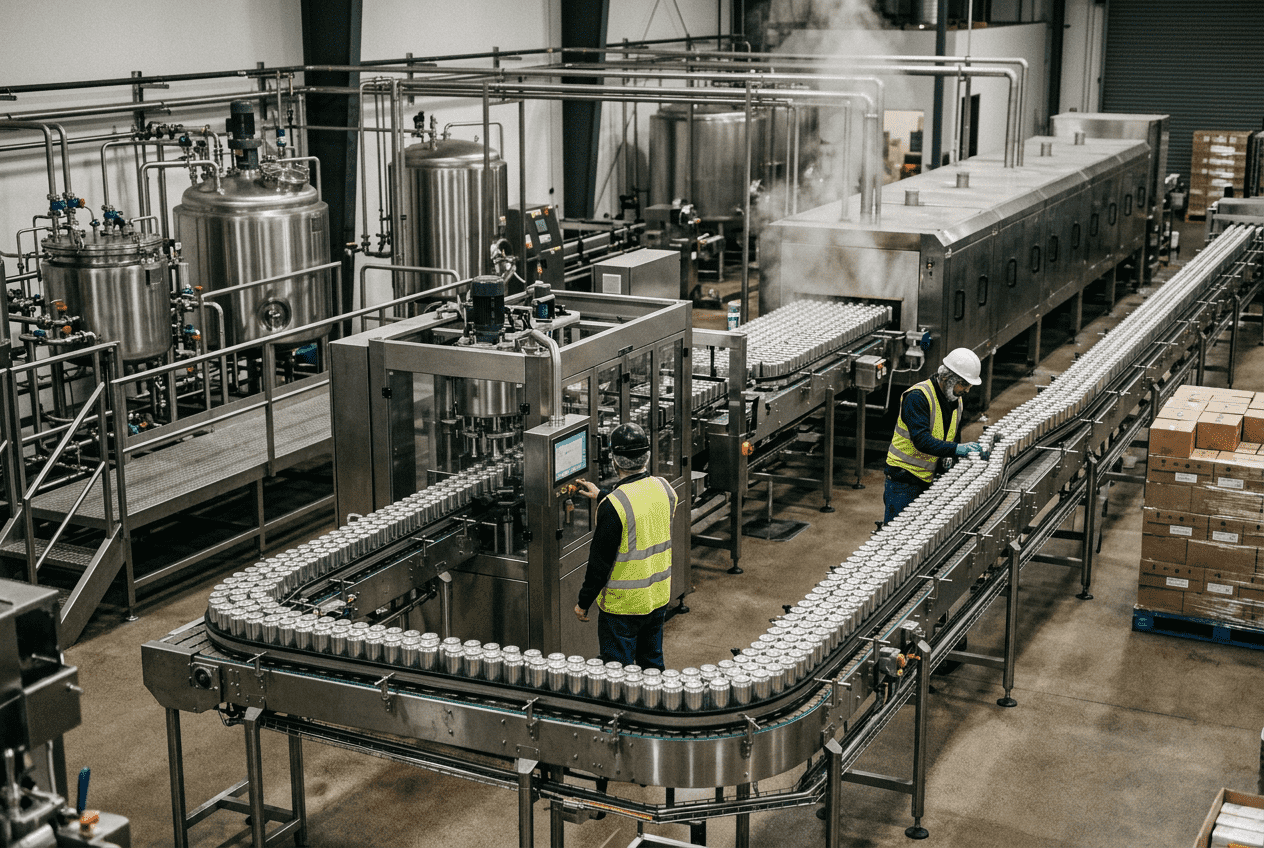
Beverage Processing Feasibility Study
[trp_language language=”en_US”]
Beverage Plant Feasibility Guide for the United States
Launching or expanding a beverage operation in the United States requires more than a good formula and a strong brand story. A beverage processing feasibility study tests whether the product can be made safely, profitably, and at the right commercial scale. It connects market demand, process design, packaging selection, utilities, labor, compliance, capital planning, and operating economics before major money is spent. For manufacturers evaluating juice, RTD coffee, energy drinks, functional beverages, dairy-based drinks, kombucha, carbonated soft drinks, spirits, or aseptic products, a strong feasibility study reduces risk and improves speed to market.
Quick Answer

A beverage processing feasibility study is a structured pre-project analysis used to determine whether a beverage product, plant, line expansion, or co-packing strategy is technically achievable, commercially viable, and financially sound in the United States. It usually examines product category fit, consumer demand, production volumes, pasteurization and filling requirements, packaging formats, water and wastewater infrastructure, utility loads, staffing, regulatory obligations, CAPEX, working capital, and the tradeoff between co-packing and in-house production.
In practical terms, it answers questions such as:
- Is there enough market demand in the target region to justify investment?
- Should the product launch in cans, PET, glass, cartons, kegs, pouches, or aseptic packs?
- What process technology is required: HTST, UHT, tunnel pasteurization, flash pasteurization, HPP, or aseptic?
- Can the local water source support flavor consistency and sanitation needs?
- Will wastewater discharge limits create hidden expansion costs?
- Is co-packing a better short-term path than building an in-house plant?
- How much capital is needed for equipment, installation, utilities, commissioning, and ramp-up?
For U.S. beverage investors, founders, and plant operators, the feasibility phase is often where the best decisions are made. It is also where costly mistakes are avoided.
What Is a Beverage Processing Feasibility Study?

A beverage processing feasibility study is a decision-making document that combines engineering, operations, and business planning. Unlike a simple market report, it goes into plant-level reality: ingredients, batch size, process sequence, thermal treatment, clean-in-place design, carbonation, blending, packaging speed, warehouse needs, utility demand, and compliance.
In the United States, a robust study generally covers the following:
- Commercial feasibility: target customers, competing brands, category growth, regional demand, price points, and route-to-market.
- Product feasibility: formula stability, shelf-life target, pH, Brix, allergen profile, viscosity, particulates, carbonation level, and cold-chain needs.
- Process feasibility: receiving, storage, batching, pasteurization, filtration, homogenization, deaeration, filling, labeling, case packing, palletizing, and CIP.
- Facility feasibility: building layout, utility corridors, hygienic zoning, tank farm needs, floor drainage, access to trucking, and room for future expansion.
- Regulatory feasibility: FDA requirements, state permits, food safety plans, wastewater permits, air permitting where needed, and audit readiness for SQF or BRC.
- Financial feasibility: CAPEX, OPEX, margin assumptions, labor, maintenance, startup scrap, and working capital.
For many manufacturers, the feasibility phase is the bridge between concept and execution. It is also where a partner with both engineering depth and project delivery experience becomes valuable. Disruptive Process Solutions supports beverage and food manufacturers across the United States and Canada with capital planning, feasibility studies, process engineering, installation, and project leadership built around profitability rather than equipment-first selling.
Whether the project is in North Carolina, California, Texas, Illinois, New Jersey, or near logistics hubs such as the Port of Los Angeles, Port of Long Beach, Port of Savannah, Port of Houston, or Port Newark, site realities can shift feasibility outcomes dramatically. Freight costs, utility rates, labor availability, and local discharge limits all affect the business case.
Beverage Processing Feasibility: Key Differences from Food Processing

Beverage feasibility work overlaps with food processing in sanitation, utilities, automation, and compliance, but several factors make beverage projects different. Liquids move continuously, often at high speed, and slight changes in pH, dissolved oxygen, carbonation, or fill temperature can change shelf life and product quality. Packaging also has a much larger impact on throughput economics.
The table below highlights major differences between beverage and broader food processing feasibility analysis.
| Feasibility Topic | Beverage Processing Focus | Food Processing Focus | Why It Matters |
|---|---|---|---|
| Product Stability | pH, Brix, carbonation, flavor hold, sediment control | Texture, cook yield, microbial lethality, moisture control | Beverages often fail on taste drift or shelf-life instability rather than visible defects. |
| Thermal Process | HTST, UHT, flash, tunnel, hot fill, aseptic | Cook, retort, smoking, baking, chilling | The process choice drives package compatibility and line speed. |
| Filling Speed | High-speed continuous filling is common | Often slower or intermittent packaging operations | Small efficiency losses can have large annual cost impacts in beverage plants. |
| Water Dependence | Water is often an ingredient and a utility | Water is critical but less often the core product component | Water quality directly affects flavor consistency in beverages. |
| Package Mix | Cans, PET, glass, cartons, bag-in-box, kegs | Trays, pouches, tubs, cans, cartons | Primary package choice strongly influences line architecture. |
| Wastewater Profile | Sugars, acids, caustic, product loss, CIP discharge | Fats, proteins, solids, brine, washdown waste | Permitting and pretreatment costs differ significantly. |
| Automation Need | Recipe accuracy, fill control, CIP validation, SCADA | Batch sequencing, cook controls, material handling | Beverage plants often depend on tight repeatability and fast changeovers. |
Because of these differences, copying a food plant evaluation framework into a beverage project can create blind spots. Beverage feasibility needs greater attention to package-line integration, utility balance, syrup or blend room design, clean product pathways, and high-speed filling performance.
At the technology level, DPS brings cross-functional engineering across structural, mechanical, plumbing, electrical, process, and controls disciplines. That matters in beverage projects because process design cannot be separated from compressed air sizing, glycol demand, boiler capacity, clean steam, plant automation, or CIP return routing. Its teams also work with fermentation systems, distillation systems, carbonation, in-line blending, filtration, clarification, aseptic environments, and water treatment systems, making the feasibility work grounded in execution reality rather than theoretical layouts.
Market Feasibility: Product Category Selection and Consumer Trends
Market feasibility asks a simple question with expensive consequences: what category should you actually build around? In the United States, category growth is uneven. Carbonated soft drinks remain large, but growth pockets are often stronger in functional beverages, zero-sugar formats, premium hydration, energy, RTD coffee, protein drinks, botanical beverages, and better-for-you sparkling products. Regional factors also matter. Wellness-forward launches may perform well in Southern California, Austin, Denver, Seattle, Boston, and Miami, while value-oriented or convenience-driven formats may do better in large grocery and club channels across the Midwest and Southeast.
A feasibility study should compare category size with channel access and manufacturing complexity. A fast-growing category is not automatically a good entry point if it requires expensive aseptic filling, refrigerated distribution, or highly specialized ingredients.
| Beverage Category | U.S. Demand Outlook | Process Complexity | Packaging Sensitivity | Margin Potential |
|---|---|---|---|---|
| Energy and functional drinks | High | Medium | High, especially sleek cans | High |
| RTD coffee and tea | High | Medium to high | High, flavor and oxygen control matter | Medium to high |
| Juice and juice blends | Stable to moderate | Medium | Medium | Medium |
| Kombucha and fermented beverages | Niche but growing | High | High, microbiology risk is significant | Medium to high |
| Dairy and protein beverages | Growing | High | High, cold chain or aseptic decisions matter | Medium |
| Carbonated soft drinks | Large but mature | Medium | High, line efficiency is critical | Volume-dependent |
| Spirits mixers and RTD cocktails | Strong | Medium to high | High, regulatory and canning details matter | High |
The table shows why category selection cannot be separated from process and packaging strategy. An attractive consumer trend may still be a poor fit if startup volume is too low for the equipment required.
Below is a market growth view using realistic directional data for key U.S. beverage categories from 2022 through 2026.
Industry demand also varies by customer type. Club stores, foodservice, c-stores, e-commerce, and direct-to-consumer all place different demands on pack size and line scheduling.
For 2026, the strongest market signals are likely to center on reduced sugar, functional positioning, cleaner labels, localized sourcing stories, recyclable packaging, AI-supported demand planning, and automation that supports smaller, more frequent SKU runs.
Technical Feasibility: Pasteurization, Filling, and Packaging Systems
Technical feasibility is where the product concept meets engineering reality. The right process depends on acidity, shelf-life target, package type, product sensitivity, production volume, and route-to-market. A low-acid dairy beverage and a high-acid juice shot do not belong on the same process path without careful design logic.
Common thermal and package approaches in U.S. beverage projects include:
- HTST pasteurization: common for many refrigerated beverages and dairy applications.
- UHT processing: used where extended shelf life is needed, often with aseptic packaging.
- Flash pasteurization: useful in certain beer, cider, and beverage applications where package flexibility matters.
- Tunnel pasteurization: often selected for filled package treatment in cans or bottles.
- Hot fill: suitable for many acidified beverages if package compatibility is right.
- HPP: attractive for premium refrigerated products, though throughput economics require care.
- Aseptic filling: capital-intensive but powerful for shelf-stable premium beverages.
| Technology | Typical Use | Best For | Main Limitation | Feasibility Note |
|---|---|---|---|---|
| HTST | Continuous thermal treatment | Milk-based drinks, teas, juices | Cold chain may still be needed | Strong option for mid-volume refrigerated products. |
| UHT | Ultra-high temperature treatment | Shelf-stable dairy and functional beverages | Higher complexity and capital | Best when long shelf life justifies equipment cost. |
| Hot Fill | Product filled at elevated temperature | Acid beverages, teas, juices | Package constraints | Often simpler than aseptic for qualifying products. |
| Tunnel Pasteurization | In-package treatment | Beer, certain carbonated beverages | Water and energy demand | Helpful where package integrity is a priority. |
| Flash Pasteurization | Short thermal exposure before filling | Brewed and specialty drinks | Requires matched filling strategy | Useful when preserving flavor is critical. |
| HPP | Pressure-based preservation | Premium cold-pressed products | High unit cost, batch logistics | Feasible when premium pricing supports it. |
| Aseptic Filling | Sterile process and package environment | High-value shelf-stable beverages | Highest validation burden | Excellent for scale, but only if volumes justify it. |
Packaging system selection is equally important. Cans dominate many growth categories because of shelf presence, recyclability, and strong logistics performance. PET remains important for value and high-volume formats. Glass still matters in premium, specialty, and some alcoholic beverage segments. Cartons and aseptic packs can win when shelf stability and brand position align.
Trend shifts in the United States show growing preference for portable, recyclable, and premium-looking formats.
Technical feasibility must also include utilities and controls. Beverage operations depend on well-designed CIP systems, steam or hot water generation, compressed air, process cooling, refrigeration where needed, electrical capacity, and production automation. DPS is especially relevant here because its process technology experience spans pasteurization and sterilization platforms, carbonation and bright tank systems, blending with in-line Brix monitoring, filtration, clarification, water treatment, PLC programming, SCADA, and full system integration. That depth helps ensure the selected process can actually be installed, controlled, cleaned, and scaled.
From a manufacturing standpoint, DPS also designs and integrates complete systems for brewing, spirits, wine, kombucha, RTD, juices, soft drinks, dairy beverages, and aseptic applications. For projects requiring custom tanks, CIP skids, or purpose-built process vessels, its proprietary equipment capability can help reduce coordination gaps between design intent and delivered hardware. More about its equipment scope can be found through its process equipment solutions.
Financial Feasibility: CAPEX Breakdown and Working Capital Requirements
Financial feasibility should not stop at quoted equipment prices. Many beverage projects fail financially because founders underestimate installation, controls integration, startup losses, utility tie-ins, spare parts, sanitation systems, warehousing, and the cash required to survive the ramp-up period.
Typical U.S. beverage CAPEX categories include process equipment, packaging equipment, utilities, building modifications, automation, installation, commissioning, and contingency. Working capital then covers inventory, packaging materials, labor, receivables, and startup inefficiency.
| CAPEX Category | Typical Share of Total Project Cost | Key Cost Drivers | Common Underestimate Risk |
|---|---|---|---|
| Process equipment | 20% to 30% | Tanks, pasteurizers, blenders, filtration, CIP | Skid interconnections and hygienic valving |
| Packaging line | 20% to 35% | Filler, seamer/capper, labeler, packer, palletizer | Change parts and downstream accumulation |
| Utilities | 10% to 20% | Boilers, compressors, glycol, cooling towers, RO | Future capacity and redundancy |
| Building and site work | 10% to 20% | Floor drains, trenching, pads, traffic flow, dock access | Sanitary upgrades and drainage corrections |
| Automation and controls | 5% to 12% | PLC, SCADA, panels, instrumentation | Data integration and recipe management |
| Installation and commissioning | 10% to 18% | Piping, wiring, rigging, startup support | Compressed schedule premiums |
| Contingency | 8% to 15% | Scope gaps and price escalation | Utility surprises and permit delays |
The table above shows why budget accuracy requires integrated engineering. It is also why owners often benefit from a partner that can move from feasibility into design-build execution. DPS uses a Design Build Manage model that aligns front-end planning with construction oversight and project management, helping clients avoid the disconnect between paper estimates and field conditions. Its broader engineering and project services are especially useful when timing, compliance, and capital discipline are all important.
Working capital is just as important as CAPEX. The following table provides a practical framework.
| Working Capital Item | Typical Timing | Why It Is Needed | Risk if Underfunded |
|---|---|---|---|
| Ingredient inventory | Pre-launch and ongoing | Supports batch continuity and supplier MOQs | Production interruptions |
| Packaging inventory | Pre-launch and ongoing | Cans, closures, labels, cartons, trays | Inability to fulfill orders |
| Labor and training | 60 to 90 days before startup | Operators must be trained before commercial runs | Low OEE and quality losses |
| Startup scrap and rework | First 1 to 3 months | Line tuning and process adjustment are normal | Gross margin shock |
| Receivables support | After first shipments | Retail and distribution payment cycles can be long | Cash squeeze despite growing sales |
| Maintenance and spare parts | At startup | Critical parts reduce downtime risk | Unexpected production stoppages |
| Compliance and testing | Pre-launch and ongoing | Shelf-life, validation, lab, environmental monitoring | Delayed launch or recall exposure |
Buying advice for the U.S. market: do not approve a beverage project based only on vendor quotations. Ask for a full installed cost model, a ramp-up cash model, and a sensitivity analysis for line efficiency, ingredient pricing, and freight. A feasibility study should show best case, expected case, and downside case economics.
Water Source, Treatment, and Wastewater Compliance Assessment
Water is often the most underestimated variable in beverage processing feasibility. In many beverages, it is both a utility and a primary ingredient. Even when municipal water is available, hardness, alkalinity, chlorine residual, seasonal variability, and microbial profile can affect flavor and process consistency.
Water feasibility in the United States should examine:
- Municipal versus well supply reliability
- Peak flow and pressure availability
- RO, carbon filtration, softening, UV, ozone, or other treatment needs
- Water usage ratios per gallon produced
- CIP demand and sanitation loads
- Local sewer discharge requirements and surcharge structure
- Pretreatment needs for pH, BOD, COD, and suspended solids
Different regions present different water realities. The Southwest may face scarcity and higher scrutiny on usage efficiency. Parts of the Midwest may offer lower-cost utilities but require attention to hardness. Coastal industrial corridors can provide logistics advantages while imposing stricter discharge expectations. In locations such as Houston, Los Angeles, Chicago, Atlanta, and New Jersey manufacturing corridors, utility and wastewater discussions should begin early, not after process equipment is selected.
| Assessment Area | Main Question | Common Solution | Feasibility Impact |
|---|---|---|---|
| Water source reliability | Can the site sustain full production demand? | Dual feed, storage, booster systems | Impacts uptime and expansion planning |
| Ingredient water quality | Will water alter flavor or formulation? | RO, carbon, remineralization | Directly affects brand consistency |
| Sanitation demand | Can water support CIP and washdown peaks? | Dedicated process water loops | Impacts cleaning cycle reliability |
| Wastewater load | Will product loss or CIP exceed permit limits? | Equalization, pH correction, screening | Can add major unplanned cost |
| Environmental compliance | What local and state permits are needed? | Early utility and permit review | Prevents schedule delays |
| Sustainability performance | Can usage and discharge be reduced? | Recovery, reuse, automation, metering | Improves long-term OPEX and ESG profile |
This is an area where service capability matters more than isolated equipment supply. DPS supports feasibility, capital planning, owner’s representation, project management, system integration, and installation with strong regulatory fluency across FDA, USDA, SQF, and BRC environments. For beverage clients, that means water, utilities, compliance, and plant execution can be handled within one coordinated project strategy rather than in disconnected pieces.
Co-Packing vs In-House Manufacturing: A Cost-Benefit Analysis
One of the biggest strategic decisions in beverage feasibility is whether to launch through a co-packer or build internal capacity. The right answer depends on volume, margin, process complexity, brand control, and funding. Co-packing can lower upfront capital and accelerate launch, but it may limit scheduling flexibility, margin, proprietary process control, and long-term scalability. In-house manufacturing offers control and asset value but requires more capital, more management depth, and more execution risk.
The comparison below helps frame the decision.
| Decision Factor | Co-Packing | In-House Manufacturing | Best Fit |
|---|---|---|---|
| Initial capital need | Low | High | Co-packing for early-stage brands |
| Speed to market | Usually faster | Slower at first | Co-packing for urgent launches |
| Process control | Shared or limited | Full control | In-house for complex quality targets |
| Margin capture | Lower per unit margin | Higher long-term potential | In-house at stable volume |
| Scheduling flexibility | Dependent on co-packer capacity | Owner-controlled | In-house for many SKUs or fast turns |
| Confidentiality | Moderate risk | Higher protection | In-house for proprietary formulas |
| Scalability economics | Can get expensive at large volume | Improves with scale if managed well | In-house for sustained growth |
For many brands, the best path is staged: begin with co-packing, prove demand, then transition selected SKUs in-house once volume and margin justify investment. This is especially useful for founders testing regional demand in markets like the Northeast corridor, Southern California, Texas, or the Southeast before committing to a full plant.
Supplier and operating model comparison can also be visualized by scoring key criteria.
Case experience matters in this decision. DPS has supported both beverage manufacturers and co-packing environments, including large-scale beverage infrastructure programs built around first-year profitability and future capacity expansion. Examples of project thinking and execution style can be explored through selected project case studies.
Beverage Processing Feasibility Timeline and Key Milestones
Timing is often underestimated. In the United States, beverage projects can move quickly when decisions are clear and utility or permit constraints are limited, but many projects stretch because of package changes, building surprises, long-lead equipment, or late-stage regulatory issues.
A realistic feasibility-to-startup timeline should include gates, not just dates.
| Project Phase | Typical Duration | Main Activities | Milestone Output |
|---|---|---|---|
| Concept definition | 2 to 4 weeks | Product, category, target volume, launch market | Project charter and decision criteria |
| Feasibility study | 4 to 10 weeks | Market, process, utilities, site, cost modeling | Go/no-go recommendation |
| Basis of design | 3 to 6 weeks | PFDs, equipment list, layout logic, utility loads | Approved concept package |
| Detailed engineering and procurement | 8 to 20 weeks | Vendor alignment, drawings, controls, long leads | Issued-for-construction package |
| Installation and integration | 8 to 24 weeks | Site work, mechanical, electrical, controls, FAT/SAT | Mechanical completion |
| Commissioning and validation | 2 to 8 weeks | Water runs, CIP checks, product trials, training | Commercial readiness |
| Ramp-up | 1 to 6 months | OEE improvement, scrap reduction, SOP tuning | Steady-state production |
Important milestone advice:
- Freeze package format early to avoid layout rework.
- Confirm utility capacity before signing major equipment.
- Review wastewater implications before selecting cleaning chemistry and expected throughput.
- Include startup staffing and training in the critical path.
- Reserve contingency for lead-time volatility, especially on controls and packaging components.
Looking toward 2026, beverage feasibility studies should also account for AI-assisted maintenance, more advanced plant data integration, sustainability reporting expectations, greater pressure for water efficiency, expanded interest in electrification where practical, and stronger retailer emphasis on resilient supply chains.
For owners choosing a project partner, buying advice is straightforward: work with a team that can challenge assumptions, not just validate them. A technically strong and commercially grounded feasibility effort should sometimes tell you not to spend money, or to spend it differently. That business-first mindset is central to how DPS approaches projects across North America, combining process engineering, capital planning, project management, installation, and owner-side advocacy with a lean structure that supports faster decisions and practical execution.
FAQ
What does a beverage processing feasibility study cost in the United States?
Costs vary by project size and complexity. A narrow assessment for a single SKU and co-packing path may be modest, while a full greenfield or brownfield analysis with process design, utility review, and CAPEX modeling is more substantial. The right scope depends on investment risk and decision value.
How long does a beverage feasibility study usually take?
Many studies take 4 to 10 weeks. Complex projects involving site selection, wastewater analysis, multiple package formats, or aseptic processing can take longer.
When should I choose co-packing instead of building a plant?
Co-packing is often better for lower initial volumes, uncertain demand, limited capital, or fast market entry. In-house production becomes more attractive when volume stabilizes, margins matter more, and process or quality control is strategically important.
What is the biggest mistake in beverage plant planning?
Underestimating utility, wastewater, packaging, and working capital requirements. Many projects focus too heavily on the filler and not enough on the full system that supports profitable operation.
Why is water such a major issue in beverage feasibility?
Because water affects both product quality and operating cost. It influences taste, sanitation, treatment systems, and wastewater discharge. A poor early water assessment can derail budgets and timelines later.
Do all beverage products need pasteurization?
No. The required process depends on product chemistry, microbiological risk, shelf-life target, package type, and distribution method. Some products need HTST or UHT, others may use hot fill, tunnel pasteurization, HPP, or aseptic systems.
Can one line run multiple beverage categories?
Sometimes, but only if product chemistry, allergen profile, cleaning validation, package type, and throughput needs are compatible. Multi-category flexibility is valuable but should not be assumed without engineering review.
How important is automation in a feasibility study?
Very important. PLC programming, SCADA visibility, recipe management, in-line quality measurement, and CIP validation all affect consistency, labor use, troubleshooting speed, and long-term profitability.
What U.S. regions are attractive for beverage manufacturing?
It depends on your channels and ingredients. The Southeast offers strong logistics and growing manufacturing bases. Texas offers scale and central access. Southern California provides market proximity and innovation energy. The Midwest can offer efficient distribution and labor advantages. Port proximity matters for imported ingredients and packaging.
How do I know if a feasibility partner is credible?
Look for practical experience in beverage process design, utilities, packaging integration, compliance, installation, and startup support. The strongest partners connect engineering decisions directly to commercial outcomes and can support implementation after the study.
A well-built beverage processing feasibility study is not just a report. It is a decision framework for capital, timing, process choice, and market entry. In the United States, where speed, compliance, and margin pressure all matter, disciplined front-end planning remains one of the most valuable investments a beverage company can make.
[/trp_language]
Complete Company Portfolio

About the Author: Disruptive Process Solutions (DPS)
The DPS team combines process engineering expertise with real-world food and beverage manufacturing experience. Our content focuses on process optimization, production efficiency, facility improvements, and practical solutions that help manufacturers operate more effectively in a rapidly evolving industry.
Share

