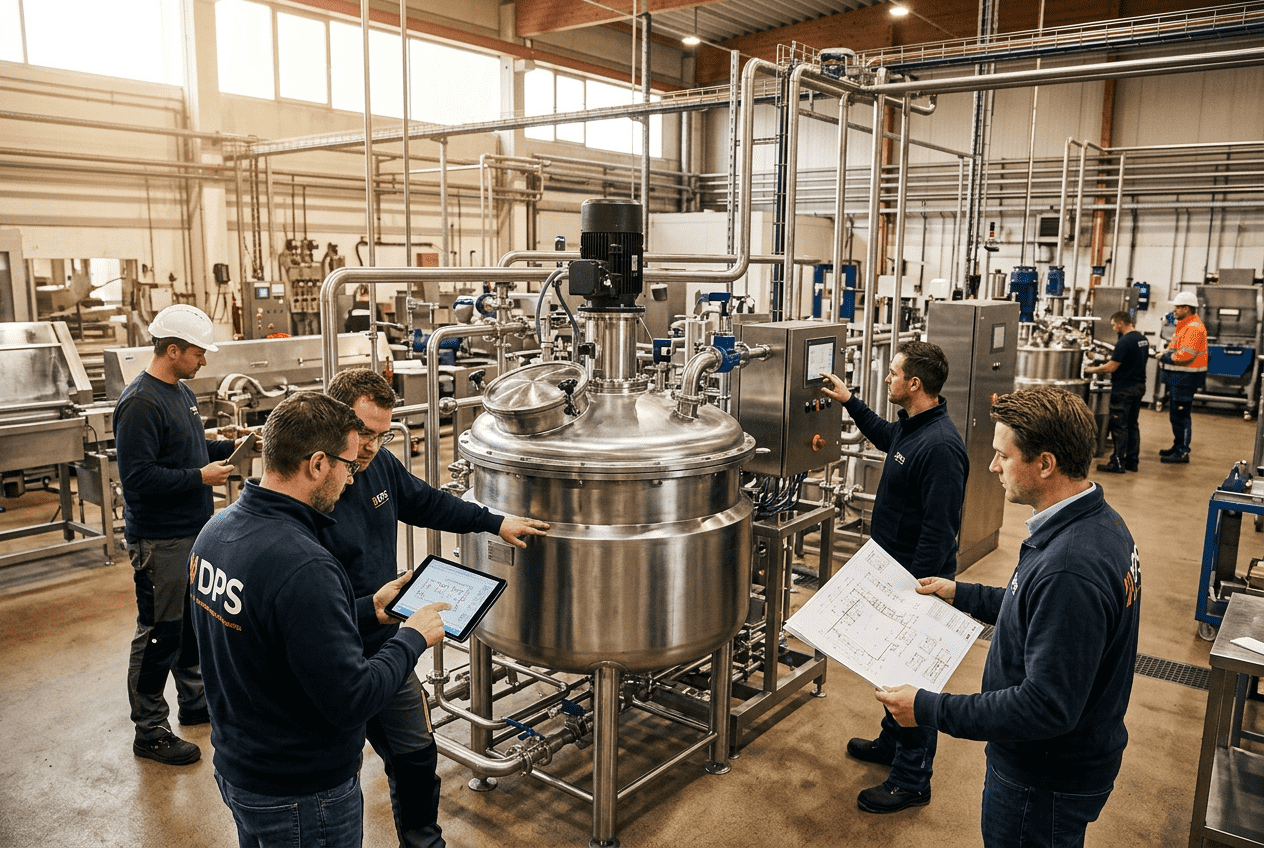
Food Manufacturing Capital Project Planning
[trp_language language=”en_US”]
Capital Planning for U.S. Food Manufacturing Projects
Quick Answer

Food manufacturing capital project planning is the structured process of turning a business need—more capacity, better food safety, lower utility costs, new product capability, or plant modernization—into an executable project with clear scope, budget, schedule, risk controls, and return targets. In the United States, successful planning usually starts long before equipment is ordered. It includes feasibility analysis, process definition, utility sizing, compliance review, cost modeling, stakeholder alignment, and commissioning strategy. For food and beverage manufacturers, good planning reduces change orders, protects uptime, improves regulatory readiness, and helps leadership invest capital where it produces the strongest operational and financial return.
Whether a processor is building a greenfield plant near Dallas, expanding a protein line in Kansas City, modernizing dairy operations in Wisconsin, or upgrading a beverage facility near the Port of Savannah, the same principle applies: smart capital must be tied to smart manufacturing outcomes. That means a project should not simply “fit the budget.” It should support throughput, labor efficiency, food safety, maintenance access, utilities, automation, and future expansion without creating hidden bottlenecks.
What Is Food Manufacturing Capital Project Planning?

Food manufacturing capital project planning is the front-end and execution framework used to evaluate, design, fund, and deliver physical improvements in a processing operation. These projects can include new processing lines, plant expansions, utility upgrades, warehouse additions, packaging automation, wastewater systems, aseptic processing suites, retort systems, refrigeration upgrades, CIP skids, and full facility relocations.
In the United States market, capital planning is especially important because food manufacturers operate under demanding production economics and strict compliance requirements. Projects often must satisfy FDA expectations, USDA inspection requirements, customer quality programs, SQF or BRC certification needs, local building codes, wastewater discharge limits, and utility provider constraints. A plan that looks strong on paper can fail in practice if it ignores sanitary zoning, process flow, compressed air demand, steam load, chilled water balance, or labor availability.
The best capital planning process connects four levels of decision-making:
| Planning Level | Main Question | Typical Stakeholders | Why It Matters |
|---|---|---|---|
| Business strategy | Why invest now? | Owners, CEO, CFO, board | Links capital to growth, margin, and market demand |
| Operations strategy | What problem are we solving? | Plant manager, operations, supply chain | Prevents capacity or labor assumptions from being unrealistic |
| Technical strategy | What process and utility solution works best? | Engineering, maintenance, automation | Ensures the facility can actually run as intended |
| Execution strategy | How do we deliver with minimal disruption? | Project managers, contractors, vendors | Reduces downtime, safety incidents, and schedule slips |
| Compliance strategy | What approvals and standards apply? | QA, regulatory, EHS | Avoids late redesign and startup delays |
| Financial strategy | What is the ROI and funding path? | Finance, procurement, lenders | Supports capital approval and post-project accountability |
This structure is where an engineering partner can add outsized value. Disruptive Process Solutions approaches planning as a profitability exercise, not just a construction exercise. That distinction matters because many food projects succeed or fail based on decisions made before detailed design begins.
The 5-Stage Capital Project Planning Process for Food Manufacturers

A practical capital planning model for food processors in the United States can be organized into five stages. These stages create a disciplined path from concept to startup.
| Stage | Core Activities | Primary Deliverables | Common Mistakes to Avoid |
|---|---|---|---|
| 1. Concept definition | Identify business objective, baseline capacity, constraints, success metrics | Project charter, initial scope, business case | Starting with equipment quotes before defining the problem |
| 2. Feasibility and options | Evaluate layouts, utility loads, site limits, process alternatives | Feasibility study, options matrix, ROM budget | Assuming existing utilities can absorb new demand |
| 3. Front-end planning | Develop process flow, sanitation concept, schedule logic, risk register | Basis of design, phased schedule, updated estimate | Ignoring shutdown windows and sanitation realities |
| 4. Detailed execution planning | Finalize engineering, procurement strategy, contractor sequencing | Issued-for-construction package, procurement log | Late stakeholder approval and uncontrolled scope growth |
| 5. Startup and closeout | Commissioning, training, punch list, performance verification | SAT/FAT records, SOP updates, turnover package | Rushing startup without operator readiness |
| 6. Post-project optimization | Measure actual performance, tune controls, compare ROI | Lessons learned, KPI report, optimization roadmap | Declaring success before stable production is proven |
Stage 1 begins with the business trigger. Is the company adding SKUs for a national retailer? Is a co-manufacturer trying to support a new aseptic beverage customer? Is a protein processor losing yield because of outdated forming or slicing equipment? Capital planning must translate those pressures into measurable goals such as lines per minute, pounds per hour, OEE improvement, labor reduction, margin lift, or utility cost savings.
Stage 2 evaluates alternatives. This is often where companies discover that the original assumption was incomplete. A new packaging line may require electrical service upgrades, compressed air storage, additional floor drains, or revised ingredient handling. A relocation project may need a new syrup room, boiler capacity, wastewater pretreatment, and controls integration. In many cases, the least expensive equipment quote is not the lowest total installed cost.
Stage 3 is the transition from possibility to execution logic. Here, planners define sanitary zoning, process adjacency, traffic flow, control architecture, maintenance access, allergen separation, and phasing strategy. This stage often makes or breaks a brownfield project because production continuity must be balanced with construction access.
Stage 4 focuses on engineering depth, procurement timing, local permitting, and field execution. In major U.S. manufacturing hubs such as Chicago, Charlotte, Fresno, Houston, and Indianapolis, contractor availability and lead times can materially affect budget and schedule. Long-lead items like boilers, switchgear, fillers, tanks, retorts, chillers, and automation hardware should be tracked early.
Stage 5 covers commissioning, operator training, control tuning, punch list closure, and performance verification. For food processors, startup is not complete when the line turns on. It is complete when the line produces safe product at expected throughput with acceptable scrap, labor, and cleaning time.
Greenfield vs Expansion vs Renovation: Choosing the Right Project Type
One of the first planning decisions is selecting the right project type. Food manufacturers usually choose between a greenfield build, an expansion of existing space, or a renovation/retrofit of current operations. Each has different economics, risks, and speed profiles.
| Project Type | Best Use Case | Main Advantages | Main Risks |
|---|---|---|---|
| Greenfield | New product platform or major volume growth | Optimized layout, future scalability, modern utilities | Higher capital, permitting complexity, longer schedule |
| Building expansion | Existing site has good infrastructure and labor base | Leverages current team and utilities | May inherit site constraints and traffic conflicts |
| Line addition | Need targeted capacity increase | Lower capital than a new plant | Can expose hidden bottlenecks upstream or downstream |
| Renovation | Compliance, safety, sanitation, or modernization needs | Can improve ROI with limited footprint change | Construction around live production is challenging |
| Relocation | Facility lease issues, logistics shift, major consolidation | Reuses assets while upgrading layout | Startup risk and asset condition uncertainty |
| Hybrid phased approach | Need quick wins while planning long-term growth | Balances speed and strategic flexibility | Requires tight sequencing and governance |
A greenfield project is often the best choice when a manufacturer needs a highly efficient process flow, modern utility infrastructure, higher automation, or large-scale expansion. This is common in fast-growing beverage, dairy, and prepared foods operations near logistics corridors such as Atlanta, Nashville, Phoenix, or the Inland Empire. Greenfield allows better segregation of raw and ready-to-eat zones, cleaner forklift routes, improved wastewater strategy, and future line installation space.
An expansion works well when the existing site has strong labor retention, favorable tax position, good utility service, and enough land. Manufacturers near established trade hubs like Columbus, Memphis, or the Port of Houston often prefer this option because they can preserve current operations while adding capacity.
Renovation is usually driven by aging infrastructure, sanitation concerns, compliance gaps, or automation needs. It can deliver excellent returns, especially when the core business is strong but the plant was not designed for current SKU complexity. However, renovations carry significant execution risk because hidden field conditions, utility congestion, and production downtime can erode the budget fast.
Choosing among these options should be based on total business impact, not just initial capital. If an expansion saves $2 million but limits future throughput or creates an unmanageable sanitation workflow, the “cheaper” option may be more expensive over five years.
How to Build Realistic Cost Estimates for Food Processing Projects
Cost estimating for food processing projects is often where optimism causes trouble. Realistic capital estimates should include direct process equipment costs, installation, utilities, automation, building modifications, permitting, startup support, contingency, and internal owner costs. In live manufacturing environments, temporary systems, weekend shutdown labor, overtime, and sanitation controls can add meaningful cost.
In the United States, cost estimates are heavily influenced by region, local labor rates, contractor competition, freight, utility interconnection requirements, and lead times. A beverage project in Southern California may face different electrical, mechanical, and permitting costs than a similar project in North Carolina or Iowa.
| Cost Category | What It Includes | Typical Risk if Underestimated | Planning Tip |
|---|---|---|---|
| Process equipment | Tanks, pumps, fillers, mixers, retorts, CIP, conveyors | Budget gap before installation begins | Use installed cost, not vendor-only cost |
| Mechanical utilities | Steam, glycol, refrigeration, air, water, drains | Equipment cannot reach designed throughput | Model peak load and redundancy needs |
| Electrical and controls | Switchgear, MCCs, panels, PLC, SCADA, cabling | Late redesign and startup instability | Include integration and programming hours early |
| Building and structural | Slabs, mezzanines, openings, roofs, supports | Field rework and permit delays | Confirm actual site conditions before final estimate |
| Compliance and validation | Permits, inspections, QA documentation, commissioning | Delayed production approval | Assign responsibility by owner, OEM, and integrator |
| Contingency | Unknowns, escalation, hidden conditions | Capital request becomes inadequate | Match contingency to design maturity and project type |
A reliable estimate usually improves through stages. A rough order of magnitude estimate may be acceptable for early portfolio screening, but a funding request should be tied to a defined basis of design. That means the company understands the process capacities, utility assumptions, equipment list, site constraints, shutdown windows, and project delivery model.
Food processors should also distinguish between capital efficiency and cost cutting. Removing CIP automation, under-sizing refrigeration, or minimizing drainage improvements may reduce initial spend but create long-term operating losses. The right estimate reflects lifecycle value.
This is where service capability matters. Firms like DPS support capital planning, feasibility, owner representation, project management, and full execution, which helps align the estimate with how the project will actually be built and operated. The result is usually better budget confidence and fewer surprises in the field.
Cross-Functional Planning: Aligning Engineering, Operations, and Finance
Capital projects fail when departments agree too late. Engineering may prioritize technical robustness, operations may focus on uptime and labor, while finance may pressure for lower capital intensity and faster payback. Effective planning aligns these groups early around common assumptions.
Engineering needs to define what the process requires: vessel sizing, thermal process design, controls architecture, utility demand, sanitary design, and maintainability. Operations needs to validate shift patterns, cleaning windows, staffing, changeover time, warehouse flow, and operator capability. Finance needs clear cost categories, cash flow timing, ROI logic, and risk-adjusted alternatives.
Cross-functional planning should also include procurement, quality, maintenance, safety, IT/OT, and in some cases commercial teams. For example, a new beverage line may be justified based on customer demand, but if packaging material lead times, recipe control, and utility reliability are not aligned, the project may miss launch dates.
Strong capital teams use decision gates. At each gate, leaders confirm scope, budget confidence, major risks, and go/no-go criteria. This keeps enthusiasm from outrunning evidence.
Technological capability is especially relevant here. A food and beverage engineering partner should understand structural, mechanical, plumbing, electrical, process, and controls integration—not just one discipline in isolation. DPS is positioned in this space with capabilities spanning PLC programming, automation, SCADA, process engineering, utility systems, and full project engineering, which is valuable when the project depends on system-level coordination instead of standalone equipment procurement.
Manufacturing capability matters too. Planning is stronger when the project team understands fermentation systems, pasteurization, aseptic processing, carbonation, blending, retort, dairy systems, protein handling, marination, cooking, slicing, and CIP from an operating perspective. That experience reduces the gap between drawings and real plant behavior.
| Function | Primary Concern | Key Question During Planning | Best KPI |
|---|---|---|---|
| Engineering | System performance | Will the process, utilities, and controls work together? | Design capacity vs actual throughput |
| Operations | Runability | Can the line be staffed, cleaned, and maintained efficiently? | OEE and labor hours per unit |
| Finance | Return and risk | Does the project meet hurdle rate and cash flow targets? | Payback and IRR |
| Quality/Regulatory | Compliance | Does the design support food safety and audit readiness? | Deviation rate and audit findings |
| Maintenance | Reliability | Can assets be serviced without excessive downtime? | MTBF and spare parts availability |
| Supply chain | Flow and storage | Will inbound and outbound logistics support the new state? | Inventory turns and dock utilization |
Risk Management in Food Manufacturing Capital Projects
Risk management in food manufacturing capital projects is not just about safety and construction claims. It includes food safety, utility resilience, startup performance, labor readiness, regulatory timing, and commercial exposure. A delayed launch for a retailer program or co-packing contract can have larger consequences than the direct construction overrun.
The most common risk categories include scope risk, schedule risk, cost escalation, utility insufficiency, process integration failure, sanitary design gaps, vendor delays, contractor coordination issues, and staffing readiness. Brownfield work adds hidden field conditions, shutdown dependency, and contamination control risks.
Good planning creates a live risk register with assigned owners, probability and impact ratings, mitigation actions, and trigger dates. For example, if switchgear lead time is 40 weeks, electrical procurement becomes a critical path risk. If the project requires USDA inspection layout approval, that review must be built into the schedule early. If the facility is in a water-stressed or wastewater-sensitive region, discharge capacity must be verified before detailed design.
Service capability is again important here. An end-to-end model that covers design, build, and management can reduce handoff risk. DPS uses a design-build-manage approach that combines engineering, contractor oversight, installation coordination, and execution control. For owners, this can improve accountability across the project lifecycle, especially when multiple trades and process vendors must be synchronized.
| Risk Type | Example | Potential Impact | Mitigation |
|---|---|---|---|
| Scope creep | Adding new SKUs after equipment selection | Cost growth and redesign | Freeze requirements at stage gates |
| Utility shortfall | Undersized steam or chilled water | Reduced throughput and startup delays | Perform load study with peak scenarios |
| Permitting delay | Late wastewater or building permit approval | Schedule slippage | Engage local authorities early |
| Vendor lead time | Boilers, fillers, switchgear, tanks | Critical path disruption | Release long-lead items early |
| Sanitary design gap | Poor zoning or drainage | Food safety and audit risk | Review hygienic design before IFC |
| Startup readiness | Operators not trained on controls or CIP | Slow ramp and excess waste | Build training and SAT into schedule |
Project Timeline: From Concept to Commissioning
Food manufacturing project schedules vary widely, but many U.S. processors underestimate the time required for front-end planning, permitting, procurement, installation sequencing, and startup stabilization. A realistic timeline depends on project type, site conditions, utility upgrades, OEM lead times, and whether production continues during construction.
A small line addition might move from concept to startup in 6 to 10 months. A major expansion often takes 12 to 18 months. A greenfield facility can easily require 18 to 30 months depending on complexity, site development, and equipment lead times.
Ports, freight corridors, and labor markets also influence timing. Projects tied to import equipment through Long Beach, Savannah, Houston, or Newark should consider transport and customs timing. Facilities in high-growth regions may face tighter contractor availability and longer permit cycles.
| Phase | Typical Duration | Main Tasks | Schedule Risk |
|---|---|---|---|
| Concept and business case | 2-6 weeks | Define need, capacity goals, approval logic | Unclear success criteria |
| Feasibility and site study | 4-10 weeks | Layouts, utility review, options analysis | Incomplete existing-condition data |
| Front-end engineering | 6-12 weeks | Process basis, budget, phasing, risk plan | Late stakeholder decisions |
| Detailed design and procurement | 10-24 weeks | Construction docs, bid packages, long-lead releases | Vendor delay and design revisions |
| Construction and installation | 8-30 weeks | Site prep, utilities, equipment set, integration | Shutdown conflicts and trade stacking |
| Commissioning and ramp-up | 2-8 weeks | Testing, training, trial runs, punch list | Controls tuning and operator readiness |
Commissioning should be treated as a business milestone, not a final construction activity. SATs, utility verification, CIP validation, alarm testing, recipe checks, and production trials must all be planned in detail. If the project includes proprietary equipment, custom controls, or unusual process integration, the startup plan should include extra buffer.
For manufacturers seeking outside support, it helps to work with partners who can manage the full sequence from engineering through installation and turnover. DPS also manufactures selected process equipment, including tanks, CIP systems, marination tumblers, and cooking vessels. That manufacturing capability can simplify coordination on projects where custom equipment fit, lead time, and integration are critical. More detail on available systems can be found through its process equipment offerings.
Post-Project Review: Measuring Capital Project ROI
Many companies approve projects using careful financial models, then fail to measure whether the promised value was delivered. Post-project review is essential because it turns a one-time project into organizational learning.
ROI review should compare approved assumptions against actual outcomes in at least six areas: throughput, yield, labor, downtime, utility cost, and quality performance. It should also measure whether the project improved strategic position—such as winning a new customer, enabling a new package format, or reducing compliance exposure.
A good review usually occurs in stages: at mechanical completion, after initial startup, after 60 to 90 days of operation, and again after a full business cycle. The last review is especially important for seasonal products or plants with fluctuating SKU mix.
Case examples often show that the best returns come from identifying the real constraint, not the most visible one. Sometimes a processor thinks it needs building expansion, but the actual issue is controls logic, packaging balance, utility instability, or sanitation downtime. This is one reason owners value firms that challenge assumptions. DPS has built its reputation around that style of engagement, including project work where detailed analysis uncovered a lower-cost path to meaningful capacity gain before larger capital was committed. Additional examples of project thinking and execution can be explored in its project case studies.
| ROI Metric | Target Example | Actual Measurement Window | Why It Matters |
|---|---|---|---|
| Throughput increase | +25% units/hour | 30-90 days after startup | Tests whether capacity goal was achieved |
| Labor efficiency | -15% labor hours/unit | 60-120 days | Validates staffing assumptions |
| Yield improvement | +2.5% net yield | 30-180 days | Important in protein, dairy, and high-cost ingredients |
| Downtime reduction | -20% unplanned stops | 90 days | Measures reliability and controls performance |
| Utility savings | -12% energy or water per unit | 90-180 days | Supports sustainability and cost objectives |
| Commercial impact | New customer or SKU launch enabled | One business cycle | Captures strategic value beyond plant KPIs |
Looking ahead to 2026, post-project ROI analysis will increasingly include sustainability and digital metrics. More U.S. food and beverage companies are evaluating energy intensity, water reuse, emissions impact, traceability readiness, cyber-resilience of controls, and data quality for predictive maintenance. Policy pressure, retailer expectations, and utility pricing will keep these factors in the capital planning conversation.
Future-ready projects are likely to prioritize modular utility systems, smarter SCADA layers, recipe and batch visibility, energy management dashboards, heat recovery, improved wastewater strategies, and layout flexibility for shifting product mix. In sectors such as RTD beverages, dairy alternatives, prepared proteins, and aseptic foods, the plants that win will usually be those designed for both efficiency and adaptation.
FAQ
What is the first step in a food manufacturing capital project?
The first step is defining the business problem clearly. That may be capacity growth, compliance improvement, labor reduction, margin protection, or a new product launch. Without a defined objective, the project can become an equipment shopping exercise instead of a strategic investment.
How long does capital project planning take?
Early planning can take a few weeks for a small line project or several months for a major expansion or greenfield plant. The more complex the process, utility, and compliance requirements, the more important front-end planning becomes.
What is the difference between a ROM estimate and a final budget?
A ROM estimate is a rough early-stage budget based on limited definition. A final funding budget should be built on a clearer basis of design, known site constraints, utility assumptions, schedule logic, and vendor or contractor input.
When should food manufacturers choose renovation instead of expansion?
Renovation is often the right choice when the existing building has strong strategic value and the main issues are sanitation, compliance, aging utilities, or outdated process flow. Expansion is better when the site can support additional footprint and future growth without major operational conflicts.
Why do food projects go over budget?
Common causes include incomplete scope, underestimated utilities, poor existing-condition data, uncontrolled changes, late vendor decisions, weak shutdown planning, and insufficient contingency for brownfield conditions.
How important is automation in capital planning?
Very important. Controls, PLC logic, SCADA, recipe management, and integration often determine whether a project delivers the expected throughput, consistency, and labor savings. Automation should be planned as part of the process, not added at the end.
What should be included in a commissioning plan?
A commissioning plan should include mechanical completion checks, utility verification, controls testing, CIP confirmation, alarm testing, operator training, production trial criteria, documentation, and performance acceptance standards.
How do I evaluate an engineering and project delivery partner?
Look for food-industry process knowledge, multidisciplinary engineering depth, utility and controls expertise, field execution capability, regulatory familiarity, transparent estimating, and a track record of solving root problems rather than simply selling scope.
What U.S. market trends will shape food capital planning in 2026?
Expect stronger focus on automation, energy efficiency, water stewardship, resilient domestic supply chains, cybersecurity for industrial controls, modular expansion strategies, and projects that can flex across multiple SKUs and channels.
Why does location matter in U.S. project planning?
Location affects labor cost, access to trades, freight, utility availability, wastewater capacity, tax incentives, permitting speed, and logistics. A project near Charlotte, Chicago, Los Angeles, Houston, or Savannah may have very different constraints and opportunities than one in a rural processing corridor.
[/trp_language]
Complete Company Portfolio
About the Author: Disruptive Process Solutions (DPS)
The DPS team combines process engineering expertise with real-world food and beverage manufacturing experience. Our content focuses on process optimization, production efficiency, facility improvements, and practical solutions that help manufacturers operate more effectively in a rapidly evolving industry.
Share